


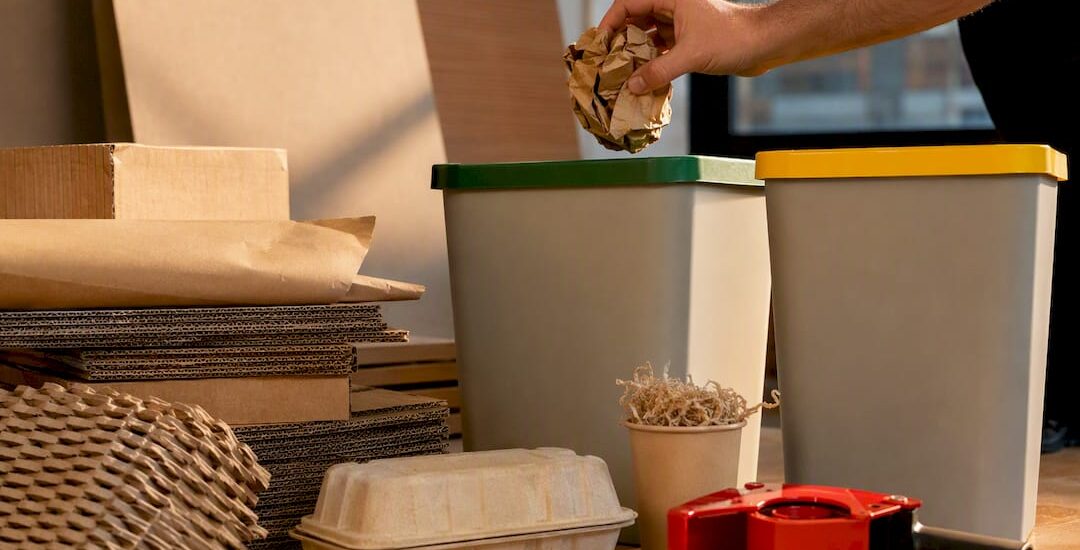
Recycled cardboard, kraft paper, and plant-fibre products like bagasse handle most packing jobs without fuss, while certified compostable bioplastics only make sense where industrial composting exists. The one thing worth checking before you buy anything: does it carry AS 4736 or AS 5810 certification, and does that match a disposal route you can actually access? Businesses chasing compliance should lean toward plant-fibre certified items, which tend to sit comfortably inside state single-use plastic bans and APCO’s national targets.
TL;DR:
- Certified compostable bioplastics only break down effectively in industrial or home composting, so verify local disposal infrastructure before purchasing.
- Recycled kraft paper, corrugated cardboard, and plant-fibre containers are versatile, with plant-fibre options ideal for food contact and heat resistance.
- Moisture sensitivity limits the use of cardboard in humid or refrigerated conditions unless extra barriers are added.
- Using reusable boxes and wrapping reduces material waste, but must be combined with proper sorting and disposal practices for maximum impact.
- Always request official certification numbers and independent lab reports to confirm genuine compostability claims and avoid contamination in recycling streams.
Not every “green” packing product does the same job, and picking the wrong one for the task usually costs you more, not less. Some materials excel at cushioning fragile goods; others are built purely for foodservice contact. Here’s how the main categories stack up.
Recycled kraft paper, corrugated cardboard, and recycled boxes remain the workhorses of sustainable packing. Corrugated cardboard from recycled fibre handles multiple recycling cycles through standard kerbside collection, and it’s light relative to its strength, which matters for freight emissions on long-haul shipments. The trade off is moisture sensitivity: wet cardboard loses structural integrity fast, so it’s a poor match for anything travelling through humid conditions or refrigerated logistics without an extra barrier layer.
Paper tape, kraft void fill, and recycled tissue solve the cushioning problem without the plastic. Kraft void fill, scrunched or shredded, fills gaps in a box efficiently and recycles alongside the cardboard it protects, provided it’s not contaminated with grease or food residue. Paper tape avoids the classic recycling headache of plastic packing tape, which mills often have to cut out of bales by hand.
Bagasse and other plant-fibre containers (made from sugarcane pulp, wheat straw, or bamboo fibre) are the standard for foodservice packaging. They handle heat and moderate moisture well, which is exactly why cafes use them for hot food containers. Plant-fibre options are commonly certified to home-compostable conditions and have become the compliant swap under several state single-use plastic bans, while some “biodegradable plastic” alternatives fail those same rules.
Mushroom (mycelium) foam and seaweed-based materials occupy a smaller niche, but a useful one. Mycelium foam grows into a mould over several days and performs similarly to polystyrene for protecting delicate, oddly shaped items, think electronics or ceramics, without the landfill legacy. Seaweed-derived films are still mostly used by small-batch eco brands for wrapping rather than structural packing, but they’re worth watching as production scales up.
Cornstarch-based void fill and packing peanuts dissolve in water and break down in composting conditions, unlike polystyrene peanuts. The catch is humidity: leave a bag of cornstarch peanuts in a damp shed and they’ll start breaking down before you’ve even used them, so storage conditions matter more than with synthetic alternatives.
Certified compostable bioplastics like PLA and PHA sit in a category that trips people up constantly. These plastics look and feel like conventional plastic but are engineered to break down, though only under the right conditions. PLA typically needs industrial composting facilities to fully degrade, while some PHA formulations perform better in home compost. Buying either without confirming local access to the matching composting infrastructure is where a lot of “eco” packaging ends up doing more harm than good, sitting in landfill exactly like the plastic it replaced.
Reusable alternatives deserve a mention here too, because reuse beats single-use compostables on both cost and impact for repeat applications. Rental moving boxes, washable padded wraps, and reusable satchels for ecommerce returns cut material use altogether rather than just changing what the material is made from.
Pro Tip: Before you commit to a bulk order of any compostable material, check what happens to it in your own bin system. A product can be genuinely compostable and still end up in landfill if your council doesn’t run FOGO collection or accept certified bioplastics.
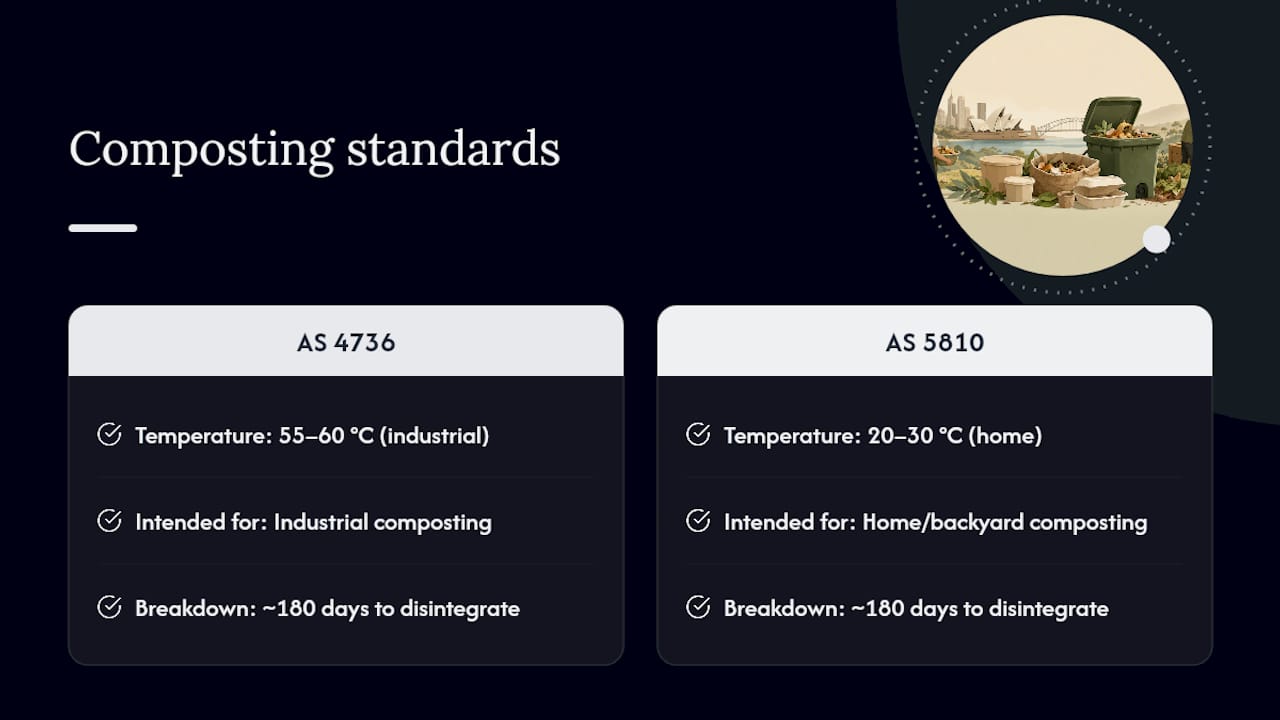
The single most useful fact in this whole topic: AS 4736 requires industrial composting conditions around 55 to 60 degrees Celsius, while AS 5810 is tested to break down at home compost temperatures of roughly 20 to 30 degrees, and both standards expect the material to disintegrate within about 180 days. That temperature gap is the whole story. A product certified only to AS 4736 will sit largely unchanged in a suburban compost bin because it never reaches the heat an industrial facility generates.
This is also where a common and costly mistake happens: people assume “compostable” automatically means “home compostable.” It doesn’t. AS 5810 is the stricter, more useful claim for anyone without access to commercial composting, because it’s verified to work at ambient backyard temperatures rather than relying on infrastructure most households never see. The Australasian Bioplastics Association runs the verification programs behind both standards and issues a distinct home-compostable logo specifically so shoppers can tell the difference at a glance.
Government policy backs this distinction with real weight. Australia’s 2025 National Packaging Targets commit to 100% of packaging being reusable, recyclable, or compostable, alongside recycled-content goals tied to specific material types. The Department of Climate Change, Energy, the Environment and Water frames this as part of a broader push toward a circular economy for packaging, and the Australian Packaging Covenant Organisation (APCO) coordinates the industry side of hitting those targets. If you’re running a business, aligning your packaging procurement with APCO’s framework isn’t just good practice, it’s increasingly what regulators and larger retail partners expect to see documented.
Certification snapshot: AS 4736 (industrial composting, ~55–60°C) and AS 5810 (home composting, ~20–30°C) both require breakdown within roughly 180 days under their respective conditions. Match the certificate to the bin you actually have access to.
In practice, disposal routes fall into a few clear lanes. Kerbside recycling takes clean paper, cardboard, and rigid plastics, but not compostable bioplastics, which contaminate the recycling stream if they end up there. FOGO (food organics, garden organics) bins accept AS 5810 items in councils that run the service. Industrial composting facilities are where AS 4736 items belong, and they’re typically reached through commercial waste contracts rather than household bins. Landfill is where uncertified “biodegradable” and oxo-degradable products usually end up regardless of marketing claims, because those labels aren’t backed by an enforceable standard the way AS 4736 and AS 5810 are. Sending genuinely certified compostable material to landfill wastes its entire purpose, since anaerobic landfill conditions halt the breakdown process a well-run compost system relies on.
Watch for logos and phrases with no teeth: “biodegradable” alone, “eco” printed in green text, and unverified leaf icons. None of these carry a testing standard behind them. If a product doesn’t show an AS 4736 or AS 5810 number, treat the compostable claim as unproven.
The right material depends entirely on what you’re protecting, where it’s headed, and what happens to the packaging once it arrives. Run through this before ordering anything in bulk:
Once you’ve worked through those five questions, the buying process itself should follow a similar discipline. Ask suppliers for the exact AS certificate number, not just the word “compostable” on a spec sheet. Request the independent lab test report behind that certificate, since the Australasian Bioplastics Association explicitly recommends checking for verified testing rather than trusting a label at face value. Order samples before committing to a pallet, and trial the packaging across a handful of real shipments to see how it performs under actual freight conditions, not just in a warehouse.
The trade offs are real and worth naming honestly. Compostable materials are usually less durable under sustained pressure or repeated handling than plastic equivalents, so multi-leg freight routes might still call for a sturdier recycled-cardboard option even if it’s not compostable at end of life. Heavier plant-fibre packaging can also add freight weight, which increases transport emissions, an irony worth weighing against the packaging’s own compostability. And recycled content isn’t the same claim as compostability: a box can be 100% recycled cardboard and still not be compostable in the AS 5810 sense, because “recycled” and “compostable” measure two different things entirely.
For businesses making this switch at scale, the order of operations matters. Set a written procurement rule (for example, “all customer-facing packaging must carry AS 4736 or AS 5810 certification”), document the certificate number against every purchase order, update supplier contracts to require ongoing certification proof rather than a one-off check, and test any new material across a small batch of real orders before switching your entire supply line over. Documenting certificate numbers this way also gives you a straightforward paper trail if you’re reporting against APCO’s national targets.
Pro Tip: Ask your supplier one blunt question: “What happens to this product if it goes into a standard council bin?” If they can’t answer clearly, that’s a sign the compostability claim hasn’t been tested against real-world disposal, and you should keep looking.
Specialist eco-packaging suppliers are the most direct route, and most stock both AS 4736 and AS 5810 certified ranges alongside standard recycled cardboard and kraft products. Trade wholesalers serving the packaging and food service industries often carry bulk bagasse and plant-fibre containers at better per-unit pricing than retail-facing shops, which matters once volumes climb. Local composting networks and organic waste aggregators, meanwhile, aren’t a materials source so much as a disposal partner, but they’re worth contacting before you buy, since some run collection services specifically for certified compostable packaging from local businesses.
Box rental and returned-box suppliers offer a genuinely different model worth considering for repeat shippers or anyone moving house: instead of buying single-use cardboard, you rent sturdy boxes that get collected, cleaned, and reused across multiple cycles. This sidesteps the compostability question altogether by removing the single-use problem at the source.
Whichever channel you use, ask the same set of questions every time:
On buying tactics, always start with a small sample order before locking in a bulk purchase, factor freight weight into your cost comparison since heavier “eco” materials can erase their environmental advantage on long routes, and check whether pooling orders with other local businesses or going through a distributor network reduces both cost and per-shipment freight emissions. For anyone specifically weighing compostable bioplastics or home-compostable claims, confirm your council’s FOGO collection status first. There’s little point buying AS 5810 certified caddy liners if your area doesn’t run a green-waste bin.
Household moves generate a genuinely staggering amount of packing waste, and the fix isn’t a single perfect material, it’s a hybrid approach. The most reliable method combines reusable boxes for bulky, sturdy items with shredded recycled paper or corrugated inserts for cushioning, then reserves certified plant-fibre or AS 5810 items specifically for food-contact or small disposable needs like kitchen scraps during the final clean-out.
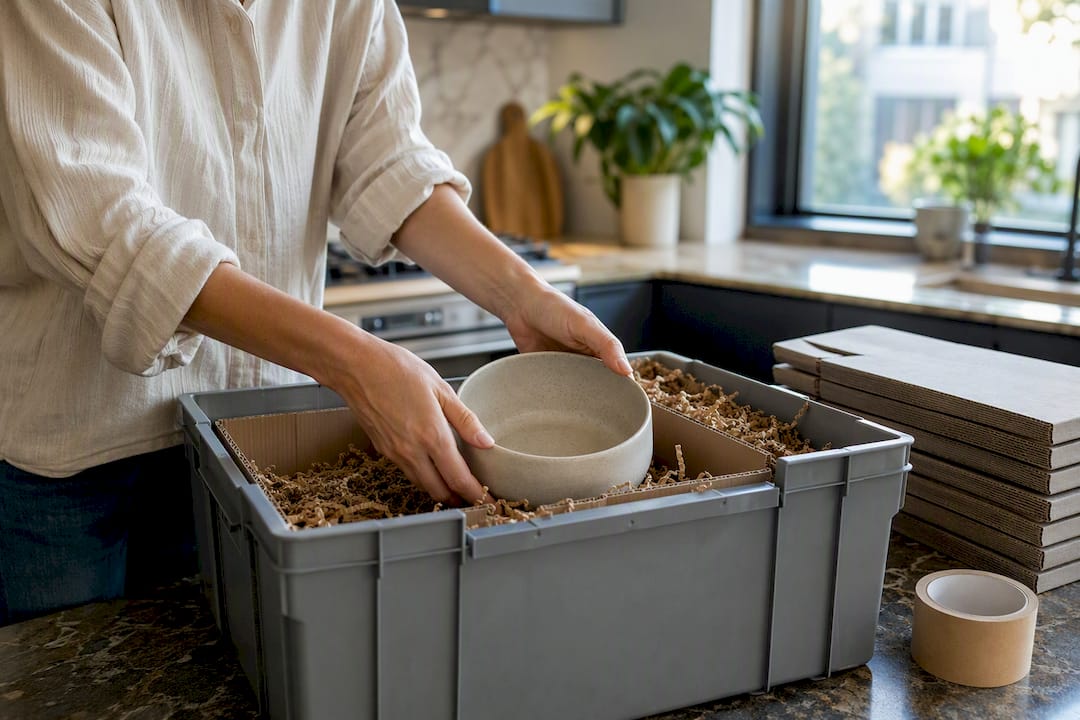
Rental boxes make sense for the bulk of a move: linens, books, kitchenware, anything that doesn’t need single-use packaging at all. Certified compostable padding earns its place in narrower situations, wrapping food containers going into storage, lining a kitchen caddy during the final pack-up, or cushioning small breakables where a reusable option isn’t practical.
Labelling matters more than most people expect. Keeping compostable items separate from general packing waste at collection time avoids exactly the contamination problem the Australasian Bioplastics Association warns about, where a genuinely compostable item ends up in a general recycling stream and either gets rejected or contaminates the whole batch.
A practical low-waste moving checklist looks like this:
Readers wanting more detail on the specifics can check our full guide to eco-friendly moving practices, our Melbourne-specific sustainable relocation advice, or our breakdown of what packing supplies you actually need for a move of any size.
Verification is the whole game here. If a product doesn’t carry an AS 4736 or AS 5810 number, don’t take the compostable claim at face value, no matter how convincing the packaging looks. Start small: swap one material, one supplier, or one part of your process this month, then watch what it actually does to your costs and your bin.
Businesses have a bigger lever to pull. Document your sourcing, push suppliers for recycled content figures and real certification, and treat every purchase order as a chance to build a paper trail you can stand behind. None of this needs to happen overnight. Pick one change, try it for a month, and see what your customers and your budget tell you.
— Dinshaw
Sorting eco-friendly packing materials while juggling everything else a move demands is where most households and small businesses run out of time, not intention. A professional moving company brings sustainability thinking into the packing itself, combining reusable boxes with certified compostable supplies where they genuinely make sense, rather than defaulting to whatever’s cheapest and heading straight to landfill.
Our team draws on real move experience to know when a rental box beats a cardboard one and when plant-fibre padding earns its place in the truck. If you’re planning a move and want packing handled by people who already think this way, our residential removal services page is the place to start, and our guide to packing supplies that actually matter gives you a head start on what to source yourself. Customer feedback and our own eco-focused guides back up the approach. Get in touch for a quote and tell us you want a low-waste pack. That’s it. That’s the whole ask.
There’s no single “most” eco-friendly option, it depends on the job. Recycled cardboard and kraft paper suit general shipping best, while plant-fibre materials like bagasse suit food contact, and certified AS 5810 bioplastics suit home composting where the infrastructure exists.
Common options include recycled corrugated cardboard, kraft paper and tape, bagasse and other plant-fibre containers, cornstarch-based void fill, mycelium foam, and certified compostable bioplastics carrying AS 4736 or AS 5810 marks.
Specialist eco-packaging suppliers, trade wholesalers, and box rental services are the main channels, and it’s worth asking each for AS certificate numbers and independent lab reports before buying in bulk. For moving specifically, Onyx Removals can point you to supplies and rental box options suited to a low-waste move.
For rigid packaging, recycled cardboard beats plastic outright on recyclability. For flexible or moulded packaging, certified compostable bioplastics (PLA or PHA) work as an alternative, but only where you have confirmed access to the matching composting facility, industrial for AS 4736, home compost for AS 5810.

No Related Post


