


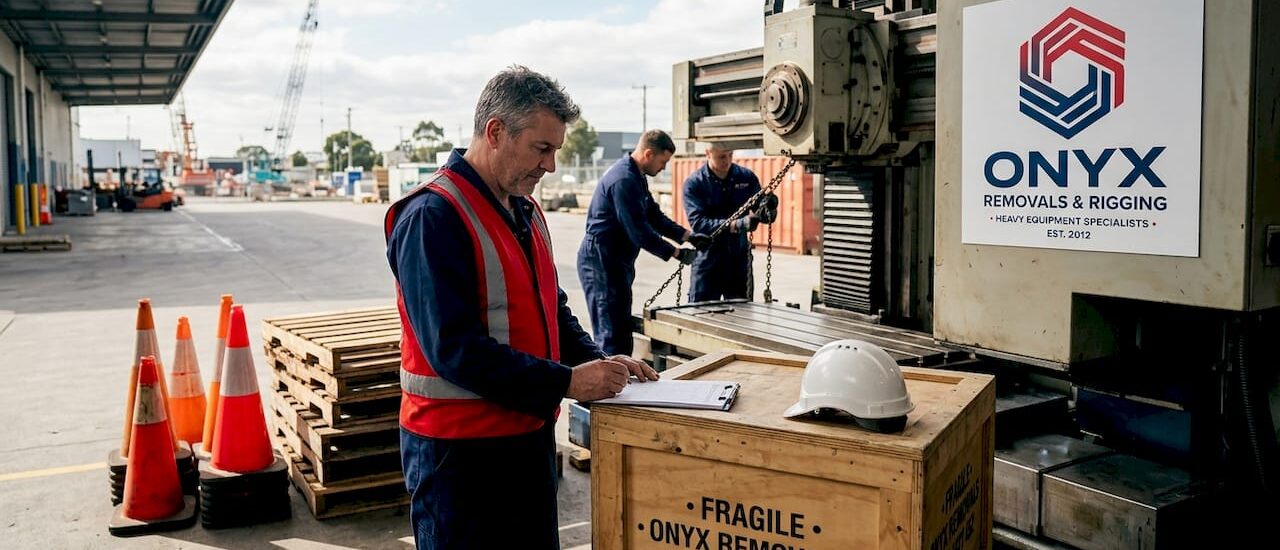
TL;DR:
- Relocating heavy machinery in Melbourne involves complex stages such as site assessment, lift planning, and permit acquisition to prevent damage and legal issues.
- Choosing a specialized mover with proven methodology, tailored equipment, and extensive experience ensures safety, compliance, and minimal downtime during the process.
Most people assume that moving heavy equipment is simply a matter of hiring a truck and a few strong hands. In reality, relocating industrial machinery in Melbourne is a complex, risk-managed process that touches on site engineering, road law, and precision logistics. Get it wrong and you’re looking at damaged equipment, workplace injuries, regulatory fines, and costly operational downtime. This guide cuts through the confusion, walking you through exactly what a professional heavy equipment move involves, how to evaluate your options, and what safety and compliance standards your chosen mover must meet.
| Point | Details |
|---|---|
| End-to-end process matters | Choosing a mover who manages assessment, planning, permits, and installation minimises risk and stress. |
| Compliance is non-negotiable | Confirm your mover meets legal and safety standards for restraints and permits before moving. |
| Ask the right questions | Don’t just check price—ask about project methodology, equipment, and their approach to safety. |
| Plan ahead for less downtime | Early preparation and choosing a specialist keeps your business running smoothly during moves. |
Building on why expert support matters, let’s look at what a professional mover actually does beyond just transport.
Many business owners picture a forklift being loaded onto a flatbed and driven across town. The reality is considerably more involved. A genuine heavy equipment relocation encompasses multiple stages, each requiring specialist knowledge and equipment. Skipping even one stage can lead to expensive consequences, from structural damage during lifting to legal liability on public roads.
Here are the key stages a professional heavy equipment move should cover:
For heavy machinery relocation in Melbourne, end-to-end machinery relocation that includes site assessments and lift planning through transport and final placement represents the professional standard you should expect from any serious provider.
“Planning and dismantling… transport and reinstallation… using trucks, cranes, and specialist lifting equipment, aiming to minimise downtime.” — Wallan Engineering
That phrase “minimise downtime” is worth focusing on. For a manufacturing business or a warehouse operation, every hour of equipment unavailability translates directly to lost revenue. A well-coordinated, end-to-end relocation can mean the difference between a one-day pause and a two-week disruption. Choosing a mover who understands this distinction is critical.
If you’re still in the early stages of planning, it’s worth reviewing some practical moving large machinery tips before locking in any provider.
To make an informed choice, here’s how you can separate specialists from standard providers.
Not every company that advertises “heavy equipment moving” has the expertise to back it up. Some are general removalists who occasionally handle oversized items. Others are haulage companies with trucks but no engineering background. And a few are genuine specialists with the systems, equipment, and experience to handle complex industrial relocations safely.
Here’s what genuine specialists offer that separates them from the rest:
When evaluating “heavy equipment movers,” prioritise project methodology over fleet advertising. A company that leads with “we have 20 trucks” but can’t explain how they’d assess your site is a red flag.
Some providers, like those offering machinery towing and haulage, specialise in heavy and oversized loads including permit handling and specialised trailers, which represents a more credible offering than generic moving services.
Here’s a quick comparison to help you evaluate your options:
| Criteria | End-to-end specialist | Haulage-only provider | General removalist |
|---|---|---|---|
| Site assessment | Yes | Sometimes | Rarely |
| Lift planning | Yes | No | No |
| Permit management | Yes | Sometimes | No |
| Disassembly/reassembly | Yes | No | No |
| Specialist lifting gear | Yes | Sometimes | No |
| Industrial insurance | Yes | Sometimes | Unlikely |
| Reinstallation support | Yes | No | No |
Red flags to watch out for:
Pro Tip: Always ask a prospective mover to walk you through their process for a job similar to yours. A specialist will speak confidently about lift angles, restraint methods, and permit timelines. A generalist will struggle to answer these questions in any detail.
For a thorough breakdown of the evaluation process, see our guide on choosing the right heavy equipment mover in Melbourne.
Safety and legal compliance are non-negotiable — here’s what Melbourne law expects and how top movers deliver.
Heavy equipment moves in Victoria are governed by a combination of state road regulations and national heavy vehicle standards. The National Heavy Vehicle Regulator (NHVR) sets out detailed requirements for how loads must be secured during transport, and these rules apply whether you’re moving a single machine across a suburb or a fleet of assets across the state.
One of the most critical compliance areas is direct restraint. This refers to the method of securing a load directly to the vehicle using chains, straps, or the vehicle structure itself. The NHVR’s loading guide provides detailed benchmark guidance on securing heavy machinery, including specific lashing angle requirements. For example, lashing angles of less than 25 degrees significantly reduce the effectiveness of restraint, meaning a seemingly secure load can shift dangerously during braking or cornering.
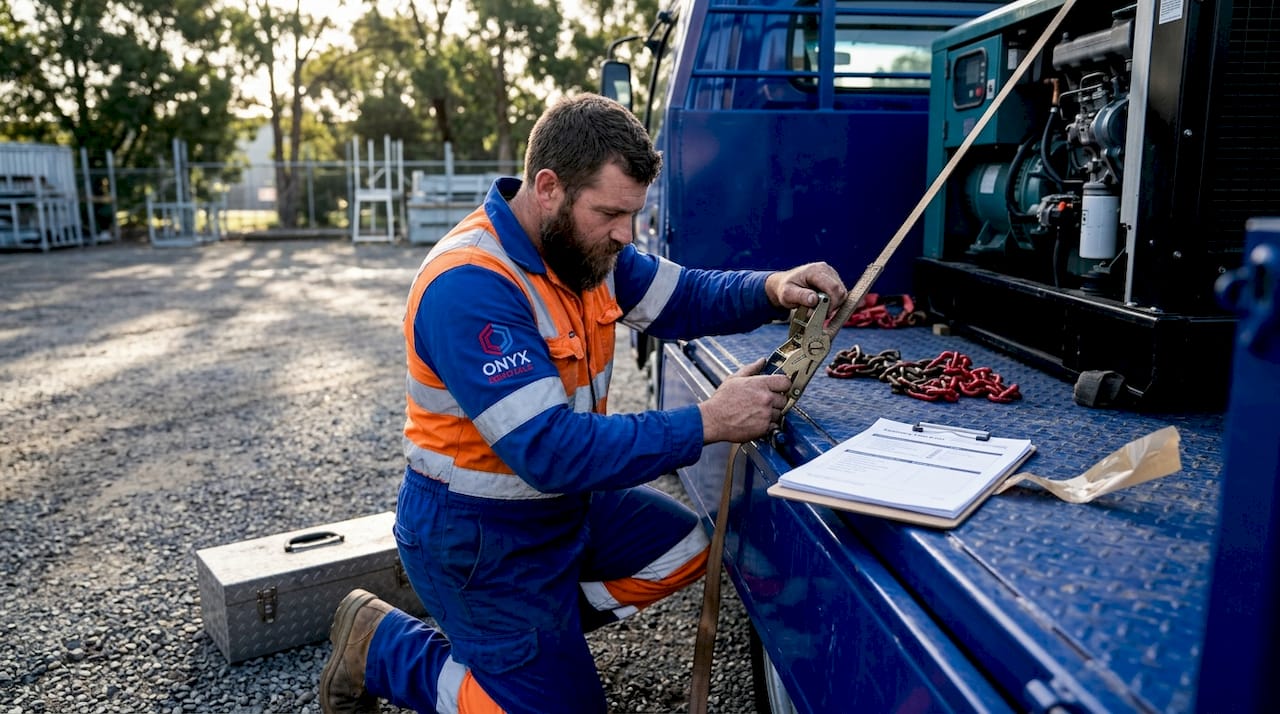
Restraint must perform in all directions: forward, rearward, and sideways. This means the total restraint system needs to account for multiple forces simultaneously, which is why experienced riggers calculate load weights, friction coefficients, and chain angles before a single strap is applied.
Here’s what you should confirm with any mover before signing a contract:
Beyond load security, oversized moves commonly require specialist permits and escort vehicles, particularly when the load exceeds standard width, height, or weight limits on Victorian roads. These permits must be obtained before the move, not as an afterthought.
| Compliance area | What to check | Why it matters |
|---|---|---|
| Direct restraint rating | Chains/straps rated to load weight | Prevents load shift during transit |
| Lashing angle | Angles ideally above 25 degrees | Maintains restraint effectiveness |
| Permit documentation | Permits sourced before transport date | Legal requirement for oversized loads |
| Operator certification | Formal rigging/crane licences | Reduces risk of accidents |
| Route survey | Completed before transport | Identifies low bridges, narrow roads |
For more guidance on keeping people and equipment safe during a relocation, our article on moving heavy machinery safely covers the key principles in practical detail.
Once you’ve chosen your mover and checked compliance, here’s how to prepare for a problem-free move.
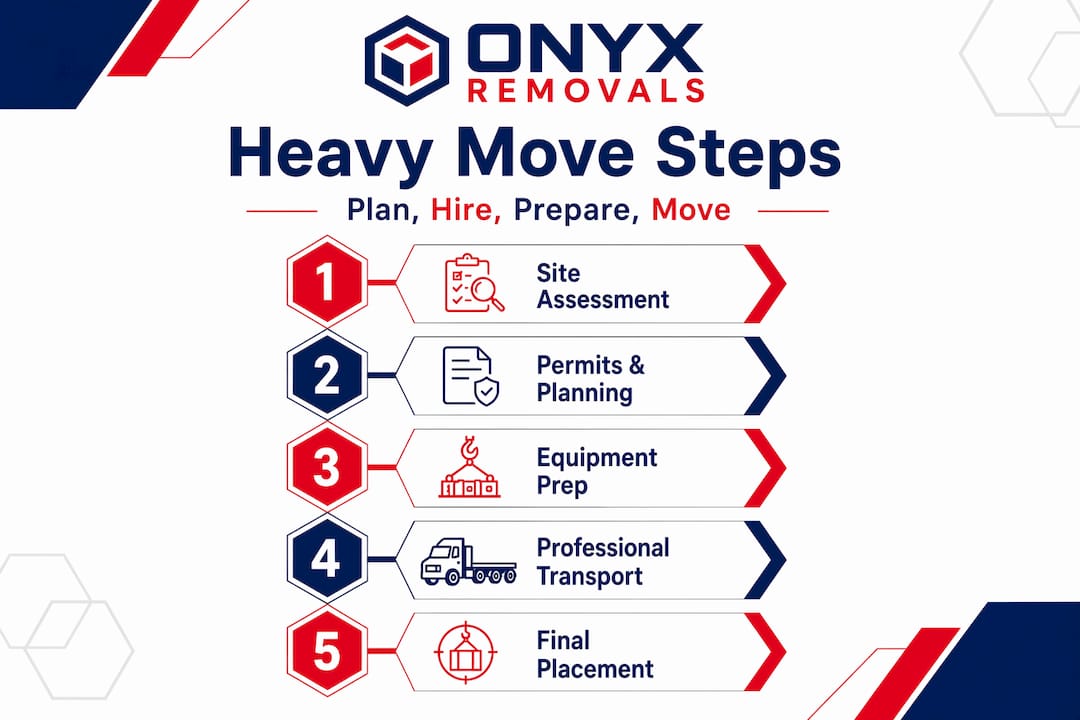
Even with the best mover in Melbourne handling your relocation, the success of the job depends partly on how well you prepare. The businesses that experience the smoothest moves are those that treat it as a project, not just a booking. A well-managed relocation that runs “from planning and dismantling to transport and reinstallation” with minimal downtime is the result of collaboration between client and mover, not the mover working in isolation.
Follow these steps to set your move up for success:
Pro Tip: Walk the route from your machinery’s current location to the loading area before the move day. What seems like an easy path can hide obstacles like drainage grates, overhead beams, or tight corners that a loaded trolley or crane can’t navigate without advance planning.
For specific guidance on handling large appliances and equipment in domestic or light commercial settings, our heavy appliance moving tips and overview of essential equipment for safe moves are worth a read before your move day arrives.
Here’s the truth that most relocation guides won’t tell you: the biggest mistake businesses make when planning a heavy equipment move isn’t choosing the wrong truck. It’s choosing based on price rather than process.
We see it regularly. A business owner gets three quotes, picks the lowest one, and discovers on move day that the “specialist” doesn’t have permits, doesn’t own the right lifting gear, and is subcontracting the actual work to someone else entirely. The result is delays, unexpected charges, and sometimes equipment damage that voids the original cost savings several times over.
The mind-shift that leads to better outcomes is this: evaluate your mover the way you’d evaluate a structural engineer. You wouldn’t hire an engineer based solely on their hourly rate. You’d ask about their methodology, their experience with comparable projects, and their risk management approach. Heavy equipment moves deserve the same scrutiny.
Transparency is everything in this industry. A mover who can confidently explain how they calculate restraint forces, why they’ve chosen a particular crane configuration for your job, and exactly how they’ll handle a permit delay is a mover who has done this before. A mover who gives vague reassurances and tells you “don’t worry, we do this all the time” without specifics is one to avoid.
The NHVR’s guidance on load restraint compliance is publicly available, and any reputable provider should be familiar with it. If you ask a prospective mover how they comply with direct restraint requirements and they can’t give you a clear answer, walk away. That’s not a minor knowledge gap — it’s a liability waiting to happen.
For a broader perspective on what separates capable providers from risky ones, our resource on heavy object movers insights offers useful context from the field.
The best relocations we’ve seen share one common thread: early, open communication between the client and the specialist team. The client knows what’s happening at each stage, the mover has all the information they need, and everyone is working toward the same outcome. That’s not luck. It’s the result of choosing the right partner from the start.
Moving heavy equipment in Melbourne is a job that rewards preparation and penalises shortcuts. Whether you’re relocating a single industrial press or an entire production line, the right specialist partner makes all the difference between a smooth transition and a costly disruption.
At Onyx Removals, we connect Melbourne businesses and individuals with proven, experienced specialists across the full spectrum of equipment and commercial relocations. From initial site assessment through to final reinstallation, we help you plan every stage with confidence. Explore our resources on Melbourne heavy equipment moving experts and learn how commercial relocation project management can minimise your downtime and protect your bottom line. Ready to take the next step? Browse our full suite of removal services or get in touch for a tailored quote today.
Professional movers in Melbourne can relocate large machinery including forklifts, generators, industrial presses, bulldozers, and other oversized assets, as outlined in NHVR heavy machinery categories.
Yes, oversized or over-dimensional machinery moves require permits for road safety and legal compliance. Reputable providers will obtain all necessary permits as part of their service.
Ideally, engage your mover at least four to six weeks before your target date to allow adequate time for site visits, permit applications, and specialist equipment scheduling.
Expect direct restraint methods using rated chains and straps, full adherence to NHVR load restraint guidance, certified operators, and proper permits for oversized loads secured before transport begins.

No Related Post


