



A well-executed office relocation project plan does one thing above all else: it keeps your business running while everything around it changes. The moves that go wrong rarely fail because of one catastrophic decision. They fail because lease dates don’t align, IT cutover gets booked too late, or staff are left guessing until the week before. Getting this right means treating the relocation as a structured project with clear phases, named owners, and enough lead time to absorb the surprises that always come.
Here is what a complete plan covers:
The sections below break each of these into practical steps you can act on now.
The single biggest planning mistake Australian businesses make is starting too late. Planning should begin 4–6 months before the move date, and that window extends further if your new space requires a full fit-out, landlord approvals, or significant IT upgrades. A Sydney office fit-out typically takes several weeks to construct, with landlord approval requiring additional weeks. That alone consumes two months of your runway before a single box is packed.
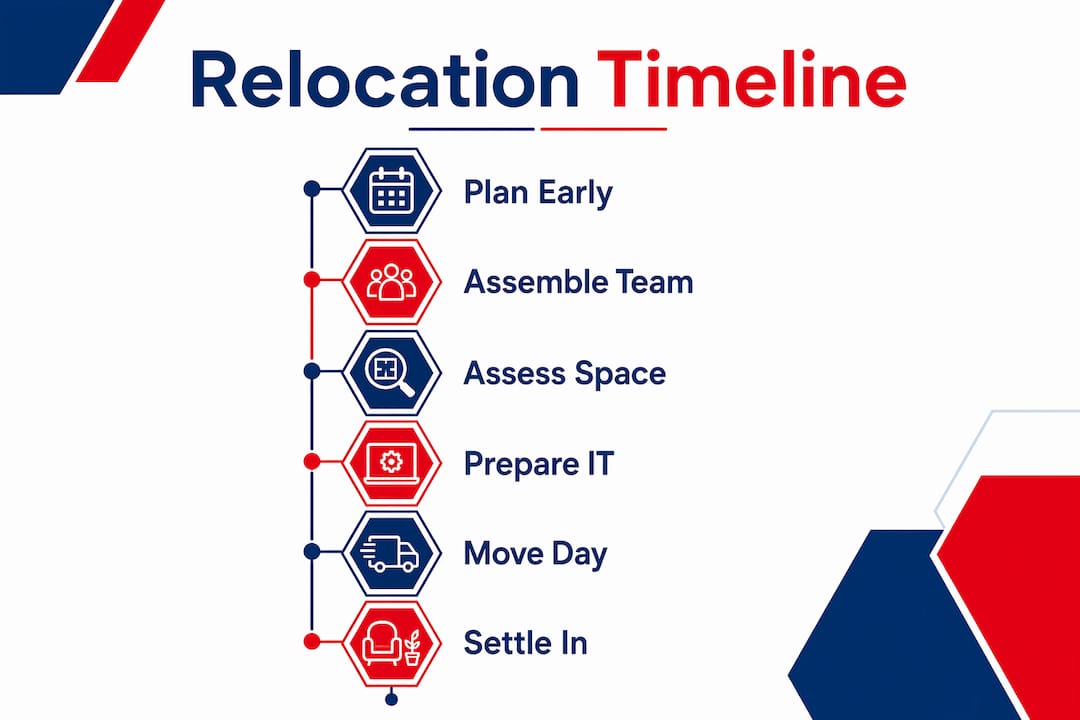
Map your timeline backwards from the move date, which is usually fixed by your old lease expiry. The make-good period must sit inside that window too. Make-good work, patching walls, cleaning carpets, removing fixtures, can take several weeks and has to be completed before your landlord releases you from your obligations. Businesses that treat make-good as a post-move task often end up paying double rent longer than necessary.
Your budget needs to cover far more than the removalists. A complete relocation budget includes:
Overlapping leases are almost unavoidable on a full fit-out. Office fit-out overlaps commonly last several weeks, allowing time to complete construction, commission IT, and move without rushing. Businesses that compress this window to save on double rent often spend more through premium labour rates, expedited deliveries, and the productivity hit of moving into a space that isn’t ready.
Pro Tip: Document what is explicitly in and out of scope before approving any spend. Are you refreshing meeting rooms or relocating them as-is? Are acoustic treatments required? These decisions affect both cost and programme, and they are far harder to change once procurement has started.
Every office move needs a single project lead with genuine decision-making authority. Without that, every vendor query, every scheduling conflict, and every staff question becomes a committee discussion. Centralising coordination prevents the bottlenecks that turn a manageable move into a chaotic one.
Your office move project management team should cover these roles at minimum:
Each role needs a named person, not a department. Shared accountability is no accountability. Build a simple RACI matrix (Responsible, Accountable, Consulted, Informed) for the major decisions and review it at the start of each planning phase. Bring external experts, your fit-out contractor, IT provider, and removalist, into the planning conversation early. The later they join, the less they can help you avoid problems.
Before you brief a fit-out contractor, you need an honest picture of what your business actually needs from its next office. Not what the current office has, and not what looks good in a brochure. Start by counting workpoints: how many do you need today, and how many in two to three years given your hiring plans and hybrid work arrangements? Then look at meeting room usage. Most offices have too many enclosed boardrooms and not enough small collaboration spaces.
Assess the new space against your real operational needs, not assumptions. Measure carefully. A tenancy that looks generous during inspection can feel cramped once you account for storage, circulation paths, and the acoustic separation that focused work requires. Involve a qualified workplace designer early, particularly for layout, ergonomics, and branding. They will spot constraints in the floor plate that aren’t obvious from a lease plan.
Key design and planning considerations for Australian offices:
Get landlord approval in writing before any trades start work. Delays in approval are one of the most common reasons fit-out programmes slip, and they are almost always avoidable with earlier engagement.
Technology downtime is the most expensive risk in any office move. A business that can’t take calls or access its systems on day one loses revenue in ways that never appear in the original relocation budget. IT planning needs to start at the same time as your space planning, not after the fit-out is finished.

Early IT planning should cover server disconnection and transport, data backups and cloud migration, internet and phone setup, cabling and power access, and security systems including access control. Internet connectivity at the new office needs to be ordered months in advance depending on your carrier and the building’s existing infrastructure. Some buildings require new fibre runs that take weeks to provision.
Your IT move checklist should include:
The interaction between IT and the fit-out is where most problems originate. If IT and the fit-out contractor are planning separately, you will discover on move day that data points don’t match the desk layout, or that the comms room doesn’t have the power capacity the server rack needs. Put IT inside the master project schedule from week one.
Move day should have very few surprises left by the time it arrives. The preparation that happens in the weeks before is what determines whether the physical move runs smoothly or turns into a twelve-hour scramble.
Building manager protocols at commercial properties commonly include loading dock bookings, lift protection requirements, after-hours access arrangements, contractor inductions, and insurance verification. Ignoring these can cause scheduling delays or incur fines. Book the loading dock and service lifts at both the old and new buildings as early as possible. These slots fill quickly, particularly on Fridays and weekends.
Your move day logistics checklist:
Packing discipline matters more than most teams expect. Boxes that aren’t labelled correctly create hours of confusion during unpacking. A simple colour-coded labelling system tied to the floor plan saves time and reduces the risk of equipment being placed in the wrong area.
Pro Tip: Schedule IT shutdown and handover as a formal step on move day, not an informal “someone will sort it out.” Assign a specific person to confirm that servers are safely powered down, backed up, and ready for transport before the removalists touch the comms room.
A technically well-managed move can still feel like a failure if staff feel uninformed or blindsided. Relocations affect commute patterns, team dynamics, daily routines, and perceptions of leadership. Communication that starts too late leaves a gap that rumour fills.

The most effective approach is to share the reasons for the move early, alongside the expected benefits. Staff don’t need every detail from the beginning, but they do need confidence that the process is being managed properly. Explain the timeline, what support will be provided, and when teams will be asked to pack, test equipment, or adjust working arrangements.
Communication best practices for office relocations:
The opening week in a new office shapes staff perception more than the move weekend does. A well-organised first Monday, with working systems, clear wayfinding, and someone available to answer questions, sets the tone for how the new space is received.
The physical move is not the end of the project. The first two weeks in a new office are when the real operational picture emerges: the meeting room that’s too cold, the workstation that doesn’t fit the person assigned to it, the access card that doesn’t open the right doors. These issues are normal. The question is whether you have a plan to resolve them quickly.
Schedule a formal settling-in period with a named owner responsible for defect resolution and practical adjustments. This person collects issues, prioritises them, and coordinates with the fit-out contractor, building manager, and IT team to close them out. Leaving defects to resolve themselves is how minor irritants become lasting complaints.
Key post-move tasks:
The most successful relocations don’t end when the last crate is unpacked. They end when the business is operating at full capacity in a space that genuinely works better than the one it left.
Australian workplace health and safety obligations don’t pause during a relocation. They apply to the new tenancy from day one, and several compliance requirements need to be addressed during the planning phase, not after the move.
WorkSafe Australia guidelines cover hazard identification, manual handling risks during the move itself, and the safety of the new workspace before staff occupy it. The Disability Discrimination Act requires that the new office meets accessibility standards for entrances, amenities, corridors, and workstations. These aren’t optional considerations; they are legal obligations that apply regardless of whether you’re leasing a brand-new fit-out or moving into an existing tenancy.
Compliance checkpoints for Australian office relocations:
Make-good obligations deserve particular attention. Businesses that leave make-good planning until after the physical move frequently discover the work takes longer and costs more than expected. Address it at the same time as your new fit-out design, so the cost is factored into the overall budget rather than emerging as an unplanned expense at the end.
An office relocation is as much a people project as a logistics one. The physical move takes a weekend. The adjustment to a new workspace, new commute, new desk arrangements, and potentially new ways of working can take months. Change management is what bridges that gap.
Start by being clear about the reasons for the move. Staff who understand why the business is relocating, whether it’s for better space, a more accessible location, or a layout that supports hybrid work more effectively, are more likely to engage positively with the transition. Vague messaging creates anxiety. Specific, honest communication builds confidence.
Practical change management steps for office relocations:
Hybrid work arrangements add a layer of complexity. Staff who split their time between home and the office may feel the impact of a relocation differently from those who are in five days a week. Make sure remote and hybrid workers are included in all communications and that the new office genuinely supports the way they work when they’re on-site.
Every office relocation involves a web of suppliers: removalists, fit-out contractors, furniture suppliers, IT providers, cleaners, and potentially a storage company. Managing these relationships without a clear coordination framework is where projects lose time and money.
Start by identifying every vendor involved and documenting their scope, timeline commitments, and key contacts in a single register. This doesn’t need to be complex. A shared spreadsheet with columns for vendor name, scope, contract value, key dates, and contact details gives your project lead visibility across all commitments at a glance.
Vendor coordination priorities:
For the business relocation challenges that tend to catch teams off guard, vendor delays are consistently near the top. Custom joinery, imported furniture, and specialist IT equipment all carry lead times that can shift the entire programme if ordered late. Lock in procurement decisions as early as possible and build lead time buffers into your schedule for any item that can’t be substituted at short notice.
Contract variations are another common source of cost blowout. Every time the scope changes, even a small change to a partition layout or an additional data point, get the variation in writing with a confirmed price before the work proceeds. Verbal agreements during a busy fit-out are how budgets drift.
Office relocations have a lot of moving parts, and the physical move itself is where poor planning becomes most visible. Onyx Removals specialises in commercial removals in Melbourne, managing the logistics of office moves with the kind of coordination that keeps your business operational through the transition.
The Onyx Removals team handles office furniture, IT equipment, storage solutions, packing and unpacking, cleaning, and specialised items, all under one roof. That means fewer handovers, fewer gaps in accountability, and a move day that runs to a plan rather than improvised on the spot. For businesses that need temporary storage between sites, Onyx Removals provides flexible options that fit around your lease timeline. Every move is supported by a personalised plan built around your specific building access requirements, team size, and operational constraints. Get in touch with Onyx Removals for a customised quote and a clear plan for your next office move.
A successful office relocation project plan requires early action, a named project lead, and a budget that accounts for every cost from fit-out to make-good, not just the removalists.
| Point | Details |
|---|---|
| Start planning 4–6 months out | Fit-out construction and landlord approvals alone can consume 6–10 weeks of your timeline. |
| Appoint a project lead early | Single-point accountability prevents bottlenecks across IT, vendors, and building management. |
| Budget beyond the removalists | Include fit-out, make-good, IT, signage, permits, cleaning, and a moderate contingency. |
| Treat IT as a parallel workstream | Order internet months in advance and align cabling with the furniture layout before installation. |
| Plan the post-move period | Schedule a formal settling-in phase with a named owner for defect resolution and staff support. |
| Onyx Removals for Melbourne moves | Onyx Removals manages commercial office relocations with personalised plans, storage, and full packing support. |

No Related Post


