


Business moving expenses cover every fee tied to physically shifting an office or commercial space: removalist labour, truck time, packing and unpacking, storage, cleaning, and specialised handling for servers or heavy equipment. This is separate from any tax or accounting treatment of those costs. A realistic planning range runs from around $2,500 for a small office through to $20,000 or more for a large multi-floor relocation, driven mostly by workstation count, building access, and whether the job runs after hours. Before you ring anyone, put together a written brief. That single step does more to control your final bill than any negotiating tactic.
TL;DR:
- Larger moves over 50 desks often require advanced booking of 10 to 12 weeks or more, especially for full project management and complex access needs.
- Expect a typical fixed price range from $2,500 for small offices to over $20,000 for large multi-floor relocations, depending on volume, distance, and access conditions.
- Hidden fees such as lift access charges, storage, or server handling can significantly increase costs and should be clarified in writing before signing any contracts.
- Detailed, consistent quotes that include line-item costs for labour, materials, and third-party services depend on comprehensive inventories and site photos provided upfront.
- Using bundled services from a single provider like Onyx Removals reduces administrative hassle, minimizes hidden costs, and ensures clearer accountability during the move.
Most removalists quote office jobs at a fixed price rather than an hourly rate, because timing risk on a business move is high. A late finish on a Friday night doesn’t just cost the mover money. It costs you a Monday morning with staff standing in a half-packed office.
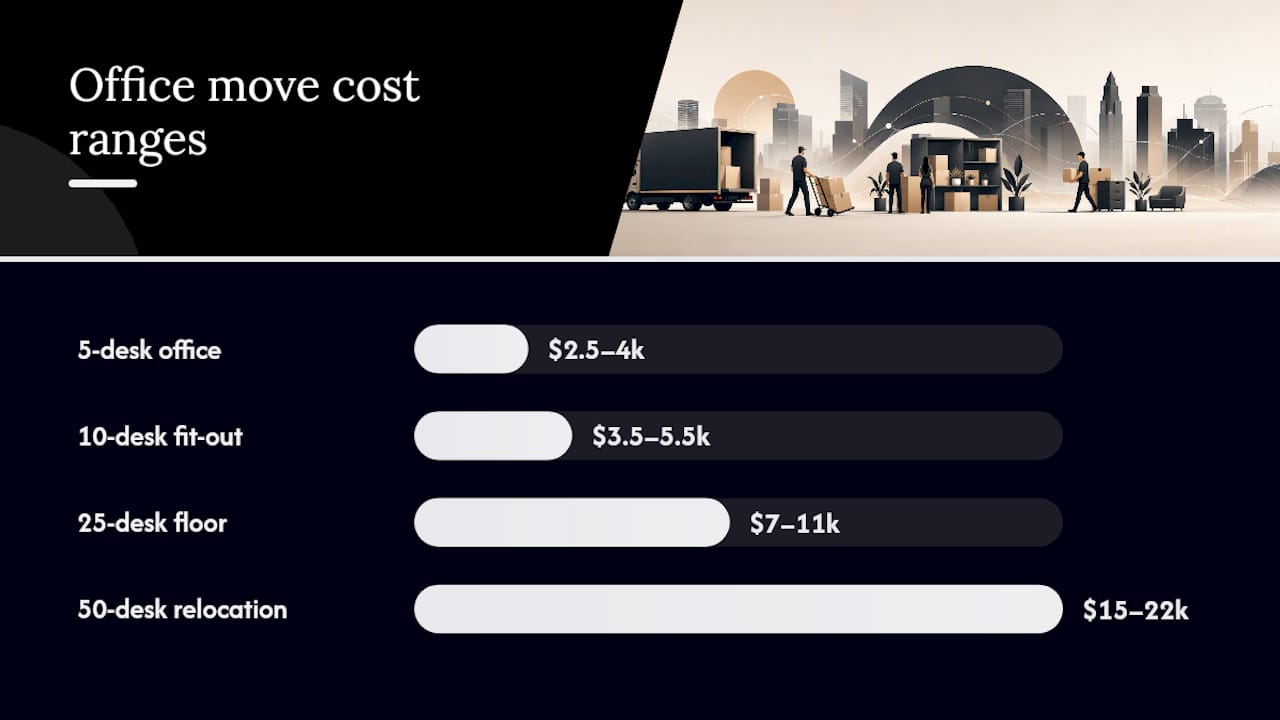
Ballpark figures give you a starting point for comparison. Based on typical Sydney commercial pricing, a 5-desk office generally runs $2,500 to $4,000, a 10-desk fit-out sits between $3,500 and $5,500, a 25-desk floor lands around $7,000 to $11,000, and a 50-desk relocation climbs to $15,000 to $22,000. These are ballpark figures, not quotes, and your actual number will move depending on a handful of specific factors.
The variables that swing a quote up or down:
Hourly rates still show up for very small jobs, like a single-office shift with a handful of items, where a fixed quote isn’t worth the paperwork for either side.
A vague phone call gets you a vague number. A detailed written brief gets you a fixed-price quote you can actually compare against a competitor’s. Written briefs with matching measurements and photos consistently produce tighter, more comparable quotes than a walk-through description over the phone.
Send every prospective provider the same information:
Request a line-itemed written quote from each provider, breaking out labour, materials, and third-party costs such as storage or disposal, along with clear inclusions, exclusions, and the process for approving any variation.
Pro Tip: If two quotes come back wildly different, don’t just ask which price is right. Ask each provider what assumptions they made about access, timing, and crew size. The gap usually comes from different assumptions, not different honesty.
The base quote is rarely the final invoice. Lift access fees charged by building managers, stairs or restricted-access surcharges, and server-rack handling as a standalone line item are the three surprises that catch business owners out most often.
Watch for these extras before you sign anything:
Insist on a written variation process in the contract, so any on-the-day change has an agreed rate before work continues. Confirm insurance certificates, permits, and building access rules with your property manager in the week before the move, not the morning of.
Removalists book out fast, especially around quarter ends. Lock in your date earlier than you think you need to.
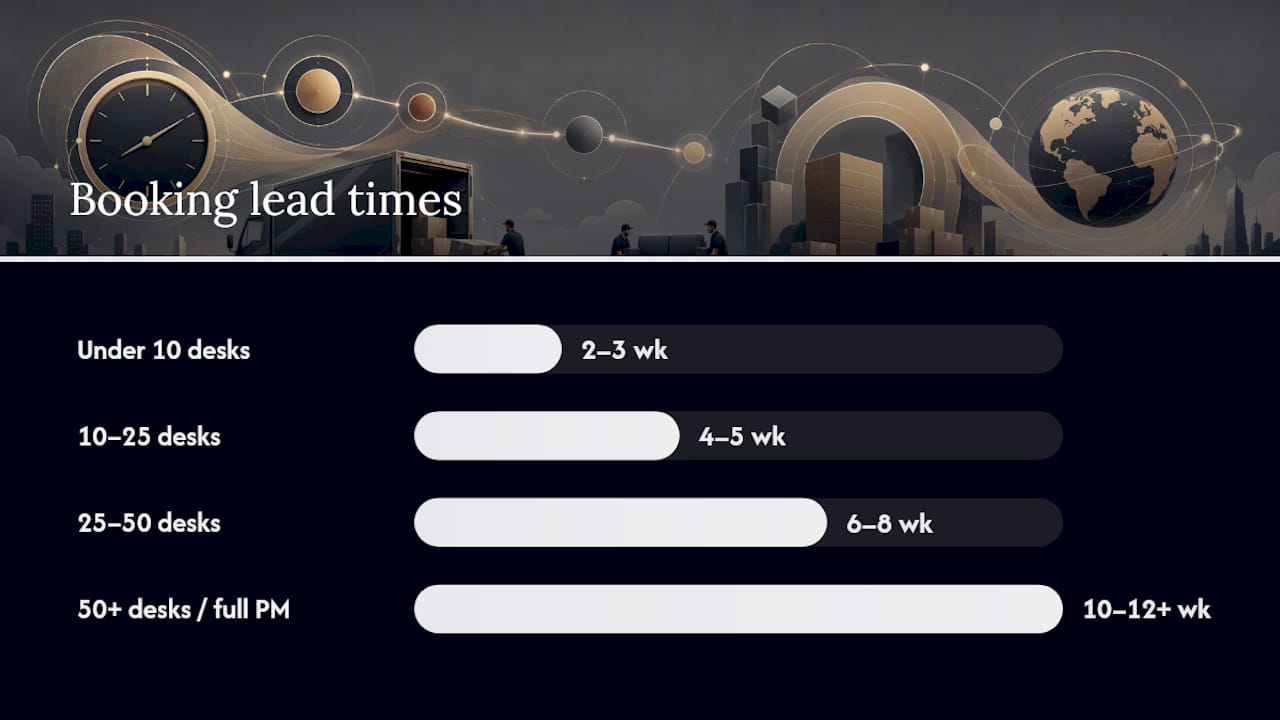
Recommended lead times scale with job size: book 2 to 3 weeks ahead for moves under 10 desks, 4 to 5 weeks for 10 to 25 desks, 6 to 8 weeks for 25 to 50 desks, and 10 to 12 weeks or more for anything over 50 desks or requiring full project management.
Building managers add their own delays into this timeline. Lift bookings and current insurance certificates often need lodging days or weeks ahead, and a building manager who’s slow to respond can eat into your buffer fast. Avoid quarter-end and end-of-financial-year windows if you have any flexibility. Midweek, mid-month moves tend to be cheaper and easier to book than weekend slots during busy periods like the end of financial year.
Most of the cost control happens before the truck arrives, not during the negotiation.
Pro Tip: Build a 10% contingency line into your budget and require a written acceptance checklist at hand-over. It’s the cheapest insurance against a dispute over what was and wasn’t included.
Removalist fees, packing services, storage, and specialist handling are typically treated as ordinary business expenses, which generally makes them deductible in the year they’re incurred, provided the move relates to running the business rather than a private matter. That’s the general principle. It is not advice for your specific situation.
The practical wrinkle is documentation. Tax authorities expect a clear paper trail: invoices that separate labour, materials, storage, and disposal, not a single lump-sum figure from your removalist. This is another reason to insist on line-itemed quotes and invoices rather than a flat total. A single number is harder to defend and harder to categorise correctly at tax time.
Some costs sit in a grey area depending on how they’re structured. Fit-out work, leasehold improvements, and certain IT reconnection costs may be treated as capital expenses rather than immediate deductions, which changes how and when they can be claimed. Rules also vary depending on your business structure and jurisdiction, and they change from year to year.
Treat this section as a signal to raise the topic early, not as a substitute for advice. Talk to your accountant or a registered tax agent before the move, not after, so your invoicing and record-keeping line up with how you plan to claim the costs. Getting the paperwork format right from day one saves a messy reconciliation exercise months later.
Standard removalist liability rarely covers the full replacement value of business equipment. That gap is where most disputes start after something gets damaged.
Ask every provider for two things before you book: proof of current public liability insurance, and clarity on what transit cover applies to your goods while they’re in the truck. Many removalists offer basic transit cover as standard, with higher-value cover available as an add-on for expensive equipment, server infrastructure, or specialised machinery. If your business carries its own business insurance policy, check whether it already extends to goods in transit during a relocation. It sometimes does, and paying for duplicate cover is money wasted.
Building-side insurance matters too. Landlords and building managers commonly require proof of insurance before they’ll approve lift bookings or loading dock access, so get this certificate sorted well ahead of your move date rather than the week before. For high-value or fragile items like specialised machinery or lab equipment, ask specifically about specialist crating and cover, because standard transit insurance often excludes or caps this category. Get every insurance commitment in writing as part of the quote, not as a verbal assurance from the sales call.
Three checks separate an accurate quote from a guess: a full, itemised inventory, clear photos and dimensions of access points at both ends, and a firm go-live date the whole move plan can work backwards from. Skip any of these and you’re negotiating on incomplete information, which is how budgets blow out. Get them right, and most of the surprises in this article simply don’t happen.
— Dinshaw
Consider a provider that offers commercial services covering the full scope of a business relocation, including packing and unpacking, furniture assembly and dismantling, short-term storage, specialised handling for sensitive equipment, and end-of-lease cleaning, coordinated as one project rather than three separate bookings.
Bundling these services under one provider does more than save you admin time. It closes the gap where hidden costs usually appear, the handoff between the mover, the cleaner, and the storage provider, where nobody takes responsibility for a missed deadline or a damaged item. A single point of accountability means one written quote, one team to call if something changes, and one company that answers if a lift booking falls through.
If you’re preparing to get quotes for an upcoming move, start with a written brief and use our office move budget planning guide to build it out. Then request a line-itemed quote through our commercial removals page and see how a bundled, single-provider quote compares to piecing the job together yourself.
Cost ranges and hidden-fee examples come from We Move Group’s Sydney pricing guide and Cockatoo’s Australian relocation guide. Lease and budgeting guidance comes from Allied’s business relocation guide. For marketing support if you run a moving business yourself, see Baby Love Growth’s SEO services for movers.
A small office of around 5 desks generally costs a few thousand dollars, while a 50-desk relocation typically involves significantly higher expense, depending on access, distance, and timing.
Send a full furniture inventory, photos and dimensions of access points at both sites, your preferred move dates, and a list of any specialist items like server racks or artwork.
Book 2 to 3 weeks ahead for moves under 10 desks, 4 to 5 weeks for 10 to 25 desks, and 6 to 12 weeks or more for larger or project-managed relocations.
Removalist and relocation service fees are generally treated as ordinary deductible business expenses, though capital items like fit-outs may be treated differently, so confirm the specifics with your accountant.
Onyx Removals coordinates packing, storage, and specialised handling as part of its commercial removal service, and can confirm current insurance details directly when you request a quote.

No Related Post


