


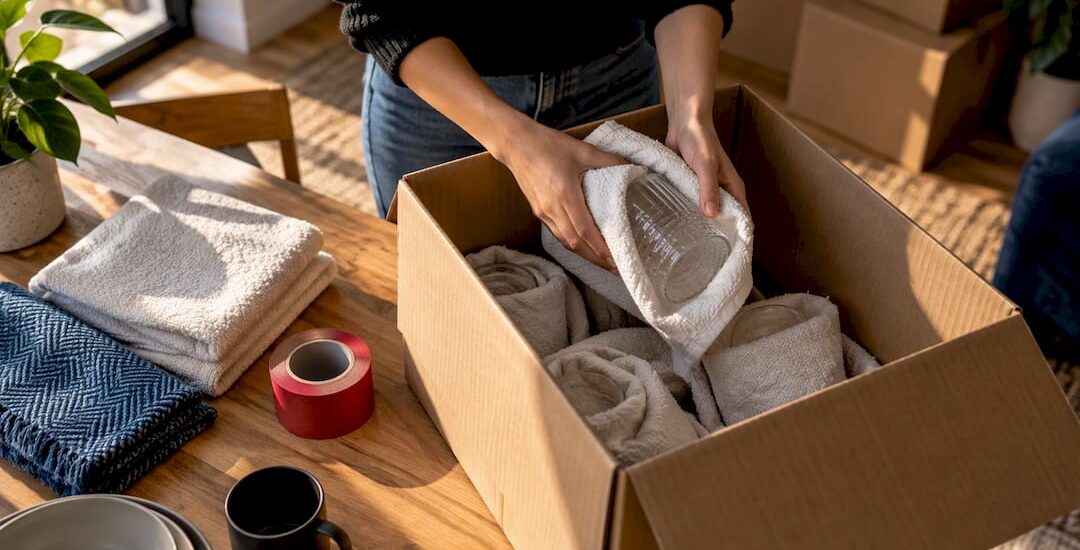
The most sustainable way to pack for a move is to avoid buying anything new first, reuse what you already own second, and hire reusable crates for the heavy lifting. Buy recycled-content boxes only to fill the gaps. Reach for household towels, spare linen, and existing boxes before anything else, then look at crate hire for a long-distance or bulky move. The sourcing steps and trade-offs are below.
TL;DR:
- Reusing household textiles and existing boxes significantly reduces environmental impact compared to new purchases, especially for short-distance and lightweight moves.
- Hiring reusable crates is often more cost-effective and environmentally friendly than single-use cardboard when damage, labor, and disposal costs are factored in.
- Recycled-content cardboard is a suitable middle ground, but it is less durable in wet conditions and for long-distance moves compared to reusables.
- Proper sorting and limiting the use of soft plastics like bubble wrap are essential, as most local recycling systems cannot process these materials properly.
- Choosing eco-friendly packing options through professional services like Onyx Removals ensures sustainable practices are incorporated with minimal effort from the mover.
Australia’s National Waste Policy ranks options in a strict order: avoid first, reuse second, recycle third, dispose last. That ordering isn’t bureaucratic box ticking. It reflects a hard truth about material flows that most packing advice skips over entirely.
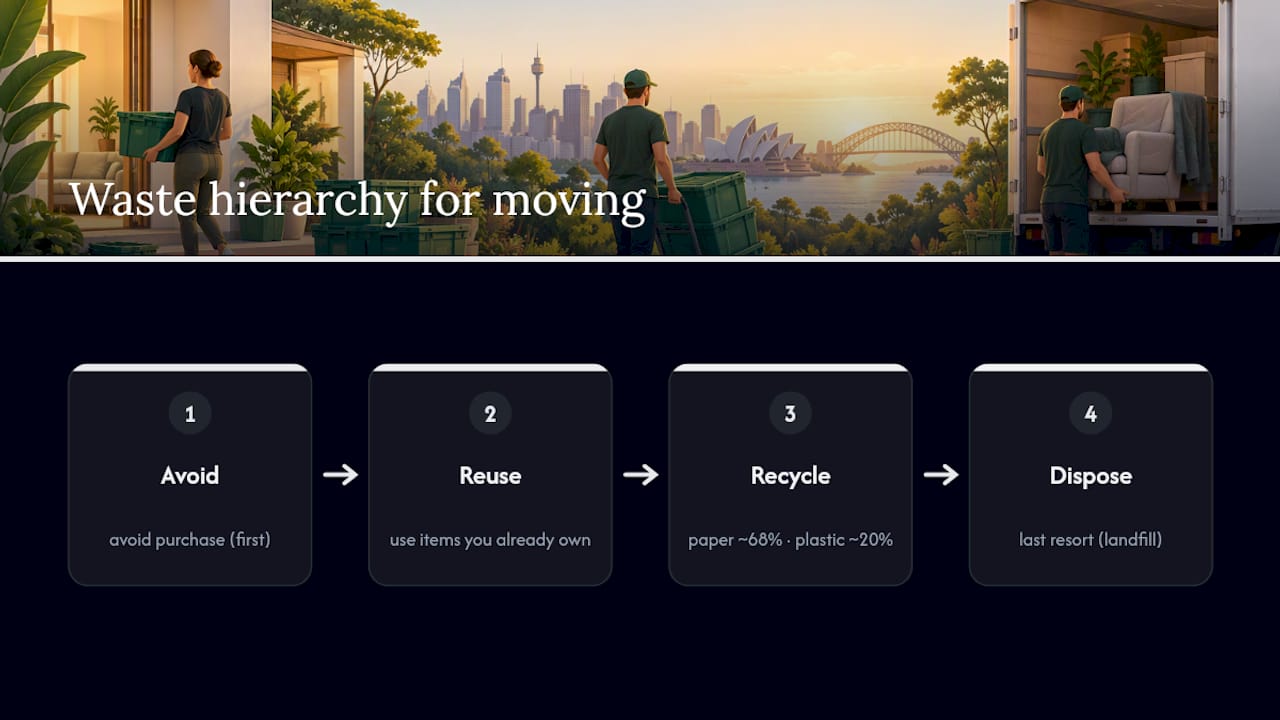
Recycling has real limits. Paper and cardboard get recovered at around 68%, but plastic recovery sits closer to 20%, according to the national waste and resource recovery report.
The gap between plastic and paper recovery rates is large, with paper and cardboard recycling much more common than plastic recovery. That means every roll of plastic bubble wrap or polymer void fill you buy for a move has a much higher chance of ending up in landfill than the cardboard box it’s packed inside.
This changes how you should think about “eco-friendly” packing. Recyclable isn’t the same as recycled, and buying a product just because it’s technically recyclable still puts a demand on virgin material and transport emissions. Avoiding the purchase altogether, or reusing something you already own, skips that whole cycle.
Not every eco option suits every move. Here’s what actually works, roughly in order of impact:
Pro Tip: Ask around before you buy a single box. Someone in your street, your workplace, or your local “buy nothing” group almost certainly has a stack of moving boxes sitting in a garage right now.
This is where most packing guides get vague, so here’s the specific trade-off. A supply-chain analysis from the Institute for Sustainable Futures at UTS found that reusable plastic crates can end up cheaper overall than single-use cardboard once you factor in the hidden costs: labour, damage, and disposal.
Standardised crates stack and handle more predictably than cardboard boxes of mismatched sizes, which cuts injury risk and packing time for the crew moving them.
Some practical rules of thumb:
Getting this right comes down to sequence: check before you buy, and pack in a way that keeps materials reusable or recyclable at the other end.
Pro Tip: Mark reused cardboard boxes with a texta as “reused” so whoever handles them next in the chain knows not to overload them or expect factory-fresh strength.
Most of the practical steps above are things you can do yourself. But if you’d rather hand the sustainability decisions to someone who does this daily, that’s what a managed move is for.
When you book with Onyx Removals, a few things happen that reduce waste without you having to think about it:
If you’re weighing a DIY pack against booking help, our guide on professional packing versus DIY covers where each approach makes sense.
Every packing material carries an embodied footprint before it ever touches your belongings; growing, extracting, manufacturing, and transporting it all adds up before you even seal a box.
Virgin cardboard demands new pulp, water, and energy to produce. Recycled-content cardboard cuts that footprint substantially, but it still needs processing and transport to reach you. Reused cardboard has effectively zero additional manufacturing footprint. It’s already been made; using it again is close to a free environmental win.
Plastic-based products carry a different problem. Bubble wrap, foam peanuts, and plastic stretch film come from fossil fuel feedstocks, and because so little of that material gets recovered in household recycling streams, most of it ends up as long-lived landfill waste rather than looping back into new products.
Textiles you already own, towels, blankets, old clothing, have no additional footprint at all when reused as padding. That’s the practical case for putting them at the top of your packing list rather than treating them as an afterthought.
Distance matters too. A crate hired locally and reused dozens of times across a city carries a smaller transport footprint per use than a single-use box trucked in from a distant warehouse and binned after one trip. When you’re comparing options, think about how many times a material will realistically get used, not just what it’s made from.
Labels help you skip the guesswork, provided you know what they actually promise. FSC (Forest Stewardship Council) certification on cardboard or paper packaging confirms the fibre came from responsibly managed forests, which matters if you’re buying new box stock rather than reusing old ones.
Green Seal and similar third-party ecolabels assess a product across its full lifecycle, covering things like chemical content in adhesives and manufacturing impact, not just the end material.
Look also for explicit recycled content percentages printed on the box rather than a vague “eco” claim with no figure attached.
For tape, check for plastic-free or paper-based labelling with a natural rubber adhesive rather than synthetic acrylic, since paper tape is far more likely to be accepted in standard cardboard recycling streams without contaminating the batch.
None of these labels replace the waste hierarchy though. A perfectly certified box you didn’t need to buy still isn’t as good as reusing one you already had sitting in the garage.
The packing supplies market is shifting, slowly, toward genuine alternatives rather than just marketing claims. Biodegradable void fill, made from cornstarch or mushroom-based mycelium, is starting to replace polystyrene packing peanuts in some retail and moving supply ranges. It breaks down in home composting conditions rather than sitting inert in landfill for decades.
Plant-based plastics, often derived from sugarcane or corn, are appearing in some stretch wraps and furniture covers as an alternative to petroleum-based film. They still require industrial composting facilities to break down properly in most cases, so check local access before assuming they’ll compost at home.
Honeycomb paper wrap has become a genuine substitute for bubble wrap in a lot of moving supply catalogues. It cushions glassware and picture frames just as well and goes straight into standard cardboard recycling afterwards.

On the business side, some companies have installed cardboard perforating machines that turn waste cardboard into protective packing material on demand, an approach documented in an EPA NSW case study of a Sydney eyewear business that cut both packaging costs and landfill volume this way. It’s a reminder that the most useful innovations aren’t always flashy new materials. Sometimes they’re just smarter ways of using what’s already there.
Sustainable packing doesn’t have to cost more, and in several cases it costs noticeably less.
Reusing your own towels, linen, and existing boxes is free. That’s the biggest lever in your entire packing budget, and it’s the one most people skip because buying a matching set of new boxes feels easier.
Hiring reusable crates usually costs more upfront than buying flat-pack cardboard, but the ISF/UTS analysis found that once you account for reduced damage, faster packing, and no disposal cost at the other end, the total cost across a move can come out lower than buying single-use boxes outright.
Recycled-content cardboard sits in the middle, typically priced close to standard cardboard but with a lower embodied footprint. Budget for it where reuse genuinely isn’t an option, kitchenware and books being the obvious candidates.
The costliest mistake is over-ordering. Buying a generic “moving kit” bundle almost always includes more tape, wrap, and boxes than a typical household needs, and the surplus usually ends up binned rather than returned. Measure your rooms, count your existing boxes, and only fill the actual gap. Our guide to budget relocation breaks down where moving costs typically blow out.
The Sunshades Eyewear case referenced above is a useful local example: rather than buying new protective packaging for outgoing stock, the business invested in equipment to convert its own waste cardboard into cushioning material, cutting both spend and landfill volume in one move.
Retailers facing similar packaging pressure are increasingly guided by targets under Australia’s national packaging framework, which pushes industry toward 100% reusable, recyclable, or compostable packaging and higher recycled content across supply chains. For a household move, the same logic scales down neatly: look at what you’re already generating as waste (old boxes, offcuts, textiles) before sourcing anything new, and treat every purchase as a last resort rather than a default.
Most guides to eco-friendly moving jump straight to “buy these recycled boxes,” as if the purchase decision is where sustainability begins. It isn’t. The waste hierarchy is explicit that avoidance and reuse rank above recycling, and yet almost every packing checklist treats recycled-content cardboard as the ceiling of good behaviour rather than the fallback it’s meant to be.
The uncomfortable point buried in the national recovery figures is that recycling infrastructure, especially for plastics, simply isn’t reliable enough to be your primary strategy.
What the research supports, and what conventional packing advice underweights, is that the biggest single win for most households is sitting in their linen cupboard already. Towels, blankets, and old clothing cost nothing and carry zero manufacturing footprint. Reusable crate hire is the next best lever, particularly for anything heavy or interstate, because the ISF/UTS numbers show the total cost can undercut single-use cardboard once damage and disposal are factored in.
Buying new should be the last box ticked, not the first.
— Dinshaw
Skip-hunting for boxes and researching crate hire yourself takes time most people moving house simply don’t have. Onyx Removals builds eco-friendly options straight into a managed move, so you get the sustainability benefits without doing the legwork.
When you request a quote, specifically ask for reusable crates, recycled-content boxes for the gaps you can’t cover with reuse, and clarity on how packing waste gets sorted and disposed of at the end. Our packing and unpacking service is priced at $109 per hour and can be scoped around exactly how much of your own material you want reused versus supplied fresh. Have your rough box count, any existing supplies you already own, and your move dates ready when you contact us. Check current pricing and book a quote, or browse the full range of moving services if you also need storage, cleaning, or waste disposal handled as part of the same job.
Reused household textiles, existing boxes, and hired reusable crates rank highest, ahead of any newly purchased product. Recycled-content cardboard and paper-based cushioning are good fallbacks once reuse options run out.
It depends on how many times each gets used. The ISF/UTS study found reusable plastic crates can be cheaper and lower-impact overall once reuse cycles and disposal costs are counted, while cardboard suits light, short, dry moves better.
Check with friends, workplaces, and local reuse groups before buying anything, then look at local crate hire services for heavier loads. Onyx Removals can also arrange reusable and recycled packing options as part of a booked move.
Standard council kerbside recycling generally can’t process soft plastics like bubble wrap or stretch film, which is why avoiding them in favour of paper-based cushioning or reused textiles is the better default.
Yes. Requesting reusable crates, recycled-content boxes, or clarity on waste handling when booking a packing and unpacking service lets the team prioritise lower-impact materials for your specific move.

No Related Post

