



TL;DR:
- Short-notice commercial moving involves rapidly relocating business premises within 24 to 72 hours through strategic planning and specialized logistics. Success depends on confirming paperwork, building access, and IT sequencing before crew arrival to minimize downtime and prevent delays. Prioritizing IT infrastructure and scheduling after-hours moves effectively protects business operations during urgent relocations.
Short-notice commercial moving is the process of relocating business premises rapidly, typically within 24–72 hours, by using strategic planning, specialised crew scheduling, and precise sequencing of critical assets. The industry term for this is emergency commercial relocation, and it covers everything from a forced exit due to lease termination to a sudden opportunity to occupy a better space. What separates a successful last-minute office move from a costly disaster is not speed alone. It is the order in which you handle paperwork, IT infrastructure, and building logistics before a single box leaves the floor.
The most frequent failure in compressed commercial move timelines stems from late paperwork and logistics, not haulage or labour. Get these confirmed first, before you book a single truck.
Building management controls your timeline more than your moving crew does. Freight elevator and dock access logistics often determine the schedule, making pre-booking the single most critical early step. Contact both the origin and destination building managers on day one. Confirm loading dock availability, freight elevator hours, and any restrictions on move times.
A Certificate of Insurance (COI) is a document your moving company provides to prove liability coverage. Class A commercial towers commonly require COIs 24–72 hours before moving day to activate freight elevator access. A late COI submission is one of the most common reasons urgent moves are delayed or cancelled outright.
Treat the COI requirements as a specification sheet, not a formality. Exact matching of coverage limits and named parties is mandatory. A mismatch of even one named entity or dollar figure can result in elevator access being denied on move day.
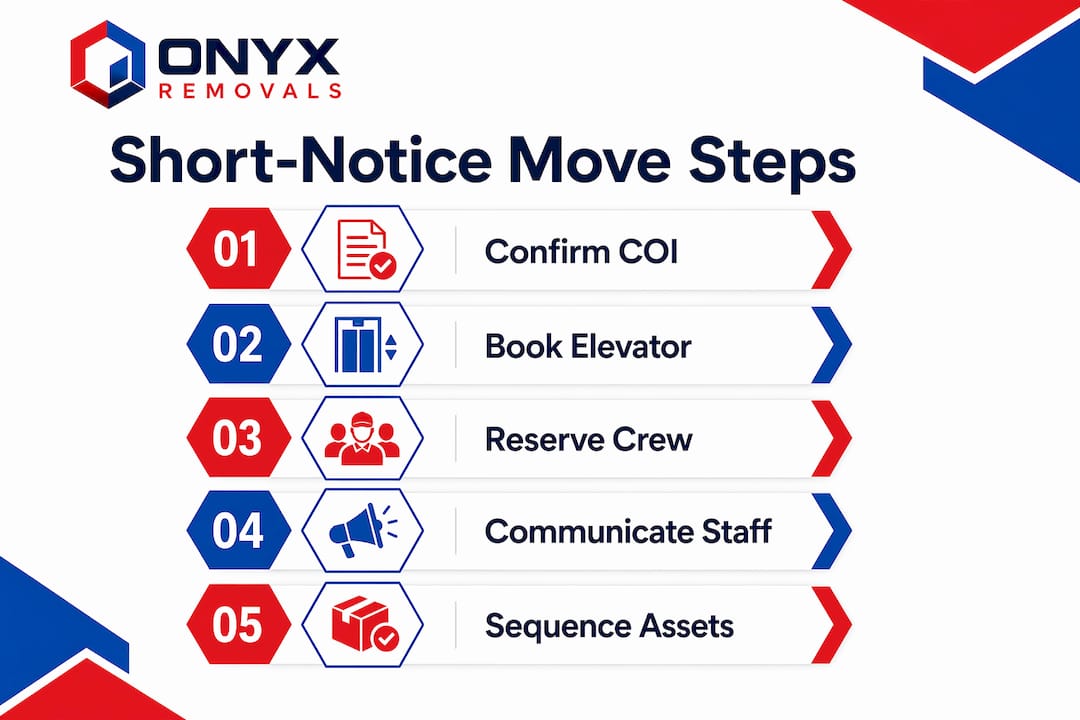
Not all moving companies offer same-day or next-day commercial services. Immediate booking is critical because crew and truck availability shrinks fast, particularly on weekends. Call your preferred provider the moment you know the move is happening. If they cannot confirm availability within the hour, contact a backup provider simultaneously.
Pro Tip: Keep a shortlist of two or three commercial removalists in your city before you ever need one. Vetting them under pressure costs you time you do not have.
Staff who do not know what is happening on move day create confusion that slows everything down. Send a clear briefing at least 24 hours before the move. Cover the move schedule, their role on the day, remote work arrangements during IT cutover, and who to contact with questions. A five-minute briefing email prevents hours of disruption.

| Document / Logistics Item | Why It Matters | When to Confirm |
|---|---|---|
| Certificate of Insurance (COI) | Required for freight elevator and dock access | 24–72 hours before move |
| Freight elevator booking | Controls physical access to both buildings | Day one of planning |
| Loading dock reservation | Prevents truck queuing and delays | Day one of planning |
| Staff communication brief | Reduces confusion and keeps work flowing | 24 hours before move |
| IT cutover plan | Protects core business operations | Before packing begins |
Prioritising IT and critical infrastructure first in the move sequence, while allowing staff to work remotely during cutover, keeps the business operational during an urgent relocation. The sequence you choose on move day determines how quickly you are back to full capacity.
A practical move-day order for most commercial offices looks like this:
IT equipment moves in urgent relocations use anti-static packaging and chain-of-custody documentation, with items labelled by room to speed the process. Clearing pathways at both sites before the crew arrives saves significant time under tight timelines.
Pro Tip: Pre-draw a workstation assignment map for the new office and share it with your moving crew the night before. A labelled floor plan cuts placement time by a third and eliminates the “where does this go?” delays that stack up fast.
For a structured approach to office move project management, including sequencing templates and timeline tools, Onyx Removals provides detailed guidance built around Melbourne’s specific building requirements.
After-hours and weekend moving windows are the most effective scheduling choice for urgent business relocation. A 25-employee firm may lose approximately $30,000 in revenue from downtime during business hours. An after-hours move incurs only a 10–17% premium in labour costs, roughly $3,000–$5,000, to protect that revenue. The maths are straightforward.
A Friday evening start targeting Monday morning operational status is the standard model for compressed commercial relocations. This gives the crew the full weekend without disrupting a single billable hour. After-hours move premiums of 10–17% in labour cost consistently prevent substantial lost billable hours and client impact.
| Move Timing | Pros | Cons |
|---|---|---|
| Business hours (weekday) | Lower labour rate | Disrupts operations, staff productivity lost |
| After-hours weekday | Moderate premium, less disruption | Crew fatigue risk on long days |
| Weekend (Friday night start) | Full weekend buffer, zero business hour impact | 10–17% labour premium |
| Phased move over multiple days | Reduces single-day risk | Extends disruption period |
Coordinated planning with building management, phased moving schedules, and after-hours windows are the proven methods for reducing disruption during urgent relocations. Clear furniture and equipment placement plans at the new site, combined with strict coordination around building rules, are what separate a smooth move from a chaotic one.
Common mistakes in rushed move scheduling include:
Pro Tip: Ask your building manager for the freight elevator booking confirmation in writing. Verbal agreements disappear when a conflict arises on move day.
The biggest causes of failure in compressed timeline moves are paperwork and building access issues, not the physical move itself. Late or mismatched insurance certificates block elevator access and stall the entire operation.
“Treat your COI requirements as a spec sheet. Every named party, every coverage limit, every additional insured must match exactly what the building manager has requested. One mismatch and the elevator stays locked.” — Commercial Relocation Playbook 2026, Muscleman Moving
Strict COI compliance means building property managers require exact matches in coverage and named parties to approve elevator and dock use. This administrative detail frequently stalls compressed timeline moves. Send the COI draft to the building manager for review before the moving company finalises it.
Other common challenges and how to address them:
Rapid scope definition and triage of core operational assets are the steps that maximise efficiency and minimise downtime in last-minute moves. Define what is critical, move it first, and verify it works before anything else.
For a detailed commercial relocation project management framework that covers escalation protocols and post-move checklists, the Onyx Removals resource library is worth bookmarking before you need it.
Short-notice commercial moving succeeds when paperwork, building access, and IT sequencing are locked in before the crew arrives, not after.
| Point | Details |
|---|---|
| COI is the gating document | Submit your Certificate of Insurance 24–72 hours early and verify every detail matches the building’s spec. |
| Book crew immediately | Crew and truck availability shrinks within hours; contact your removalist the moment the move is confirmed. |
| Sequence IT assets first | Move servers and networking equipment before furniture to restore operations at the new site faster. |
| After-hours moves protect revenue | A 10–17% labour premium prevents far larger losses from business-hour downtime. |
| Paperwork causes most failures | Building access issues and COI mismatches stall more moves than any physical or logistical challenge. |
I have seen businesses spend weeks agonising over which furniture to take and which to leave, then lose half a day on move day because nobody confirmed the freight elevator booking at the new building. The physical move is almost never the problem. The problem is always the 48 hours before the truck arrives.
The COI requirement catches people off guard every time. Most business owners assume their moving company handles it automatically. They do, but only if you tell them the exact specifications the building manager requires. I have watched a move stall for three hours because the COI listed the moving company’s trading name instead of its registered legal entity name. The building manager would not budge. Three hours of crew standing in a loading bay at overtime rates.
The other thing most guides do not tell you: your IT team’s definition of “ready to move” and your moving crew’s definition are completely different. Your IT team means the data is backed up. Your crew means the cables are unplugged and the equipment is boxed. Get both teams in the same conversation before move day, not during it.
Staff morale during a rushed move is also underrated. People feel unsettled when they do not know what is happening. A two-paragraph email the night before, telling them where to go, what to bring, and who to call if something goes wrong, does more for productivity in the first week at the new site than any amount of new furniture.
If you are choosing a moving company under time pressure, ask one question: “Have you completed a move in this building before?” A crew that knows the freight elevator schedule, the dock layout, and the building manager’s preferences is worth more than a cheaper crew learning it all on the day.
— Dinshaw
When your business needs to move fast, the last thing you need is a removalist learning on the job.
Onyx Removals specialises in commercial removals across Melbourne, including after-hours and weekend moves designed to protect your operating hours. The team coordinates directly with building managers on COI requirements, freight elevator bookings, and dock scheduling so you are not managing three conversations at once. Whether you are relocating a five-person office or a multi-floor operation, Onyx Removals builds a move plan around your timeline, not a standard one. Contact the team today to confirm availability and get a tailored quote for your urgent relocation.
Short-notice commercial moving, also called emergency commercial relocation, is the rapid relocation of business premises within 24–72 hours using specialised planning and crew scheduling. The goal is to restore full operations at the new site with minimal downtime.
Submit your Certificate of Insurance at least 24–72 hours before the move date, as Class A commercial buildings commonly require this lead time to activate freight elevator access. Verify every detail matches the building manager’s exact specifications before submitting.
Yes. An after-hours move premium of 10–17% in labour costs is consistently lower than the revenue lost from disrupting a full business day. A Friday evening start targeting Monday morning operational status is the standard model for urgent relocations.
IT infrastructure, including servers, networking equipment, and critical systems, should be moved first. This allows the IT team to begin setup at the new site while furniture is still being transported, reducing total downtime significantly.
Contact commercial removalists immediately and confirm crew and truck availability within the hour. Not all providers offer same-day or next-day services, so having a shortlist of two or three vetted commercial moving services before an emergency arises is the most reliable approach.

No Related Post


