



TL;DR:
- Senior relocation focuses on the emotional well-being and comfort of older adults rather than just transporting belongings. It involves sorting possessions, coordinating services, and creating familiar environments to support a smooth transition. Proper planning, emotional support, and professional assistance ensure a dignified and stress-free move for seniors.
Senior relocation is a specialised process that prioritises the care, comfort, and emotional well-being of older adults over the speed and efficiency that standard moving services typically focus on. Unlike a typical residential move, relocating a senior involves sorting decades of possessions, managing the emotional weight of leaving a longtime home, and coordinating services that extend well beyond loading a truck. Senior moves require patience, empathy, and a plan built around the person, not just the property. Whether you are planning your own move or helping a parent transition to more suitable housing, understanding what specialised senior moving services actually involve will save you time, money, and significant stress.
Senior relocation, known in the industry as senior move management, covers a far broader scope than transport and packing. It addresses the full transition: sorting belongings, making decisions about what to keep or donate, coordinating estate sales, packing fragile or sentimental items with care, and setting up the new home so it feels familiar from day one. NASMM certification (the National Association of Senior and Geriatric Care Managers) is the recognised professional standard for Senior Move Managers, signalling adherence to ethics and specialised training in this field.

The distinction between a Senior Move Manager and a standard removalist matters. A standard removalist focuses on volume and speed. A Senior Move Manager acts as a project manager across the entire transition, including emotional support, donation coordination, and new home setup. 51% of Baby Boomers have already downsized or plan to, and 70% of people aged 65 and over will need some form of long-term care. Those numbers reflect a generation actively navigating this transition, which means demand for genuinely specialised services is growing fast.
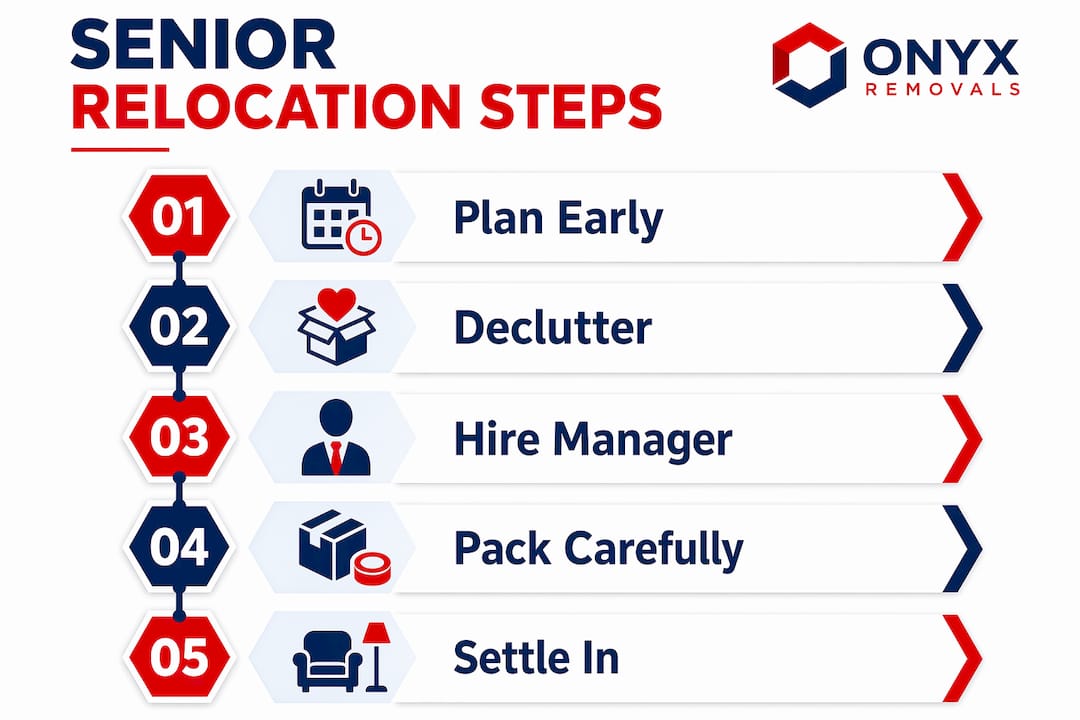
Industry standards recommend a lead time of 4 to 8 weeks for most senior relocations, with more complex moves requiring additional time. Rushing this process is one of the most common mistakes families make. A longer runway allows for thoughtful decision-making about possessions, reduces physical and emotional fatigue, and gives everyone involved time to adjust to the idea of the change.
A practical planning timeline looks like this:
Pro Tip: Create a simple floor plan of the new home before moving day and share it with your removalist team. This eliminates guesswork on the day and means furniture lands in the right place the first time.
For families coordinating a move for a parent, the elderly parents moving guide from Onyx Removals covers the specific logistics and communication strategies that make this process smoother.
Professional long-distance senior moves typically cost between $6,000 and $10,000, depending on home size, distance, and the level of service required. That range reflects full-service moves where packing, decluttering, transport, and new home setup are all included. Local moves within Melbourne will generally sit at the lower end of that scale.
| Service type | Typical cost range | What is included |
|---|---|---|
| Standard removalist (local) | $500 to $1,500 | Transport and basic loading only |
| Full-service senior move (local) | $2,000 to $5,000 | Packing, transport, and unpacking |
| Full-service senior move (long-distance) | $6,000 to $10,000 | Full transition including sorting and setup |
| Senior Move Manager (coordination only) | $500 to $2,000 | Planning, coordination, and emotional support |
The biggest cost drivers are home size, the volume of items requiring sorting or disposal, and whether you need a Senior Move Manager in addition to a removalist. Some companies, including Allied Van Lines and JK Moving Services, offer discount programmes for clients aged 55 and older. Always ask about senior pricing before accepting a quote.
Pro Tip: Be cautious of quotes that seem unusually low. A reputable senior moving company will provide a written, itemised quote and hold current licences. Ask to see both before committing.
The range of professional support available for seniors relocating is broader than most people realise. Knowing your options helps you build a plan that fits both your needs and your budget.
Pro Tip: If budget is tight, consider hiring a Senior Move Manager for the planning and sorting phase only, then use a standard removalist for the physical move. You get the expertise where it counts most without paying for full-service coordination.
The emotional complexity of leaving a home where you have lived for decades is real and should not be minimised. Successful transitions emphasise dignity, pacing, and emotional well-being as much as logistics. Treating the move purely as a practical exercise is one of the most common reasons seniors resist or struggle after the transition.
Several approaches make a genuine difference:
The stress-free relocation guide from Onyx Removals covers these emotional strategies in more detail, with specific advice for families supporting a senior through the transition.
Downsizing for seniors works best when it is treated as a series of small, manageable decisions rather than a single overwhelming task. The goal is to reduce possessions thoughtfully, not quickly.
Professional decluttering services can assist with the physical sorting if the volume of possessions feels unmanageable. Many Senior Move Managers include decluttering as part of their coordination service.
Senior relocation succeeds when it prioritises the senior’s dignity, emotional well-being, and sense of control at every stage, from the first sort to the final unpack.
| Point | Details |
|---|---|
| Start planning early | Allow 4 to 8 weeks minimum; complex moves need more time to avoid rushed decisions. |
| Budget realistically | Full-service senior moves cost $6,000 to $10,000; local moves are significantly less. |
| Use the right professional | Senior Move Managers coordinate the full transition; standard removalists handle transport only. |
| Prioritise emotional support | Involve the senior in decisions and recreate familiar spaces to ease adjustment. |
| Downsize room by room | Use four clear categories and avoid rushing the final week to prevent regret. |
There is a pattern I have noticed across many senior relocations. The moves that go well are almost never the fastest ones. They are the ones where someone took the time to sit with the senior, look at each item, and ask what it meant. That conversation is not a delay. It is the work.
The industry tends to frame senior relocation as a logistics problem with some emotional complexity layered on top. I think that framing is backwards. The emotional complexity is the primary challenge. The logistics are manageable once the person feels heard and in control. Families who treat the move as a project to be completed efficiently often create resistance that slows everything down anyway.
What actually works is pacing. A Senior Move Manager who spends three sessions sorting before a single box is packed will produce a smoother move than a team that arrives and packs everything in a day. The NASMM certification standard exists precisely because this work requires training in communication and emotional support, not just physical coordination.
The other thing I would say plainly: do not underestimate the first week in the new home. Getting the bedroom and bathroom right before anything else is not just a comfort tip. It is the difference between a senior who wakes up disoriented and one who wakes up and recognises where they are. That recognition matters more than any amount of efficient unpacking.
— Dinshaw

Onyx Removals provides tailored senior moving services across Melbourne, built around the specific needs of older adults and their families. The team handles packing, transport, downsizing support, and new home setup with the care and patience that senior moves require. Every plan is personalised, with no pressure to move faster than the senior is comfortable with. For a broader look at what a full-service Melbourne move includes, the Melbourne moving services page covers the complete range of options available. Contact Onyx Removals for an obligation-free quote tailored to your situation.
A Senior Move Manager is a trained professional who coordinates the full relocation process for older adults, including sorting, decluttering, donation coordination, packing, and new home setup. NASMM certification is the recognised standard of professional practice in this field.
Most senior relocations require 4 to 8 weeks of lead time, with more complex moves needing longer. Starting early reduces stress, allows for thoughtful downsizing decisions, and prevents last-minute rushed choices.
Full-service, long-distance senior moves typically cost between $6,000 and $10,000. Local moves within Melbourne are generally less expensive, and partial services can reduce costs further for those on a tighter budget.
Non-profit organisations like H.O.M.E. (Housing Opportunities and Maintenance for the Elderly) offer moving assistance on sliding-scale fees. Some commercial moving companies also offer discount programmes for clients aged 55 and older.
Experts recommend prioritising the bedroom and bathroom in the first week after moving. Familiar surroundings in these two rooms help seniors orient themselves quickly and reduce the disorientation that often accompanies a major move.

No Related Post


