



A corporate relocation agent coordinates destination services, move logistics and settling-in support so HR can minimise downtime and protect employee wellbeing. Hiring one makes sense for executive transfers, interstate moves, international assignments or any relocation where getting it wrong costs you a valuable hire. The next step is simple: scope the move properly, put the terms in writing, and brief an agent before you make promises to the employee.
TL;DR:
- Relocation agents are essential for executive, interstate, or international moves where local knowledge, visa complexity, or tight schedules increase risks and costs.
- They handle destination services, move logistics, and settling-in support, with additional options like family assistance, pet transit, and immigration liaison.
- Starting the process early, especially for senior or international roles, and funding familiarisation visits significantly reduces relocation failure risks.
- Clear documentation, contractual privacy safeguards, and detailed quotes help prevent scope misunderstandings and hidden costs.
- Choosing an experienced, destination-aware, and well-referenced agent ensures smoother transitions, minimizes downtime, and improves employee retention after relocation.
A relocation specialist company handles three distinct jobs that most HR teams don’t have the bandwidth or local knowledge to run in-house. Confusing these three, or assuming one supplier covers all of them, is where most relocation budgets blow out.
Destination services cover home search, neighbourhood briefings, school enquiries and short-term housing while the employee finds a permanent place. A good agent knows commute times, rental markets and school catchments in the destination city, not just how to book a truck.
Move logistics is the physical side: packing, transport, storage, inventory tracking and claims handling if something gets damaged in transit. This is where a corporate moving company’s operational experience actually shows, particularly on interstate or group moves with tight timeframes.
Settling-in services get the employee functioning in their new city: bank account setup, utility connections, Medicare and licence transfers, local orientation and introductions to community groups. This is often the most underfunded part of a relocation package, yet it’s what determines whether an employee actually stays.
Beyond these three pillars, many relocation management companies offer add-ons that matter more than they sound:
Guidance from the Mental Health Commission recommends bundling practical settling-in help, like school and bank account setup, with a documented relocation handbook, because employees who get structured support settle faster and stay longer.
Not every move needs an external agent. A junior employee relocating within the same city can usually manage with a stipend and a list of removalists. The calculation changes once you’re dealing with any of the following:
Timing matters as much as the decision itself. For senior and executive roles, bring an agent in at offer stage, before the employee has mentally committed to timelines you can’t deliver. For international moves, start early in the acceptance process, since visa processing and destination housing searches often take longer than the notice period allows.
Funding a paid familiarisation visit before the move, so the employee and their family can see the city, look at housing options and meet the team, is one of the more effective ways to reduce relocation failure, according to guidance from Mentally Healthy Workplaces. It’s a modest cost against the price of a senior hire backing out three months in.
Corporate relocation companies typically sell one of a few standard bundles, and knowing the shape of these before you request quotes stops you comparing apples to oranges.
Fee models vary. Some relocation managers quote a flat package price per employee; others charge per person with add-ons itemised separately; some bill hourly for coordination time on top of fixed moving costs. None of these is inherently better, but you need to know which one you’re being quoted before you can compare two suppliers fairly.
When requesting a quote, ask for the scope in writing: what’s included, what’s excluded, the timeline for each phase, insurance coverage for goods in transit, and any service-level agreement on response times. Public-sector employers such as Queensland Health publish examples of what’s commonly reimbursed, including transport of belongings, temporary accommodation and registration costs, which is a useful benchmark when negotiating your own package.
Pro Tip: Ask every shortlisted agent for a sample itemised quote from a comparable past move, not just a generic rate card. It’s the fastest way to spot what a cheaper quote is quietly leaving out.
Selecting the wrong agent doesn’t just waste money, it can damage an employee’s confidence in the whole relocation before they’ve even started the new role. Run every shortlisted supplier through the same checklist:
Privacy is the part HR most often skips. Sharing an employee’s personal details, address history, family information, sometimes financial data, with a relocation agent is a disclosure under the Australian Privacy Principles, and a standard service agreement often doesn’t cover it adequately. Insist on a contractual clause that binds the agent’s subcontractors to the same data-handling standards, not just the agent itself.
Check insurance and liability terms carefully: public liability, professional indemnity, and what happens if goods are damaged or a subcontracted mover is at fault. If an employee later refuses a relocation, Fair Work guidance notes that reasonableness depends heavily on what was documented in the offer, so a clear written scope protects both the employee and the business.
Ask directly in the interview: “What happens if the employee’s start date slips by three weeks?” and “Who is the single point of contact if something goes wrong on move day?” A supplier who can’t answer both plainly is a red flag regardless of price.
Onyx Removals runs the operational side of corporate relocations across Melbourne, and it’s built around the categories HR actually needs when briefing a move:
For proof of how this works in practice, HR teams can review the office relocation project plan to see how timelines are structured, or look at how relocations are handled to minimise operational downtime during a business move. These pages are worth checking before a briefing call, since they show sample timelines and scope rather than marketing claims alone.
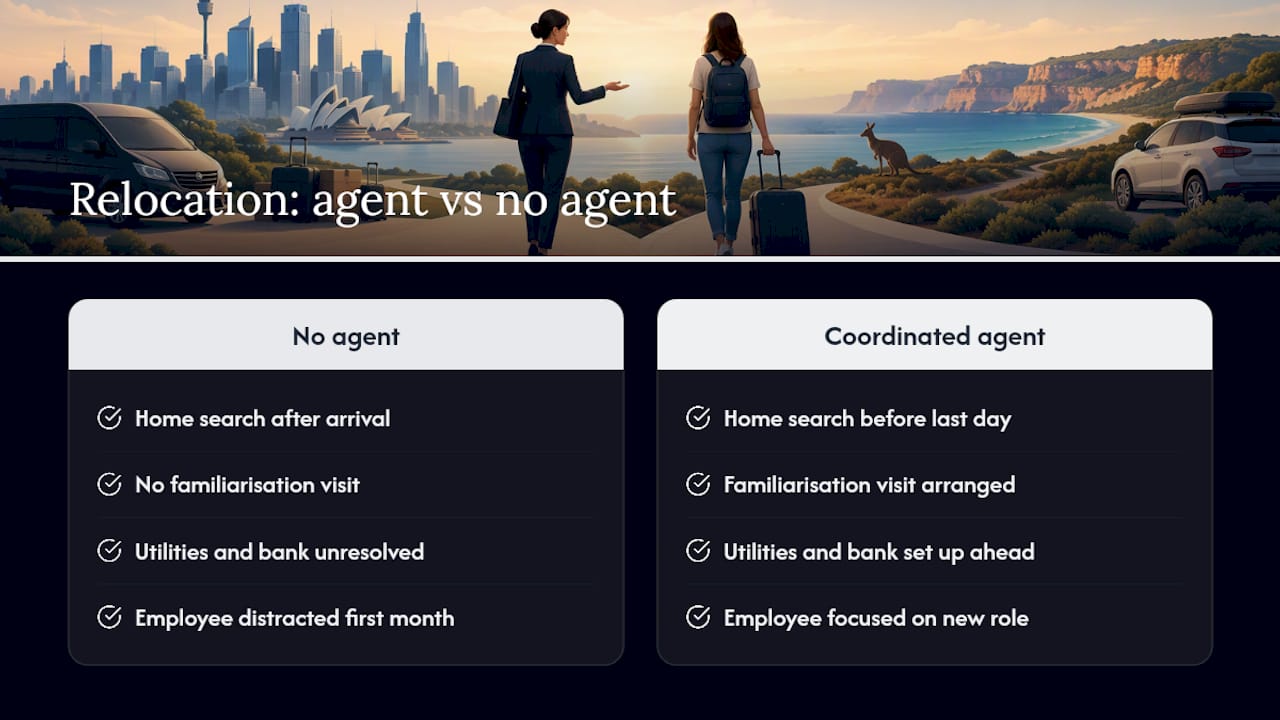
The clearest way to see an agent’s value is to compare two versions of the same move. A finance manager relocated from Sydney to Melbourne without destination support typically spends their first fortnight on the job distracted: chasing a rental application, sorting a bank account, finding a school for their kids, while trying to onboard into a new role. Productivity in that first month suffers, and it’s the employee, not the business, who absorbs most of that stress.
Run the same move with a coordinated agent and the shape changes. The home search starts before the employee’s last day at the old job. A familiarisation visit lets the family choose a school and suburb in advance. Utilities and bank accounts are set up ahead of the moving truck arriving. The employee starts their new role focused on the job, not on logistics.
This is not a hypothetical difference. Guidance from the Mental Health Commission links structured organisational support, documented terms, familiarisation visits, settling-in help, directly to lower attrition risk after a relocation. For a senior hire, that’s the difference between a relocation that pays off and one that quietly costs the business a second recruitment round eighteen months later.
Group relocations show the same pattern at scale. When an office consolidation moves a dozen staff simultaneously, the businesses that plan settling-in support for each household individually see far fewer people quietly job-hunting six months after the move than those that treat it as a single logistics exercise.
Most relocation failures trace back to a handful of avoidable mistakes, and they repeat across industries.
Underestimating settling-in needs. Businesses will happily fund a removalist and a flight, then leave the employee to sort bank accounts, school enrolments and utility connections alone in a city they don’t know. This is usually the cheapest part of the budget to fix and the most damaging to skip.
Vague scopes and verbal promises. When the relocation offer isn’t documented, HR and the employee often remember different terms. Fair Work’s guidance on workplace relocation makes clear that disputes usually come down to what was actually agreed and recorded, not what was intended.
No familiarisation visit before committing. Sending an employee’s family sight-unseen into a new city, particularly for interstate or international moves, materially raises the odds they’ll want to reverse the decision within the first year.
Treating storage and end-of-lease tasks as an afterthought. Bridging storage and bond cleaning at the old address get forgotten until the last week, creating unnecessary stress right when the employee needs to focus on starting the new role.

Ignoring data-handling obligations. Passing employee personal information to a relocation agent without contractual privacy safeguards exposes the business to compliance risk that’s entirely preventable with the right clause in the service agreement.
None of these mistakes are exotic. They’re the result of treating relocation as a logistics task instead of a change-management exercise with a person and a family at the centre of it.
Scope clarity comes before anything else. If the relocation terms aren’t documented before the employee accepts, you’re negotiating after the fact, and that rarely goes well for anyone. Employee wellbeing should sit alongside logistics, not after it. Fund a familiarisation visit wherever the budget allows, and choose partners willing to accept contractual data handling obligations rather than treating privacy as an afterthought.
— Dinshaw
Onyx Removals provides coordinated packing, transport, storage, and cleaning services for corporate relocations. That matters most on tight timelines, when a missed handover between a packer and a mover can cost a new hire their first week of productivity.
If you’re preparing to request quotes, have the basics ready before you call: number of employees moving, origin and destination locations, target dates, and whether you need storage or cleaning bundled in. That’s enough for Onyx to scope a tailored plan rather than a generic estimate. Browse the full service catalogue to see what’s covered, check current pricing for packing and cleaning, and request a project plan for your next corporate move.
A corporate relocation typically starts with a written offer specifying relocation support, followed by an agent coordinating destination services, the physical move and settling-in tasks. HR usually briefs the agent on timelines and scope before the employee’s start date, and a documented relocation handbook helps set expectations for everyone involved.
A relocation agent is a specialist who manages the logistics, destination research and settling-in support around an employee’s move, rather than just the physical transport of goods. They coordinate between removalists, real estate agents, schools and utility providers so HR doesn’t have to manage each supplier directly.
There’s no single official ranking of top relocation companies, since needs vary by move type, destination and budget. For the physical move, storage and cleaning side of a Melbourne corporate relocation, Onyx Removals’ commercial move services cover packing, transport and end-of-lease cleaning under one booking.
It depends on the employer and role. Some employers reimburse costs like transport of belongings, temporary accommodation and registration fees, as outlined in Queensland Health’s relocation support guidance, while private employers set their own eligibility rules in the employment contract.
Generally no. A same-city move usually doesn’t need a specialist relocation agent, but a corporate moving company still helps with packing, transport and storage for office or executive moves where downtime matters. Reserve full relocation agent services for interstate, international or executive relocations where destination knowledge and settling-in support genuinely add value.

No Related Post


