



TL;DR:
- Australian Consumer Law makes retailers responsible for furniture arriving safe and on time.
- Preparing your home and thoroughly inspecting items before signing helps prevent disputes and damage claims.
Furniture store delivery services are the organised processes by which retailers manage the transport, handling, and placement of your purchased furniture from their warehouse to your home. Understanding how furniture store delivery services work protects you legally and practically. Under Australian Consumer Law (ACL), the retailer, not the courier, is responsible for your furniture arriving safely and on time. Knowing your rights and the delivery process before you buy saves you from costly surprises, failed delivery attempts, and disputes that drag on for weeks.
Furniture stores typically offer three tiers of delivery service, and the differences between them are significant.

Curbside delivery is the most basic option. The driver drops your furniture at the kerb or building entrance. You are responsible for carrying it inside, assembling it, and disposing of the packaging. This tier suits small, lightweight pieces but creates real risk for heavy or fragile items.
Inside delivery takes the furniture to your nominated room. The team carries it through doorways, up stairs, and into position. Most mid-range furniture retailers offer this as a standard or paid upgrade.
White-glove delivery is the premium tier. Specialised two-person delivery teams handle in-home placement, assembly, and packaging removal for high-end or heavy furniture. This level of service reduces damage risk and is worth the extra cost for large sofas, dining tables, or bedroom suites.
Key factors that affect delivery fees include:
Pro Tip: Watch out for flat-rate shipping on large or varied items. Flat-rate shipping often signals the retailer has not accounted for item-specific handling needs, which raises the risk of careless transit and damage.
Delivery options also vary by product type. A flat-pack bookcase travels differently from a solid timber dining table. Always confirm exactly what your chosen delivery tier includes before you pay.
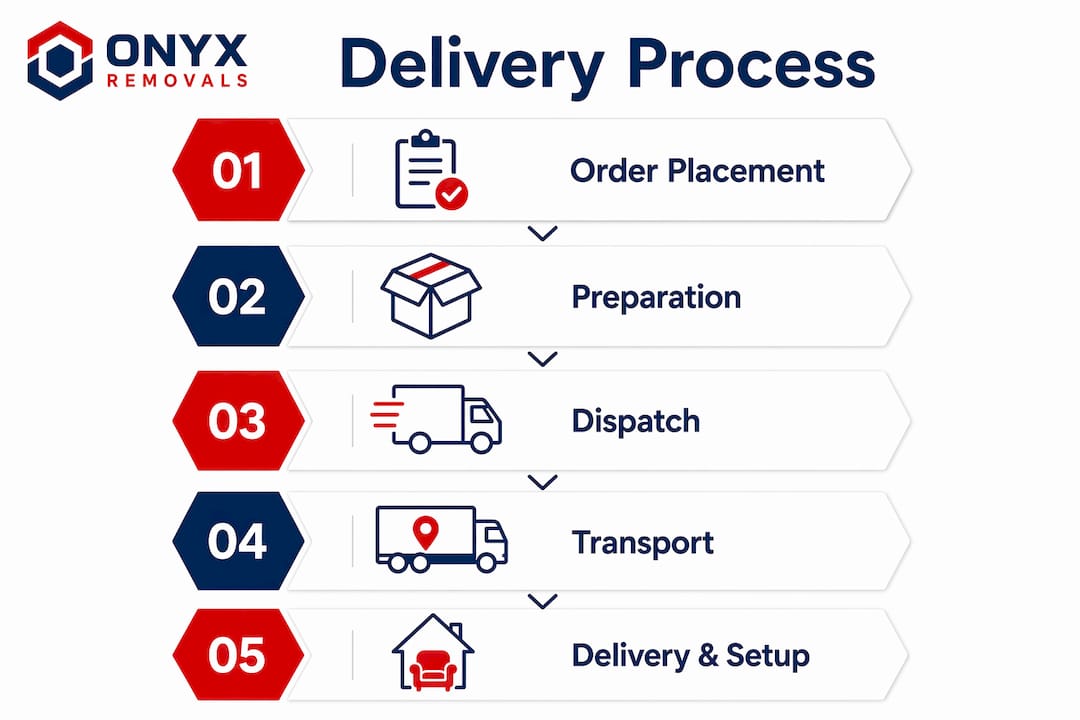
The furniture delivery process follows a clear sequence. Knowing each step helps you prepare and avoid delays.
Order confirmation. After purchase, the retailer sends a confirmation with your order details and an estimated delivery window. Read this carefully and check that the delivery address and contact number are correct.
Scheduling your delivery. Most retailers offer a booking system where you select a date and time window. Narrow windows, such as a two-hour slot, are more convenient but may cost extra. Under the Competition and Consumer Act 2010, retailers cannot accept payment if they cannot supply goods within a promised or reasonable time, and they must inform you of any delays.
Pre-delivery access checks. Before delivery day, measure every access point your furniture must pass through. Check lift dimensions, hallway widths, stairwell clearances, and door frames. Unmeasured access constraints are a leading cause of failed delivery attempts, and you may be charged for a second attempt.
Tracking and communication. Professional retailers provide real-time tracking and proactive updates. Transparent communication and detailed tracking reduce uncertainty and give you confidence that your delivery is on schedule.
Delivery day. The team arrives, unloads the furniture, and carries it to your nominated room. Watch the process. Do not leave the team unsupervised with fragile or high-value pieces.
Inspection and sign-off. Before you sign anything, inspect every item thoroughly. Check surfaces, seams, corners, and moving parts. Signing the delivery docket confirms you accept the furniture in its current condition.
Pro Tip: Ask the delivery team to leave packaging in place until you have completed your inspection. Removing packaging before checking for damage makes it harder to photograph and claim later.
Preparation is as important as professional handling. Most delivery issues stem from poor planning rather than transport alone.
Clearing walkways and reserving parking before the team arrives reduces damage risk and speeds up the entire process. A delivery team that cannot park close to your entrance or navigate a cluttered hallway will struggle, and that is when accidents happen.
Practical steps to prepare your home:
Being present for the entire delivery is non-negotiable. You cannot inspect furniture you did not watch being placed. If you need to disassemble existing furniture to make room, do it the day before so the space is clear and ready.
Communicate clearly and calmly with the delivery team. A calm, clear, and firm approach fosters respect and leads to smoother outcomes. Tell them exactly where each piece goes before they lift it. Repositioning a heavy sofa after placement wastes time and risks floor damage.
Your rights under Australian Consumer Law are clear and non-negotiable. The retailer, not the courier, holds the primary contractual obligation for your delivery.
ACL guarantees apply regardless of sale tags, store disclaimers, or “as-is” notices. If your furniture arrives damaged, late, or not at all, you are entitled to a full refund, replacement, or compensation. The retailer cannot redirect you to the courier to resolve the issue.
The risk for your furniture remains with the retailer until delivery is complete and accepted. Until delivery is accepted, the retailer is liable even if the item is lost or damaged in transit. This is why signing the delivery docket matters so much.
Follow these steps if your furniture arrives damaged:
“Consumers should deal directly with retailers, not couriers, for issues with delivery or non-arrival. The retailer holds the primary contractual obligation under ACL, which streamlines resolution and avoids futile courier disputes.”
ACL consumer rights, fairgo
ACL distinguishes between major and minor failures. A major failure, such as furniture that is structurally broken or completely different from what you ordered, entitles you to a full refund or replacement. A minor failure, such as a small scratch, entitles you to a repair or partial remedy. Do not accept a store credit when the law entitles you to more.
A common mistake is inspecting furniture immediately only visually. Touch surfaces, test seams, check for chips, and confirm that drawers and doors move correctly. Concealed damage discovered after sign-off is harder to claim.
Furniture store delivery services work best when buyers understand their rights, prepare their home thoroughly, and inspect every item before signing off.
| Point | Details |
|---|---|
| Retailer is responsible | Under ACL, the retailer, not the courier, is liable for damaged or late furniture. |
| Choose the right delivery tier | White-glove delivery reduces damage risk for heavy or high-value furniture. |
| Measure before delivery day | Check all doorways, lifts, and hallways to avoid failed delivery attempts and extra charges. |
| Inspect before you sign | Document all damage with timestamped photos and note it on the docket before signing. |
| Escalate to fair trading if needed | If the retailer refuses a valid claim, contact your state’s fair trading office or tribunal. |
After years working in the removals and relocation industry in Melbourne, I have seen the same mistakes repeated constantly. Families spend thousands on a new dining suite or bedroom set, then lose that investment to a damaged delivery they accepted without proper inspection.
The single biggest mistake is signing the delivery docket under pressure. Delivery teams are often on tight schedules, and some will push you to sign quickly. Do not. You have every right to take the time you need to inspect each piece properly. A signature is your acceptance of the furniture’s condition, and it significantly weakens your ACL claim if damage surfaces later.
I also think most buyers underestimate the value of white-glove delivery for anything heavy or high-end. The cost difference between standard inside delivery and a specialist two-person team is often minor compared to the cost of repairing or replacing a damaged piece. For a solid timber table or a large sectional sofa, the upgrade pays for itself.
The other thing I have seen consistently is that preparation makes or breaks a delivery. Buyers who measure their access points, clear their walkways, and communicate placement preferences clearly almost always have smooth deliveries. Those who leave it to chance almost always do not.
— Dinshaw
Arranging furniture delivery gets complicated fast, especially when you are also managing a move, a renovation, or a tight timeline.
Onyx Removals provides professional residential removal services across Melbourne, including expert transport, placement, and handling of large and high-value furniture. The team manages access challenges, protects your floors and walls, and places every piece exactly where you want it. For buyers who need more than a standard store delivery, Onyx Removals also offers packing and unpacking services, disassembly, and storage solutions to cover every stage of your furniture arrival. Get in touch for a clear quote with no hidden fees.
The retailer is responsible under Australian Consumer Law, not the courier. You are entitled to a refund, replacement, or compensation regardless of any store disclaimers.
White-glove delivery is a premium service where a specialist team carries your furniture inside, places it in your nominated room, assembles it, and removes all packaging.
Measure all doorways, hallways, stairwells, and lift openings. Clear a direct path from your entrance to the placement room and reserve kerbside parking if possible.
Yes. You can note the damage on the docket before signing or refuse to sign entirely if the damage is significant. Contact the retailer in writing the same day with timestamped photos.
Contact your state’s fair trading office or consumer tribunal if the retailer refuses your claim. ACL protections apply regardless of the retailer’s internal policies.

No Related Post


