



TL;DR:
- A commercial relocation brief is a detailed written document that aligns all stakeholders and reduces costs during an office move. It covers goals, requirements, budget, access rules, and site specifics, ensuring accurate quotes and smoother approvals. Investing time upfront in thorough briefing prevents scope conflicts, delays, and unexpected expenses.
A commercial relocation brief is a written planning document that serves as the single source of truth for every stakeholder involved in an office move. It captures your organisation’s goals, functional requirements, budget, site access rules, and technical needs in one place. Without it, contractors, IT teams, and removalists each operate on different assumptions, and those gaps cost money. This guide explains what the document contains, why it matters, and how to write one that keeps your Melbourne office move on track.

A commercial relocation brief is a formal, written document that defines every requirement for an office move before a single box is packed or a contract is signed. Industry guidance places standard briefs at 10–20 pages for major projects. That length reflects genuine complexity, not padding. A well-structured brief covers six core content areas.
Pro Tip: Attach floor plans, photographs of the new premises, and a site measurement summary as appendices. Contractors who can see the space before quoting produce far more accurate proposals.
A detailed brief reduces the risk of misaligned assumptions among every party involved in the relocation. Office relocation involves multiple staged activities, including pre-move planning, design, approvals, packing, transportation, setup, and post-move support. Each stage involves different specialists, and each specialist needs the same baseline information to do their job without creating conflicts downstream.
“Investing time in detailed briefing upfront reduces project iterations, accelerates approvals, and significantly decreases onsite surprises. Written documentation is the number one way to receive accurate, comparable quotes.”
Office Relocation Costs, Quotes & Hiring Guide
Accurate quotes depend on a consistent scope. Office relocation costs range from $220 to $4,200 per move depending on scope, access, urgency, and finishes. That wide range shows how much assumptions drive pricing. A removalist quoting on vague verbal instructions will build in risk margins. A removalist quoting against a detailed brief will price the actual job. The difference can be significant.
A brief also speeds up landlord and building approvals. Building managers require written confirmation of access times, lift usage, and contractor insurance before granting permission. Providing a brief excerpt tailored to their requirements removes weeks of back-and-forth. Faster approvals mean a shorter gap between lease end and operational readiness at the new site.
The brief also protects against scope creep. When every contractor receives the same document, there is no room for one party to expand their scope at another’s expense. Sharing the same brief with movers, IT teams, cleaners, and fit-out specialists keeps everyone working to the same boundaries. You can read more about managing the broader challenges of business relocation in Australia to understand how a brief fits into the larger picture.
Most problems with commercial relocation briefs fall into a predictable set of errors. Recognising them before you start drafting saves time and money.
Pro Tip: Ask each contractor to confirm in writing that they have read the brief and that their quote is based solely on its contents. This single step eliminates most scope disputes before they start.
Writing a brief that actually works requires a structured approach. The goal is a document that any contractor can pick up and quote from without needing a phone call to clarify the basics.
A real-world example from the retail sector illustrates the value of this approach. When BANZ USA relocated to a larger warehouse and office, coordinating logistics across multiple service providers required clear written documentation of requirements and timelines. The same principle applies to any commercial move, regardless of industry.
| Brief element | Outcome-focused example | Prescriptive example to avoid |
|---|---|---|
| Meeting rooms | “Four rooms supporting video calls for up to 8 people” | “Four rooms with 65-inch screens and Logitech Rally cameras” |
| Workstations | “Desks supporting dual monitors with sit-stand capability” | “Sit-stand desks, model X, 1,500mm wide” |
| IT infrastructure | “Server room with N+1 power redundancy and 24-hour cooling” | “Two APC UPS units and a Daikin split system” |
| Storage | “Secure document storage accessible to finance team only” | “Four-drawer filing cabinets with key locks in room 3B” |
A clear, itemised brief is the most effective tool for comparing vendor quotes on a consistent basis. Consistent briefs allow businesses to compare quotes effectively and avoid costly surprises. When every removalist, IT contractor, and fit-out team quotes against the same scope, you can compare line items directly rather than trying to reconcile different assumptions.
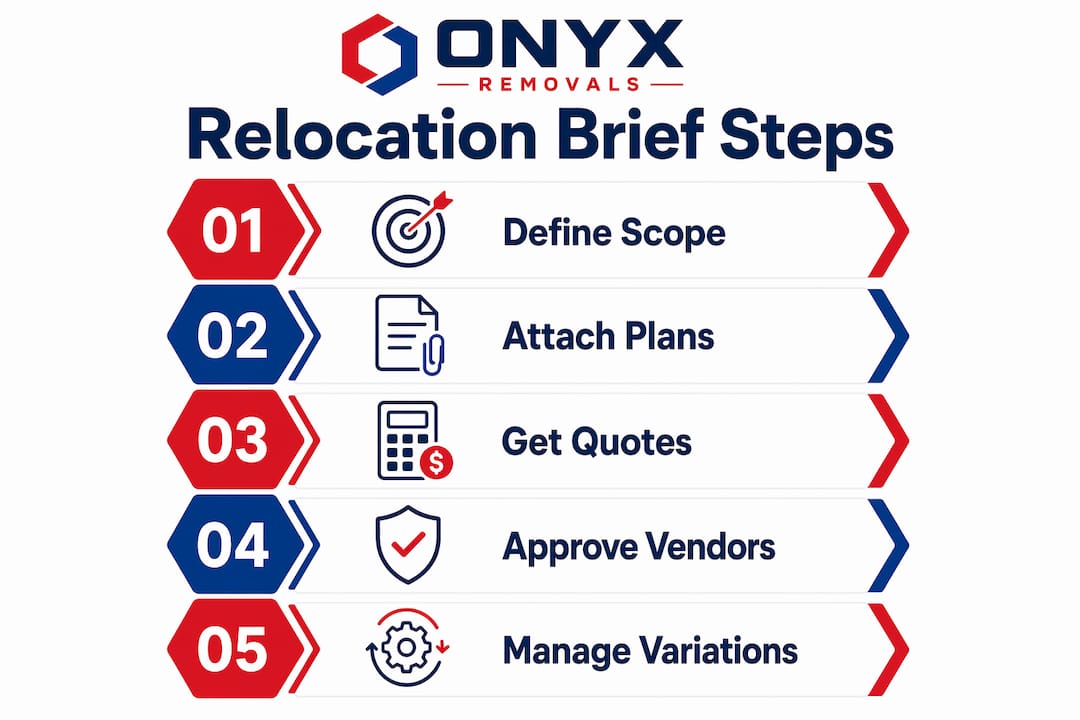
The brief also gives you a basis for questioning proposals. If one vendor’s quote is significantly lower than others, you can identify exactly which line items they have excluded or underpriced. Without a brief, that analysis is impossible. You are comparing documents built on different foundations.
Contingency planning becomes concrete when the brief is specific. IT cutovers, building make-good requirements, and access surcharges are all foreseeable costs that a detailed brief forces you to acknowledge upfront. Proper office move budget planning starts with the brief, not the quotes. The brief defines the scope; the quotes price it.
Variation pricing is another area where a strong brief pays off. When a contractor requests a variation, the brief is the reference point. If the variation falls within the documented scope, it should not attract additional cost. If it falls outside the scope, you have a clear record of why it was not included. That clarity protects your budget at every stage of the project.
A commercial relocation brief is the single document that aligns every contractor, controls costs, and prevents the miscommunications that derail office moves before they begin.
| Point | Details |
|---|---|
| Define scope in writing | A brief of 10–20 pages documents goals, requirements, budget, and access rules before any contractor is engaged. |
| Include a budget contingency | Allow 10–20% above your base budget to cover hidden costs such as utility cutovers and make-good obligations. |
| Use outcome-focused language | Describe what the space must achieve, not how to build it, to invite better and more cost-effective proposals. |
| Distribute uniformly | Send the same brief to all contractors simultaneously to prevent scope conflicts and inconsistent assumptions. |
| Brief early, brief thoroughly | Investing time in detailed briefing upfront reduces revisions, accelerates approvals, and cuts onsite surprises. |
I have seen office moves go sideways in ways that were entirely predictable, and almost every time, the root cause was the same: no written brief, or a brief so vague it was functionally useless. Business owners often treat the brief as an administrative hurdle before the “real” work begins. That framing is backwards. The brief is the project. Everything else, the quotes, the approvals, the move day itself, is just execution.
The gap I see most often is technical omissions. Office managers document workstations and meeting rooms but forget to specify server room requirements, existing AV configurations, or building-specific compliance obligations. Those gaps do not stay invisible for long. They surface as variations at the worst possible moment, usually when the lease clock is already ticking.
My strongest advice is to treat the brief as a living document during its development. Share early drafts with your IT manager, your building manager, and at least one experienced removalist before you finalise it. Their feedback will surface requirements you have not considered. A brief that has been stress-tested by the people who will execute against it is worth ten times a brief written in isolation.
The businesses that move well are the ones that invest two or three weeks in serious briefing before they engage a single contractor. That upfront effort compresses the entire project timeline because approvals move faster, quotes are accurate, and there are no surprises on move day.
— Dinshaw
A thorough relocation brief sets the standard for every contractor on your project. Onyx Removals works best when clients arrive with a clear brief in hand, because it means we can price accurately, plan precisely, and deliver without the costly back-and-forth that vague scopes produce.
Onyx Removals provides commercial removalist services in Melbourne built around minimising business downtime. The team handles office furniture, IT equipment, specialist items, and everything in between, working within the access windows and milestones your brief defines. Whether your move involves a single floor or an entire building, Onyx Removals brings the experience to execute against a detailed scope without surprises. Contact Onyx Removals to discuss your brief and get a quote based on your actual requirements.
A commercial relocation brief is a written document, typically 10–20 pages, that defines an organisation’s goals, functional requirements, budget, and site access rules for an office move. It serves as the single source of truth for all contractors and stakeholders involved.
For major commercial moves, a brief should be 10–20 pages. Smaller relocations may require less detail, but the document should always cover goals, requirements, budget, timeline, and site access at a minimum.
Australian industry guidance recommends a 10–20% contingency above your base budget to cover hidden costs such as utility cutovers, building make-good requirements, and access surcharges.
Every contractor involved in the move should receive the same brief simultaneously. This includes your removalist, IT provider, fit-out contractor, cleaner, and building manager. Staggered or inconsistent distribution creates scope conflicts.
Rushing the briefing stage and relying on verbal instructions is the most common error. Written, detailed briefs produce accurate quotes, faster approvals, and fewer costly revisions throughout the project.

No Related Post


