



TL;DR:
- Interstate family moves in Australia typically take longer than expected due to complex logistics, legal requirements, and emotional settling. Proper planning at least 8 to 12 weeks in advance helps families manage moving tasks such as booking removalists, enrolling children, and handling pets effectively. Recognizing these factors and starting preparations early reduces delays and eases the emotional and administrative burdens of relocation.
Interstate family relocation is defined as a permanent household move across Australian state or territory borders, and it consistently takes longer than families anticipate. The reasons interstate moves are slower come down to three overlapping forces: complex logistics, state-specific legal requirements, and the emotional time families need to genuinely settle. Experts recommend planning 8 to 12 weeks ahead to cover schools, pets, utilities, and administrative updates across different state systems. That timeline surprises most families, who assume a move is mostly about packing boxes and booking a truck.
Logistics are the first and most visible reason family relocations drag out. Booking a reputable removalist is not a last-minute task. Quality removalists fill their interstate schedules weeks out, and families who leave it late either pay a premium or accept a less experienced crew.
The volume of belongings is the single biggest cost and time driver in any interstate move. Decluttering early reduces the load, cuts transport costs, and keeps the schedule from blowing out. Families who wait until the week before the move to sort through years of accumulated furniture and household goods almost always run short on time.
Coordinating utility transfers and settlement or lease dates adds another layer of complexity. Your electricity, gas, and internet need to be active at the new address before you arrive, and your old accounts need to close without overlap. Settlement dates and rental availability rarely align perfectly across state lines, which often forces families into temporary accommodation and extends the overall relocation timeline.
Some household items face restrictions when crossing state borders. Certain plants, firewood, and fresh produce are prohibited or require inspection under Australian biosecurity rules. Families moving from Victoria to Western Australia, for example, need to check what they can legally transport, and that process takes time.
Pro Tip: Get at least three removalist quotes and ask each company about their specific interstate scheduling windows. Some firms only run certain routes on set days, which can shift your entire move date.
Legal and administrative requirements are the most underestimated factor in family relocation timeline issues. Each Australian state runs its own systems for driver’s licences, vehicle registration, Medicare enrolments, and electoral roll updates. Most states require updating your driver’s licence within 14 to 90 days of arrival and re-registering your vehicle through the new state’s transport agency. Missing these deadlines can result in fines.

School enrolment is a critical pressure point for families with children. Each state sets its own enrolment windows and deadlines, and applying late can mean your child misses the start of a term. You generally need a confirmed address before you can apply, which creates a frustrating chicken-and-egg problem when housing arrangements are still unsettled.
Pet relocation adds another administrative layer that families frequently underestimate. Western Australia and Tasmania have quarantine requirements for certain animals, and the paperwork and waiting periods can add weeks to your planning timeline. Families with dogs, cats, or livestock need to start this process early, not as an afterthought.
The full administrative checklist for an interstate family move includes:
Each of these tasks involves a different government agency, different processing times, and different documentation. Families who treat them as a single to-do list item rather than a coordinated project almost always find themselves scrambling after arrival.
Emotional adjustment is the hidden timeline in any interstate move, and it consistently runs longer than families expect. Most people feel functional within two weeks of arriving, but genuinely settled takes two to three months or more. For children, that timeline can stretch further, particularly if they are changing schools mid-year or leaving behind close friendships.
Distance from extended family and established social networks amplifies the emotional weight of the move. Adults lose their informal support systems, the neighbours they could call on, the friends who knew them before the move. Building new social connections takes deliberate effort and real time, and families who underestimate this often find the first few months harder than the move itself.
Children need specific strategies to ease their transition. Enrolling them in local sports clubs, community groups, or after-school activities gives them a structured way to meet peers outside the classroom. Keeping familiar routines, like bedtime rituals and weekend habits, provides stability when everything else feels new.
Pro Tip: Set up the children’s bedrooms first on moving day. A familiar, functional space gives kids a sense of ownership and security in the new home, which reduces anxiety and speeds up emotional settling.
Emotional readiness also affects how quickly families complete practical tasks. A parent managing grief about leaving their community is less likely to tackle the administrative checklist efficiently. Acknowledging the emotional dimension of the move as a real part of the timeline, not a weakness, helps families plan more honestly.
Starting the planning process too late is the most common cause of delays in family relocations. Six weeks is the absolute minimum for major steps like removalist quotes and housing arrangements, but families who start at six weeks are already behind. Rushed bookings mean fewer options, higher costs, and more stress.
Misaligned timelines between housing and employment create significant delays. Families often find that the lease on their new rental starts two weeks before their current lease ends, or that a job start date does not align with school term dates. These gaps force expensive short-term solutions like storage facilities or temporary accommodation.
Interstate moves cost more than most families budget for, with a typical family-sized move ranging from AUD 3,000 to 8,000 depending on distance and service level. That figure does not include temporary accommodation, school enrolment fees, or the cost of replacing items that were sold or disposed of before the move. Underestimating the budget creates pressure that slows decision-making at every stage.
Families with multiple children face compounded coordination challenges. Each child may have different school enrolment requirements, different activity schedules to wind down, and different emotional needs during the transition. Treating each child’s needs as a separate planning stream, rather than assuming one approach fits all, prevents last-minute surprises.
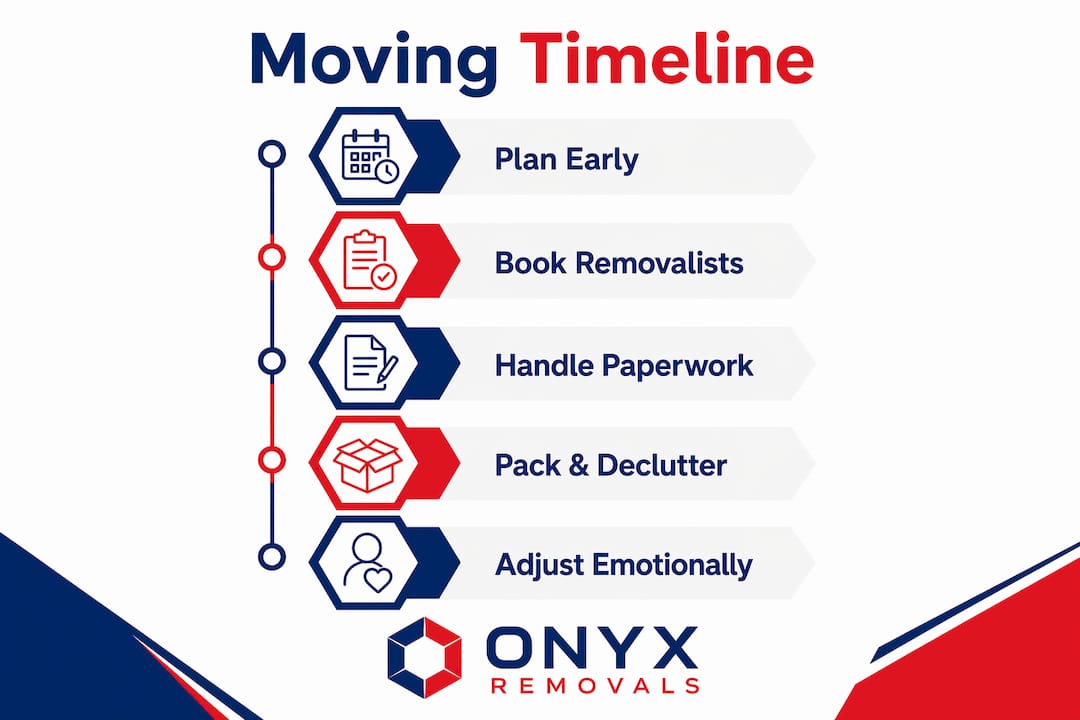
The most effective way to shorten the overall relocation timeline is to start planning 8 to 12 weeks out with a written checklist that assigns tasks to specific weeks. Vague intentions to “sort things out” do not survive contact with the complexity of an interstate move.
Professional packing services are worth considering for families with young children or complex household contents. They reduce the physical and mental load during the final weeks, which are typically the most stressful. Onyx Removals offers packing and unpacking services that can be tailored to your specific move requirements.
Pro Tip: Create a shared digital checklist that every adult in the household can access and update. Visibility across tasks prevents duplication and catches things that fall through the cracks.
For families moving with pets, the interstate pet transport process deserves its own dedicated planning stream. Do not fold it into the general checklist and assume it will sort itself out.
Interstate family moves take longer because they involve simultaneous coordination of logistics, state-specific legal requirements, and emotional adjustment, all of which require at least 8 to 12 weeks of active planning to manage without significant delays.
| Point | Details |
|---|---|
| Start planning early | Begin at least 8 to 12 weeks out to cover removalists, schools, pets, and admin. |
| Legal tasks take real time | Driver’s licences, vehicle registration, and school enrolments each have separate deadlines. |
| Pets need their own plan | WA and Tasmania quarantine rules can add weeks to your relocation timeline. |
| Emotional settling takes months | Most families need 2 to 3 months to feel genuinely settled, not just functional. |
| Budget for the unexpected | A family interstate move typically costs AUD 3,000 to 8,000 before surprise expenses. |
After working with families across Australian states, the pattern I see most often is not poor organisation. It is underestimation. Families who are perfectly capable of managing complex projects in their professional lives consistently underestimate how many separate systems an interstate move touches simultaneously.
The families who handle it best share one trait: they treat the move as a process with a defined start date, not a single event on a calendar. They build in buffer time not because they expect things to go wrong, but because they know that coordinating schools, removalists, pets, utilities, and housing across state lines involves parties they cannot fully control.
The emotional side is where I see the most honest mistakes. Parents focus so hard on the practical checklist that they do not acknowledge, to themselves or their children, that leaving a community is genuinely hard. Children who are told “you will love it” without being allowed to grieve what they are leaving tend to take longer to settle. Giving the emotional adjustment its own space in the planning conversation shortens the overall settling period, not lengthens it.
My honest advice is to read the tips for moving interstate before you think you need to. The families who struggle most are the ones who started reading two weeks before moving day.
— Dinshaw
Onyx Removals specialises in residential moving services for families relocating across Australian states. The team understands the coordination demands of family moves, from managing large furniture volumes to advising on packing sequences that keep your timeline on track. Onyx Removals offers professional packing, unpacking, and scheduling support designed to reduce the pressure on families during the final weeks before moving day. If you are planning an interstate relocation and want a clear quote and a realistic timeline, the Onyx Removals team is ready to help you map it out.
Families should book a removalist at least 8 to 12 weeks before their move date. Quality interstate removalists fill their schedules quickly, and late bookings result in fewer options and higher costs.
Interstate moves involve coordinating multiple state-specific systems simultaneously, including school enrolments, vehicle registration, pet quarantine requirements, and utility transfers across different jurisdictions. Each system has its own deadlines and processing times.
Most people feel functional within two weeks of arriving but genuinely settled after two to three months. Children often need additional time, particularly if they change schools mid-year or leave close friendships behind.
Starting the planning process too late is the leading cause of delays. Six weeks is the absolute minimum for major steps, but families who begin at six weeks are already behind on removalist bookings and school enrolment applications.
Yes. Western Australia and Tasmania have quarantine requirements for certain animals, which require health certificates and can add weeks to your planning timeline. Families with pets should treat pet relocation as a separate planning stream from the main move.

No Related Post


