


Backloading is the cheapest full-service way to move interstate for most households, often 30–50% cheaper than a dedicated truck, because you’re paying for spare space on a truck that’s already making the trip. Tiny loads move cheaper again on a freight or pallet service, and short hops within a state or region are usually cheapest as a straight truck hire. Whichever route you pick, ask for a proper volume survey before you commit, stay flexible on your pickup date, and check what the insurance actually covers.
TL;DR:
- Backloading is most cost-effective for households with flexible dates and large volumes, offering savings of up to 50% compared to dedicated trucks.
- Quotes are primarily based on cubic meters, with rates typically between $150 and $260 per cubic meter in 2026, so accurate volume assessment is crucial.
- Decluttering and downsizing before requesting quotes can reduce your cubic meter volume by 15–30%, significantly lowering costs.
- Choosing a flexible delivery window and booking well in advance (6 to 8 weeks) can secure lower rates and better availability for backloads or container services.
- Precise, itemized quotes that specify cubic meters, delivery windows, insurance coverage, and separate add-ons are the most trustworthy for budgeting accurately.
Not every “cheap” option suits every move. Here’s how the main options stack up, roughly from cheapest to most expensive for a typical household.
As a rough guide, a studio or one-bedroom load might run a few hundred dollars cheaper on a backload than a dedicated truck, while a family home shifting a full three-bedroom’s worth of furniture can save well into four figures. Route matters too. A backload from Melbourne to Adelaide fills faster than one from Perth to Hobart, simply because fewer trucks run that leg.
Interstate removalists price almost everything by cubic metres, not kilometres. Your quote is built from a rate per cubic metre multiplied by how much space your gear takes up, then adjusted for schedule and service level.
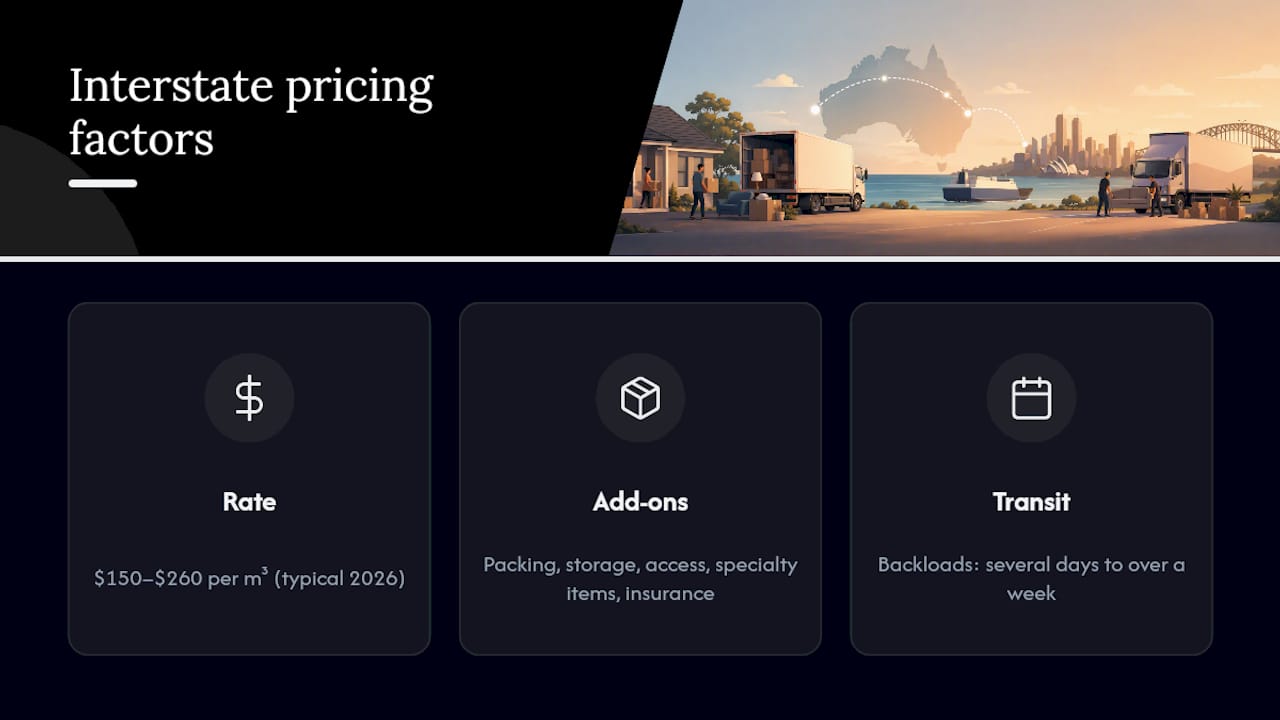
Per-cubic-metre rates in 2026 typically sit between $150 and $260, depending on the route and what’s included. Volume, not distance, is the number that moves your quote the most.
Pro Tip: Ask your quote to break down cubic metres separately from add-ons. If a removalist won’t give you a volume figure, that’s a sign the quote is a guess, not a measurement.
Five things routinely push a quote up: professional packing, storage while you’re between homes, difficult access (stairs, long carries, no parking), specialty items like pianos or pool tables, and insurance cover. Backload transit windows also run longer than a dedicated truck, often several days to over a week between pickup and delivery, so build that into your plan if you need the keys turned over on a set date.
Cost-saving on an interstate move comes down to five moves, done in roughly this order.
Once you’ve got two or three quotes, compare them line by line, not just on the bottom number. A cheaper total that hides a vague volume figure or skips insurance detail usually isn’t cheaper once things go wrong. Onyx’s guide to cost-saving strategies walks through this comparison step in more detail if you want it.
The right choice depends less on your budget and more on your route, volume, and how much physical work you’re up for.
Onyx’s comparison of DIY moving versus professional removalists breaks down where the DIY saving actually holds up and where it quietly disappears.
Locking in the best price is mostly about sequencing, not luck.
Lead times of 4 to 8 weeks give you the best shot at a backload slot at the lowest rate, since last-minute bookings get whatever space is left. Sell or donate large items early rather than the week before, and check your council’s rules on hazardous waste like paint or batteries before disposal. On the final quote, confirm cubic metres in writing, the pickup and delivery window, what insurance actually covers, and whether access fees apply at either address. TAXIBOX’s budget breakdown also flags smaller line items worth planning for, such as fuel and accommodation for your own trip and a modest contingency for last-minute supplies.
A quote you can trust states cubic metres explicitly, not just a flat “3 bedroom” label, alongside a defined pickup window and delivery window, an insurance figure with its terms spelled out, and a separate line for each add-on rather than a bundled service fee.
On a typical two-bedroom interstate move, a household that downsized hard, packed its own boxes, and booked a backload slot instead of a dedicated truck can realistically land 30 to 40% below the equivalent full-service dedicated quote. The saving comes almost entirely from two things: fewer cubic metres to move, and accepting a delivery window instead of a fixed date.
Onyx Removals’ guide to securing an accurate removal quote sets out exactly which fields to demand before you sign anything.
Cheap is a smart bet when you can live with a delivery window and you’ve checked the insurance. It’s the wrong place to cut corners on irreplaceable items or a fixed start date, where paying more buys certainty you’ll actually need.
— Dinshaw
Onyx Removals runs shared-truck and backload options alongside full-service moves, so you’re not choosing between “cheap and risky” or “safe and expensive.” Our team measures your load properly with a genuine volume survey rather than a phone estimate, and we’ll tell you plainly if a hybrid approach, pack it yourself, we load and drive, will save you more than a full-service booking.
What sets a budget-conscious move apart isn’t a discount code, it’s an accurate quote from the start: cubic metres, a real pickup and delivery window, and insurance terms you can actually read. Onyx also offers short-term storage if your new place isn’t ready the day your load arrives, so a flexible delivery window doesn’t leave you stuck. If you’re weighing up a backload against a dedicated truck for your own move, get a free itemised quote for your residential move and see exactly where your cubic metres, and your money, are going before you book anything.

No Related Post


