


For a full-house move, hire a professional removalist, collect at least three written, itemised quotes, and check each company’s AFRA membership, independent reviews and insurance terms before you pay a deposit. Local moves are usually charged by the hour, while interstate moves are often quoted as a fixed price. The sections below give you cost ranges, surcharges and a booking timeline.
TL;DR:
- Local removalists commonly charge $140 to $200 per hour, while Canstar reports $300 to $3,500 for same state moves and $2,000 to $6,000 interstate.
- Send each company the same room by room inventory, photos of difficult access, and request an on site inspection for large homes before comparing written inclusions.
- Book lifts and truck parking early; missed reservations can cause delays, extra crew time, or fines, and buildings may restrict moving hours.
- Removalist transit cover may cap payouts, so check your home policy for transit and storage, and document damage promptly because consumer guarantees still apply.
- Decluttering reduces truck volume and labor time, while midweek bookings may cost less and backloading can suit interstate moves when delivery dates are flexible.
Table of Contents
- Where to find removalists and how to compare them
- Removalist services explained: what each one covers
- How removalist pricing works and what to budget
- Moving timeline: when to book and what to do at each stage
- Moving day logistics: parking, lifts, inventories and safety
- Insurance, liability and consumer rights when you move
- How to get accurate, comparable quotes
- Cost-saving strategies that do not add risk
- Move with Onyx Removals: our services and how to get a quote
- What I would tell anyone planning a move
- FAQ
- Sources
Where to find removalists and how to compare them
Start with sources that a company cannot write for itself. The Australian Furniture Removers Association (AFRA) publishes a moving guide kit and an inventory list, and your state government’s consumer pages explain what to look for. NSW Government guidance tells shoppers to compare services and check accreditation, ask for written itemised quotes and read independent reviews. Victoria’s premier’s office gives the same advice on checking credentials and reading independent third-party reviews rather than relying on testimonials a company publishes on its own website.
Aim for a shortlist of companies, then work through the same checks for each one:
- Business identity: ask for the ABN and confirm the trading name matches the quote and the contract.
- Accreditation: look for AFRA membership and ask for the member number.
- Insurance: ask for written details of public liability and transit cover, and what the excess is.
- Contract terms: read the cancellation, deposit and damage claim clauses before signing anything.
- Independent reviews: check Google, ProductReview or similar platforms, and look for how the company replies to complaints, not just the star rating.
Quote comparison websites can speed up the first round, but treat their numbers as a starting point. A remote quote is only as good as the inventory behind it, so you still need to confirm details directly with each company.
Questions that expose the real price
Ask every company the same questions so the answers line up:
- Is the price hourly, fixed, or hourly with a cap?
- How many movers will turn up, and what size is the truck?
- How many hours do they estimate, and is travel time charged?
- Do they use their own staff or subcontract the job?
- Are there peak-season, weekend, stairs or long-carry surcharges?
- What is the minimum charge, and what happens if the job runs over?
How to read reviews
Reviews on a company’s own site are curated, so treat them as marketing. Independent platforms are more useful, especially the middle ratings, where people describe what actually went wrong and how it was handled. A pattern of complaints about surprise charges or late arrivals matters more than one angry review. A company that answers a bad review calmly and specifically is usually one that will answer your phone call on moving day.
Removalist services explained: what each one covers
Removalists use a lot of overlapping terms, and asking for the wrong service is a common way to overpay. Here is what the main options usually mean.
Core moves
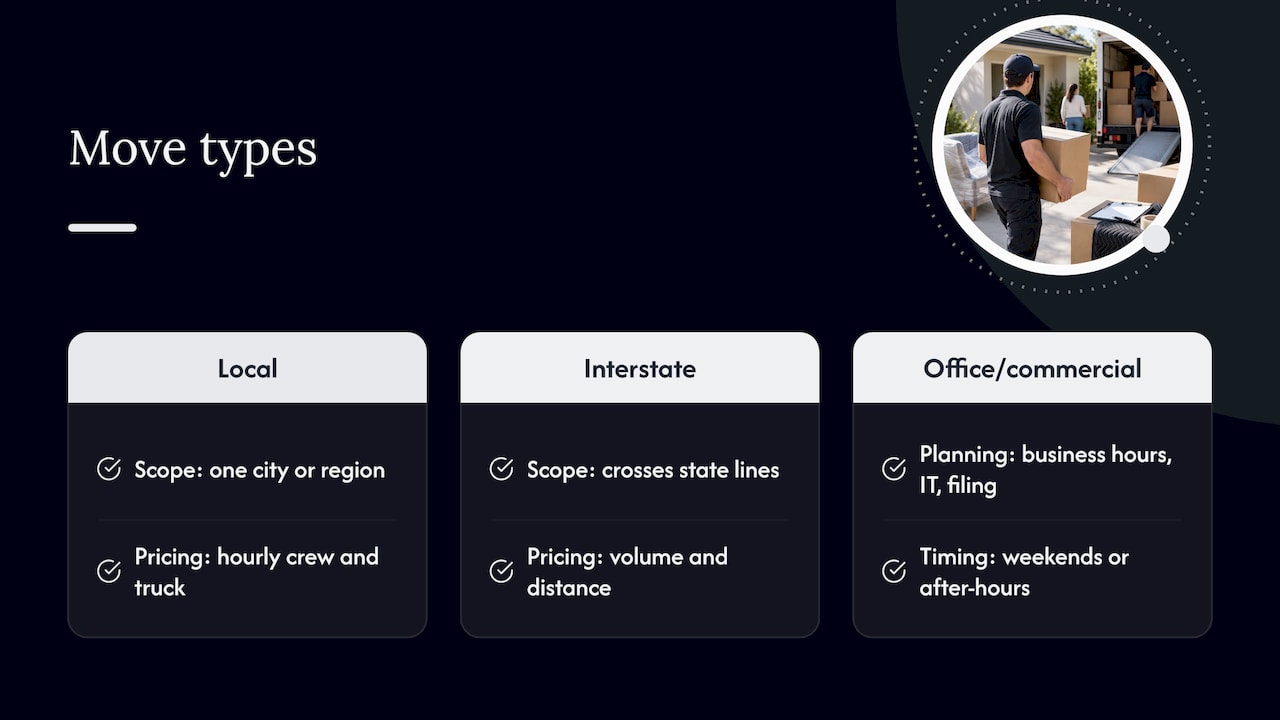
A local move stays within one city or region and is typically charged by the hour for a crew and truck. An interstate move crosses state lines and is usually priced on the volume of your belongings and the distance. An office or commercial move adds scheduling around business hours, IT equipment and filing, and often needs weekend or after-hours work to limit downtime.
Packing options
- Full packing: the crew packs everything, including wrapping furniture and boxing the kitchen. It saves days of effort and suits tight timelines or heavy workloads.
- Partial packing: the crew packs fragile or awkward items such as glassware, artwork and mirrors, while you box books and clothes.
- Labour-only or self-pack: you pack everything and the crew only loads, drives and unloads. It is the cheapest option if you have time and are careful.
Our own office and house packing and unpacking service is charged at $109 per hour, which gives you a concrete figure to measure other quotes against. Our guide to packing versus unpacking services explains when each is worth paying for.
Storage and transit
Short-term storage bridges gaps between settlement dates, while longer storage suits renovations or overseas postings. Be careful with liability. Consumer advice from CHOICE says that storage providers often limit their liability for loss or damage, so you should confirm whether your home and contents insurance covers belongings in transit or storage rather than assuming it does.
Specialised services
- Pianos and large appliances: these need specialised equipment and trained handlers, and are normally quoted as a separate line item.
- Plant transport: indoor plants need ventilation, upright positioning and a short time in the truck.
- Assembly and disassembly: beds, wardrobes and desks are taken apart and rebuilt, which saves time on the day.
- Backloading: your goods ride in a truck that already has a return trip, a flexible option for interstate moves if you can wait on delivery dates.
How removalist pricing works and what to budget
Most local quotes combine an hourly rate for a crew and truck with a minimum charge. Ask each company what its minimum charge is. Interstate quotes usually rest on the volume of your goods and the distance, and are more likely to be a fixed price. The more detail you give about volume, access and fragile items, the closer the quote will be to the final bill.
Published benchmarks vary, which is why you need written quotes. Canstar’s cost guide reports that same-state moves commonly range from about $300 to $3,500, with interstate moves from about $2,000 to $6,000, depending on size and distance.
Budget benchmark: Canstar reports $300 to $3,500 for same-state moves and $2,000 to $6,000 for interstate. Your quote will land at one end or the other depending on how much you own, how far you go and how hard the access is.
For hourly work, Airtasker’s market summary shows local removalists commonly charging around $140 to $200 per hour, with regional and interstate costs higher. Treat that as the band to hold other quotes against. A quote far below it deserves a question about staffing, insurance or hidden extras, and a quote far above it deserves a request for a breakdown.
Common surcharges
Ask whether the price already includes each of these, because they are where a cheap quote turns into an expensive invoice:
- Stairs and long carries: extra time when the truck cannot park close to the door.
- Access limits: narrow streets, steep driveways or buildings with restricted loading zones.
- Peak and weekend premiums: end of month, school holidays and Saturdays are the busiest slots.
- Fuel and depot call-out fees: some companies charge for travel from their depot to your door and back.
- Packing materials: boxes, tape, bubble wrap and mattress covers are often charged separately.
- Waste disposal and cleaning: removing unwanted items or cleaning the old place is rarely in the base price.
Insurance and what it does to the price
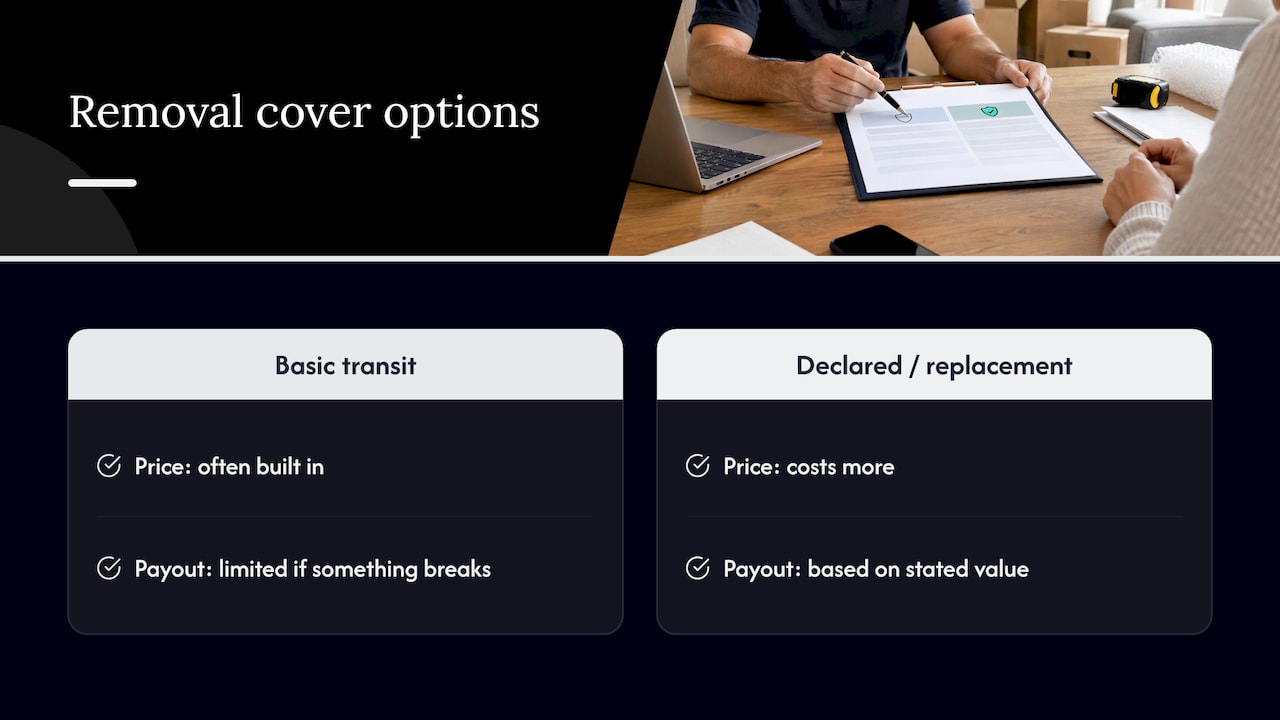
Basic transit cover is often built into the price but limits what the removalist will pay if something breaks. Declared-value or full replacement cover costs more because you state what your belongings are worth and the insurer pays on that basis. If you own high-value furniture, art or electronics, ask for the cover terms in writing and compare them with your own home and contents policy. Paying a bit more for proper cover can cost far less than replacing a damaged item out of pocket.
Moving timeline: when to book and what to do at each stage
Book well ahead for a local move, and earlier for interstate moves or peak-season dates. AFRA’s moving guide kit suggests booking an AFRA removal company several weeks ahead and using its inventory list. Our own moving checklist for Australia and the NSW version give you a fuller task list if you want more detail.
- Before the move: declutter room by room, request quotes from companies, and check whether your building needs a lift booking or your street needs a parking permit.
- Once you have compared quotes: choose a removalist, pay the deposit only against a written quote, and confirm the date in writing.
- Before moving day: confirm the final inventory, organise insurance, and book cleaners and storage if you need them.
- Before moving day: start notifying banks, utilities and providers. Australia Post mail redirection is available in one, three, six or twelve month terms, and our guide to changing your address explains what else to update.
- As moving day approaches: pack non-essentials, label boxes by room, and arrange pet care if needed. Our guide to moving house with pets covers the practical steps.
- The day before: defrost the freezer, pack an essentials kit with chargers, medication, toiletries and a change of clothes, and keep your passports and valuables with you.
- Moving day: walk through with the crew leader, check the inventory, take photos of valuable items and sign the paperwork only when you are satisfied with it.
- After you arrive: work through our move-in checklist so urgent tasks like utilities and keys come before unpacking every box.
Moving day logistics: parking, lifts, inventories and safety
Most delays on moving day come from access problems, not from the crew. If the truck cannot park near your door or the building lift has not been booked, the clock keeps running while the crew waits.
Council guidance is clear on this point. Burwood Council’s moving checklist warns that apartment moves often need lifts and truck parking booked in advance, and that failing to do so can lead to fines and delays. Contact your strata manager early, because many buildings limit moves to set hours and require a deposit.
- Parking: arrange a council permit or reserve a loading bay at both ends of the move, and put cones out early if you are allowed to.
- Lifts and loading docks: book the lift for the whole window, not just the start, and ask whether padding is required.
- Inventory: keep a room-by-room list of items, photograph valuables and existing scratches, and check everything off at handover.
- Sign-off: inspect before you sign. Note any damage on the paperwork on the day, because it speeds up any claim later.
- Household safety: keep pets and children away from the loading area, and set aside valuables, documents and medication so they never go on the truck.
- Placement at the new home: tell the crew where heavy items go before they carry them in, so nothing needs to be moved twice.
Pro Tip: Confirm the truck’s arrival window in writing, and name an on-site contact with a working phone if you cannot be there yourself.
Insurance, liability and consumer rights when you move
You have legal protections even before you buy extra cover. The ACCC explains that Australian Consumer Law provides consumer guarantees for services that cannot be excluded, and that remedies can include repairs, refunds or reimbursement when guarantees are not met. Removalists must deliver services with due care and skill and within a reasonable time.
Consumer guarantees for services apply to removalists, and a business must not mislead you about those rights or the remedies available.
NSW Government guidance also notes that removalist services are covered by consumer guarantees, which is why a written contract matters. If a company’s terms try to remove your rights entirely, treat that as a warning sign.
Transit insurance from the removalist is only part of the picture. Check your own home and contents policy to see whether it covers goods while they are being moved or sitting in storage. Many policies cover only some of that period, and some exclude it entirely.
If something goes wrong:
- Document it: photograph the damage, keep the signed inventory and write down what happened and when.
- Ask for insurance details: get the policy and claim process in writing from the removalist.
- Raise it quickly: report the damage on the day and follow up in writing within a few days.
- Escalate if needed: if the company does not respond, contact AFRA if they are a member, or your state fair trading office.
How to get accurate, comparable quotes
A quote is only comparable if every company priced the same job. The simplest way to get there is to give each one an identical inventory.
- Build a room-by-room list: include furniture, appliances, boxes, outdoor items and anything in a shed, garage or storage cage.
- Photograph awkward items: bulky sofas, pianos, wardrobes and tight stairwells are worth a photo, as are the parking and loading areas at both ends.
- Request an on-site inspection for large jobs: a full house, a multi-storey home or an unusual access route is much harder to price over the phone.
- Compare inclusions, not just totals: check travel time, packing materials, insurance, loading and unloading time, and any extra fees.
- Ask whether the price is fixed: a fixed price should say what happens if the job takes longer, and an hourly price should state a cap or an estimate.
Keep every quote in writing and ask each company to confirm it by email, so you have a reference point if the invoice changes.
Cost-saving strategies that do not add risk
You can cut a moving bill without cutting corners if you change the shape of the job, not the quality of the crew.
- Book off-peak: Airtasker’s market summary notes that booking midweek or in off-peak seasons can reduce costs, and that backloading is an option for flexible interstate moves.
- Declutter first: sell, donate or dump what you will not use. Fewer items means a smaller truck and fewer hours.
- Pre-pack the safe items: books, linen, clothes and pantry goods are easy to box yourself, which leaves the crew to focus on furniture.
- Negotiate fixed pricing: for a predictable job, ask for a fixed price rather than an open hourly rate.
- Bundle related services: packing and cleaning from one provider can be cheaper than two bookings, and our guide to budget relocation covers more ways to keep the total down.
If your wardrobes and storage are part of the problem, sorting them before you pack can reduce volume further. One Day Doors & Closets has a handy piece on organising your home that works just as well before a move.
Move with Onyx Removals: our services and how to get a quote
We are a Melbourne removalist offering residential and commercial moves, packing and unpacking, bond cleaning, short-term storage, skip bin arrangement and waste disposal, and specialised transport such as plant moving.
- Personalised plans: each move is planned around your inventory, access and dates.
- Experienced teams: our crews handle furniture, fragile items and specialist goods.
- One provider: moving, cleaning, storage and waste disposal can be booked together.
To get a written, itemised quote, send us your room-by-room inventory, preferred dates and access notes for both addresses. See our pricing and services pages, then request your quote today.
What I would tell anyone planning a move
Most problems I see start with access, not with the crew. Book strata lifts and council parking early, because a missed booking can derail the whole day. Always get a signed inventory at handover, since it makes any dispute faster to resolve. Keep passports, medication and valuables with you rather than on the truck, and pack an essentials box you can open first.
— Dinshaw
FAQ
How much do removalists cost in Melbourne?
Most Australian removalists charge by the hour for local moves, and rates depend on crew size, truck size and timing. Market data suggests about $140 to $200 per hour for local work. Get three written quotes to see where your job lands.
Is $20,000 enough to move to Australia?
It depends on where you are moving from and how much you are bringing. The removal itself is only one cost, alongside travel, accommodation, bond and living expenses, so price each piece separately. For the removal, get written quotes that state whether insurance and packing are included.
What is the most trusted moving company?
There is no single answer, so judge each company on checkable signs. Look for AFRA membership, written itemised quotes, public liability and transit insurance, and independent reviews. Government guidance recommends comparing providers and checking accreditation.
Do consumer guarantees apply to removalists?
Yes. Australian Consumer Law provides consumer guarantees for services, and remedies can include repairs, refunds or reimbursement if they are not met. Keep your contract, inventory and photos in case you need to make a claim.
Sources
- Choosing a removalist | NSW Government
- How Much Do Removalists Cost In Australia (2026) | Canstar
- How to find the best self-storage
- Moving Checklist | Burwood Council
Recommended
About the Author


