



Many Melbourne businesses dismiss temporary office spaces as unprofessional or inconvenient stopgaps, assuming they lack the credibility needed for client meetings or team coordination. In reality, these flexible environments offer fully equipped, professional settings that support seamless operations during relocations, expansions, or transitional phases. From serviced offices with reception support to collaborative coworking hubs, temporary spaces provide the infrastructure and flexibility your business needs without long-term commitments. This guide explores the types, mechanics, costs, and strategic considerations to help you choose the right temporary office solution in Melbourne.
| Point | Details |
|---|---|
| Space types explained | The article outlines serviced offices, coworking, hot desks, dedicated desks, private offices and satellite offices as flexible options for relocations. |
| Flexible short term leases | Temporary offices operate on month to month agreements or daily bookings. |
| Networking versus privacy | Coworking can boost networking while private spaces help maintain confidentiality. |
| Cost ranges noted | Costs range from about $532 per coworking desk to more than $1200 per month for private offices. |
Melbourne’s flexible workspace market offers distinct solutions tailored to different business needs and team sizes. Temporary office spaces in Melbourne primarily consist of serviced offices, coworking spaces, hot desks, dedicated desks, private offices, and satellite offices offered by providers like Servcorp, JustCo, and Hub Australia. Understanding these categories helps you match your relocation requirements with the right environment.
Serviced offices provide fully furnished private spaces with reception services, meeting rooms, and administrative support. These suit established businesses needing professional settings for client interactions during transitions. Coworking spaces offer open-plan environments where multiple companies share facilities, fostering networking opportunities ideal for startups and creative teams. Hot desks provide non-reserved workstations in shared areas, perfect for solo entrepreneurs or remote workers needing occasional office access.
Dedicated desks give you a permanent workstation in a shared space, combining cost efficiency with personal workspace consistency. Private offices within coworking facilities offer enclosed rooms for small teams requiring confidentiality whilst maintaining access to communal amenities. Satellite offices are secondary locations that complement your main office, enabling distributed teams to work closer to home or clients across Melbourne’s suburbs.
Space suitability by team size:
Providers maintain locations throughout Melbourne CBD, Southbank, Richmond, Cremorne, and Docklands, giving you geographic flexibility during relocations. Many offer Servcorp office options that include virtual office services, allowing you to maintain a CBD business address whilst operating from a suburban location. This flexibility proves invaluable when coordinating office furniture moving services between locations or staging equipment during multi-phase relocations.
The variety ensures businesses can scale up or down quickly, adjusting desk counts or upgrading to larger private offices as relocation timelines shift. Short-term lease options ranging from daily passes to monthly agreements eliminate the risk of being locked into unsuitable spaces during uncertain transition periods.
Mechanics include flexible short-term leases, pay-for-use models, scalability, and all-inclusive amenities supporting hybrid access across locations. Unlike traditional commercial leases requiring 3 to 5 year commitments, temporary offices operate on month-to-month agreements or even daily bookings. You pay only for the space and duration you need, with the ability to add or reduce desks as your team size fluctuates during relocation phases.
Inclusive amenities eliminate setup headaches. Furnished workstations, high-speed internet, phone systems, printing facilities, meeting rooms, and kitchen areas come standard. Reception staff handle mail, greet visitors, and manage bookings, maintaining professional appearances without hiring additional personnel. Many providers include IT support, ensuring technical issues don’t disrupt operations during critical transition periods.
Hybrid working models have transformed temporary office usage post-pandemic. Multi-location access agreements let your team book desks at different sites across Melbourne, accommodating employees who live in various suburbs. This flexibility supports distributed teams during office moves, allowing some staff to work from temporary locations whilst others coordinate the physical relocation.
Key benefits during relocations:
The pay-for-use model particularly benefits businesses managing office moving timelines, where you might need overflow space for two weeks or bridge accommodation for three months. Rather than negotiating complex sublease arrangements, you simply book the required capacity and cancel when your permanent office becomes available.
Pro Tip: Test potential temporary office spaces with day or week passes before signing monthly agreements. This hands-on evaluation reveals noise levels, commute practicality, and whether the environment suits your team’s work style, preventing costly mismatches during critical relocation periods.
Providers typically require minimal documentation compared to traditional leases. Most need only business registration details and payment information, enabling you to secure space within days rather than weeks. This speed proves crucial when unexpected delays in your new office fit-out force you to find interim workspace quickly. Integration with office move project management processes ensures temporary space bookings align with your broader relocation schedule.
Pricing benchmarks show coworking averages at $532/person/month, private offices around $799/person/month in Melbourne CBD. Understanding these costs helps you budget accurately for temporary office needs during relocations. Prices vary significantly based on location, amenities, and space type, with suburban options often offering better value for teams prioritising cost over CBD prestige.
| Space type | Monthly cost per person | Privacy level | Ideal team size | Noise considerations |
|---|---|---|---|---|
| Hot desk | $250 to $532 | Low | 1 to 2 | High activity, open plan |
| Dedicated desk | $450 to $650 | Medium | 1 to 3 | Moderate, shared space |
| Private office (small) | $799 to $1,200 | High | 3 to 8 | Low, enclosed space |
| Private office (large) | $1,200 to $2,500+ | High | 8 to 20+ | Low, customisable |
| Serviced office suite | $2,000 to $5,000+ | Very high | 15 to 50+ | Minimal, premium facilities |
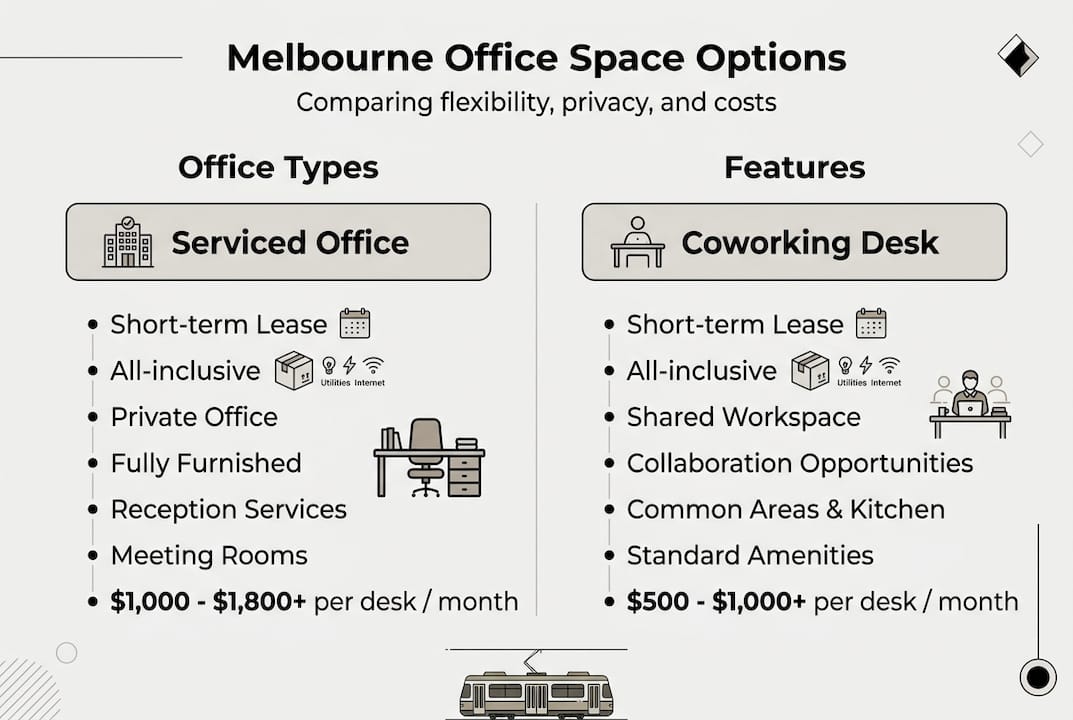
CBD locations command premium pricing due to transport accessibility and client proximity. Richmond, Cremorne, and Collingwood offer competitive alternatives, typically 20 to 30% cheaper whilst maintaining good public transport links. For businesses relocating from CBD to suburban permanent offices, these areas provide convenient interim solutions without excessive cost.
Practical drawbacks to consider:
Privacy concerns particularly affect professional services firms handling sensitive client information. Financial advisers, legal practices, and healthcare providers typically need private offices to maintain confidentiality standards. Creative agencies and tech startups often thrive in collaborative coworking environments where spontaneous interactions spark innovation.
Pro Tip: For teams over 5 people, compare the total cost of individual coworking desks against a small private office. Private offices frequently offer better per-person value whilst providing the enclosed space needed for team coordination during relocation planning sessions.
Hidden costs sometimes catch businesses off guard. Printing charges, additional meeting room hours beyond included allocations, and premium internet speeds may incur extra fees. Review provider agreements carefully to understand what’s included in base pricing versus optional add-ons. Some operators charge for mail handling, visitor parking, or after-hours access, which can add 10 to 15% to your monthly costs.
Suburban locations offer strategic advantages beyond cost savings. Businesses relocating to growth corridors like Dandenong, Frankston, or Geelong can establish temporary presences in these areas, testing market viability before committing to permanent premises. This approach reduces risk whilst maintaining operational flexibility. Coordinating temporary storage during relocation with nearby temporary office space creates efficient logistics, minimising travel time between stored equipment and your working location.
For relocations, prioritise providers with multi-location access and test with day passes; pre-product-market-fit teams should avoid fixed costs; post-validation teams use offices for coordination. Strategic selection ensures your temporary space supports rather than hinders your relocation objectives.
Step-by-step selection checklist:
Assess team size and growth projections: Calculate current headcount plus anticipated hires during your temporary office period. Build in 20% buffer capacity to avoid premature upgrades.
Define privacy and confidentiality requirements: Determine whether your work involves sensitive information, client meetings, or focus-intensive tasks requiring enclosed spaces.
Establish budget parameters: Calculate total monthly costs including base rent, estimated meeting room usage, printing, and parking. Compare against your relocation budget allocation.
Evaluate location priorities: Balance client accessibility, employee commute times, and proximity to your permanent office site. Consider whether CBD presence matters for your brand positioning.
Test provider flexibility: Confirm you can scale desk counts up or down monthly without penalties. Verify multi-location access if your team is distributed across Melbourne.
Inspect facilities personally: Visit shortlisted spaces during your typical working hours. Observe noise levels, check internet speeds, and evaluate meeting room availability.
Review contract terms: Ensure notice periods align with your relocation timeline. Clarify what happens if your permanent office becomes available earlier than expected.
Hybrid working adoption fundamentally changes space calculations. If 40% of your team works remotely on any given day, you need fewer desks than total headcount. Hot-desking arrangements within your temporary office can reduce costs by 30 to 40% compared to providing dedicated desks for everyone.
“Multi-location access proves essential during complex relocations, enabling different team functions to operate from optimal locations whilst maintaining cohesion through scheduled all-hands meetings at a central hub.”
Client and investor perceptions influence location choices. Early-stage tech companies might prioritise cost-effective suburban coworking spaces, accepting that stakeholder meetings occur at cafes or clients’ offices. Established professional services firms typically need CBD addresses and premium meeting facilities to maintain credibility during transitions.
Scaling considerations dictate when to upgrade from coworking to private offices. Solo founders or pairs work effectively in coworking environments, benefiting from networking and lower costs. Once you reach 3 to 5 people, coordination challenges and privacy needs often justify private offices. Teams exceeding 10 people usually require dedicated suites to maintain productivity and culture.
Timing your temporary office booking requires balancing certainty against flexibility. Secure space 4 to 6 weeks before you need it if relocating during peak periods like January or July when availability tightens. For off-peak moves, 2 to 3 weeks’ notice typically suffices. Maintain regular contact with your permanent office landlord to anticipate handover dates, adjusting your temporary booking accordingly.
Integrating temporary office selection with broader office relocation services ensures all moving components align. Coordinate your temporary space start date with furniture delivery schedules, IT installations, and staff transition plans. This synchronisation prevents gaps where your team lacks workspace or overlaps where you’re paying for both temporary and permanent spaces simultaneously.
Securing the right temporary office space solves only part of your relocation puzzle. Moving your equipment, furniture, and technology between locations requires experienced coordination to maintain business continuity. Onyx Removals specialises in stress-free moving services that complement your temporary office strategy, handling the physical logistics whilst you focus on operations.
Our office relocation expertise includes detailed project management, secure packing of sensitive equipment, and flexible scheduling that aligns with your office moving timeline. We coordinate with your temporary office provider to ensure seamless transitions, whether you’re staging a multi-phase move or executing a rapid shift between locations. When you need temporary storage during relocation, our secure facilities keep your equipment accessible whilst you settle into your new permanent space. Contact us to discuss how professional moving support enhances your flexible office strategy.
Temporary office spaces are flexible, short-term workplaces offering ready-to-use offices or desks for businesses needing interim solutions during relocations, expansions, or transitional periods. They range from open-plan coworking desks to fully serviced private offices with reception support. The key advantage lies in month-to-month flexibility without long-term lease commitments, allowing businesses to operate professionally whilst permanent arrangements are finalised.
Costs vary from $532/person/month for hot desks to $799+ for private offices in Melbourne CBD, with suburban locations offering 20 to 30% savings. Prices typically include furniture, internet, reception services, and communal facilities like meeting rooms and kitchens. Additional charges may apply for extra meeting room hours, printing, or premium services, so clarify inclusions before signing agreements.
Temporary offices avoid fit-out costs and offer scalable, short-term leases ideal for staging during office moves. They provide immediate professional environments without renovation delays, maintain client access and team productivity throughout transitions, and eliminate long-term commitments when permanent office timelines remain uncertain. The flexibility to scale space up or down monthly accommodates changing needs as relocation phases progress.
Private offices tend to be more cost-effective and private for teams over 5, whilst coworking suits smaller teams or individuals. Teams of 2 to 4 people often benefit from dedicated desks or small private offices within coworking facilities, balancing cost with coordination needs. Solo entrepreneurs maximise value with hot desks, accessing professional environments without paying for unused capacity. Evaluate your privacy requirements and budget to determine the optimal balance between collaboration and confidentiality.

No Related Post


