


TL;DR:
- Planning a move from Perth to Melbourne requires careful research and detailed preparation to avoid surprises. Choosing an AFRA-accredited removalist with local expertise, obtaining binding quotes, and scheduling during mid-week or mid-month can significantly reduce costs and ensure a smoother process. Proper planning, including volume estimation, addressing specialty items, and securing insurance, increases the likelihood of a successful long-distance relocation.
Planning a move from Perth to Melbourne is not as simple as hiring a truck and pointing it east. The sheer distance (over 3,400 kilometres), the logistics of loading and delivering across state lines, and the wild variation in quotes from interstate removalists Perth to Melbourne can leave you feeling overwhelmed before you have packed a single box. Some movers offer polished service with full insurance and binding quotes. Others give you a suspiciously low number and then hit you with fees you never saw coming. This guide cuts through the noise so you can move with confidence.
| Point | Details |
|---|---|
| AFRA accreditation matters | Choose removalists with AFRA membership to guarantee minimum standards for equipment, insurance, and training. |
| Timing affects your price | Mid-month, mid-week moves can significantly reduce costs due to lower demand and better availability. |
| Get binding quotes | Always compare detailed, itemised quotes to avoid hidden charges like fuel levies or stair carries. |
| Plan storage in advance | If your new Melbourne property is not ready on arrival day, storage-in-transit options prevent expensive last-minute scrambling. |
| Specialised items need specialists | Vehicles, fragile antiques, and bulky furniture require dedicated handling, not a standard box-and-truck approach. |
Not every removalist quoting on your Perth to Melbourne relocation is operating at the same level. The price gap between operators can be thousands of dollars, and the service gap can be just as wide. Before you commit to anyone, you need to know what separates a reliable mover from one that will cost you more in stress, damage, and surprise fees than you ever saved on the headline quote.
The most reliable filter is AFRA membership. The Australian Furniture Removers Association sets higher standards for equipment, insurance coverage, and staff training across the industry. A removalist displaying current AFRA accreditation has agreed to operate within those standards, which gives you a level of protection that an unaccredited operator simply cannot offer.
Local Perth expertise also matters more than most people realise. Experienced local teams understand Perth’s suburban access quirks, narrow driveways in older suburbs, traffic patterns on Stirling Highway in the morning, and the kind of ground-floor versus lift-access variables that can add hours to a job if the removalist is flying blind. That local knowledge speeds up loading and reduces the risk of damage before the truck even leaves your street.
The biggest trap for budget-conscious movers is selecting purely on the lowest number. Many removalist quotes exclude fuel levies, insurance, stair carries, long carry fees, and delayed delivery charges. The cheapest headline price often becomes the most expensive invoice once everything is itemised on delivery day.
When comparing quotes, look for these items specifically:
Pro Tip: Ask every removalist for a binding written quote rather than an estimate. A binding quote locks in the price regardless of how long the job takes, while an estimate is simply a starting point.
Understanding the numbers behind a Perth to Melbourne interstate move is the fastest way to set a realistic budget and avoid nasty surprises.

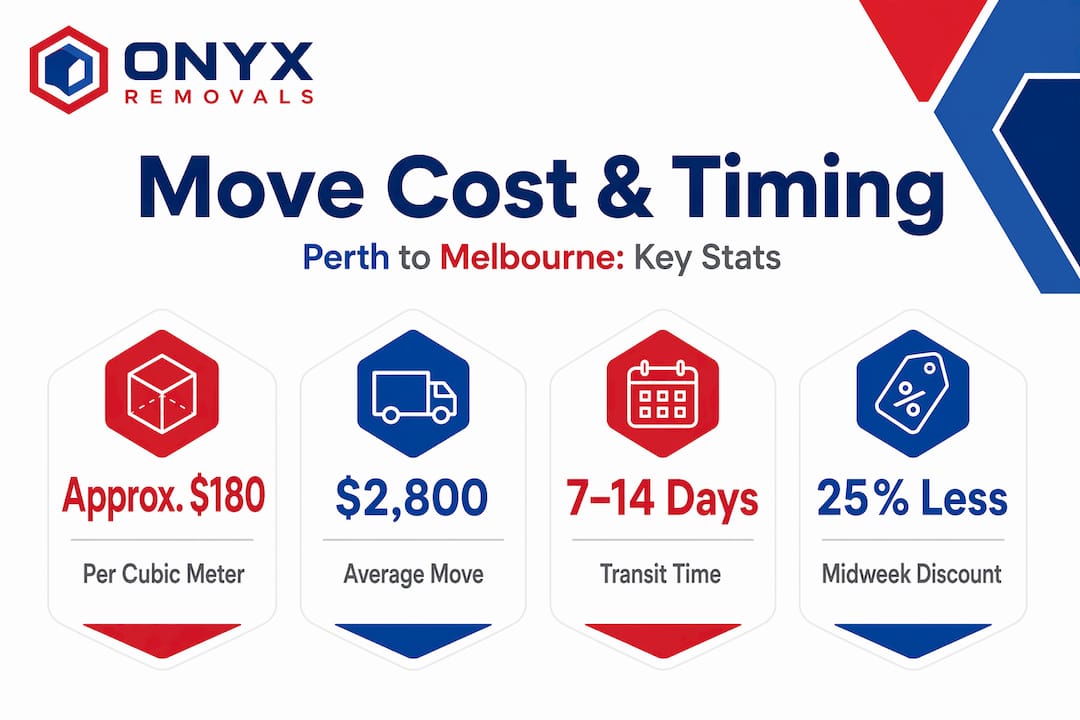
The average cost per cubic metre for this route sits around $180, with a typical move coming in around $2,800 depending on volume and any additional services. That figure shifts considerably based on the size of your home, the accessibility of both properties, and when you choose to move.
| Home size | Estimated cubic metres | Approximate cost range |
|---|---|---|
| Studio or 1-bedroom unit | 10 to 20 cbm | $1,800 to $3,600 |
| 2-bedroom home | 20 to 35 cbm | $3,600 to $6,300 |
| 3-bedroom home | 35 to 50 cbm | $6,300 to $9,000 |
| 4-bedroom home | 50 to 70 cbm | $9,000 to $12,600 |
These are baseline ranges. Add professional packing, vehicle transport, or storage-in-transit and the total climbs accordingly. If you need affordable moving options in Melbourne, planning your volume carefully before requesting quotes can save hundreds.
Timing is one of the few cost levers you can actually control. Mid-month, mid-week moves attract significantly lower demand, which translates into better price availability and more attentive service. School holidays, end-of-month dates, and Friday moves are peak demand windows. If your settlement date or lease end gives you any flexibility at all, a Tuesday in the middle of the month can meaningfully reduce what you pay.
Storage-in-transit is another cost variable worth factoring in early. Some removalists offer short-term storage as part of their interstate packages, which is particularly useful when your new Melbourne property will not be available on the exact day your Perth property is vacated. Booking this in advance avoids the premium rates that come with emergency storage arrangements.
Pro Tip: Request quotes in cubic metres rather than accepting “per room” estimates. Rooms vary wildly in how much furniture and volume they actually contain.
A long-distance move rewards the organised and punishes the unprepared. Here is a practical timeline to keep you on track from the moment you decide to relocate.
Reviewing your moving insurance options before move day is non-negotiable on a journey of this length. Interstate transit involves far more handling than a local move, and the risk profile is correspondingly higher.
Pro Tip: Take a full video walkthrough of your home before the removalists arrive. This is your most powerful evidence if a damage claim is ever disputed.
Moving a car from Perth to Melbourne presents a genuine decision point. Driving it yourself adds roughly four to five days of travel, fuel costs, accommodation, and significant wear to the vehicle. Professional car transport services offer tracked, insured alternatives that free you to fly and settle into your new home faster.
When selecting vehicle transport, you have several options worth understanding:
For fragile or high-value items inside your home, the approach is different again. Quality bubble wrap alone is not enough for long-distance transit. Use double-walled boxes for anything breakable, fill dead space with packing paper rather than air, and mark boxes containing fragile items on all four sides, not just the top. Artwork, mirrors, and large glass items should be professionally crated if their value justifies it.
If you are moving a piano, a significant wine collection, or items that require temperature or humidity control, a standard removalist truck is not the right tool. Hire specialist movers for these pieces. The Perth property considerations around staircase access and older building layouts mean that getting a specialist team to assess the job before moving day prevents damage and injury on the day.
I have seen a lot of interstate moves, and the ones that go badly share a common thread. It is almost never the truck that causes the problem. It is the planning that happened three weeks before it.
People consistently underestimate what this move actually costs. They get one quote, assume it is representative, and then discover on delivery day that the fuel levy, the stair carry at both ends, and the storage holding fee were never included. The total comes in 30 to 40 percent higher than expected. That shock is entirely avoidable with binding quotes and thorough comparison.
What I find works is treating the quote process like a job interview. Ask every removalist the same set of questions. What is included? What is excluded? What happens if the truck is delayed? What is their claims process if something is damaged? A removalist who answers these confidently and in writing is one you can trust. One who gets vague or dismissive is telling you something important.
The timing flexibility point is also underrated. I have watched people spend an extra $1,500 simply because they locked in a Friday at the end of the month before exploring alternatives. That money could cover your first month of groceries in Melbourne.
Perth to Melbourne removalists also vary significantly in how much they know about the Perth end of the job. A Melbourne-based operator quoting your move may not have the ground-level knowledge of your specific suburb that a local Perth team would bring. That local expertise changes how efficiently the loading phase runs, and efficiency on a job this size directly affects your bill.
— Dinshaw
Moving interstate is a major undertaking, and having the right team behind you makes the difference between a stressful experience and a genuinely smooth one. Onyx Removals brings Melbourne-based expertise and a track record of handling long-distance relocations with care, transparency, and attention to detail.

Whether you need full residential moving services for a family home, professional packing and unpacking support, or secure storage-in-transit options while your Melbourne property settles, Onyx Removals has the capability to manage each stage. You can also explore packing service options to decide how much of the physical work you want professionals to handle. Request a detailed, itemised quote today and start your Perth to Melbourne relocation with a plan you can actually trust.
The average cost is roughly $180 per cubic metre, with a typical two to three bedroom home move coming in around $2,800 to $9,000 depending on volume, services, and timing.
Transit times typically range from seven to fourteen days depending on the removalist’s schedule, whether they are running a dedicated truck or a shared load service, and any storage-in-transit arrangements.
AFRA-accredited removalists meet minimum standards for equipment, insurance, and training set by the Australian Furniture Removers Association, which gives you stronger consumer protection than unaccredited operators can provide.
Professional packing reduces damage risk on long-distance moves but adds to cost. DIY packing works well if you use the right materials and technique, particularly for non-fragile items.
Mid-month and mid-week dates attract lower demand and better pricing. Avoid school holidays, end-of-month dates, and Fridays if cost is a primary consideration.

No Related Post


