



Did you know that poor planning during office moves can lead to up to 30 percent higher costs and weeks of lost productivity? Moving office equipment is far more complex than packing a few boxes. Every step, from safeguarding sensitive technology to managing tight timelines, impacts your business. By understanding the full scope of office equipment relocation, you can steer clear of hidden risks and make decisions that save time, money, and stress.
| Point | Details |
|---|---|
| Professional Management | Office equipment relocation requires specialized professional services for systematic movement and logistical coordination. |
| Planning & Coordination | Effective relocations demand meticulous planning, clear roles, and comprehensive migration strategies to minimize disruptions. |
| Legal & Safety Compliance | Organizations must adhere to strict legal and safety regulations to ensure a safe relocation process and protect employees. |
| Risk Mitigation | Anticipating potential risks and financial challenges is critical to avoid common pitfalls during office relocations. |
Office equipment relocation is a specialized professional service involving the systematic movement of workplace furniture, technology, and infrastructure from one location to another. According to the Australian Bureau of Statistics, this process is managed by skilled furniture removalists who handle complex logistical challenges with precision and care.
The core objective of office equipment relocation extends beyond simple transportation. As outlined by CIT Education, the process encompasses comprehensive workspace transformation, which involves carefully coordinating the movement of staff, their associated furniture, and critical equipment while minimizing work disruptions and maintaining stringent workplace health and safety standards.
Key components of effective office equipment relocation typically include:
Successful office relocations demand meticulous planning, expert handling, and a strategic approach that ensures minimal downtime and maximum efficiency for businesses undergoing workspace transitions.
Professional removalists like Onyx Removals specialize in transforming what could be a stressful move into a seamless, well-orchestrated transition. Understanding the office relocation process becomes crucial for organizations looking to navigate these complex logistical challenges effectively.
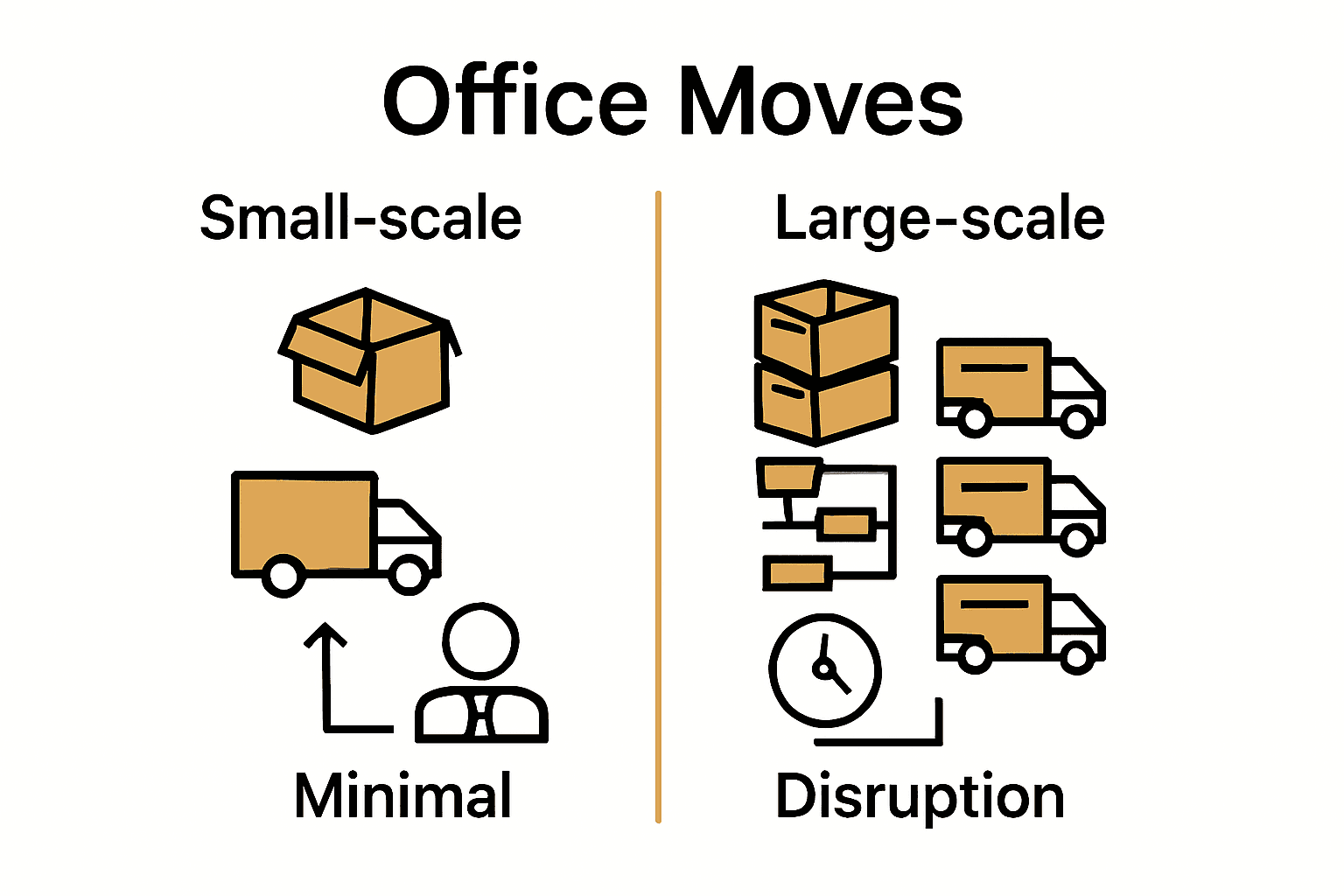
Office equipment moves represent a complex logistical challenge that varies significantly in scope and complexity. According to University of Queensland Staff Services, these moves can be broadly categorized into two primary types: small-scale relocations and large-scale relocations.
Small-scale relocations typically involve moving equipment and personnel within the same organizational unit, requiring minimal disruption and precise coordination. In contrast, large-scale relocations are more comprehensive, often tied to broader construction or restructuring projects that may necessitate temporary or permanent workspace transformations.
According to Newcastle University, office equipment moves can be further differentiated by their complexity:
Professional removalists understand that each move type demands a unique approach.
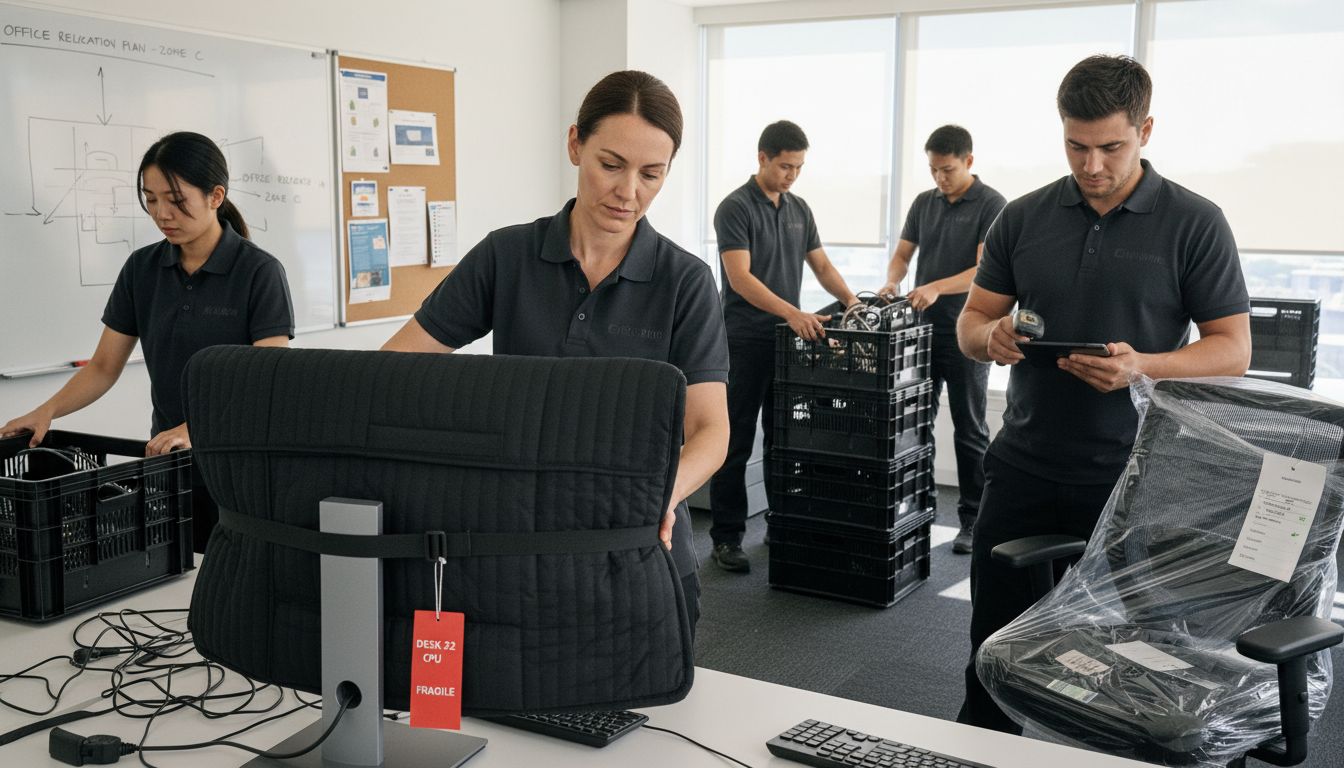 Effective IT equipment relocation strategies become crucial in ensuring minimal disruption and maintaining operational continuity during these complex transitions.
Here’s a comparison of the main types of office equipment moves:
| Move Type | Scale & Scope | Typical Requirements |
|---|---|---|
| Individual Item Moves | Single items or equipment | Minimal disruption Quick turnaround |
| Workstation Transfers | Moving one or more workspaces | Coordinated packing IT reconnections |
| Department-Wide Relocations | Whole teams/departments | Detailed planning Inventory checks |
| Entire Organisation Moves | Full business infrastructure | Extensive logistics Temporary storage |
Office equipment relocation demands meticulous planning and strategic coordination to ensure a smooth transition. According to CIT Education, developing a comprehensive Schedule of Works is the foundational step in managing potential risks and outlining the entire relocation process.
Key to successful coordination is establishing clear leadership and communication channels. University of Queensland Staff Services recommends appointing a Client Relocation Coordinator (CRC) who serves as the primary liaison between all stakeholders, ensuring seamless communication and efficient project management.
Critical planning steps for office equipment relocation include:
For organizations seeking a structured approach to complex relocations, relocation project management strategies provide essential guidance in navigating the intricate process of office equipment moves while minimizing disruption and maintaining operational continuity.
Office equipment relocations in Australia are governed by strict legal and safety regulations that demand comprehensive planning and risk management. According to CIT Education, organizations must comply with the Work Health and Safety Act 2011, which mandates that managers provide a safe work environment throughout all relocation activities.
Beyond physical safety, legal considerations extend to financial and administrative responsibilities. Australian Taxation Office guidelines indicate that removal and relocation expenses are typically considered personal costs, with limited tax deductibility for most businesses and employees.
Key legal and safety considerations for office equipment relocations include:
Furniture removal safety practices play a critical role in mitigating potential risks, ensuring that organizations can navigate the complex landscape of legal and safety requirements during office equipment relocations.
Office equipment relocations present a complex landscape of potential risks and financial challenges that require strategic planning and meticulous attention. According to CIT Education, work health and safety hazards represent significant risks that can disrupt organizational operations and potentially lead to substantial financial and legal consequences.
Financial considerations are equally critical during office relocations. Australian Taxation Office highlights a common misconception that relocation expenses are tax-deductible, emphasizing that most organizations will need to absorb these costs as non-recoverable expenditures.
Common risks and pitfalls to anticipate include:
Moving insurance options provide critical protection against potential financial losses, helping organizations mitigate risks and ensure a smoother, more predictable relocation process.
Relocating office equipment can feel overwhelming with the need to manage detailed inventories, protect valuable IT assets, and minimise downtime. If you are seeking a stress-free move that keeps your business running smoothly, you are not alone. Many organisations face challenges like coordinating large-scale furniture moves, ensuring safety compliance, and avoiding costly disruptions, as highlighted in the guide.
This is where Onyx Removals steps in with tailored solutions for every type of office relocation. Our experienced team understands the importance of clear communication and strategic planning to protect your workplace environment and equipment during the move. Whether you are managing an individual workspace transfer or an entire department relocation, our professional services guarantee reliability and personalised care at every step. Explore all our dedicated options at business – Onyx Removals to discover how we transform complex office moves into seamless transitions.
Take the first step towards a smooth, safe, and efficient office equipment move. Contact Onyx Removals today to get a customised moving plan that suits your unique requirements. Visit our main site at https://onyxremovals.com.au and turn your office relocation challenges into opportunities for growth and success.
Office equipment relocation is a professional service that involves the systematic movement of furniture, technology, and infrastructure within a workplace from one location to another, ensuring minimal disruption and adherence to safety standards.
The key components include detailed inventory management, specialized packing techniques, professional loading and unloading, strategic transportation planning, and equipment reassembly and setup to ensure a smooth transition.
There are primarily two types of office equipment moves: small-scale relocations, which involve minor transfers within the same unit, and large-scale relocations, which can encompass entire departments or organizations, requiring extensive planning and logistics.
Organizations must comply with the Work Health and Safety Act, conduct thorough risk assessments, ensure proper equipment handling, maintain documentation, and protect employee health to navigate legal and safety requirements effectively.

No Related Post


