



Did you know that moving is ranked among the top five most stressful life events, alongside divorce and job loss? The process becomes even more complex when comparing the needs of households to the demands of entire businesses. Understanding the crucial distinctions between residential and commercial relocations can save time, money, and stress by ensuring proper planning from the start.
| Point | Details |
|---|---|
| Differentiation of Moves | Residential moves focus on personal belongings, while commercial moves involve complex business infrastructure. |
| Planning and Duration | Residential relocations are less complex, typically lasting hours to a day, whereas commercial moves can take days to weeks. |
| Legal Considerations | Residential moves require compliance with tenant rights and lease agreements; commercial moves involve extensive HR and legal compliance. |
| Choosing Moving Partners | Selecting the right moving partner is critical; residential moves require proven experience, while commercial moves need specialized expertise and coordinated support. |
Moving might seem straightforward, but there’s a world of difference between shifting your household belongings and relocating an entire business operation. Residential moves and commercial moves represent two distinct types of relocation services with unique requirements, challenges, and strategic considerations.
According to the National Construction Code, Australia distinguishes between residential and commercial spaces through precise building classifications. Volume One covers commercial building requirements, while Volume Two focuses on residential structures. This legal framework underscores the fundamental differences between residential and commercial moving processes.
In the context of Australian relocations, residential moves typically involve transferring personal household items from one private residence to another. These moves generally include:
conversely, finance.gov.au highlights that commercial moves involve more complex organizational transitions. These relocations encompass entire business infrastructures, including:
The scope and complexity of these moves differ dramatically. A residential move might take several hours to a day, while a commercial relocation could span multiple days or even weeks, depending on the business size and operational requirements. Professional moving services like Understanding Residential vs Commercial Moving: Key Differences recognize these nuanced distinctions and provide tailored strategies to ensure smooth transitions for both residential and commercial clients.
Here’s a summary comparison of residential and commercial moves in Australia:
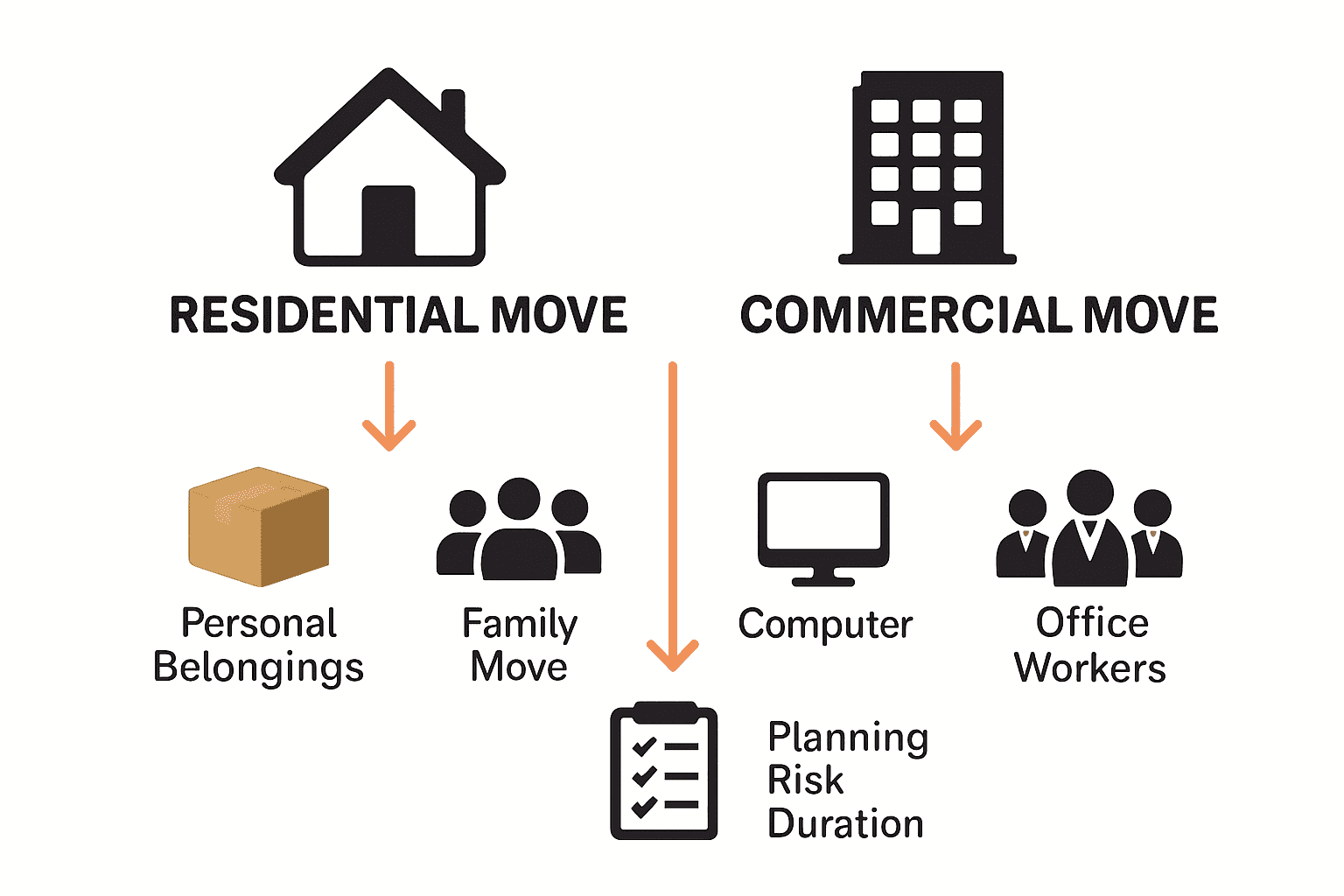
| Aspect | Residential Moves | Commercial Moves |
|---|---|---|
| Main Focus | Household belongings | Business infrastructure |
| Typical Items | Furniture Personal items Appliances |
Office equipment Technology Machinery |
| Planning Complexity | Low to moderate | High |
| Legal Requirements | Lease agreements Insurance Local regulations |
HR compliance Data protection Contract management |
| Typical Duration | Hours to 1 day | Multiple days to weeks |
| Key Risks | Emotional stress Logistics issues |
Business disruption Productivity loss |
| Cost Factors | Distance Volume Season |
Infrastructure Technology Operational downtime |
| Partner Selection | Customer reviews Insurance Service variety |
Specialist expertise Project management Risk protocols |
The moving process varies dramatically between residential and commercial relocations, with each requiring distinct approaches, planning strategies, and logistical considerations. While both types of moves involve transporting items from one location to another, the complexity and coordination required differ substantially.
According to finance.gov.au, residential moves are typically employee-initiated and focus on personal relocation logistics, whereas commercial moves are organization-driven, involving comprehensive structural changes and resource reallocation. This fundamental difference shapes every aspect of the moving process.
Residential moves generally involve:
In contrast, Australian Public Service Commission highlights that commercial moves demand extensive corporate support, requiring coordinated efforts across multiple departments. These moves involve:
A professional guide on understanding the office relocation process can provide deeper insights into navigating these complex commercial transitions. The scale and stakes are significantly different: while a residential move might disrupt a family’s weekend, a commercial move can potentially impact an entire organization’s productivity and financial performance.
Ultimately, successful moves hinge on meticulous planning, specialized expertise, and an understanding of the unique challenges inherent in either residential or commercial relocations. Professional moving services must adapt their approach to meet these distinctly different requirements, ensuring smooth transitions for individuals and businesses alike.

Residential and commercial moves are not just logistical challenges but also complex legal undertakings with specific regulatory requirements. Understanding the legal framework surrounding relocations is crucial for ensuring compliance, protecting assets, and mitigating potential risks.
According to finance.gov.au, commercial moves in the Australian public sector come with stringent legal stipulations. Specifically, employees can only be transferred while maintaining their existing employment status, and any flexible working arrangements must be carefully reviewed and continued where practical.
Residential moves involve several critical legal considerations:
Commercial relocations present more intricate legal challenges. The Australian Public Service Commission emphasizes the need for comprehensive corporate support during moves, which includes:
For businesses seeking guidance, our understanding the office relocation process resource provides deeper insights into navigating these complex legal landscapes.
Understanding these legal nuances is paramount.
Whether you’re a homeowner moving to a new residence or a business relocating operations, professional guidance can help you navigate the intricate legal requirements, ensuring a smooth, compliant transition that protects your interests and minimizes potential legal complications.
Every move presents its own set of unique challenges and potential risks, with residential and commercial relocations requiring distinctly different strategic approaches to mitigate potential complications. The complexity and stakes of these moves can vary dramatically, making thorough preparation and professional support essential.
According to the Australian Public Service Commission, poorly managed commercial moves can have significant consequences, potentially negatively impacting relationships between organizations and stakeholders, reducing operational efficiency, and undermining public confidence. This underscores the critical nature of strategic planning and execution in complex relocations.
Residential moves come with their own unique set of risks:
Commercial relocations present even more intricate challenges. The Australian Public Service Commission highlights the need for rapid setup and wind-down of operational taskforces, which requires:
For businesses seeking detailed guidance, our understanding the office relocation process resource offers comprehensive insights into navigating these complex transitions.
Ultimately, successful moves demand more than just physical transportation of items. They require meticulous planning, risk assessment, and adaptable strategies that can respond to unexpected challenges. Professional moving services play a crucial role in identifying potential risks, developing mitigation strategies, and ensuring a smooth, efficient transition for both residential and commercial clients.
Moving costs represent a significant consideration for both residential and commercial relocations, with numerous variables influencing the overall financial investment and strategic planning required. Understanding these cost factors and developing comprehensive planning strategies can help minimize unexpected expenses and ensure a smooth transition.
According to the Australian Public Service Commission, effective planning for commercial moves involves investing in coordinated corporate support and taskforce advisers to facilitate rapid setup and efficient operation. This strategic approach helps organizations manage complex relocation expenses more effectively.
Residential move cost factors typically include:
Commercial relocations demand more intricate financial planning. The Australian Public Service Commission emphasizes the importance of addressing unpredictable factors to manage costs effectively, which involves:
For businesses seeking detailed financial guidance, our understanding the office relocation process resource provides comprehensive insights into strategic cost management.
Successful moves require a holistic approach that balances financial constraints with operational requirements. Professional moving services can help develop tailored strategies that optimize resources, minimize disruptions, and provide transparent cost structures for both residential and commercial clients.
Selecting the ideal moving partner is a critical decision that can significantly impact the success and smoothness of your residential or commercial relocation. The right moving company can transform a potentially stressful experience into a seamless transition, while the wrong choice can lead to costly complications and unnecessary disruptions.
According to the Australian Public Service Commission, effective partner selection for moves involves establishing coordinated support teams with specialized expertise across multiple corporate functions. This principle applies equally to residential and commercial relocations, emphasizing the importance of comprehensive capabilities.
When evaluating residential moving partners, consider these essential factors:
Commercial moves require even more rigorous partner evaluation. The Australian Public Service Commission highlights the need for partners capable of providing coordinated corporate support across technology, finance, security, and logistical domains.
Our guide to comparing moving companies offers in-depth insights to help you make an informed decision. Professional movers should demonstrate:
Ultimately, the right moving partner becomes an extension of your team, understanding your unique needs and delivering a stress-free relocation experience. Take time to research, ask detailed questions, and select a partner who truly understands the nuanced requirements of your specific move.
Whether you are facing the challenge of moving your home or relocating your business, understanding the distinct demands of residential and commercial moves is crucial. Common pain points like protecting valuable assets, minimising disruption, managing legal requirements, and handling complex logistics can make moving feel overwhelming. Onyx Removals specialises in tailored solutions that address these concerns head-on, ensuring your move is smooth and stress free.
With expert services spanning from personal household removals to comprehensive corporate relocations, our team takes care of every detail. We handle furniture and fragile belongings with care during residential moves while expertly managing office equipment, technology transfers, and operational continuity for commercial clients. Check out our dedicated business – Onyx Removals page to explore how our corporate moving expertise can support your organisation’s needs.
Take control of your moving journey today and avoid costly disruptions. Whether you are planning a residential or commercial relocation, trust Onyx Removals to provide experienced professionals, personalised strategies, and transparent planning. Visit Onyx Removals now to get a detailed quote and start your hassle free move with confidence.
Residential moves focus on personal household belongings and are typically simpler, while commercial moves involve relocating business infrastructure and require more complex planning and coordination.
A residential move can typically be completed within a few hours to a day, while a commercial move may take several days or even weeks depending on the size and complexity of the business relocation.
For residential moves, key legal considerations include lease agreements, insurance coverage for personal belongings, and compliance with local moving regulations.
When selecting a moving partner for a commercial move, consider their specialized expertise in corporate relocations, project management skills, risk management protocols, and ability to minimize operational disruptions.

No Related Post


