



TL;DR:
- A commercial move manager oversees every aspect of office relocation, from planning to execution, ensuring smooth transitions. They own project timelines, budgets, stakeholder communication, and vendor coordination to prevent costly delays. Engaging a professional early reduces risks and improves business continuity during move day.
A commercial move manager is the professional accountable for planning, coordinating, and executing every element of an office relocation from the first site assessment through to the final day of settlement. The industry also refers to this role as a commercial relocation specialist or office move coordinator, and both terms describe the same function: a single point of accountability who connects strategy, design, approvals, procurement, and the physical move. Without this role, gaps between design, fit-out, and relocation stages create costly delays that disrupt operations and erode staff confidence. For business owners and corporate decision-makers, understanding what this professional does, and why it matters, is the difference between a controlled transition and an expensive scramble.

The responsibilities of a move manager span the full lifecycle of a relocation project, not just the physical move day. This is the most common misconception business owners hold. The role covers six core areas.
Pro Tip: Ask any prospective move manager to show you a sample programme. A credible professional will have a detailed, phased schedule ready. A vague answer at this stage signals trouble ahead.
Many businesses assign relocation responsibilities to an office manager, an operations lead, or a facilities coordinator. This approach carries a hidden cost that rarely appears in the initial budget.
The advantages of professional movers extend well beyond lifting furniture. The planning, sequencing, and communication work that happens in the weeks before move day determines whether the business loses two days of productivity or two weeks.
Commercial relocations are genuinely complex projects. The challenges are predictable, but they require experience to manage well.
Pro Tip: Engage your move manager during the fit-out phase, not after it. Early involvement is the single most effective way to prevent the handover problems that cause the most expensive delays.
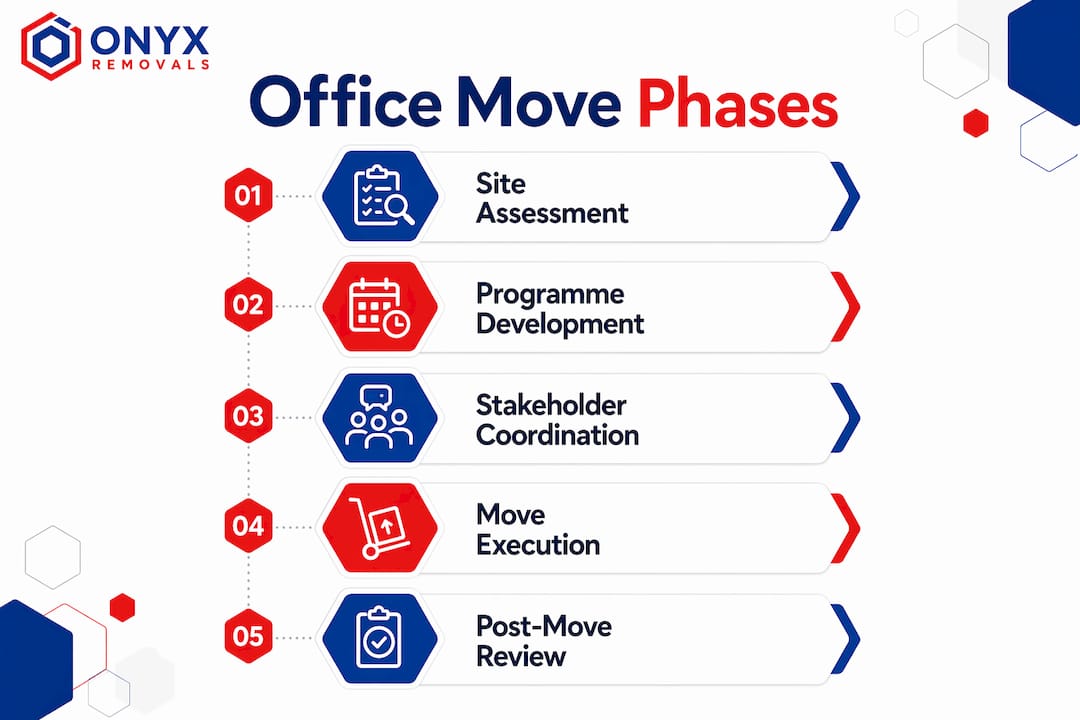
The execution of a commercial relocation follows a clear sequence. Each phase builds on the last, and skipping any stage creates risk in the next.
| Phase | Key deliverable |
|---|---|
| Site assessment | Scope document and access constraints report |
| Programme and budget | Signed-off schedule with contingency allowances |
| Stakeholder engagement | Communication plan for all affected parties |
| Vendor procurement | Confirmed schedules and briefing documents |
| Move day management | On-site direction and real-time issue resolution |
| Post-move follow-up | Defect log and operational sign-off |
The corporate moving benefits of this structured approach are measurable. Businesses that follow a phased programme consistently report fewer lost workdays and lower total relocation costs than those that treat the move as a single event.
A commercial move manager is the single point of accountability who prevents the planning, coordination, and communication failures that turn office relocations into costly disruptions.
| Point | Details |
|---|---|
| Single accountability | One professional owns every decision, reducing gaps between workstreams. |
| Early involvement matters | Engaging a move manager during fit-out prevents expensive handover problems. |
| Communication is operational | Clear staff updates maintain productivity through the transition period. |
| Structured phases reduce risk | A phased programme with contingency allowances keeps budgets and schedules on track. |
| Internal coordination has limits | Internal staff managing moves alongside their usual workloads create avoidable delays. |
The most underrated quality in a commercial move manager is not their ability to manage a programme. It is their willingness to give you an honest conversation when something is off track.
I have seen relocations managed by people who sent weekly updates full of green status indicators right up until the week before move day, when everything turned red at once. Reliable reporting and honest conversations about shifting lead times give businesses the ability to adjust operational expectations before a problem becomes a crisis. That is a fundamentally different skill from producing polished status reports.
The other thing I have observed consistently is that businesses which involve their move manager early, during the fit-out phase rather than after it, avoid the category of problems that are genuinely hard to fix. Inadequate power capacity, furniture that does not fit the floor plan, IT cabling that conflicts with workstation layouts. These are not move-day problems. They are design-phase problems that went unnoticed because no one with relocation experience was in the room. The office relocation project management discipline exists precisely to close that gap.
The businesses that get the most value from a commercial move manager are those that treat the role as a project lead, not a logistics coordinator. The distinction matters. A logistics coordinator moves boxes. A project lead protects your business continuity.
— Dinshaw
Onyx Removals provides commercial removalist services in Melbourne with a focus on minimising business downtime during office relocations. The team brings structured project management to every commercial move, covering vendor coordination, stakeholder communication, risk planning, and on-site execution.
Onyx Removals operates as a single point of accountability for the full relocation process, from initial site assessment through to post-move issue resolution. Business owners and corporate decision-makers who want a controlled, well-communicated transition can explore the full range of commercial moving services or contact the team directly for a tailored relocation plan.
A commercial move manager is the single point of accountability for planning, coordinating, and executing an office relocation. The role covers programme development, budget management, vendor coordination, staff communication, and on-site move-day management.
A removalist transports assets on move day. A commercial move manager plans everything before the move and ensures the business is fully operational from day one, which significantly reduces costly disruption.
A business should engage a commercial move manager as early as the fit-out phase, not after it. Early involvement prevents handover risks where design decisions create expensive problems on move day.
The main risks include handover gaps between fit-out and relocation, supply chain delays, stakeholder communication failures, and non-compliance with building access and safety requirements.
Ask to see a sample programme, a risk register, and examples of stakeholder communication plans from previous projects. A credible commercial relocation specialist will have all three ready without hesitation.

No Related Post


