



Yes, you can hire a professional one-way removalist in Australia right now. For a full-service move where someone else handles the pickup, transport and delivery, Onyx Removals is a strong starting point for Melbourne households and businesses.
Your fastest next steps:
Hiring a professional one-way removalist in Australia requires confirming Goods in Transit insurance, getting a written itemised quote, and scheduling a pre-move site assessment before committing.
| Point | Details |
|---|---|
| Get written quotes | Request itemised quotes from professional removalists; verbal estimates are not binding. |
| Confirm insurance | Ask for Goods in Transit insurance details in writing before signing any agreement. |
| Interstate cost range | A Melbourne–Sydney family move typically costs $4,000–$5,000 including insurance and packing. |
| Book early | Allow 4–6 weeks lead time for interstate moves, especially during peak periods. |
| Onyx Removals | Covers residential and commercial one-way moves with site assessments, insurance and written quotes. |
In this guide, the phrase refers to hiring a professional removalist company to collect your belongings from one address and deliver them to another. That includes local suburb-to-suburb moves and long-distance interstate relocations. The removalist supplies the vehicle, the crew and the expertise. You do not drive anything.
This is distinct from renting a van and driving it yourself. Every section of this guide covers the full-service model: professional movers, packing and unpacking services, storage options, insurance and specialty-item handling. Two industry benchmarks worth knowing early: AFRA (the Australian Furniture Removers Association) membership signals a removalist meets minimum professional standards, and Goods in Transit insurance protects your belongings during transport.
The clearest cases are interstate family moves, long-distance relocations between cities, and CBD office moves where downtime costs money. A Melbourne-to-Sydney household move with a three-bedroom home’s worth of furniture is the textbook example. Attempting that with a hired van and two friends is technically possible; it is rarely worth it.

Full-service moves cost more than DIY but reduce risk and save significant time. DIY remains a reasonable option for a tight budget or a short local move with minimal furniture. For anything heavier, more complex or time-sensitive, a professional one-way removalist is the practical choice.
Other situations that fit well: single-direction deliveries from storage facilities or auction houses, business equipment relocations, and moves involving specialty items like pianos or large artworks.
Core inclusions you should expect in any standard quote:
Common add-ons that cost extra:
Professional interstate removalists commonly offer warehousing, bespoke packing, lifting and tailored transport solutions alongside upfront quotes.
Pro Tip: Before signing anything, photograph every item of value and request line-item pricing on the quote: labour, vehicle, packing materials, insurance and any extras listed separately. That documentation makes any post-move claim far simpler.
Pricing follows two main models. Local moves are usually charged hourly, with the rate depending on crew size and truck type. Interstate moves are typically quoted as a flat rate based on volume, distance and access conditions at both ends.
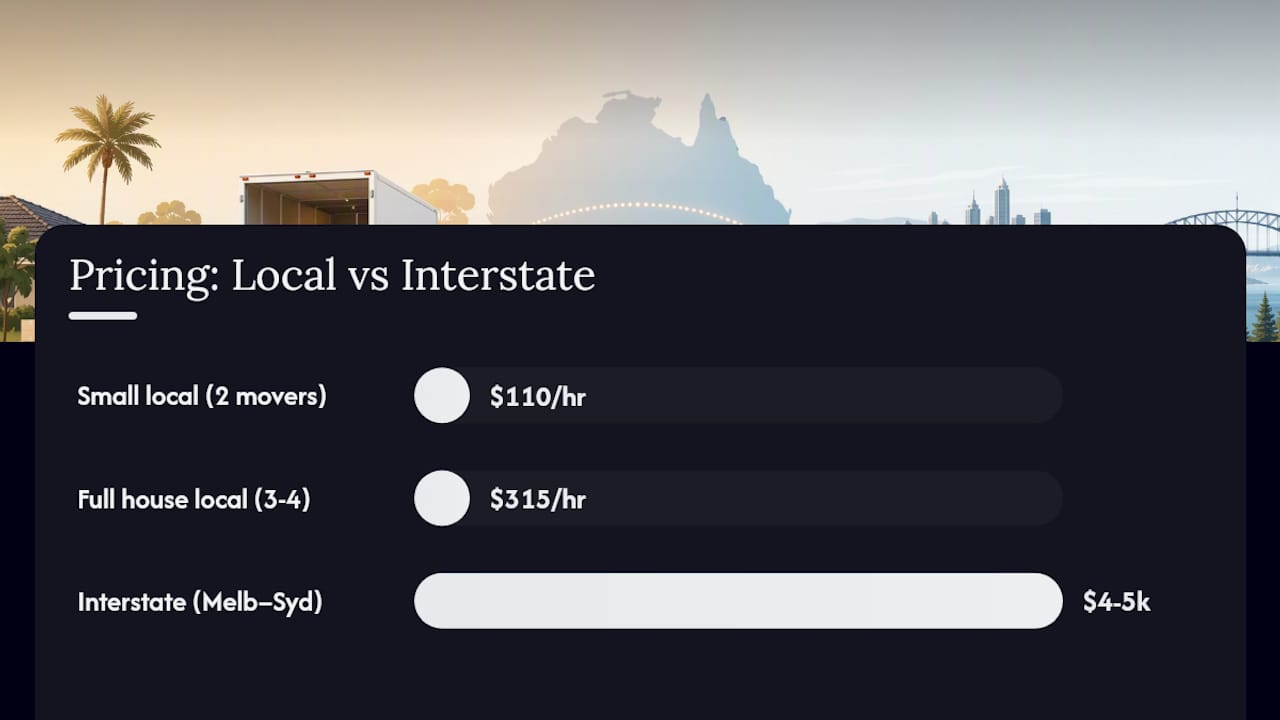
Typical Sydney hourly rates run from around $110/hr for a small two-person job to $315/hr for a larger team. A Melbourne-to-Sydney interstate family move commonly lands in the $4,000–$5,000 range, including insurance and packing. Use Onyx’s interstate cost calculator for a faster estimate.
| Move type | Ballpark range (AUD) | Notes |
|---|---|---|
| Small local job (2 movers) | $110/hr | 2–3 hours typical for a 1-bedroom |
| Full house local (3–4 movers) | $315/hr | 4–8 hours depending on access |
| Interstate family move | $4,000–$5,000 | Melbourne–Sydney, includes insurance |
| Stairs surcharge | Varies by provider | Confirm in writing before booking |
| Piano or specialty item | Quoted separately | Disclose early to avoid day-of delays |
Primary cost drivers:
Must-have checks before you book:
Checking licences, AFRA membership and Goods in Transit insurance, and insisting on itemised written quotes, reduces delays and disputes significantly.
Questions to ask on the call or site visit:
Red flags to walk away from:
4+ weeks out: Book your removalist, confirm dates, request a site assessment, and start decluttering. A pre-move junk removal reduces your volume and can lower the quote.
2 weeks out: Confirm packing materials, notify utilities and update your address with Australia Post. If you need short-term storage, book it now.
1 week out: Pack non-essentials, label every box with room and contents, and photograph valuables. Confirm the removalist’s arrival time and your delivery address contact.
Day before: Clear access paths at both ends, arrange parking permits if needed, and book any building lifts. Have your inventory list and insurance documents ready.
On moving day: Walk through with the crew before loading starts, sign off on the inventory, and keep your contact details accessible for the delivery team. Confirm the delivery window in writing if you have not already.
On cancellation and rescheduling: Most removalists require 48–72 hours’ notice to avoid a cancellation fee. Some charge a percentage of the quoted price for late cancellations. Confirm the exact terms when you book, not after.
The key metric for a business move is operational downtime, not just cost. A full-day shutdown in a CBD office can cost far more than the removalist’s invoice.
Commercial moves rely on pre-move site assessments, detailed scheduling and after-hours or weekend availability to minimise disruption. Services typically include workstation disassembly and reassembly, IT equipment handling, asset tagging and labelling, and coordinated delivery to the new premises.
Commercial move priorities:
Pro Tip: Stage the move in phases. Move non-critical departments or storage first, keep core operations running, then move the final team. A phased approach often cuts total downtime by half compared to a single-day shutdown.
A typical CBD office relocation might schedule IT disconnection on a Friday afternoon, move furniture and equipment overnight, and have the new space operational by Monday morning. That requires a removalist with confirmed after-hours availability and a documented schedule, not a verbal agreement.
Onyx Removals covers the full range of one-way move types: residential removal, commercial and office relocation, packing and unpacking, storage solutions and specialty-item handling. The services page documents the complete offering for both household and business customers.
For residential customers, Onyx handles packing, transport and unpacking for local Melbourne moves and longer interstate relocations. For businesses, Onyx’s commercial approach centres on pre-move assessments, scheduled moves to minimise downtime and insurance documentation.
Trust signals to confirm when you enquire: Goods in Transit insurance coverage, written itemised quotes, pre-move site assessments and documented delivery windows. Onyx also provides cost guides and online tools to estimate your move before you commit to a quote.
The total timeline depends on move type, but here is a realistic picture:
Booking to move day: Allow 2–4 weeks for a local move, and 4–6 weeks for an interstate move during peak periods (December–January, school holidays).
Move day itself: A local one-bedroom move typically takes 3–5 hours. A full three-bedroom house locally runs 6–10 hours. Interstate moves involve overnight or multi-day transit depending on distance.
Delivery window: For interstate moves, delivery is usually scheduled 1–5 business days after pickup, depending on route and whether shared or dedicated transport is used. Confirm the exact window in your written quote.
Total elapsed time: From first enquiry to keys-in-hand at the new address, most households should budget 3–6 weeks for a well-organised move.
Removalist agreements vary, but these clauses consistently catch people off guard:
Liability limits: Many contracts cap liability per item or per kilogram, not at replacement value. If you have high-value items, ask whether additional declared-value cover is available.
Exclusion clauses: Contracts often exclude damage to items packed by the owner, items in poor condition before the move, or damage caused by access difficulties the removalist was not told about. Disclose everything upfront.
Payment terms: Some providers require a deposit at booking and the balance before unloading. Understand when each payment falls due.
Cancellation fees: These range from a flat fee to a percentage of the quoted price. The notice period required to avoid a fee varies widely.
Delivery window clauses: Interstate contracts often give a delivery window rather than a fixed date. Understand what compensation, if any, applies if the window is missed.
Storage charges: If delivery cannot proceed on the agreed date, some contracts automatically trigger storage fees. Confirm the daily rate before signing.
The most common mistake is treating parking and access as an afterthought. A removalist crew that cannot park within a reasonable distance of your front door will either charge waiting time or reschedule. In Melbourne’s inner suburbs, a parking permit for the moving truck is not optional — it is the difference between a smooth 6-hour move and a stressful 10-hour one.
The second issue is undisclosing specialty items. A piano, a large safe or a commercial espresso machine needs to be on the quote from day one. Mentioning it on moving day means the crew may not have the right equipment, and you will pay for the delay.
Request written arrival and delivery windows, not verbal estimates. “We’ll be there in the morning” is not a window. “8:00 AM–9:00 AM arrival, delivery between 2:00 PM and 5:00 PM” is.
Onyx Removals takes the guesswork out of one-way relocations in Melbourne and beyond. Rather than coordinating multiple providers for packing, transport, storage and specialty handling, you get a single point of contact with documented insurance, written quotes and a pre-move site assessment built into the process.
To get started, use the online quote tool to estimate your costs, or contact Onyx directly to book a site assessment. Have your move date, pickup and delivery addresses, and a rough inventory ready. For business moves, mention any after-hours requirements upfront. Visit the residential moving services page to see the full scope of what is covered and request your quote today.

No Related Post


