



Moving a business is never just about loading boxes into a truck. Some office relocations end up costing between $15,000 and $75,000 for larger enterprises. Most business owners expect the price tag to be all about how much furniture or gear you have. The real shock comes when you see how factors like downtime, tech complexity and unexpected executive demands spiral the cost far beyond what anyone first imagines.
| Takeaway | Explanation |
|---|---|
| Commercial removals require strategic planning | Effective planning ensures minimal disruption and continuity during the relocation process. |
| Cost factors include volume and complexity | The overall cost varies based on asset type, quantity, and logistics involved in the move. |
| Understanding costs aids financial planning | Recognising potential expenses helps businesses create accurate budgets and avoid overruns. |
| Assess operational risks during moves | Identifying risks such as equipment damage and data security helps mitigate potential issues. |
| Professional removalists provide tailored solutions | Engaging specialists allows businesses to manage logistics effectively, turning challenges into manageable transitions. |
Commercial removals represent a specialised moving service designed to help businesses transition between different physical locations, whether relocating an entire office, warehouse, retail space, or specialised operational environment. Unlike residential moves, commercial removals involve complex logistics, precise planning, and unique considerations that directly impact a company’s operational continuity.
Commercial removals are far more intricate than standard residential moves. They require strategic planning, specialised equipment, and a deep understanding of business infrastructure. Our comprehensive commercial relocation guide highlights the multifaceted nature of these transitions.
Key factors that distinguish commercial removals include:
The cost of commercial removals varies significantly based on multiple interconnected factors. According to business logistics research, professional commercial removal expenses can range from several thousand to tens of thousands of dollars depending on the scale and complexity of the move.
Primary cost determinants include:
Below is a summary table outlining the primary factors that influence the cost of commercial removals, making it easier to identify what drives pricing differences for business relocations.
| Cost Factor | Description | Examples |
|---|---|---|
| Volume and Weight | Total amount of assets and their overall mass | Large office furniture, industrial machinery |
| Distance | Physical distance between old and new premises | Local moves vs. interstate relocations |
| Asset Complexity | Special business equipment or sensitive technological infrastructure | Medical devices, custom IT servers |
| Specialised Equipment Required | Necessity for unique tools or packing due to item nature | Heavy-duty lifts, secure data transport cases |
| Timing and Scheduling | Impact of move timing, including urgency or requirement for after-hours work | Moves during business peaks or tight deadlines |
| Additional Services Provided | Extras such as packing, unpacking, storage, or specialised insurance | Short-term storage, full-service packing |
| Building Access and Constraints | Ease of loading/unloading at both sites, including access or parking issues | High-rise buildings, CBD locations |
Businesses must approach commercial removals as strategic investments, recognising that professional, well-executed moves can significantly reduce potential operational disruptions and financial risks associated with relocation.
For businesses, understanding the comprehensive landscape of commercial removal costs represents more than a simple budgetary exercise. It is a strategic imperative that directly influences operational efficiency, financial planning, and organisational resilience. Our comprehensive guide on business continuity emphasises the critical role of meticulous planning during complex transitions.
Accurate cost comprehension enables businesses to develop precise financial strategies. According to Australian Business Research, unexpected moving expenses can disrupt financial forecasts by up to 30%, potentially compromising quarterly performance and strategic investments.
Key financial considerations include:
Comprehensive cost understanding goes beyond monetary considerations. Effective removal cost assessment helps businesses anticipate potential operational risks. These risks can include equipment damage, data security challenges, and productivity interruptions that extend far beyond immediate moving expenses.
Potential operational risks businesses must evaluate:

Businesses that invest time in understanding detailed removal costs position themselves to execute smoother, more predictable relocations. By treating commercial removals as strategic investments rather than mere logistical challenges, organisations can transform potential disruptions into opportunities for streamlined operational enhancement.
Commercial removal costs are not uniform but represent a complex interplay of multiple dynamic factors. Businesses seeking precise budgeting must understand these nuanced elements that collectively determine the financial investment required for a successful relocation. Our comprehensive guide on hidden moving costs provides deeper insights into potential unexpected expenses.
The most fundamental cost determinant in commercial removals is the total volume and complexity of assets being relocated. This goes beyond simple weight measurements and encompasses the specialised nature of business equipment. According to Australian Logistics Research, businesses spend between 2-7% of their annual operational budget on relocation and asset movement.
Key asset complexity considerations include:
Geographic factors play a substantial role in determining commercial removal expenses. The distance between origin and destination, accessibility of premises, and local infrastructure significantly impact overall costs. Urban environments with complex street layouts or restricted access zones can dramatically increase transportation and logistical expenses.
Primary geographic cost influencers include:
Businesses must approach commercial removals as strategic investments, recognising that comprehensive planning and understanding these key cost factors can transform potential logistical challenges into smooth, efficient transitions. Engaging professional commercial removalists who can provide transparent, detailed assessments becomes crucial in managing these multifaceted expenses effectively.
Commercial removal pricing varies dramatically across different business contexts, reflecting the unique complexities of each organisational move. Our comprehensive guide on commercial storage solutions provides additional context for businesses navigating these intricate pricing landscapes.
For small businesses with approximately 200-500 square metres of office space, removal costs typically range between $3,000 and $8,000. According to Australian Small Business Logistics Report, these estimates include transportation, basic packing services, and standard equipment handling.
Typical cost breakdowns for small business moves include:
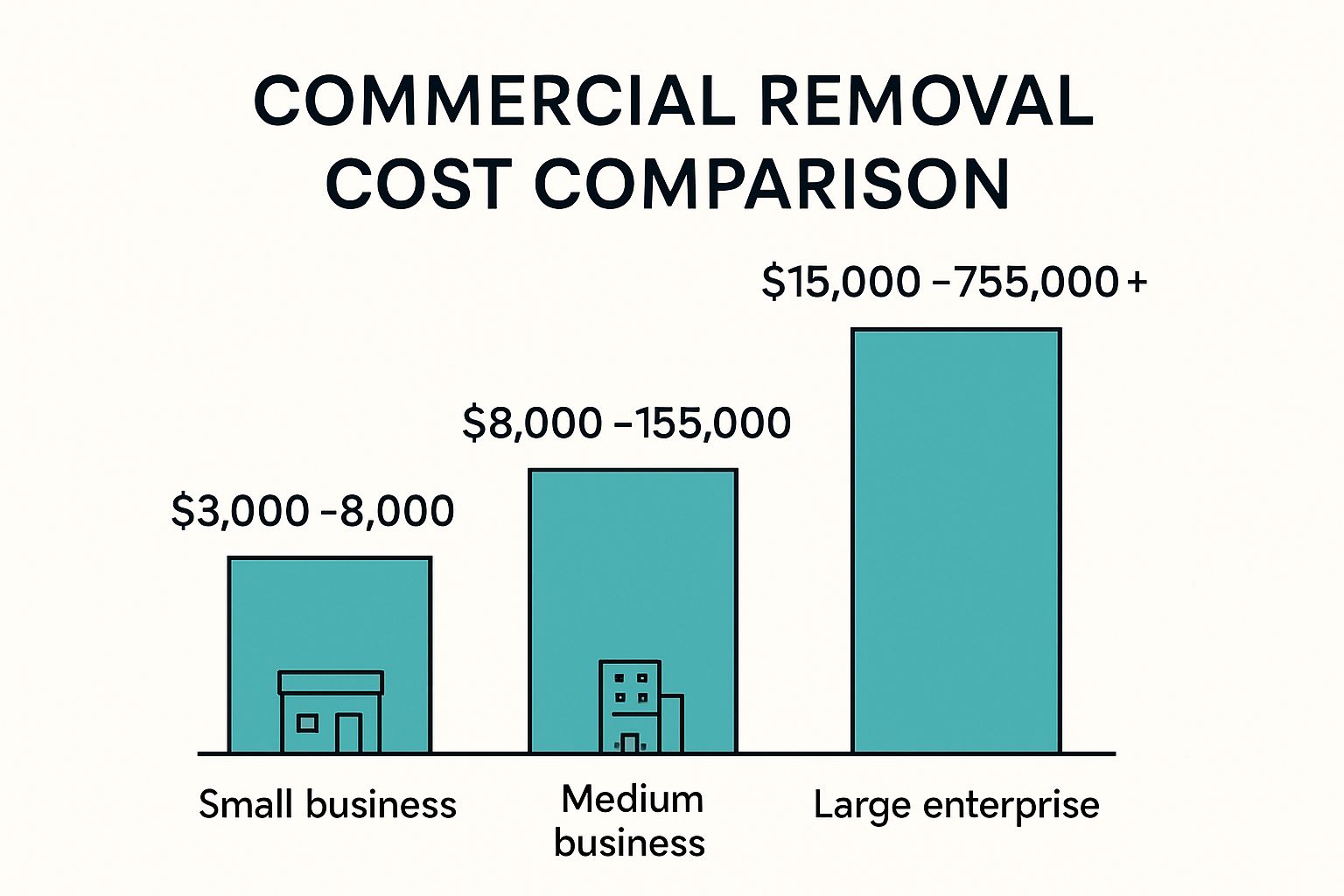
Larger organisations with complex infrastructure face significantly higher removal expenses. Enterprise-level commercial removals can range from $15,000 to $75,000, depending on technological infrastructure, geographical distance, and operational complexity.
Key pricing variables for larger moves include:
Businesses must recognise that commercial removal pricing is not a one-size-fits-all proposition.
This table provides a direct comparison of typical commercial removal costs and included services for small businesses versus medium to large enterprises, helping businesses benchmark their budgeting expectations.
| Business Size | Typical Cost Range | Key Inclusions |
|---|---|---|
| Small Business (200-500 sqm) | $3,000 – $8,000 | Transportation, basic packing, standard handling |
| Medium-Large Enterprise | $15,000 – $75,000 | Asset coordination, risk management, tech moves |
| Advanced planning, security protocols | ||
| Multiple locations, specialised logistics |
Successful commercial removal planning demands a strategic, proactive approach that anticipates potential financial complexities. Our comprehensive guide on budgeting for relocation provides additional insights into developing robust financial strategies for business transitions.
Businesses must conduct a meticulous financial evaluation before initiating any removal process. According to Australian Financial Planning Association, organisations that develop comprehensive financial models reduce unexpected expenses by up to 40%.
Key financial assessment components include:
Effective commercial removal budgeting extends beyond simple cost estimation. Successful organisations integrate multiple financial planning strategies to manage potential variabilities. This approach transforms removal expenses from potential financial risks into manageable, predictable investments.
Primary budgeting strategies include:
Businesses must approach commercial removal planning as a holistic financial strategy. By integrating comprehensive assessment, strategic budgeting, and proactive risk management, organisations can transform potential logistical challenges into smooth, financially controlled transitions that minimise operational disruption and maximise strategic efficiency.
Understanding the true cost of a commercial removal can feel overwhelming, especially when you’re faced with the risks of downtime, budget blowouts, and complex logistics. If your business demands precision planning, cost transparency, and secure asset handling, you are not alone. Your concerns about unexpected expenses and smooth operational transition are valid. That’s exactly why Onyx Removals tailors each move to your unique business needs by drawing on local Melbourne experience and proven commercial strategies. Explore our full range of office and business solutions on the business removalists page.

Why leave your move to chance when you can secure a reliable partner trusted by Melbourne businesses? Let the Onyx Removals team minimise every risk with transparent quotes, flexible planning, and specialised support at every stage. Visit our website today to request your no-obligation assessment. Bring confidence and control back to your next commercial relocation.
Commercial removals are specialised moving services designed for businesses relocating office spaces, warehouses, or retail locations. They involve complex logistics and planning to minimise operational downtime and ensure secure transportation of sensitive items.
The cost of commercial removals is influenced by factors such as the total volume and weight of items, the distance of the move, the complexity of equipment being relocated, and any additional services required, such as packing or storage.
Businesses can effectively budget by conducting a comprehensive financial assessment, obtaining multiple quotes from removalists, creating tiered budget scenarios, and setting aside contingency funds to manage unexpected expenses during the move.
Common risks include potential damage to equipment during transit, extended downtime that affects productivity, challenges with data security, and difficulties in transitioning technology infrastructure. Mitigating these risks involves thorough planning and engaging professional removalists.

No Related Post


