



TL;DR:
- Interstate moving costs from Melbourne average around $183 per cubic meter, with options for savings through backloading and early booking.
- Services include full packing, storage, and specialized handling, tailored for residential and commercial moves.
- Choosing a responsive, well-communicating removalist with personalized support greatly enhances move satisfaction.
Planning a move out of Melbourne doesn’t have to drain your savings or your sanity. Many homeowners and businesses assume that crossing state lines automatically means enormous costs and weeks of chaos, but that assumption is outdated. The reality is that today’s interstate moving industry offers a wide range of service levels, pricing models, and smart options that can make the process far more manageable. Whether you’re relocating a family home or shifting an entire office, this guide walks you through what to expect, what to spend, and how to make every dollar count.
| Point | Details |
|---|---|
| Plan for flexibility | Flexibility with your moving date or backloading can save you up to 50%. |
| Professional packing pays off | Full-service packing reduces stress, especially for families and businesses with complex needs. |
| Book off-peak times | Choosing non-peak periods for your move can cut costs by 10-30%. |
| Personalised movers stand out | Family-focused or bespoke service providers often deliver higher satisfaction than large corporates. |
| Business moves need planning | For commercial relocations, specialist support is needed to avoid costly downtime. |
Before you start comparing quotes, it helps to understand exactly what interstate moving companies actually offer and how those services differ depending on whether you’re moving a household or a business.
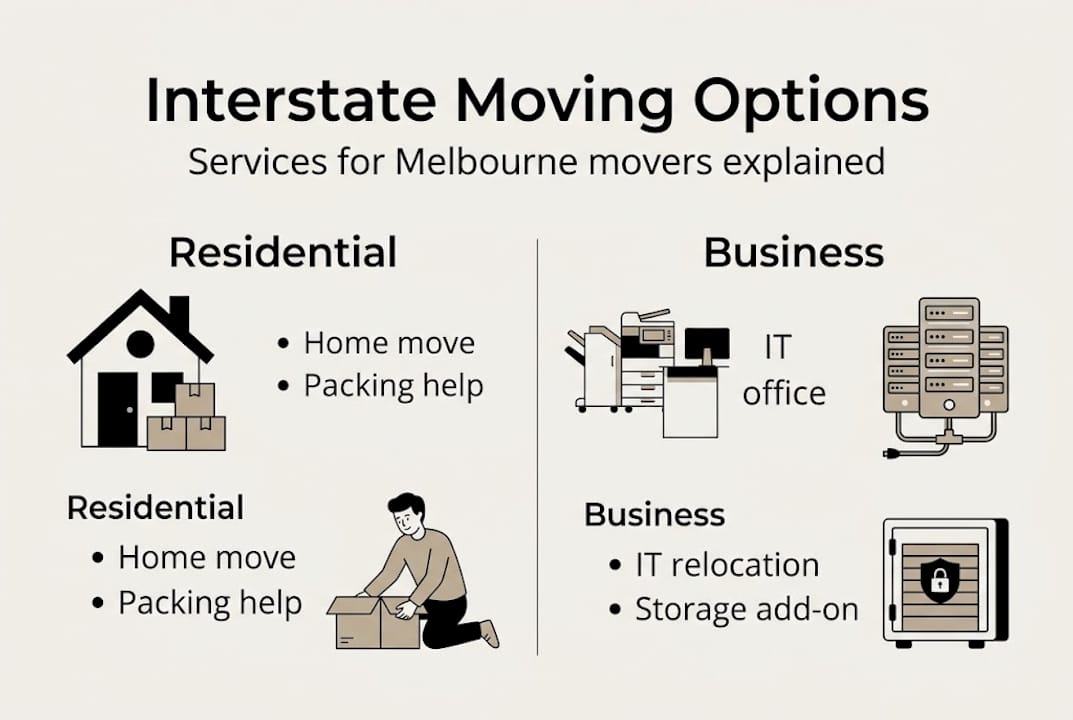
Residential removals cover everything from studio apartments to large family homes. A typical residential interstate move from Melbourne includes transport of furniture and boxes, optional packing and unpacking services, basic goods-in-transit insurance, and disassembly or reassembly of larger furniture pieces. Some providers also offer cleaning, storage, and even plant transport for families who want a genuinely full-service experience.
Commercial removals are a different matter altogether. Businesses moving interstate need a level of planning and coordination that goes well beyond loading a truck. Commercial relocations require pre-move surveys, IT infrastructure moves with zero-downtime strategies, specialised machinery trailers, and regulatory compliance. The daily downtime risk for a business during a poorly managed move can reach between $5,000 and $20,000, which makes specialist handling far more than a convenience. It’s a financial necessity.
One of the most important distinctions to understand in Melbourne’s moving industry is the difference between a dedicated truck service and backloading.
| Feature | Dedicated truck | Backloading |
|---|---|---|
| Cost | Higher | Up to 50% less |
| Transit time | Fast, direct | Flexible, longer |
| Scheduling | Your chosen date | Dependent on truck availability |
| Best for | Urgent moves, large homes | Flexible movers, budget-conscious |
| Special items | Easier to accommodate | May have restrictions |
With a dedicated truck, the vehicle is exclusively yours from pick-up to delivery. You control the timeline, and the movers focus entirely on your job. Backloading means your belongings share space on a truck that’s already making the same route, which slashes the cost but requires flexibility on your end regarding dates and sometimes delivery windows.
Here’s a quick summary of what quality interstate movers typically include:
Understanding these distinctions before you get your first quote puts you in a far stronger position to ask the right questions and choose a service that genuinely matches your needs.
The most common question we hear is: “What’s this actually going to cost me?” Fair enough. Let’s break it down with real numbers.
According to current market data, interstate moving costs from Melbourne average around $183 per cubic metre. For a standard 3-bedroom home with 20 to 25 cubic metres of goods, that translates to a total of roughly $3,600 to $4,600 for a full-service dedicated move. That figure can shift based on destination, access difficulties, and the specific services you choose.
| Move type | Approx. volume | Estimated cost range |
|---|---|---|
| 1-bedroom apartment | 8-12 m³ | $1,464 to $2,196 |
| 3-bedroom house | 20-25 m³ | $3,600 to $4,600 |
| 4-5 bedroom home | 35-45 m³ | $6,400 to $8,200 |
| Small office (10-20 staff) | Varies | $4,000 to $15,000+ |
For homeowners who have flexibility around their move date, backloading can cut that bill by up to 50%. That’s a significant saving, though it does come with trade-offs. You’ll need to work around the truck’s schedule rather than your ideal moving day.
Packing is another cost to factor in. If you’d rather not spend a weekend bubble-wrapping your crockery, professional packing services typically add $400 to $800 to the total bill for a standard home. That’s money well spent for many families, particularly those with young children, demanding jobs, or fragile collections.
Timing also plays a bigger role than most people expect. The best time to move house is generally midweek during the off-peak months. Peak season surcharges during December to February and June to July typically add 10 to 15% to your quoted price. That’s not a small amount on a $4,000 move.
For businesses, the financial picture is more complex. Beyond the direct cost of the move itself, the real risk lies in downtime. A business that loses a full day of operations during a poorly planned move faces downtime costs of $5,000 to $20,000. On the flip side, many businesses that move interstate do so to access lower overheads. A team of 50 staff moving from inner Melbourne to a regional area might save upwards of $60,000 per year in rent alone, making the upfront cost of a specialist commercial move look very reasonable indeed.
Here’s a numbered breakdown of typical cost factors for an interstate move from Melbourne:
Pro Tip: If your move can wait even a few weeks, shifting to a midweek slot during March, April, September, or October can reduce your total by 10 to 30%. Check with budget interstate movers about their off-peak availability before locking in a date.
Knowing what you’ll pay is important, but cutting those costs is even better. Here are expert-backed strategies that genuinely work.
Start with a ruthless declutter. Every cubic metre you remove from your load saves you approximately $140 to $225 in transport costs. That old treadmill nobody uses, the mismatched dining chairs in storage, the boxes that haven’t been opened since your last move — sell them, donate them, or dispose of them. You’ll save money on the move and feel lighter in your new home.
Here are the most effective cost-cutting moves for Melbourne residents:
Backloading deserves a closer look. It’s genuinely excellent for homeowners and small businesses that don’t need to move on a specific date. The trade-off is that delivery windows can be longer, sometimes by several days, and you have less control over exactly when your items arrive. If you can stay with family or use short-term storage at the destination, backloading is one of the smartest financial decisions you can make on an interstate move. You can read more about the most affordable moving options for Melbourne homes to weigh this up.
“The biggest savings don’t come from negotiating a lower hourly rate. They come from reducing your volume, choosing the right service type, and picking a date that works for the removalist’s schedule.”
For businesses, the picture is slightly different. Timing your office move around a low-demand business period, such as the week between Christmas and New Year’s or during a product slow season, can significantly reduce disruption. There’s also a growing push among Melbourne businesses to choose removalists with strong environmental credentials. Some providers now offer lower-emission vehicles and consolidated transport options that align with moving company efficiency and ESG reporting goals, which matters to businesses with sustainability commitments.
Pro Tip: Ask your commercial removalist specifically about night shifts or weekend moves. Moving outside of business hours can mean your staff arrives Monday morning to a fully operational office, with zero disruption to client-facing work.
Cost-saving is key, but genuine peace of mind often comes from personalised support and the right add-ons.
When it comes to packing, you have three realistic options:
For families, professional packing services are genuinely worth the extra cost. It’s not just about saving time. It’s about reducing the mental load during an already stressful period. Professionally packed boxes also tend to have fewer breakages, which matters when you’re moving grandmother’s china 800 kilometres.
Storage solutions are another underutilised feature of quality interstate moves. If your settlement dates don’t align perfectly or your new office isn’t quite ready when you vacate the old one, short-term storage bridges that gap without requiring you to rush the move or store items with a third party. Many premium movers build this into their service offering.
For commercial clients, the add-ons that matter most are different. IT relocation planning, including careful disconnection, transport, and reconnection of servers and workstations, is increasingly standard among quality commercial removalists. So is business continuity planning, which ensures your operations remain functional throughout the transition. These aren’t luxuries. They’re the features that separate a well-managed business move from a chaotic one.

Full-service packing and removalist support is worth discussing in detail with any provider you consider. Ask specifically what’s included, what’s extra, and how they handle fragile or high-value items.
One pattern we notice consistently is that smaller, family-run operations often outperform large corporates on personalised service. Real customer feedback supports this. A recent Reddit discussion about Melbourne to Brisbane moves highlighted several providers offering genuinely attentive service, with reviewers noting that communication before, during, and after the move made a significant difference to their experience. Family-owned businesses with 20 or more years in the industry bring a level of accountability and personal investment that larger operators sometimes struggle to match.
Pro Tip: When evaluating removalists, ask who will be your direct point of contact on moving day. A named person who knows your job and answers their phone is worth more than any brochure.
Here’s something we’ve noticed after working in this industry: most people make their removalist decision based almost entirely on price. They get three quotes, pick the cheapest, and hope for the best. And sometimes it works out fine. But more often than not, the problems show up later.
A quote that’s 25% cheaper than the others usually means something has been left out. It might be insurance, it might be an accurate volume estimate, or it might simply be that the team cutting corners on time will rush your job on the day. The lowest price tag rarely reflects the actual value you’re getting.
What genuinely drives satisfaction in an interstate move is planning quality, communication, and adaptability. A removalist who calls ahead, shows up on time, adapts when the lift is out of service, and handles your items with care is delivering far more value than one who undercuts the market by skipping those basics. When you’re understanding removalist options, focus on service style, responsiveness, and how the provider responds when things go unexpectedly. That’s where the real difference lies.
The checklist culture around moving, comparing features on paper, can obscure what actually matters: finding a team that communicates clearly and genuinely adapts to your situation. For families, that might mean flexibility around school terms. For businesses, it might mean a provider who can work overnight. The price is just the starting point.
Moving interstate from Melbourne is a significant undertaking, but it doesn’t have to be overwhelming. With the right provider managing the logistics, the experience can be genuinely straightforward.

At Onyx Removals, we work with both homeowners and businesses across Melbourne to plan and execute interstate moves that are efficient, affordable, and tailored to your specific situation. Whether you need residential moving support with full packing and storage, or expert commercial removalists to manage an office relocation with zero downtime, our team handles the details so you don’t have to. Ready to find out what your move would actually cost? Get a removal quote with no obligation and a personalised plan built around your timeline and budget.
A typical 3-bedroom home costs around $3,672 to $4,590, based on average rates of approximately $183 per cubic metre for interstate moves from Melbourne.
Booking during midweek or off-peak months saves 10 to 30%, and choosing backloading when you have flexible dates can cut costs by up to 50%.
Yes, most quality Melbourne interstate movers offer full or partial packing as an add-on, with full packing typically costing an additional $400 to $800 for a standard home.
Business daily downtime during a poorly planned interstate move can cost between $5,000 and $20,000, making specialist planning and zero-downtime strategies essential.
Yes. Client feedback and real user reviews consistently show that personalised, communicative removalists deliver significantly less stress and greater satisfaction, especially for families and businesses with complex needs.

No Related Post


