



A last minute removalist is a professional mover who handles urgent relocations booked within 24 to 72 hours of the required move date. These services exist precisely because life doesn’t always give you a month’s notice. Lease terminations, sudden settlement dates, family emergencies, and unexpected job offers all create situations where you need a truck and a trained crew today, not next week. Reputable providers keep dedicated vehicles and staff on standby specifically for these scenarios, so same day movers are a genuine option in most Australian capital cities.
Core traits of a last minute removalist service:
The industry term you’ll see used alongside “last minute removalist” is emergency moving services or short notice relocation. Both describe the same thing: a professional move executed at speed without cutting corners on safety or care.
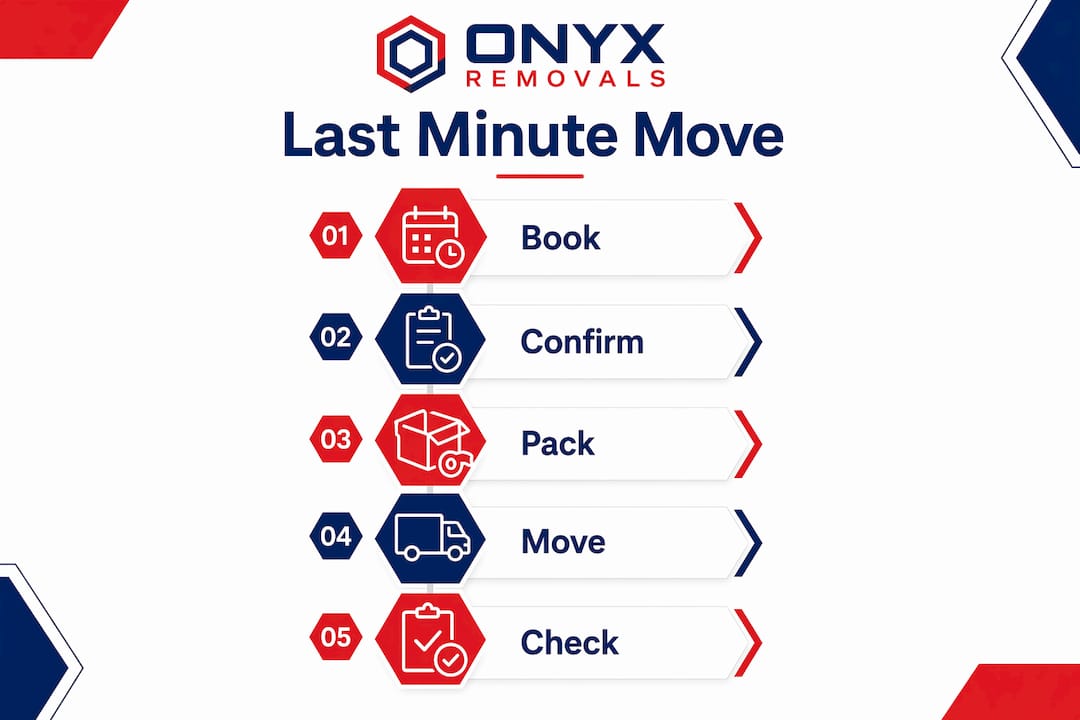
Speed matters, but so does order. The biggest mistake people make in a rushed move is treating everything as equally urgent, then running out of time on the things that actually matter.
Your first priority is confirming the move date and time with your removalist in writing. Verbal agreements fall apart under pressure. Once that’s locked in, focus on access logistics: check whether your building requires a service lift booking, whether there are height restrictions for trucks, and whether parking permits are needed. A building access oversight is one of the most common causes of delays and extra fees on moving day.

Pack a “first night” bag before anything else. Toiletries, a change of clothes, phone chargers, medications, and important documents should travel with you, not in the truck. After that, work through rooms systematically, starting with the least-used spaces so movers have room to work as soon as they arrive.
Top priorities for a last minute move:
Call directly. Don’t rely solely on online quote forms when you’re working against the clock. A phone call gets you a real answer about availability in minutes, whereas a web inquiry might sit in a queue for hours.

When you get someone on the line, ask the right questions immediately. You want to know whether they use their own employed staff or subcontractors, what size truck they’ll bring, whether the quote includes fuel levies and call-out fees, and what their policy is on stairs or difficult access. A trustworthy operator answers all of these without hesitation. One that hedges or deflects is worth skipping.
AFRA accreditation (Australian Furniture Removers Association) is a useful quality signal, particularly for larger or interstate moves. AFRA members are audited on vehicles, staff training, and equipment, and they carry the correct public liability insurance. That said, AFRA membership is voluntary, so also check for a valid ABN, Google reviews, and a physical business address.
Key questions to ask when booking on short notice:
Pro Tip: Get the quote in writing via email or SMS before you confirm. A verbal price is not a price.
Peak periods, end-of-month dates, and weekends are when removalist availability tightens fastest. If your first three calls come back fully booked, don’t panic. You have real options.
Ask each company whether they have a cancellation list. Slots open up regularly, especially for same-day or next-day moves, and being on that list costs you nothing. Flexibility with your move window helps too: a Tuesday afternoon slot is far easier to fill than a Saturday morning.
If professional movers genuinely can’t be secured in time, consider a partial self-move. Rent a trailer or small truck for boxes and lighter items, and ask friends to help. Reserve the professional crew for heavy furniture and appliances once a slot opens. Temporary storage is another practical buffer: move your belongings into a storage unit and complete the final delivery once a removalist is available.
Practical alternatives when bookings are tight:
The move is done, but the job isn’t. A rushed relocation leaves more loose ends than a planned one, so the post-move checklist matters more, not less.
Start by checking your inventory against the removalist’s paperwork. If anything is missing or damaged, report it to the company in writing on the same day. Waiting weakens your position considerably. Photograph any damage before unpacking surrounding items.
Unpack your essentials bag first, then focus on the kitchen and bathroom before anything else. Notify your utility providers of your new address, redirect your mail through Australia Post, and update your address with Medicare, the ATO, and your bank. Keep all receipts, written quotes, and the signed contract somewhere accessible in case a dispute arises.
Post-move actions to complete promptly:
AFRA sets industry standards through audits covering vehicles, staff training, and equipment, with typical public liability cover at industry-standard levels. That level of cover matters practically: strata buildings in Sydney and Melbourne routinely require a Certificate of Currency for public liability insurance before they’ll allow a move-in or approve service lift use. Without it, your move can be blocked at the door.
Removalists are not legally required to provide goods-in-transit insurance. It’s an optional extra, and in a rushed booking it’s easy to skip the conversation entirely. Don’t. Verify independently whether your goods are covered during handling and transit, and check whether your home and contents policy includes a goods-in-transit clause.
The 2026 Australian removalist market has seen consolidation, with smaller single-vehicle operators exiting and mid-market AFRA-accredited businesses gaining share. The practical effect for you: a suspiciously low quote with no documentation is more likely than ever to come from an operator with inadequate insurance or no formal training.
Red flags and best practices:
Pro Tip: Ask your removalist to email you their Certificate of Currency the day before the move. For strata buildings, forward it to your building manager immediately so lift access is confirmed before the crew arrives.
For a broader look at moving insurance options in Australia, including what public liability and goods-in-transit policies actually cover, it’s worth reviewing the details before you sign anything under time pressure.
Often, yes. Short notice bookings can attract a premium, particularly during peak periods like end-of-month, long weekends, and the december to january summer moving season. The gap between a planned booking and an urgent one varies by operator, but the cost difference is real enough to factor into your decision.
That said, a reputable operator will be upfront about any surcharge before you confirm. The price risk in last minute moves comes less from honest premiums and more from operators who quote low and add charges on the day for stairs, heavy items, or a second truck run. Getting a written, itemised quote removes most of that risk.
Booking well in advance locks in better rates and gives you access to the most experienced crews, who tend to fill their calendars first. If you’re reading this with 48 hours to go, the priority is finding a trustworthy operator at a fair price, not the cheapest one available. A low quote with no documentation almost always costs more in the end through damage, delays, or hidden fees.
When time is short, packing discipline is what separates a manageable move from a chaotic one. The goal is speed without disorder.
Work room by room rather than grabbing items at random. Label every box with its destination room and a brief contents note: “Kitchen, pots and pans” takes three seconds to write and saves ten minutes of confusion at the other end. Wrap fragile items in clothing or towels if you’ve run out of bubble wrap. For packing supplies you genuinely need versus what you can improvise, a quick reference helps avoid over-purchasing under pressure.
Last minute packing checklist:
Treat the move as triage. Not everything needs to go on the truck today, and recognising that frees up time and mental energy for what actually does.
The most effective approach is to start packing the rooms you use least: spare bedrooms, storage areas, and rarely used living spaces. This clears floor space for the removalist crew to work efficiently from the moment they arrive. Your bedroom, bathroom, and kitchen come last because you’ll need them right up until the truck pulls away.
For logistics, map out the route between properties and identify any access constraints at both ends. Confirm truck parking at both addresses. If you’re moving into a strata building, the service lift booking and Certificate of Currency need to be sorted before moving day, not on it. For complex moves involving specialty items like pianos, pool tables, or large artworks, flag these with your removalist at booking so they bring the right equipment.
The Australian Consumer Law applies to every removalist regardless of AFRA membership or move urgency. Under the ACL, services must be delivered with due care and skill, must be fit for the stated purpose, and must be completed within a reasonable time. These protections exist whether you booked six weeks ago or six hours ago.
A written contract is your primary protection. Under consumer protection guidance from Western Australia’s Consumer Protection authority, terms that allow a removalist to unilaterally vary the price or refuse last minute inventory changes without giving you the right to cancel have been found to be unfair. If a contract contains clauses that give the operator sole discretion over pricing changes, that’s a clause worth querying before you sign.
Keep copies of everything: the written quote, the signed contract, any email or SMS confirmation of the move time, and the final invoice. If something goes wrong, NSW Fair Trading or your state’s equivalent consumer authority is the first point of contact. For higher-value disputes, the relevant state tribunal (such as NCAT in NSW) handles removalist claims. The common moving mistakes that lead to disputes almost always trace back to a missing document or a verbal agreement that was never confirmed in writing.
A last minute removalist is a professional mover who handles urgent relocations booked within 24 to 72 hours, and choosing one safely in Australia requires verifying AFRA accreditation, written contracts, and insurance cover before you confirm.
| Point | Details |
|---|---|
| Definition and notice window | A last minute removalist handles moves booked within 24 to 72 hours of the required move date. |
| AFRA accreditation matters | AFRA members carry public liability cover at industry-standard levels and are audited on vehicles and training. |
| Insurance is not automatic | Goods-in-transit insurance is an optional extra; verify it separately before the move begins. |
| Written contract is essential | The Australian Consumer Law protects you, but only a written contract gives you enforceable evidence. |
| Cost premium is real | Last minute bookings often attract a surcharge; get an itemised written quote to avoid day-of surprises. |

Onyx Removals handles urgent Melbourne relocations with the same care and transparency as a planned move. Whether you need a crew tomorrow morning or later today, the team keeps flexible scheduling specifically for short notice situations. Get a clear, itemised quote for your residential removal with no hidden fees, and move with confidence even when time is short.

No Related Post


