



For large, long-distance, or complex moves, flat rate movers typically give you better budget certainty. For small local moves with a light load and easy access, hourly pricing often works out cheaper.
Before you sign anything, check three things on every quote:
Consumer and Business Services SA is direct on this: most removalists only insure their own vehicles, so arranging your own transit or contents insurance is strongly recommended regardless of which pricing model you choose.
For most Australian households, flat-rate movers offer better budget certainty on large, interstate, or access-heavy moves, while hourly pricing is usually cheaper for small local jobs with easy access and a light load.
| Point | Details |
|---|---|
| When flat rate wins | Choose fixed pricing for interstate, large-volume, or stair-heavy moves where delays are likely. |
| When hourly wins | Hourly is usually cheaper for small local moves with easy access and a light load. |
| Three quote checks | Confirm the quote is written and itemised, binding vs non-binding, and what insurance is included. |
| Insurance warning | Most removalists only insure their vehicles; arrange your own transit or contents cover separately. |
| Onyx Removals | Offers both pricing models in Melbourne with in-home or virtual surveys to produce accurate, itemised quotes. |
Hourly pricing is the default for most local moves in Australia. You pay a set rate per hour, multiplied by the number of crew members, for however long the job takes. A standard two-person team plus truck typically runs $100–$180 per hour, though rates vary by city and provider.
The billing elements you will commonly see on an hourly quote include:
Pro Tip: Ask the removalist exactly when the clock starts and stops. Some companies start timing from when the truck leaves the depot; others start from arrival at your door. That difference can add 30–60 minutes to your bill on a suburban move, so get the answer in writing before you book.
A flat-rate or fixed-price move means the removalist quotes you one number upfront, covering the full job. Removalist pricing guides explain that companies calculate flat rates by assessing your total volume (usually in cubic metres), the distance between addresses, access conditions at both ends, and which services are included.
Typical inclusions in a flat-rate quote:
What is often excluded: packing materials (boxes, tape, bubble wrap), long carries beyond a standard distance from the truck, storage, and any additional handling for oversized or fragile items.
The critical distinction is binding versus non-binding quotes. A binding quote locks the price regardless of how long the job takes, provided your inventory and access conditions do not change. A non-binding quote is an estimate, and the final bill can vary. Watch for variation clauses that allow the mover to charge more if the job takes longer than expected or if the volume is larger than quoted. These clauses are common and not inherently unfair, but they need to be clearly defined in writing before you commit.
Pro Tip: Photograph every room and every piece of furniture before the survey. If a mover visits in person or virtually and then tries to vary the price on moving day, photos of the agreed inventory are your strongest evidence.
Neither model is universally better. The right choice depends on your move’s size, complexity, and how much budget risk you can tolerate.
Hourly pricing
Pros:
Cons:
Flat-rate pricing
Pros:
Cons:
Vaz Power Removals and other industry guides consistently point to the same pattern: hourly suits small local jobs, fixed pricing protects you on larger or longer moves.
Three real-world scenarios:
One behavioural note worth knowing: on an hourly job, a slow crew costs you money directly. On a flat-rate job, the crew has every incentive to work efficiently. That said, speed without care is its own risk, so check reviews specifically for how a company handles fragile items.
Pricing model aside, these are the factors that actually move the needle on your final bill:
Surcharges to ask about specifically: fuel levies (sometimes listed separately on hourly quotes), long-carry fees beyond 20 metres from the truck, and extra handling for pianos, pool tables, or large appliances.
Pro Tip: Three actions cut costs before you even call a removalist. First, declutter before you get a quote so your volume is accurate and smaller. Second, prepare a detailed inventory with dimensions and photos so every company quotes the same job. Third, move mid-week and mid-month if your lease allows it.

The figures below are ballpark ranges drawn from published Australian removalist cost data. They assume a standard two-mover-plus-truck team, reasonable access, and a local move within the same city. Get a written quote for your specific situation before budgeting.
These are indicative ranges only. Stairs, packing services, storage, peak-date surcharges, and regional location all affect the final figure.
Regional variation is real. Moving within Melbourne or Sydney costs more than the same-sized move in a regional city, partly because of traffic, parking constraints, and higher labour costs. Getting at least two written quotes using the exact same inventory is the most reliable way to understand what your specific move should cost.
The table below maps common move situations to the pricing model most likely to keep costs down.
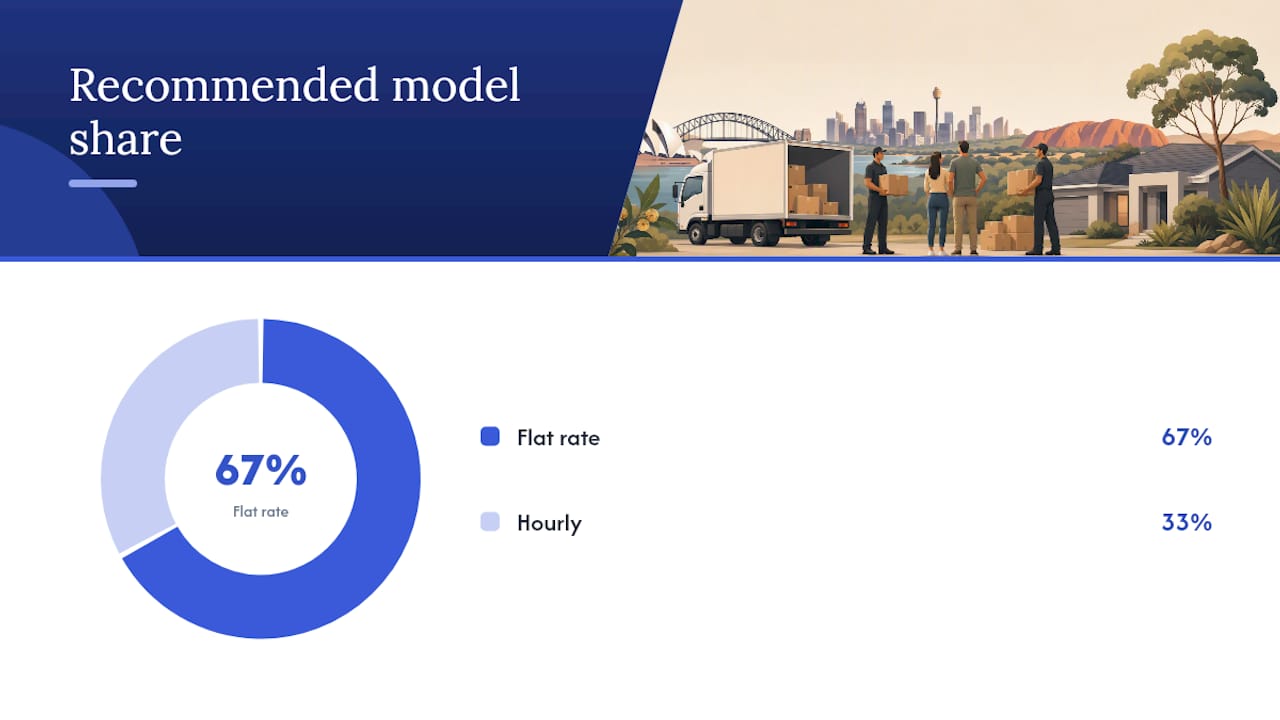
| Situation | Recommended model | Why |
|---|---|---|
| Small apartment, local, easy access | Hourly | Fast job; you only pay for actual time |
| Large house, local, multiple flights of stairs | Flat rate | Stair delays make hourly unpredictable |
| Interstate or long-distance | Flat rate | Distance and overnight variables need a fixed ceiling |
| Tight time window, must finish by a set hour | Flat rate | Removes incentive to rush and risk damage |
| Flexible schedule, light load, ground floor | Hourly | Lowest risk of overpaying on a simple job |
| Lots of fragile or specialty items | Flat rate | Extra handling time is absorbed in the agreed price |
Three steps to get certainty before you book:
When collecting multiple quotes, give every company the same inventory list, the same access notes, and the same move date. A flat-rate quote based on a different inventory than an hourly quote is not a fair comparison.
A written, itemised quote is non-negotiable. NSW Government guidance recommends shopping around, checking reviews, and requesting written quotes so you can compare charges line by line.
What to demand in writing before you sign:
Six questions to ask on the phone or during a site survey:
Red flags to walk away from:
Also check whether the removalist lists items they will not move. Knowing what not to pack before the survey avoids last-minute surprises that can trigger extra charges or delays.
Most removalists carry insurance for their own vehicles and public liability, but not for your belongings in transit. Queensland Government guidance is clear: transit insurance covers items while being moved and in storage, but consumers need to check whether their home and contents policy extends to moves, and consider taking out additional cover if it does not.
Insurance types to understand:
For a detailed breakdown of what each policy type covers, the moving insurance guide for Australia is a practical starting point.
AFRA accreditation signals that a removalist meets industry standards for equipment, training, and business practices. The NSW Government lists AFRA membership as a useful vetting signal, though not every reputable smaller operator will be a member. It is one indicator among several, not a guarantee.
Australian Consumer Law applies to removalist services. Under the consumer guarantees framework, a removalist must perform the service with due care and skill, use materials that are fit for purpose, and complete the job within a reasonable time. If they fail on any of these, you have grounds for a remedy. Keep a photographic inventory before the move and retain all written quotes and receipts; these are your evidence if a dispute arises.
For complaints, contact your state consumer protection body:
Before you sign, confirm that transit insurance is arranged (either by the removalist or by you), and make sure the contract spells out the variation process in plain language. Onyx Removals, covered in the next section, offers both pricing models and can walk you through which suits your specific move.
The most common complaint I hear about removalist bills is not that the hourly rate was too high. It is that the final bill was 40–60% above the verbal estimate because of charges the customer did not know to ask about: travel time from the depot, a minimum-hours policy, a stair surcharge that was never mentioned, or a fuel levy buried in the fine print.
Flat-rate pricing does not automatically solve this. A non-binding fixed quote with a loose variation clause can end up just as unpredictable as hourly billing. The protection is not the pricing model itself; it is the written contract and the quality of the survey behind the quote.
Pro Tip: Onyx Removals recommends booking an in-home or virtual survey rather than accepting a phone estimate. A survey that accounts for your actual volume, access, and stair count produces a quote that holds up on the day, regardless of whether it is flat-rate or hourly.
For Melbourne households comparing pricing models, Onyx Removals offers both flat-rate and hourly options across residential moves, packing and unpacking, storage, and interstate services. The difference from a generic phone quote is the survey process: Onyx conducts in-home or virtual surveys to build an itemised inventory before quoting, which means the flat-rate figure reflects your actual move rather than a rough bedroom-count estimate.

For straightforward local moves, Onyx can advise whether hourly pricing gives you a better outcome. For larger, interstate, or access-heavy moves, their fixed-price quotes are built around the specific conditions of your job. Packing materials, storage, and specialist item handling are available as add-ons, and the quote process makes inclusions and exclusions explicit from the start.
To get a written quote for your Melbourne move or to discuss interstate moving services, visit Onyx Removals’ moving services page and request an in-home or virtual survey.
These resources are worth bookmarking before you get quotes or make a complaint:
This article provides general information only and is not a substitute for professional advice. Confirm current rules, insurance requirements, and your rights with the relevant state consumer protection body or a qualified adviser.

No Related Post


