



TL;DR:
- Proper measurement, disassembly, and protection are essential for moving large furniture safely without harm. Using mechanical aids and professional help becomes necessary when access points are tight or items are fragile. Preparation and correct equipment reduce injury risk and ensure smooth relocations.
Most large pieces of furniture can be moved safely without professional help — provided you measure every access point, use mechanical aids, protect the item properly, and follow safe lifting techniques. Skip any one of those four steps and you’re looking at a scratched floor, a damaged door frame, or a back injury.
Here’s the short version before the detail:
Safe Work Australia treats manual handling as a risk-management exercise: mechanical aids come first, team lifting is a last resort. For high-risk moves in Melbourne, Onyx Removals offers residential removal services with the equipment and experience to handle what DIY can’t.
Measurement is where most DIY moves fail. People check the sofa width against the door width and assume it’ll fit. It won’t, not always, because a sofa doesn’t travel through a door flat; it tilts, pivots, and angles through. That’s why diagonal depth matters as much as width.
What to measure on the furniture itself:
What to measure on the route:
Retailers consistently recommend mapping the full floorplan and marking out the item’s location with tape before delivery day. Do the same before you move. Lay masking tape on the floor in the shape of the furniture’s footprint and walk it through the planned route mentally. You’ll spot the tight corner in the hallway that you’d otherwise only discover with the sofa in your arms.
Allow a small amount of extra clearance beyond the furniture’s dimensions at each entry point. A door that measures 80 cm wide and a sofa that measures 78 cm wide sounds fine; it isn’t, because you need room to angle and tilt. For sofas specifically, at least one dimension must be smaller than the narrowest entry point on the route.
Record every measurement in a single note on your phone or a printed sheet. Don’t rely on memory when you’re mid-lift.
Pro Tip: Remove interior doors from their hinges before the move. A standard door takes up some clearance when open; removing it can be the difference between a piece fitting and not. Use a screwdriver to tap the hinge pins upward from below. Check the hinge type first — some modern doors use non-removable hinges and need a different approach.
The goal of disassembly isn’t to make the piece smaller for its own sake. It’s to reduce weight, eliminate protrusions that catch on walls, and make the piece easier to grip and manoeuvre. A sofa with legs removed sits lower, clears door frames more easily, and is far less likely to gouge a skirting board.
Remove these parts before lifting:
Protective materials to use:
Bundle small parts methodically. Label each ziplock bag with a marker (“left side leg x4”, “shelf bracket set B”) and either tape the bag to the furniture or place all bags for one item in a single labelled box. Reassembly at the other end is much faster when you’re not hunting for a missing cam lock.
Full disassembly isn’t always necessary. A solid timber coffee table with no removable parts just needs blankets and straps. Reserve the full strip-down for pieces going through narrow doorways, tight stair landings, or lifts with inward-opening doors.
Pro Tip: Photograph every assembly point before you start removing anything. Pay particular attention to bracket positions, cable routing on adjustable shelves, and any hidden screws behind trim pieces. A 30-second photo saves 30 minutes of guesswork at reassembly.
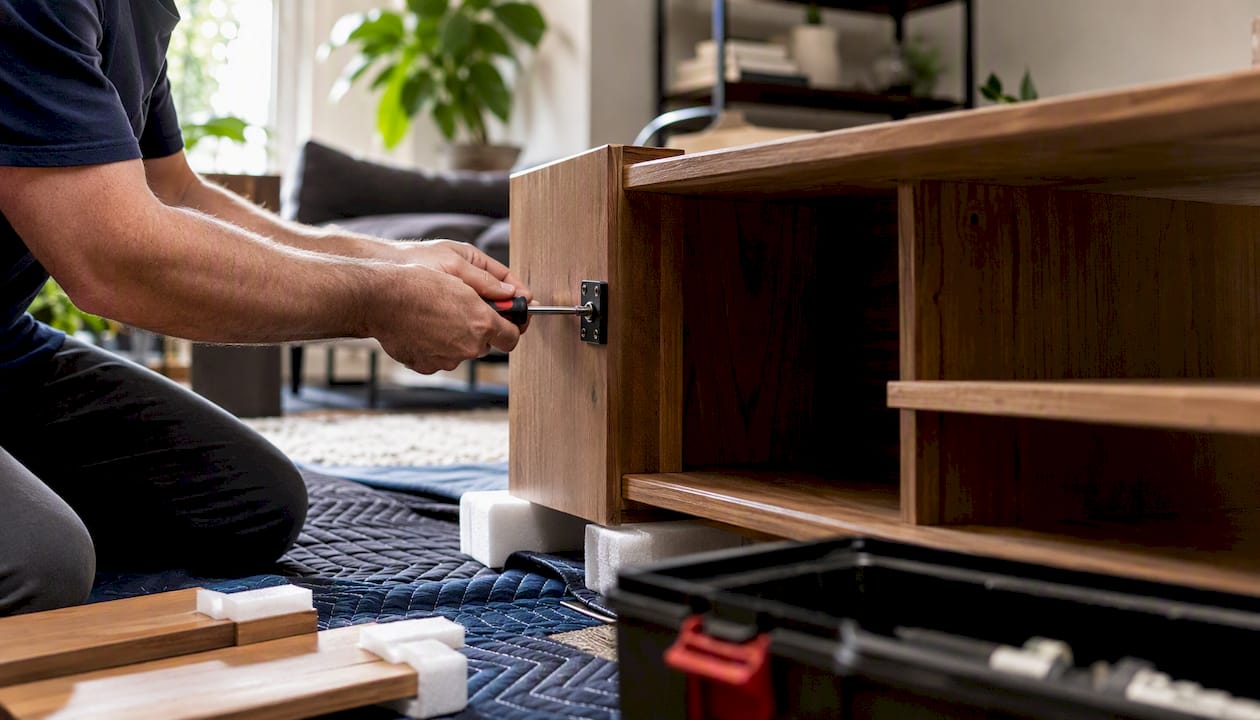
The right tools cut the physical effort dramatically and reduce injury risk. Hand trucks, four-wheel dollies, and appliance dollies are the standard recommendation for heavy pieces, especially on stairs. Furniture sliders and lifting straps handle the situations where a dolly won’t fit.
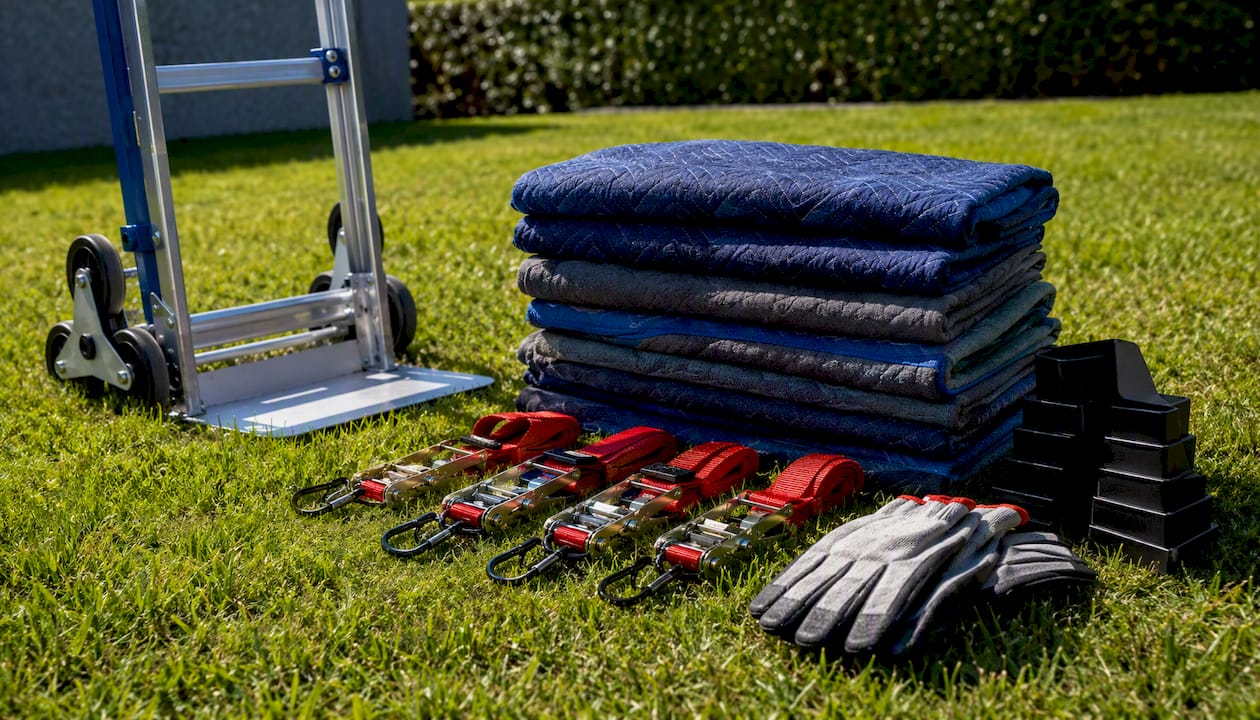
Essential equipment list:
Buy vs hire: For a single move, hiring a stair trolley is almost always cheaper and more practical than buying one. Bunnings hires a refrigerator/stair trolley for $15 for a four-hour period, with a deposit of around $100. Redspot Car Rentals also offers moving equipment hire across Australia, including trolleys and straps. Before you collect any hire item, check the maximum load rating, inspect the wheels and frame for damage, and confirm whether ratchet straps are included or separate.
For the vehicle, pack a separate kit: floor blankets to protect the tray, timber wedges or folded blankets to chock items, and spare ratchet straps beyond what you think you’ll need.
| Equipment | Buy or hire? | Notes |
|---|---|---|
| Stair/appliance trolley | Hire | One move rarely justifies the purchase price |
| Four-wheel dolly | Hire or buy | Cheap to buy; useful for multiple moves |
| Furniture sliders | Buy | Low cost; reusable; no hire option needed |
| Ratchet straps | Buy | Keep a set permanently in the vehicle |
| Moving blankets | Buy or hire | Hire if you need more than four |
| Corner protectors | Buy | Inexpensive; worth keeping a stock |
Pro Tip: Check the Onyx Removals moving equipment page for a Melbourne-specific list of what professionals use. Knowing the correct tool name before you call a hire shop saves time and avoids substitutions.
Use a mechanical aid if one is available. That’s the starting point, not the fallback. Safe Work Australia’s guidance on manual tasks is explicit: good work design eliminates the hazard first. A trolley that carries the weight is safer than any number of people carrying it by hand.
When a mechanical aid isn’t possible, team lifting with clear roles and commands is the next best option.
Step-by-step team lift:
The high-low method is used on stairs and around tight corners. One person holds the piece higher (at the top of the stairs or the leading end), the other holds it lower. This keeps the piece roughly level while allowing it to travel along the staircase. The person at the bottom controls the pace; the person at the top controls the angle. Switch roles at the landing.
Common mistakes that cause injury:
To transfer a heavy piece to a dolly: tip it onto one corner, slide the dolly underneath, then lower the piece onto the platform. Never drop it onto the dolly from height.
Pro Tip: Read the Onyx Removals step-by-step safety guide before any heavy lift. It covers grip positions and load-transfer techniques specific to residential furniture.
Measure the diagonal before you assume it won’t fit. A sofa that’s too wide for a doorway flat can often pass through on its end, provided the diagonal depth is smaller than the door height. This is the pivot principle, and it’s why diagonal depth is the critical measurement for sofas and armchairs.
Tilt-and-roll on stairs: Stand the piece on its end (if the structure allows it), place a stair trolley underneath, and walk it down one step at a time with one person guiding from above and one controlling from below. Never let the piece free-roll. Keep the trolley’s back legs in contact with the step below before releasing weight.
Quick structural fixes that gain you clearance:
Common Australian problems:
Pro Tip: Before any stair carry, tape the furniture’s footprint on the floor at the top of the staircase and physically walk through the rotation with your helpers. You’ll discover the pivot angle you need before anyone is holding 80 kg.
Heavy items go in first, lowest, and closest to the cab. That keeps the centre of gravity low and reduces the load on the rear axle. Tall pieces like wardrobes and bookshelves go against the front wall of the tray, strapped vertically, never leaning unsupported.
Vehicle loading checklist:
Tall pieces that can’t lie flat need at least two straps: one across the upper third and one across the lower third. Attach both to anchor points on opposite sides of the tray so the piece can’t tip either direction.
Before you drive, do a short test loop around the block. You’ll hear any shifting immediately. Avoid hard braking and sharp corners until you’re confident the load is stable. Check your vehicle’s payload rating; a standard ute tray typically handles 500–1,000 kg, but a loaded wardrobe plus a sofa plus a fridge can approach that limit faster than expected.
Pro Tip: Never exceed your vehicle’s gross vehicle mass (GVM). Overloading is a legal liability and affects braking distance significantly. If you’re unsure, check the compliance plate inside the driver’s door.
Hire professionals when the risk to people, property, or the item outweighs the cost of help. That’s the honest threshold. The cost of a professional move is almost always less than the cost of a back injury, a cracked staircase balustrade, or a destroyed antique.
Red flags that point to hiring professionals:
Failed deliveries can incur restocking or abort fees when items can’t pass through access points. The same applies to DIY moves: discovering mid-carry that a piece won’t fit through a landing is dangerous and expensive.
What a professional quote in Australia typically covers:
| Line item | Notes |
|---|---|
| Labour (per hour or fixed) | Usually two removalists; three for heavy/specialist items |
| Vehicle and fuel | Included in most quotes; confirm for long distances |
| Equipment (trolleys, straps, blankets) | Included by most professional removalists |
| Stair surcharge | Applied per flight or per item on stairs |
| Piano/specialist surcharge | Separate rate for instruments, safes, antiques |
| Packing/unpacking (optional) | Add-on service; priced per hour or per room |
| Insurance | Confirm transit and public liability coverage |
Onyx Removals handles residential moves across Melbourne, including stair carries, piano moves, fragile antiques, and short-notice jobs. To get an accurate quote, prepare the following before you call:
Pro Tip: For specialist items like pianos or antiques, check the Onyx Removals specialty item guide before requesting a quote. Knowing the item category helps the team price accurately and bring the right equipment.
Print this and tick each item on move day.
Measurements and planning:
Equipment and helpers:
Item preparation:
Vehicle:
Safety:
Moving large furniture safely comes down to four non-negotiables: measure every access point with 3–5 cm clearance, use mechanical aids before any manual lift, protect the item and property with blankets and corner protectors, and hire professionals when the risk to people or property is high.
| Point | Details |
|---|---|
| Measure with clearance | Allow some extra space beyond the furniture’s dimensions at every door, hallway, and stair landing. |
| Mechanical aids first | Safe Work Australia guidance prioritises trolleys and dollies over team lifting for all heavy manual tasks. |
| Disassemble to reduce risk | Remove legs, drawers, and shelves before moving; label all hardware for fast reassembly. |
| Protect surfaces and corners | Use moving blankets, shrink wrap, and corner protectors on every piece before it moves. |
| Onyx Removals for complex jobs | For stairs, pianos, antiques, or tight heritage access, Onyx Removals provides Melbourne residential removal with specialist equipment. |
This article provides general guidance only. For manual handling in a workplace context, consult Safe Work Australia or a qualified occupational health and safety professional.
The most common failure isn’t a lack of strength. It’s a lack of preparation. Time and again, the jobs that go sideways share the same pattern: someone measured the sofa width and the door width, found they matched, and assumed that was enough. They didn’t check the diagonal. They didn’t account for the door swing. They didn’t walk the route with the item’s actual footprint in mind.
The second most common problem is inadequate strapping in the vehicle. A single ratchet strap across a wardrobe looks secure until the first roundabout. Professionals use two straps at different angles as a minimum, plus wedges at the base. The piece should feel immovable before the vehicle moves.
What professionals do differently at the start of a job: they pre-rig the straps before the item is lifted, so the moment it’s on the trolley, it’s already partially secured. They wrap before they lift, not after. And they agree on commands before anyone bends down, not mid-carry when one person’s grip is already failing.
The most common moving mistakes are almost entirely avoidable with 20 minutes of planning the day before. The jobs that need professional help aren’t necessarily the heaviest ones. They’re the ones with narrow heritage staircases, inward-opening lift doors, or a single person who decided they could manage alone.
If a job has more than one of those red flags, the honest advice is to call someone who does this every day.
When the checklist above produces more red flags than green ticks, the cost of professional help is almost always less than the cost of getting it wrong.
Onyx Removals specialises in exactly the moves that DIY struggles with: stair carries, piano and antique relocations, tight heritage access, and short-notice jobs across Melbourne. Every job includes experienced removalists, the right mechanical equipment, and transit protection as standard. No sourcing your own trolley, no guessing whether your straps are rated for the weight.
To get an accurate quote, have your item dimensions, stair count, lift details, and access restrictions ready. The more specific your enquiry, the more precise the pricing. Request a home removal quote directly through the Onyx Removals website and get a breakdown that covers labour, vehicle, equipment, and any specialist surcharges upfront.

No Related Post


