


A full house local move typically costs between $800 and $2,000, while an interstate full house move usually runs from $3,000 to over $10,000 depending on distance and volume. That removalist quote, though, is only one line in a much longer bill. Budget the whole stack, not just the truck.
TL;DR:
- Local removalist rates vary between $100 and $180 per hour for two-person crews, with total costs depending on home size and minimum call-out requirements.
- Interstate moves are priced by volume, with route and season affecting the per-cubic-metre rate and potential savings of 40 to 50% through backload options.
- Non-removal costs like cleaning, packing materials, storage, and connection fees can add thousands to the total move, often exceeding the removalist fee itself.
- Access challenges, bulky or specialized items, and timing can significantly increase quotes, with fixed scheduling driving higher costs than flexible, backload arrangements.
- Accurate, in-home or video assessments reduce quote discrepancies and hidden surprises, saving money compared to phone estimates or vague volume guesses.
Table of Contents
- What does a full house removal cost for a local move?
- How does interstate removal pricing actually work?
- The full cost stack: every line item to budget for
- What pushes a moving quote up or down?
- How do you get a quote you can actually compare?
- Practical ways to cut the total moving bill
- Onyx Removals’ practical perspective: where quotes actually go wrong
- A cost stack that protects you from the renter squeeze
- Ready to plan your move? Get a quote built on a real assessment
- Sources
What does a full house removal cost for a local move?
Local removalists in Australia charge by the hour, and the crew size sets the baseline rate. A 2-person crew with a truck typically charges $100 to $180 an hour, with most jobs landing in the $120 to $150 range once you’re outside peak season. A 3-person crew costs more per hour, usually adding $40 to $60 on top, but often finishes a job in two-thirds the time, so the total can come out similar or even cheaper for larger homes.
Most companies apply a minimum call-out, commonly two or three hours, so a tiny one-bedroom unit still gets billed at that floor even if the truck is loaded and gone in ninety minutes.
Here’s how that translates into a total bill by home size:
- Studio or 1-bedroom: $400 to $800, typically 2 to 4 hours with a 2-person crew
- 2-bedroom: $700 to $1,200, typically 4 to 6 hours
- 3-bedroom: $800 to $2,000, typically 5 to 8 hours, often needing a 3-person crew
- 4+ bedroom: $1,500 to $3,000+, typically a full day and sometimes two trucks
To sanity-check any quote you’re given, do the maths yourself: multiply the quoted hourly rate by a realistic hour estimate for your home size, then add travel time (most companies charge a flat callout fee to cover the drive to your place and back to base) and check whether the minimum applies. If a quote comes in well under these bands, ask what’s excluded. If it comes in well over, ask why, because volume assessment errors are the most common reason quotes blow out.
How does interstate removal pricing actually work?
Interstate movers don’t charge by the hour. They price by volume, measured in cubic metres, because a truck’s capacity is the real constraint on a long haul, not the crew’s time. A one-bedroom home typically fills 8 to 12m³, a three-bedroom house sits around 25 to 35m³, and a four-bedroom home can push past 45m³.
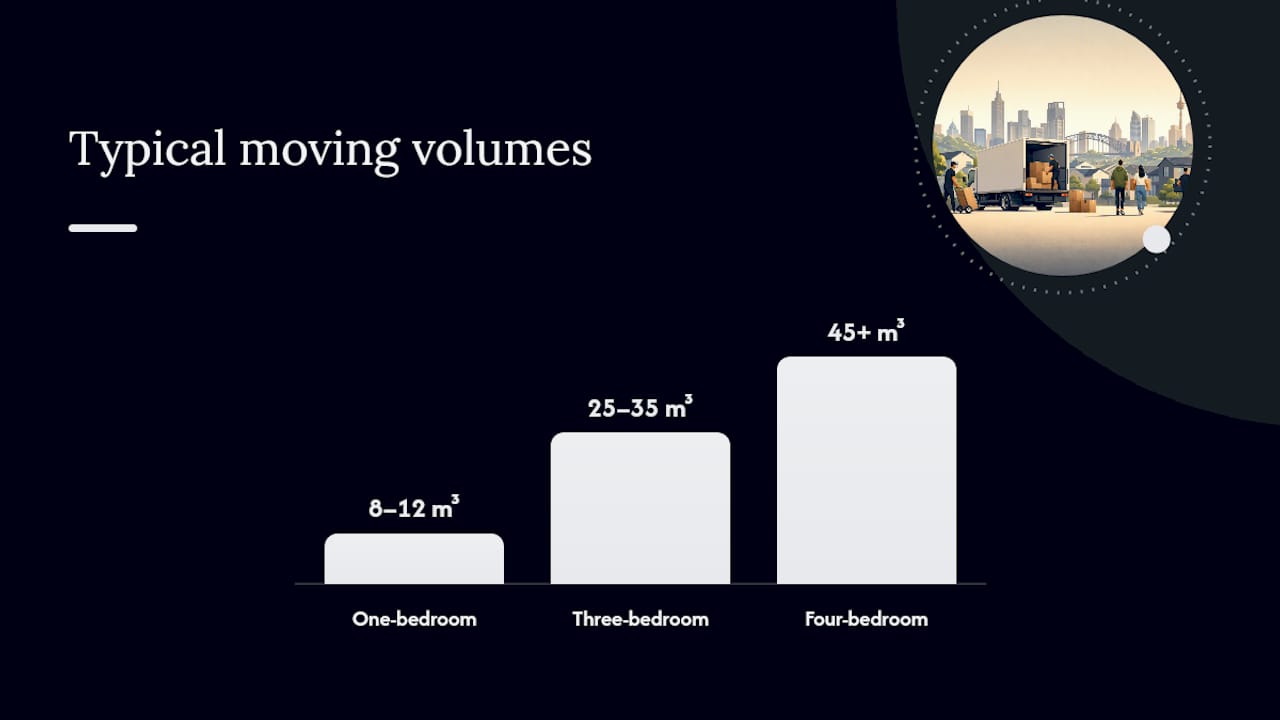
That volume figure, multiplied by a per-cubic-metre rate that varies by route and season, is what actually drives your interstate quote up or down.
Route and flexibility both move the number a long way:
- Sydney to Melbourne, one to two bedrooms: roughly $1,400 to $2,200 flexible, or $2,600 to $4,200 for a fixed dedicated date
- Melbourne to Brisbane, full household: commonly $5,500 to $10,500 plus insurance
- East coast to Perth, full household: significantly higher again, reflecting the much longer haul and thinner backload market
The gap between “flexible” and “fixed” pricing is a backload discount. A dedicated truck that drives from Sydney to Melbourne just for your goods costs the company the full return trip whether it’s full or empty. A backload slots your goods into a truck that’s already scheduled to travel that route, and you accept a delivery window (often a few days wide) instead of a guaranteed date. That trade typically saves 40 to 50% of the fixed-date price. If your moving date has any flexibility at all, this is the single biggest lever available on an interstate move, and our guide to moving interstate cheaply breaks down the timing that works best.
The full cost stack: every line item to budget for
The removalist fee is rarely the biggest number on moving day. Local removalist costs typically run $400 to $2,000 depending on home size, but the surrounding costs, especially for renters, often add up to more than that single line.
Renters moving into a new lease usually need a bond (commonly four weeks’ rent) and the first fortnight or month of rent in advance, due before or on move-in day. That’s a cashflow problem as much as a cost problem: both amounts land at once, right when you’re also paying for the truck. Owners face a different stack, with conveyancing and settlement-related costs sitting alongside the physical move.
Here’s a realistic snapshot of the non-removalist lines that catch people out:
| Cost item | Indicative range |
|---|---|
| Boxes and packing materials | $100 to $180 |
| End-of-lease clean | $150 to $500 |
| Connection fees (power, internet, gas) | $40 to $60 |
| Mail redirection | $40 to $60 |
| Short-term storage (per month) | $150 to $400 |
| Rubbish removal / skip bin | $150 to $400 |
Add it up for a typical 3-bedroom local move: $1,200 removalist fee, plus a $350 end-of-lease clean, plus $120 in boxes, plus a $250 skip bin to clear out the garage. That’s already $1,920, before bond or rent in advance even enter the picture. A written end-of-lease clean quote and a proper skip bin booking, as detailed in this guide to moving house rubbish removal, turn two of the biggest unknowns into fixed numbers early.
What pushes a moving quote up or down?
Three things move a quote more than anything else: how hard your home is to access, what you own, and when you book.
Access is the quiet cost driver nobody budgets for. Stairs instead of a lift, a long carry from the truck to the front door, or restricted parking that forces the crew to use a trolley for fifty metres each way all add real time to a job, and time is what you’re paying for on an hourly rate. Some companies apply a flat stair surcharge; others simply let the hours run longer.
Specialist items carry their own add-on fees because they need extra people, extra care, or specific equipment:
- Piano: often $150 to $400 extra, depending on type and access
- Pool table: commonly $200 to $500, since most need disassembly
- Heavy machinery or gym equipment: highly variable, frequently quoted separately
Timing matters more than most people expect. The last weekend of the month and the first weekend of a school term are the busiest windows in the removals calendar, and demand pushes rates toward the top of the range. Booking a Tuesday or Wednesday move, or shifting a week either side of month-end, routinely gets you a better rate for the identical job.
Pro Tip: Ask every mover directly whether a waiting fee applies if your settlement or key handover is delayed on the day. A crew sitting idle in a driveway for two hours because keys haven’t come through yet is a common, avoidable surprise cost.

How do you get a quote you can actually compare?
Quotes for what looks like the same job can vary by 30 to 50%, and the reason is almost always inconsistent information going in, not price gouging. Give every company the identical brief and you’ll get quotes worth comparing.
- Build a room-by-room inventory. List furniture, appliances, and an estimated box count per room; this is what turns a guess into a volume estimate.
- Take photos of access points. Front door, stairwells, lift dimensions, and parking distance all affect labour time.
- Measure and photograph specialist items. Pianos, pool tables, and oversized furniture need their own line in the quote.
- Send the same brief to at least three movers. Identical information to every company is the only way to compare quotes fairly.
- Ask for a written, itemised quote, not a verbal estimate, before you book anything.
- Confirm the pricing basis. Is it hourly with a minimum, or a fixed price based on volume?
- Ask what’s included. Furniture protection, disassembly and reassembly, and appliance disconnection are sometimes extra.
- Ask about the variation policy. What happens if the actual volume or time exceeds the estimate on the day?
- Check insurance and cover limits before you sign, not after something’s already broken.
Practical ways to cut the total moving bill
Real savings come from decisions made weeks before moving day, not from haggling with the crew on the morning of.
- Take a backload slot. Accepting a delivery window instead of a fixed date is the single biggest interstate saving available.
- Declutter hard before you pack. Every box you don’t fill is volume you don’t pay to move, whether that’s local hours or interstate cubic metres.
- Sell or donate bulky items rather than paying to transport furniture you were going to replace anyway.
- Hire a DIY truck for a short local move if you have willing helpers and no stairs; it’s genuinely cheaper for small, simple jobs. For anything with fragile items, multiple flights of stairs, or tight timing, a professional crew’s speed usually offsets its cost.
- Bundle services. Booking removal, packing and cleaning together with one operator often gets you a better combined rate than booking each separately.
Onyx Removals’ practical perspective: where quotes actually go wrong
Most quote disputes trace back to one thing: an inaccurate volume or access assessment done over the phone. A proper video survey or in-home visit catches what a phone call misses, measuring bulky items like wardrobes and pianos, photographing stairwells and parking restrictions, and confirming whether a council parking permit is needed on the day.
Customer feedback we see most often points to two recurring surprises: a flight of stairs that wasn’t mentioned upfront, and a settlement delay that pushed the crew into unplanned waiting time. Both are avoidable with a documented pre-move check and a written variation policy in the quote itself, rather than a verbal “we’ll sort it out on the day.”
If you want a written estimate built on an actual assessment of your home rather than a guess, our residential removal service page outlines how that survey process works, and our packing services guide covers what professional packing typically adds to a full-house quote.
A cost stack that protects you from the renter squeeze
The conventional advice on moving costs stops at the removalist fee, and that’s the single biggest gap in most budgeting guides. The number that actually catches people out isn’t the truck, it’s the bond and rent-in-advance landing on the same day as the moving invoice. Any cost guide that doesn’t put those two figures next to the removalist quote is giving you half a budget.
My take: build your moving budget backwards from your bank balance on the day you need the money, not forwards from a single removalist estimate. Prioritise the video survey over the phone quote every time. It’s the cheapest insurance in the entire process, and it’s free.
— Dinshaw
Ready to plan your move? Get a quote built on a real assessment
A phone quote guesses your volume. A proper survey measures it, and that’s the difference between a number you can trust and one that grows on moving day. Some removal companies run video and in-home surveys for full-house moves, covering packing and unpacking, short-term storage, end-of-lease cleaning, and rubbish removal, so the whole cost stack can be managed by one team instead of multiple separate bookings.

If your home has stairs, a piano, or a settlement date that might shift, a professional crew earns its fee by absorbing that risk instead of leaving it with you. If you’re in a ground-floor unit with no fragile items and a flexible weekday, DIY truck hire is a fair call. For everything in between, get a written quote first. Head to our residential removal page to book a video survey and get an itemised quote for your full-house move before you commit to a date.
Sources
- Interstate Removalists 2026: How the Price Is Set — Selectra
- Cost of Moving House in Australia 2026: The Full Stack — Selectra
- Removalist cost guide — Whatsthedamage
- Realestate
Recommended
About the Author


