



If you’re moving house within Melbourne, a good removalist is usually enough. If you’re relocating for an executive role, managing a corporate transferee, or juggling a lease, a job start date and a school enrolment all at once, a relocation manager earns their fee fast. Onyx Removals handles both ends of that spectrum, from straightforward residential moves through to full corporate coordination, and the fastest way to find out which you need is a quick consultation and written quote.
TL;DR:
- Relocation managers handle the entire process of setting up a move, including property searches, lease negotiations, and utility connections, not just physical transport.
- They offer tiered packages, from property search support to full end-to-end coordination, with costs varying based on scope, scope transparency, and complexity.
- Local knowledge and corporate experience are crucial when choosing a provider, with written agreements and clear scope preventing scope creep and unexpected charges.
- Typical relocation costs include a coordination fee on top of removalist rates, which generally range from $110 to $200 per hour, with a full move usually taking four to six weeks to plan.
- Onyx Removals offers combined physical and coordination services in Melbourne, streamlining the move process and reducing vendor handoffs for both individuals and corporate clients.
A relocation manager (also called a relocation specialist or relocation consultant) coordinates the parts of a move that have nothing to do with lifting boxes. A relocation specialist assists individuals and companies with complex moves, including home searches, lease negotiation, settling in services and full coordination across the whole timeline. Think of them as a project manager for your life change, not another set of hands on the truck.
That’s the core difference from a removalist. A removalist moves your physical belongings from Point A to Point B, safely and on schedule. A relocation manager handles everything around that event: finding the property, negotiating the lease, connecting utilities, and making sure you land somewhere liveable on day one. Many clients need both, working in tandem rather than as substitutes for each other.
Typical tasks a relocation manager takes off your plate include:
Relocation consultants commonly provide property search support and can attend inspections and negotiate leases for clients who simply can’t be there in person, which matters most when someone is relocating interstate or starting a new role before they’ve even seen the property. For families moving with school-age kids, this kind of orientation support often matters as much as the physical move itself, and it’s a gap our complete relocation guide covers in more detail.
Relocation providers generally structure their offering into tiers, and knowing which tier fits your move saves you paying for coordination you don’t need, or worse, going without support you do need.
End-to-end relocation services coordinate packing, shipping, furniture hire and local settling-in tasks, and most providers now offer these as flexible packages rather than one rigid bundle. A single executive relocating solo rarely needs the same package as a family of five moving interstate with two pets and a piano. If you only need one or two services, à la carte pricing usually beats a bundled package. If you need five or more coordinated services, full-service pricing tends to work out cheaper and dramatically lowers your own admin load.
Start with local knowledge. A relocation manager who knows which suburbs have genuine rental stock, which agents respond fast, and which streets flood in winter is worth more than one reading off a generic checklist. That local network is often the entire value proposition: relocation consultants reduce the stress of a move largely because they already have relationships that speed up approvals and surface off-market listings you’d never find scrolling rental sites at midnight.
For corporate clients, ask specifically about mobility programme experience. Managing one family’s move and managing forty employee relocations a year for a company are different skill sets entirely, and HR teams briefing a provider should treat this as a screening question, not an afterthought, which our guide to briefing a corporate relocation company walks through in more depth.
Here’s what to check before signing anything:
Ask these questions in your first call: What’s your earliest availability? Can you walk me through a typical timeline for a move like mine? What insurance do you carry, and does it cover my goods in transit? What’s included in the quoted price, and what costs extra? Can I speak to a recent client or see a case study?
Pro Tip: Ask for the scope of work in writing before you pay a deposit. A verbal “we’ll sort it all out” is the single biggest predictor of scope creep and surprise invoices later in the process.
Red flags worth walking away from: a provider who won’t put the scope in writing, one who can’t name a single local agent or property manager, one who dodges the insurance question, or one who has no references at all. Vague answers to specific questions almost always mean vague service on the day.
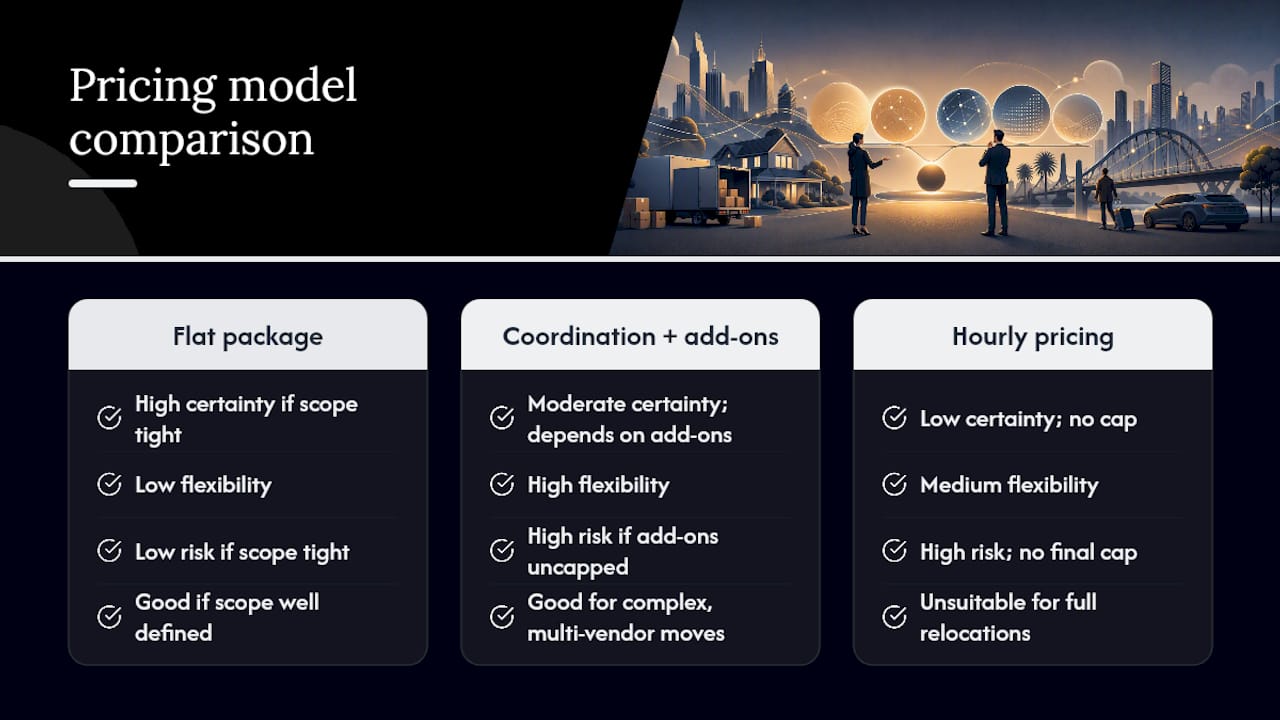
Pricing generally follows one of three shapes: a flat package fee for a defined scope, a coordination fee plus itemised add-ons for extra services, or an hourly rate for ad-hoc tasks like a single inspection or lease review. Corporate mobility packages are usually quoted per assignment, sometimes with volume discounts for multiple employees moved through the same programme.
What it actually costs: Typical local removalist rates run around $110 to $200 per hour for two movers and a truck, with a standard three-bedroom move often landing between $800 and $1,500 or more once packing and distance are factored in. Relocation management fees sit on top of this as a separate coordination cost, and vary widely depending on scope, so always request an itemised quote rather than a single headline figure.
A realistic timeline for a coordinated move looks like this: four to six weeks out, you’re briefing the relocation manager and starting the property search. Two to three weeks out, applications go in and leases get reviewed. One week out, utilities and move-day logistics get locked in. Move week itself covers the physical transition, and the days immediately after are for settling-in tasks like utility activation and school enrolment.
Onyx Removals operates across Melbourne with the full suite of services a relocation manager typically needs to draw on: residential and commercial removals, packing and unpacking, short-term storage, waste disposal, furniture assembly and specialised plant transportation. Rather than acting as a pure white-collar coordinator with no hands-on capacity, we combine planning support with the physical execution, which cuts out one layer of vendor handoff for clients who’d rather deal with one team than three.
What that looks like in practice:
[brand_signal] [author_bio] [case_study] [testimonial] [internal_data] are worth reviewing if you want a sense of how these services play out for a real move before you commit.
Getting started is deliberately simple: you send an enquiry, we run a short consultation to understand your scope, we send back a written quote with the services itemised, and you confirm the booking once you’re happy with the price and timeline. No verbal promises, no vague scopes, exactly the standard the buying guide above tells you to demand from any provider.
A well-run move day follows a predictable sequence, and knowing it in advance means you can spot when something’s being skipped.
Before the crew starts, ask to see proof of insurance, confirm who your on-the-day contact is, and get a rough finish time so you can plan around it. In the days that follow, a relocation manager typically arranges utility connections, books end-of-lease or move-in cleaners, briefs you on the local area (nearest GP, supermarket, transport links), and helps with school enrolment paperwork if you’ve relocated with kids.
When you’re comparing quotes side by side, focus less on the headline number and more on how the price is structured. A flat package fee gives you certainty but only works if the scope is defined tightly. A coordination fee plus add-ons gives you flexibility but can blow out if add-ons aren’t capped or itemised upfront. Hourly pricing suits one-off tasks like a single lease review, but it’s the wrong model for a full relocation because there’s no cap on your final bill.
Contract terms matter just as much as the price. Look for a written cancellation policy, clear liability terms for damaged goods, and a specified response time if something goes wrong mid-move. Some providers lock clients into ongoing service agreements for corporate accounts. That’s not necessarily a problem, but it should be disclosed and negotiated, not buried in fine print.
For corporate clients specifically, ask whether pricing is per assignment or per volume, and whether reporting back to HR is included in the base fee or charged separately. Centralised coordination genuinely reduces business downtime because HR benefits from a single contact managing multiple vendors rather than chasing several suppliers independently, but that benefit only shows up in the pricing if the contract makes vendor management an explicit, costed part of the deal. If a quote doesn’t separate coordination fees from execution fees, ask for a breakdown before signing.
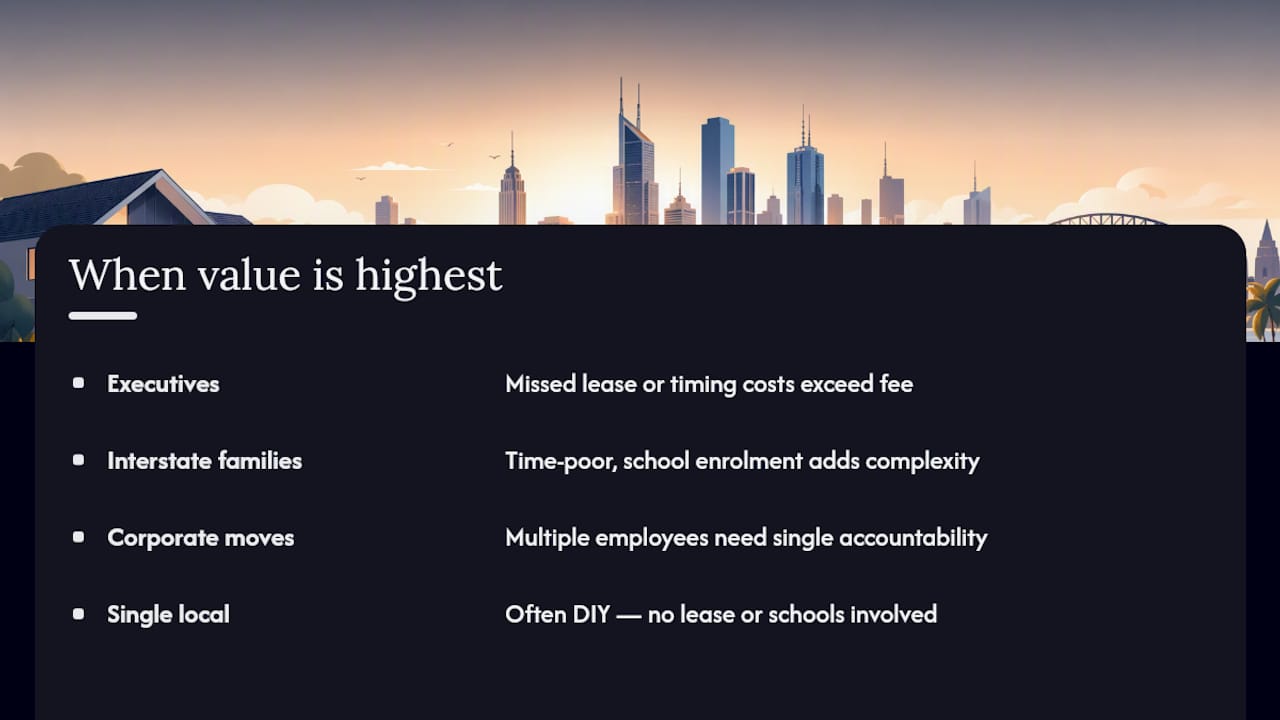
The clearest return on investment shows up with executive transfers, where a missed lease deadline or a badly timed move can cost more in disrupted work than the service fee itself. Time-poor families relocating interstate with school-age kids are a close second. So are corporate assignments where a business is moving several employees at once and needs one point of accountability rather than five separate threads to manage.
Where I’d push back on the industry’s default pitch: not every move needs full-service coordination. A single professional relocating within the same city, with no lease complexities and no kids to enrol, can often manage the property search themselves and just book a removalist for the physical job. The value of a relocation manager scales with complexity and with how expensive your time is per hour, not with the distance moved. DIY works fine until the number of moving parts exceeds what you can track in your head. If you’re unsure which side of that line you’re on, a short consultation call will tell you faster than any checklist can.
— Dinshaw
Onyx Removals is the practical alternative to hiring a separate relocation consultant and a separate removalist. One team handles the coordination and the physical move, which means fewer handoffs, fewer vendors chasing each other for updates, and one written quote instead of three.
Our core services cover exactly what this guide has walked through: residential and corporate relocation coordination, packing and unpacking, short-term storage, and specialty-item handling for fragile or high-value goods. Whether you’re an individual relocating within Melbourne or an HR team coordinating an employee move, the process starts the same way. Request a residential removal quote or get in touch for a consultation, and we’ll send back an itemised quote before you commit to anything.

No Related Post


