


Large rubbish removal comes down to two realistic routes: your council’s bulky waste collection, or a paid private removal service. Council collections suit patient residents with standard household items and no urgent deadline. Private removal wins when you need speed, have items councils won’t take, or you’re clearing a large volume for a tenancy exit or renovation.
TL;DR:
- Council pickups are limited to a set volume per property and cannot accommodate oversized or hazardous items, requiring careful planning and pre-sorting.
- Private removal services handle larger, more awkward loads, provide flexible scheduling, and include additional services like dismantling or hazardous waste handling with proper licensing.
- Hazardous materials such as asbestos, chemicals, and large vehicle fluids require licensed specialists and proper documentation to ensure lawful disposal and safety.
- Proper preparation, including sorting and bundling items within size limits and removing fridge doors, speeds up collection and reduces the risk of items being left behind.
- Cost and timing options vary: free council pickups suit non-urgent, standard waste, while paid services are better for urgent, large, or hazardous jobs, with professional documentation vital for legal disposal.
Table of Contents
- How council bulky waste collections work
- What private large rubbish removal services actually do
- What councils will and won’t take
- Preparing large items so they’re taken first time
- Weighing up costs, timing and who pays
- Hazardous items and when you need a licensed specialist
- A simple checklist for choosing your removal route
- Why local removal experience matters for this job
- Choosing the lawful, lower waste option
- How Onyx Removals can help with a large clean-out
- Sources
- FAQ
How council bulky waste collections work
Most Australian councils run an annual hard waste collection for rated properties, usually included in council rates rather than billed separately. Monash City Council, for example, sets a maximum volume, requires items to be safe for two people to lift, and caps individual pieces at 1.5 metres in length. Other councils offer similar allocations, typically one collection per year, with volume limits typically capped at moderate volumes depending on the municipality.
Exceed the limit and the excess often gets left behind, or you risk a fine for what looks like illegal dumping once the truck has been and gone. Booking is usually done through an online council portal or a phone hotline, and lead times can run several weeks during busy seasons like spring cleaning or end of financial year.
Timing matters as much as booking. Frankston City Council’s hard waste collection brochure sets a put out window, meaning items generally can’t go on the nature strip earlier than two days before your collection week. Before you book, check:
- Your allocation for the year and whether you’ve already used it.
- The exact volume and length limits your council applies.
- The put out window and any bundling rules for branches or green waste.
What private large rubbish removal services actually do
A private removalist works on a different clock. You send photos or describe the job, get a quote, and lock in a time that suits you rather than the council’s calendar. On the day, a crew arrives, does the lifting and loading, and either takes items to a transfer station, a recycler, or a charity, depending on condition.
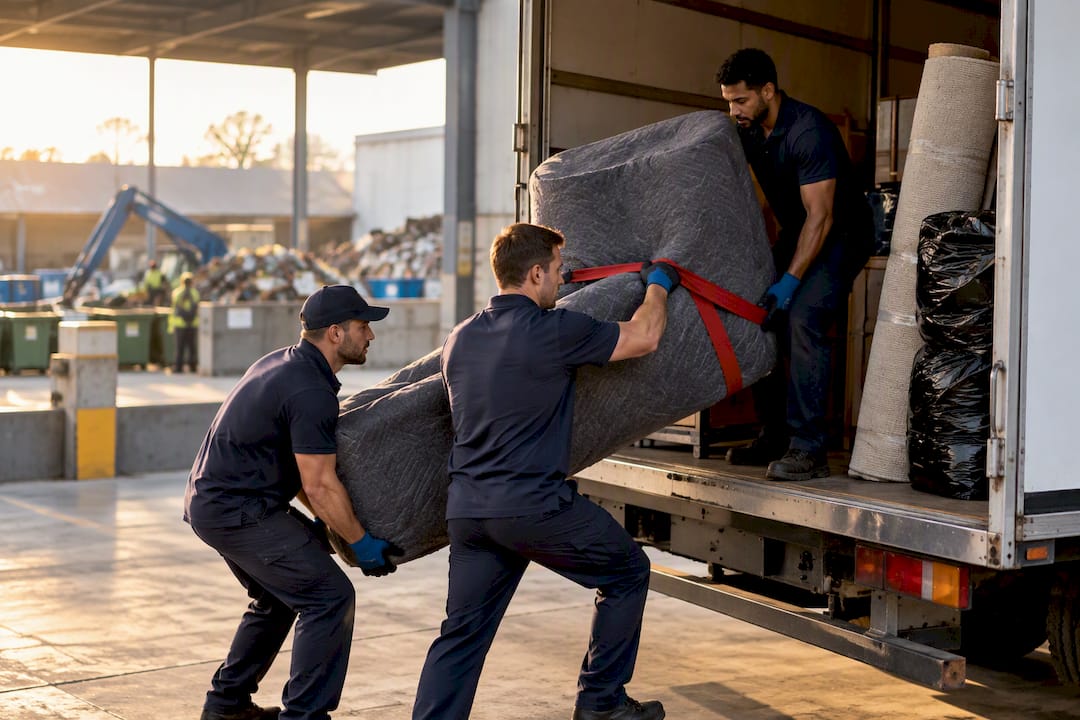
This is where private services earn their keep for bigger jobs. They handle volumes well beyond a typical council allocation, work around stairs or tricky access that a kerbside pickup can’t accommodate, and slot into short notice tenancy exits or full estate clearances that can’t wait for the next scheduled hard waste round.
Pricing usually comes down to a handful of factors:
- Truck size and the volume of rubbish being cleared.
- Labour, particularly where stairs, long carries, or awkward access add time.
- Disposal or tip fees, which vary by material and local waste facility.
- Extras such as dismantling large furniture or handling appliances with refrigerant gas.
Pro Tip: Take wide, well-lit photos of the whole pile from a few angles, not just close-ups, so a quote reflects the true volume rather than guesswork.
What councils will and won’t take
Council hard waste services accept a fairly predictable list of household items, but the exclusions catch people out more often than the inclusions. Monash’s accepted and excluded lists, echoed by other Victorian councils, give a useful benchmark.
- Couches, tables, and mattresses are generally accepted, though most councils cap the number of pieces per booking.
- Fridges and freezers go out with doors removed, a safety rule to stop children or animals getting trapped inside.
- Small e-waste and tied bundles of green waste, such as branches under 1.5 metres, are usually fine.
- Asbestos, paints, chemicals, renovation rubble, tyres, and car engine parts are almost universally refused.
- Unwrapped glass and any hazardous liquid will typically be left on the verge, sometimes with a warning tag.
Beyond the category itself, weight and liftability rule plenty of items out. If a single item can’t be safely carried by two people, it usually won’t be collected, no matter how ordinary it looks.
Preparing large items so they’re taken first time
Councils and private crews both work faster, and more safely, when items are sorted before anyone arrives. Many councils use a “five stacks” system, separating furniture, metal, mattresses, e-waste, and green waste into their own piles, because different trucks collect different categories on different days.
Practical prep matters just as much as sorting:
- Tie branches into bundles under 1.5 metres, matching common council limits.
- Remove doors from fridges and freezers before they go to the curb.
- Wrap or clearly label glass items so collectors aren’t handling shards blind.
- Check every piece can be lifted by two people; split large items where you can.
Pro Tip: For apartments and strata properties, check whether the body corporate or building manager arranges bulky waste on residents’ behalf, since individual units are often not permitted to place items in shared common areas without approval.
Weighing up costs, timing and who pays
Most councils provide at least one free hard waste collection per rated property each year. Once that allocation is used, Frankston’s booking page shows how paid extra bookings work: a set fee, plus the same put out rules as the free service, and a wait of days to weeks depending on the run schedule.
Private quotes move at a different pace. Same day or next day jobs are common for a straightforward pickup, while larger clearances get scheduled a few days out to line up the right truck and crew. Price is driven by truck size, labour, and disposal fees rather than a flat council rate.
- Waiting for a free council slot suits non-urgent jobs with standard items and no deadline.
- Paying for an extra council booking suits residents who’ve used their allocation but still have straightforward waste.
- Paying a private crew suits urgent tenancy exits, renovation clearouts, or volumes that exceed any council limit.
Hazardous items and when you need a licensed specialist
Some materials sit outside what any bulky waste service, council or private, will touch without the right licence. Asbestos, contaminated soil, large vehicle fluids, industrial chemicals, and fire damaged materials all fall into this category, and handling them incorrectly carries real health risk as well as legal exposure.
EPA Victoria’s guidance on dumped waste sets out a general environmental duty to prevent waste from ending up at unauthorised sites, and recommends licensed removal for anything hazardous or complex. Keeping your disposal receipts matters here, since they’re the record that proves the material was transferred lawfully rather than dumped.
- Ask any specialist for their licence and current insurance before they touch the job.
- Request a documented waste transfer record, not just a verbal assurance.
- Treat asbestos or contaminated soil as a separate job from standard bulky waste, always.
Australia generated 2.88 tonnes of waste per person in 2022–23, with a national target to recover 80% of resources by 2030, a scale that makes lawful disposal and documentation matter well beyond any single household.
A simple checklist for choosing your removal route
- Work out urgency: if you can wait weeks, council collection is worth booking first.
- Estimate volume and check it against your council’s limit before assuming they’ll take it all.
- Check contents against accepted and excluded lists, especially anything hazardous.
- Consider access: stairs, tight corridors, or warehouse loading favour a private crew.
- If going private, gather photos, an item list, and clear access notes before requesting a quote.
- Ask providers what’s included, whether disposal surcharges apply, and what their recycling or donation policy looks like.
Pro Tip: Ask upfront whether the provider gives you a disposal receipt or transfer record, since that’s your proof of lawful disposal if a dispute ever comes up later.
Why local removal experience matters for this job
This article is written by Dinshaw for Onyx Removals, a Melbourne based moving and relocation company that also handles waste disposal and skip bin arrangement as part of its service range. That combination matters for large rubbish jobs, because a crew used to shifting whole households understands safe lifting, vehicle loading, and how to keep disposal documentation in order.
The same skills that make a house move run smoothly, co-ordinated timing, careful handling of bulky furniture, and clear communication about what’s being taken where, apply directly to clearing large or awkward rubbish loads, particularly where a straightforward council collection won’t cut it.
Choosing the lawful, lower waste option
Reuse and donation beat disposal whenever an item still has life in it, and paying for speed is a fair trade when a tenancy deadline or renovation timeline genuinely demands it. What matters most is keeping a record of where your rubbish ended up, since that paperwork is what protects you if anyone questions the disposal later.
— Dinshaw
How Onyx Removals can help with a large clean-out
When a council allocation won’t cover the job, or the timeline is too tight to wait, A removal company offering residential and commercial moves, packing, and storage services can also combine waste disposal and skip bin arrangement into the same visit, so clients avoid juggling separate bookings for moving and clean-out services.
To get a quick, accurate quote, send through:
- Photos of the items or pile, taken from a few angles.
- A rough list of what needs to go.
- Any access notes, such as stairs, lifts, or long carries.
- Your preferred date, so we can check availability against it.
Our crews are insured, and where items are still in good condition we favour recycling or donation over landfill. Check current pricing and services or get in touch through our services page to arrange a quote.
Sources
- Measuring what matters: sustainable/circular economy (ABS)
- Hard waste collection — Monash City Council
- Hard waste collection brochure (Frankston City Council)
- Dumped waste | EPA Victoria
FAQ
How do I dispose of large rubbish?
Book your council’s hard waste collection if you have a standard allocation available, or arrange a private removal service for faster pickup or larger volumes. Check your council’s accepted items list first, since hazardous or oversized material usually needs a licensed specialist instead, as outlined by EPA Victoria.
How do I get rid of a lot of rubbish at once?
For large volumes, a private removal service is usually more practical than council collection, since councils cap the volume they’ll take in a single booking. Sort items into categories first, such as furniture, e-waste, and green waste, so the crew or council truck can process everything in one visit.
How do I dispose of big, bulky items like furniture or appliances?
Confirm the item meets your council’s size and weight rules, remove fridge or freezer doors before putting them out, and check whether a private pickup suits better if the piece is too heavy or awkward for two people to lift. Bulky furniture that doesn’t fit council limits is a common reason residents turn to paid removal instead.
What’s the cheapest way to get rid of junk?
Your council’s free annual hard waste collection, where you still have an unused allocation, is generally the lowest cost option since it’s covered by council rates rather than billed separately. Once that allocation is used, a paid council booking or a private quote becomes the next step, with cost depending on volume and access.
Recommended
About the Author


