


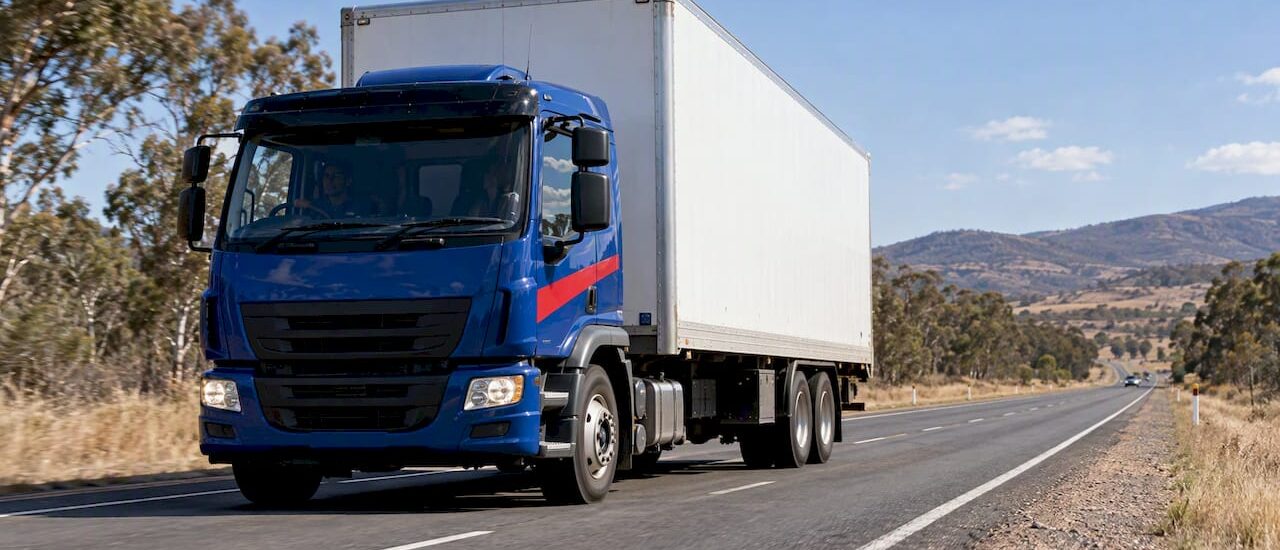
Interstate shifting means moving your belongings between Australian states, and it comes with longer transit windows, quarantine checks and the need for explicit transit insurance that local moves rarely require. Your main choices are a professional removalist (dedicated truck or backload), a self-drive truck hire, or a taxi-box courier service, each with different cost, timing and risk. Before booking anything, get written itemised quotes, confirm insurance details and check biosecurity rules for plants, produce and soil.
TL;DR:
- Backloading is generally the cheapest professional option, but shared routes make pickup and delivery dates less predictable, so choose it only when your schedule is flexible.
- Request a written, itemized quote that lists access charges, waiting time, fuel surcharges, storage, and included services before paying any deposit.
- Carrier liability may cover only a limited amount per item; arrange goods in transit insurance explicitly, since standard home policies often exclude transit damage.
- Check your route’s quarantine rules before packing plants, soil, fresh produce, or untreated timber, especially when moving to Western Australia or Tasmania.
- During peak seasons, book well ahead and allow buffer days, because backload frequency, shared routes, holiday demand, and road closures can shift delivery windows.
Moving between states follows a predictable sequence, and knowing each stage helps you schedule tasks without last-minute panic.
Pre-move planning starts weeks out, and organizing your home effectively can ease the transition; for practical advice, consider tips to organize your home for back to school that apply well to moving preparations. Walk through your home and build an inventory room by room, noting anything that needs special handling such as artwork, pianos or garden equipment. Check access at both addresses: are there stairs, narrow driveways or permit-only parking zones that a truck needs to navigate? Book your removalist or truck hire as early as you can, particularly if your move falls near a school holiday period or the end of a quarter when demand for interstate removalists spikes.
Packing responsibilities split between what a crew handles and what you handle yourself. Professional packers typically wrap furniture, box fragile items with proper materials and label everything for the unloading crew. If you are packing yourself, the same principles apply: use correctly sized boxes, wrap breakables individually, and keep a written inventory list so nothing goes missing between pickup and delivery. Mixing professional and DIY packing is common. Many households ask a crew to handle the kitchen and fragile items while packing linen, clothing and books themselves.
Loading day has its own rhythm. The crew arrives within an agreed window, briefs you on the plan, and stages items in the order they’ll be loaded, heaviest and least fragile first, fragile and frequently needed items last so they come off first at the other end. This staging decision matters more for interstate moves than local ones, since the truck may not be opened again until it reaches its destination state.
Transport then happens one of three ways:
Delivery and placement close out the move. Expect a delivery window rather than an exact time, particularly for backloads where your goods share a truck with other jobs along the route. On arrival, check furniture placement against your floor plan, unpack high-priority boxes first, and walk through your delivered inventory against your original list to flag any damage or missing items immediately while the crew is still present.
If you want a clearer sense of how far your budget stretches across these stages, our guide to moving interstate cheaply breaks down where the savings usually sit.
Three factors drive most of the price: the volume and weight of your goods, the distance between states, and the service level you choose, meaning full packing, furniture assembly, or storage versus a bare-bones transport job.
Pricing models vary by option:
On a route like Melbourne to Sydney, a dedicated truck for a larger household will sit well above a backload quote for the same volume, because you’re paying for exclusive truck space and a direct schedule rather than sharing capacity with other customers.
Watch for charges that aren’t always in the headline quote: long carries from the truck to your door, waiting time if access is delayed, fuel or distance surcharges on longer routes, storage fees if your new place isn’t ready, and separate cleaning or skip-bin charges if you need those services too.
A written, itemised quote protects you from most of these surprises because Consumer Affairs Victoria points to clear, itemised quotes and insurance explanations as a hallmark of a reputable operator, and their absence as a warning sign.
You can bring your total down in a few practical ways: downsize before the move rather than paying to transport things you’ll discard anyway, book during off-peak periods away from school holidays, consolidate smaller items into fewer boxes, and consider a backload if your dates are flexible enough to suit a shared route. Running your inventory through our interstate moving cost calculator gives you a closer estimate before you commit to a quote. For a deeper look at trimming costs further, our budget moving guide covers the detail.
Transit time depends heavily on distance and the transport option you choose, so it pays to build in buffer days rather than assuming a fixed date.
Short interstate hops between neighbouring states, say Victoria to South Australia, can take less time door to door with a dedicated truck. Long cross-country moves, such as Melbourne to Perth or Brisbane to Perth, can take considerably longer once you factor in routing and, if you’ve chosen a backload, the schedule of other jobs sharing that truck.
Several variables shift these timeframes:
Booking lead time matters more for interstate than local moves. During peak season, aim to book your removalist well ahead; off-peak, booking earlier can help secure your preferred date.
On delivery day, expect a multi-hour window rather than a fixed appointment time, especially with backloads. Keep your phone on, make sure someone can be reached at both ends, and confirm that access points, such as building loading docks or visitor parking, are available during that window.
Getting your goods there safely isn’t just about good packing. It’s about knowing what’s actually covered if something goes wrong, and what you’re legally not allowed to bring across a state border.
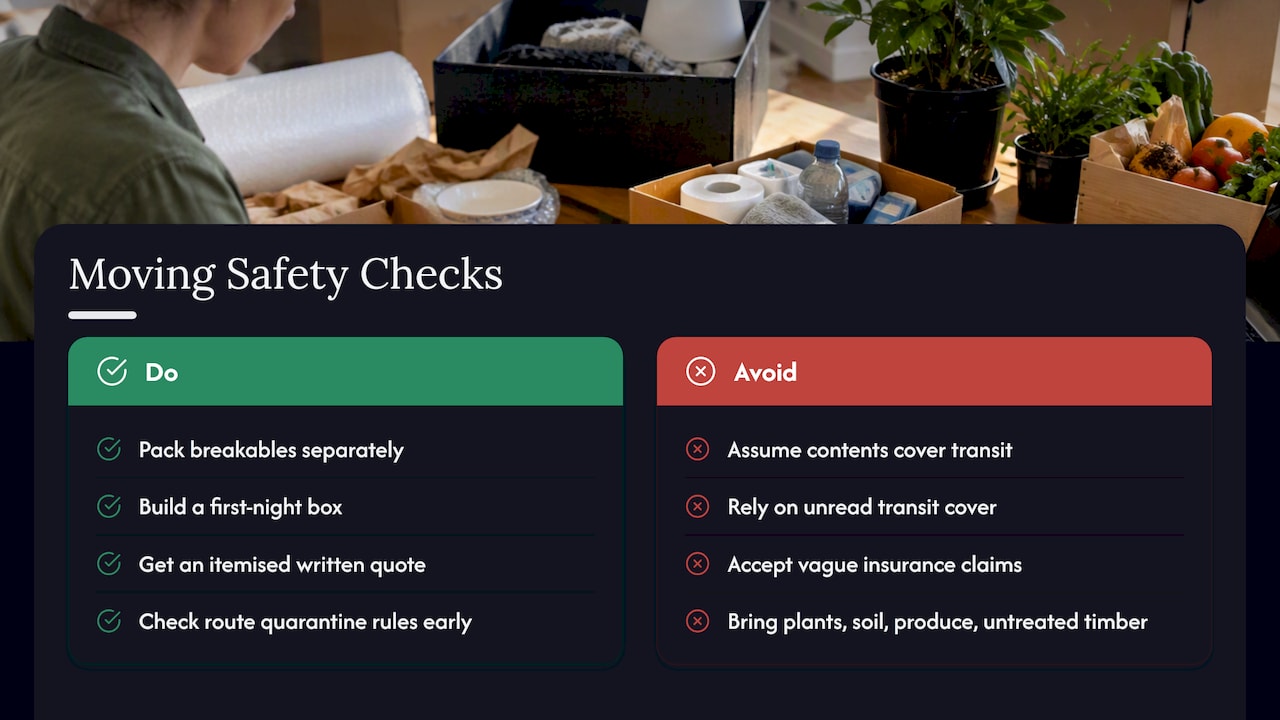
Pack breakables, electronics and important documents separately from general boxes, and build a first-night box with essentials such as toiletries, chargers, basic kitchen items and a change of clothes so you’re not digging through the whole load on arrival.
On insurance, there’s an important distinction. A carrier’s legal liability covers a basic, often limited, amount per item, while goods-in-transit insurance is a separate, broader policy you need to arrange explicitly. AFRA notes that member removalists must carry public liability and carrier’s legal liability cover, and that a qualified operator can supply a Product Disclosure Statement and Financial Services Guide when offering transit insurance, both of which you should read before relying on any policy sold alongside your move. Many people assume their home and contents insurance covers goods while in transit. Canstar points out that most standard home policies exclude transit damage unless the move is handled by a professional, insured operator.
Before paying anything, ask for a written itemised quote and keep proof of every transaction. Consumer Affairs Victoria warns that vague insurance claims, refusal to provide itemised invoices, or unwillingness to accept responsibility for damage are signs to walk away from an operator.
Quarantine rules add another layer that interstate movers often overlook. Western Australia and Tasmania enforce particularly strict biosecurity controls, and commonly restricted items include live plants, soil, fresh produce and untreated timber. AFRA’s moving tips recommend washing garden tools and outdoor equipment to remove soil and checking plant restrictions before you cross a state border. For more detail on your specific route’s rules, check the Australian Interstate Quarantine guidance early rather than at the border.
Pro Tip: Photograph valuable or fragile items before the move, and keep that record alongside your written quote and invoice in case you need to lodge a claim.
If you want to understand your options in more depth, our moving insurance guide walks through policy types and what to check before you sign.
Picking the right operator comes down to a handful of checks you can run through in one phone call or email exchange.
Red flags are usually easy to spot once you know what to look for: no written quote, a demand for a large cash-only deposit, vague or evasive answers about what insurance actually covers, no proof of transaction for any payment made, or reluctance to commit to even an approximate delivery window. Court action brought by Consumer Affairs Victoria against several removalist companies found they had misled customers about insurance cover and blocked legitimate damage claims, with the court ordering truthful insurance representations and proper proof-of-transaction practices going forward.
A DIY truck hire or taxi-box service can make sense for very small moves, a single bulky item, or a tight budget, but AFRA’s breakdown of DIY moving costs points out that truck hire fees, fuel, kilometre charges, equipment hire and your own time often add up to more than the quote suggests. Compare the full cost, not just the headline truck hire rate, before deciding. For a full list of questions worth asking any mover, our questions to ask moving companies guide covers the ground in detail.
Accreditation and paperwork aren’t box-ticking exercises. They’re the difference between a move that goes wrong quietly and one where you have recourse.
AFRA accreditation signals adherence to a code of conduct, staff training standards and an established dispute-resolution process, none of which apply to unaccredited operators. Public warning notices and court actions against dishonest movers consistently point back to the same gaps: no written quote, unclear insurance, no proof of transaction. Before you pay anything, ask for a PDS or FSG if insurance is part of the deal, get a written invoice for any payment, and keep every record until the move is fully complete.
Not every interstate move lines up pickup and delivery dates perfectly, and that’s where short-term storage earns its place in the plan.
If your new home or office isn’t ready when your goods arrive in-state, or your departure date comes before your arrival date is confirmed, storing your belongings for a few weeks bridges that gap without forcing a rushed second move. This matters more for interstate relocations than local ones, since goods often can’t simply sit in a driveway or garage overnight the way they might during a local move. A storage period also gives you breathing room to deal with unexpected delays, whether that’s a lease settlement pushed back or a backload schedule that shifts.
When choosing storage, check whether it’s climate-controlled if you’re storing anything sensitive to heat or humidity, and confirm access arrangements if you need to retrieve items mid-storage rather than waiting for final delivery. Our storage facilities can be arranged alongside your move so your goods go from truck to secure storage to your new address without a separate booking process, and our guide to temporary storage during relocation covers how to time a storage period around an interstate delivery window.
An interstate move is also the point where most households realise how much they’re not taking with them.
Sorting what stays, what’s donated and what’s rubbish before packing day saves you from paying to transport items you’ll discard anyway. A skip bin booked a week or two ahead of your move date gives you a single place to dump furniture that didn’t survive the cut, old mattresses, and general clutter that’s built up over years in one address. Timing the skip bin delivery and pickup around your packing schedule, rather than your moving day itself, keeps your driveway or loading zone clear for the truck when it matters most.
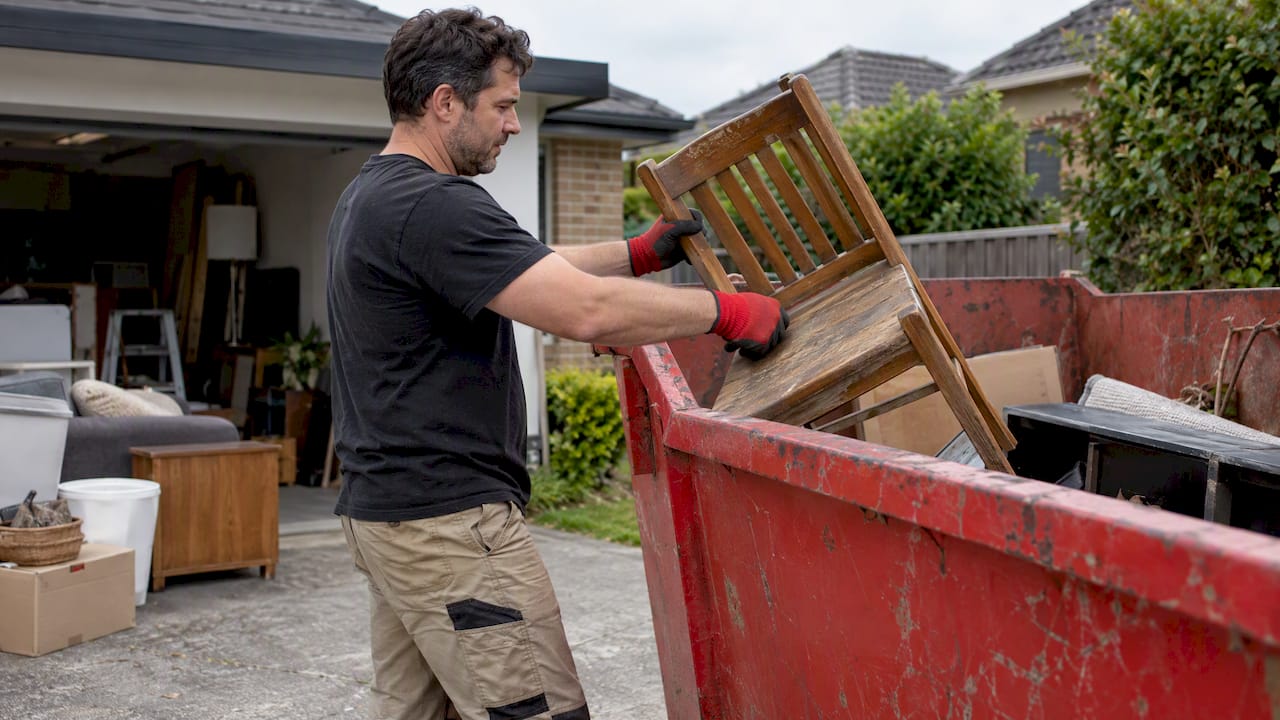
Check your council’s rules on kerbside skip placement if the bin needs to sit on the street, since permit requirements vary. If you’d rather not manage bin delivery, collection and council permissions yourself, arranging waste disposal and skip bin placement as part of your move means one less set of phone calls during an already busy week.
If you’re renting, your interstate move isn’t finished when the truck pulls away. It’s finished when your bond is returned in full.
Bond cleaning standards are typically set out in your lease agreement and checked against a condition report from when you moved in, and property managers can be strict about carpets, ovens and bathrooms specifically. The complication for interstate tenants is timing: you may already be in a new state by the time a final inspection happens, which makes it harder to fix issues a property manager flags after the fact.
Booking a bond clean to happen on or just after your move-out date, rather than leaving it until the last possible moment, gives you a buffer to address anything a managing agent raises before you’ve put real distance between yourself and the old property. Our cleaning services can be scheduled around your moving day so the property is handed back in the condition your lease requires, without you needing to coordinate a separate cleaner on top of everything else.
The biggest mistake I see is treating an interstate move like a bigger version of a local one. It isn’t. The transit windows are longer, the paperwork matters more, and a cash-only operator with no written quote is a far bigger risk when your goods are in transit for much longer.
Plan earlier than feels necessary, insist on seeing insurance documents before you need them, and get rid of anything quarantine-restricted, like plants or perishables, before packing day rather than at a state border.
— Dinshaw
We can help coordinate packing, transport, storage and cleaning as part of your move, helping take the load off you. Rather than juggling separate bookings for packing, a truck, storage and a bond clean, we manage all of it as one connected job.
Our team offers:
For current pricing details, see our cost calculator, or get in touch through our services page for a tailored written quote.
Backloading, where your goods share a truck with other customers travelling the same route, is generally the cheapest professional option because you’re paying for shared rather than exclusive truck space. DIY truck hire can also work out cheaper for very small moves, though hidden costs like fuel, kilometre charges and equipment hire often close the gap more than people expect.
Relocating interstate means permanently moving your home or business from one Australian state or territory to another, which typically involves longer transit times, state-specific registration and address updates, and biosecurity checks that local moves don’t require. You’ll generally need to notify your state transport authority of your new address within 14 days of the move.
Red flags include refusing to provide a written, itemised quote, demanding a large cash-only deposit, giving vague or shifting answers about what insurance actually covers, and failing to supply proof of transaction for any payment. Consumer Affairs Victoria treats these as clear signs to look elsewhere for a reputable operator.
There’s no single cheapest operator across Australia, since pricing depends on your route, volume and the service level you choose. The more reliable approach is comparing written, itemised quotes from AFRA-accredited removalists on your specific route rather than searching for one fixed “cheapest” answer, since AFRA members are audited and required to carry proper insurance, which affects the fair price for the job.
For exact rules on updating your address and vehicle registration, check your state transport authority’s interstate transfer guidance. AFRA publishes accreditation standards and practical moving tips specific to interstate relocations. For estimating and planning your own move, our cost calculator and insurance guide cover the practical detail.

No Related Post


