



TL;DR:
- Corporate moving companies specialize in office relocations with detailed plans, insurance, and after-hours options. They manage high-value equipment, coordinate building access, and provide tailored services to minimize business disruption. Early planning, clear contracts, and proper valuation coverage are essential for a successful corporate move.
Corporate moving companies are specialist commercial removalists that manage office relocations with the coordination, insurance, and logistical precision that residential movers simply cannot match. Where a standard removalist turns up with a truck, a corporate mover arrives with a written operational plan, certificates of insurance, IT handling protocols, and after-hours scheduling built in. For office managers and decision-makers in Melbourne and across Australia, choosing the right provider is the difference between a two-day disruption and a two-week one. The top players in this space include Onyx Removals, Xentratransport, and a range of national commercial removalists that each bring distinct strengths to business relocation services.
Corporate moving companies specialise in commercial relocations where the stakes are higher than a residential move. Every hour of downtime costs money, and a mishandled server rack or missing workstation can derail an entire department. Professional commercial movers plan around your business calendar, not their own convenience.
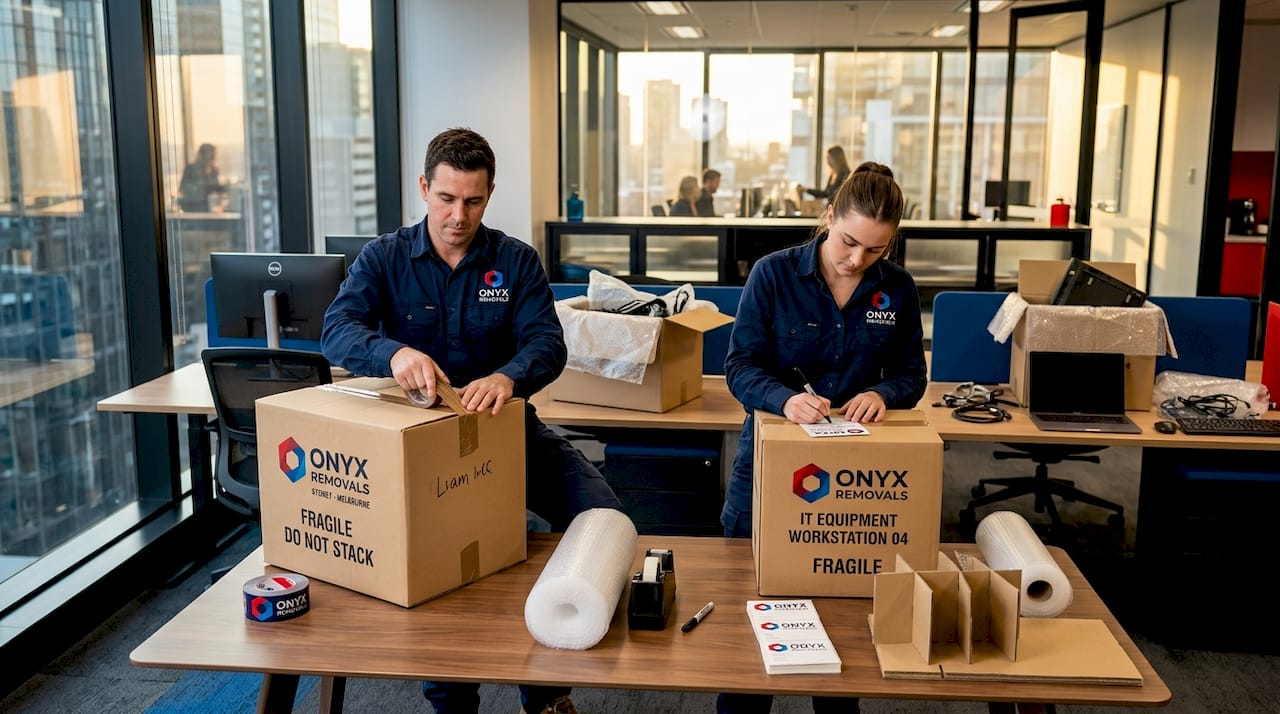
The core difference lies in service scope. Corporate moving benefits for businesses include COI provision, disassembly and reassembly of office furniture, IT equipment handling, packing of sensitive documents, and coordination with building management for elevator and loading dock access. Many providers also offer after-hours and weekend moves as standard, which means your staff walk into a fully operational office on Monday morning.
Commercial movers also carry higher insurance coverage than residential operators. This matters when you are moving server infrastructure, specialist equipment, or high-value boardroom furniture. The financial exposure on a mid-size office move can run into hundreds of thousands of dollars, and a provider without adequate coverage leaves your business holding that risk.
The following companies represent the strongest options for businesses seeking professional office relocation services, based on service scope, commercial insurance, and operational capability.
Onyx Removals (Melbourne) specialises in commercial and office removals across Melbourne, offering packing, storage, COI handling, and after-hours moves. Their service model is built around minimising business downtime, with personalised move plans for each client.
Xentratransport (New York City) is a strong benchmark for what full-service corporate moving looks like. After-hours corporate moves including elevator coordination, COIs, and disassembly/reassembly are included in flat-rate pricing, which removes cost uncertainty for budget-conscious operations managers.
Grace Removals (Australia-wide) is one of the largest commercial removalists in Australia, with national coverage and dedicated corporate relocation teams. They handle everything from single-floor office moves to full building transitions.
Kent Removals and Storage (Australia-wide) offers corporate relocation assistance with storage solutions, packing services, and interstate capability. Their project management approach suits mid-to-large businesses with complex timelines.
Allied Moving Services (Australia-wide) provides business relocation services with a focus on IT equipment handling and records management, two areas where inexperienced movers consistently cause problems.
Crown Relocations (Global) operates at the enterprise end of the market, handling multi-site corporate relocations and international office moves with full compliance management.
Wridgways (Australia-wide) has a long track record in commercial moves and offers tailored solutions for government, legal, and financial sector clients who require chain-of-custody documentation.
TWO MEN AND A TRUCK (Australia) suits smaller businesses and startups with straightforward office moves. Their pricing is transparent and their booking process is fast, though their COI handling capability varies by franchise.
Careful Hands Movers (Australia) focuses on fragile and high-value commercial items, making them a strong choice for businesses with specialist equipment or art collections.
Onyx Removals rounds out the list as the recommended option for Melbourne-based businesses seeking a provider that combines commercial expertise with personalised service and full building compliance support.
Pro Tip: Ask every provider whether after-hours moves and COI handling are included in their quoted price or charged as extras. The answer tells you immediately whether you are dealing with a genuine commercial mover or a residential operator with a corporate brochure.
Understanding the financial structure of a corporate move prevents expensive surprises. The two most important concepts are estimate type and valuation coverage, and most businesses get caught out by not understanding either before signing.
Binding versus non-binding estimates carry very different risks. A binding estimate locks the price regardless of actual weight or time. A non-binding estimate is an approximation, and under federal rules in the United States (and similar principles apply in Australia), final bills on non-binding estimates can legally exceed the original quote by up to 110%, with the balance payable within 30 days of delivery. For a large office move, that variance can represent tens of thousands of dollars.
Valuation coverage is the other critical variable. Released Value Protection reimburses up to 60 cents per pound per article by default, which is essentially worthless for office equipment. Full Value Protection, which costs more but provides repair, replacement, or cash settlement, is the only sensible choice for a commercial move. Valuation coverage legally defines the mover’s financial responsibility and must be disclosed in writing before transport begins.
The bill of lading is the binding contract between your business and the mover. Billing disputes almost always trace back to a mismatch between the estimate type promised and what appears on the bill of lading. Read it carefully before you sign.
| Estimate type | Price certainty | Risk level | Best for |
|---|---|---|---|
| Binding estimate | Fixed price | Low | Large or complex office moves |
| Non-binding estimate | Approximate | Medium to high | Smaller moves with known scope |
| Not-to-exceed estimate | Capped price | Low to medium | Businesses needing budget certainty |
Pro Tip: Always request a written, itemised quote that specifies the estimate type, valuation coverage selected, and any surcharges for after-hours work, COI provision, or specialist equipment handling. Verbal quotes are not contracts.
A Certificate of Insurance (COI) is a document issued by the mover’s insurer that confirms the mover carries adequate liability and property damage coverage. Most commercial buildings in Australia and internationally require a COI before granting access for a move. Without one, your move does not start.
COI documentation must typically be provided one to two weeks before moving day, with a follow-up confirmation three days prior to secure final approval. This timeline catches many businesses off guard, particularly those that book movers late and assume the paperwork will sort itself out.
Here is the standard COI and building compliance process for a corporate relocation:
Treating the COI as a gating workflow tied to building approvals prevents the scenario where your movers arrive at 7am and cannot access the building until noon. That four-hour delay costs you in labour, truck time, and staff productivity.
Selecting the right provider from the available commercial moving solutions requires more than comparing prices. The cheapest quote rarely reflects the true cost of a poorly managed move.
The key selection criteria for business relocation services are:
Pro Tip: Book your corporate mover at least six to eight weeks before your intended move date. CBD buildings have limited loading dock and elevator availability, and quality commercial movers fill their calendars quickly. Late bookings force you into second-tier providers.
For a deeper comparison of providers, the interstate moving services comparison from Onyx Removals covers both local and long-distance commercial options in detail.
| Provider | After-hours moves | COI handling | IT equipment | Storage | Geographic focus |
|---|---|---|---|---|---|
| Onyx Removals | Yes | Yes | Yes | Yes | Melbourne |
| Grace Removals | Yes | Yes | Yes | Yes | Australia-wide |
| Kent Removals | Yes | Yes | Limited | Yes | Australia-wide |
| Allied Moving Services | Yes | Yes | Yes | Yes | Australia-wide |
| Crown Relocations | Yes | Yes | Yes | Yes | Global |
| Wridgways | Yes | Yes | Yes | Yes | Australia-wide |
| TWO MEN AND A TRUCK | Limited | Varies | No | Limited | Australia-wide |
| Xentratransport | Yes | Yes | Yes | No | USA (NYC) |
The most effective corporate relocation strategy combines a written operational plan, Full Value Protection coverage, and COI management completed at least two weeks before moving day.
| Point | Details |
|---|---|
| Choose commercial specialists | Residential movers lack the COI capability, insurance, and planning depth that office moves require. |
| Understand valuation coverage | Released Value Protection pays as little as 60 cents per pound. Always select Full Value Protection for office equipment. |
| Manage COIs proactively | Submit COI requirements to your mover four weeks out and confirm approval three days before moving day. |
| Demand a written plan | A detailed operational plan covering trucks, personnel, and timeline prevents scope gaps and hidden costs. |
| Book early | Quality commercial movers in CBD locations fill their schedules six to eight weeks in advance. |
The businesses that have the smoothest relocations are not the ones with the biggest budgets. They are the ones that treated the move as a project with a proper brief, a named owner, and a written plan from the mover. Every chaotic office move I have seen traces back to one of three failures: a verbal quote that did not match the bill of lading, a COI that was not ready on time, or a mover that had never handled a building with restricted elevator access.
The valuation coverage issue is the one that genuinely surprises people. Most office managers assume their mover’s insurance covers the replacement value of their equipment. It does not, unless you have explicitly selected Full Value Protection and paid for it. Released Value Protection at 60 cents per pound means a 10-kilogram laptop gets you six dollars in compensation. That is not insurance. It is a legal disclaimer dressed up as coverage.
My practical advice is to treat the COI workflow as the critical path of your entire move. Everything else can flex. If the COI is not approved by the building, nothing moves. Start that process the moment you sign with a mover, not the week before. The tips for choosing corporate movers that experienced facilities managers follow consistently come back to documentation, early booking, and asking the hard questions before the contract is signed. The movers who cannot answer those questions clearly are the ones who will cost you more in the end.
— Dinshaw
Onyx Removals provides commercial removalist services in Melbourne built specifically for businesses that cannot afford disruption. Their team handles COI preparation, building compliance coordination, after-hours scheduling, packing, and IT equipment transport under a single written plan tailored to your office size and timeline.
Whether you are relocating a five-person startup or a 200-person corporate floor, Onyx Removals brings the planning rigour and commercial insurance that office moves demand. Explore their full range of moving and packing services or request a written quote to get your relocation on the right track from day one.
Corporate moving companies provide COI documentation, commercial insurance, after-hours scheduling, and written operational plans that residential movers do not offer. They are equipped to handle IT equipment, large furniture, and building compliance requirements specific to commercial properties.
Costs vary significantly based on office size, distance, and service scope. Always request a binding or not-to-exceed written estimate, as non-binding estimates can legally exceed the original quote by up to 110%.
A Certificate of Insurance confirms the mover carries adequate liability and property damage coverage. Most commercial buildings require it before granting access, and COI documentation typically needs to be submitted one to two weeks before moving day.
Full Value Protection is the correct choice for any commercial move. Released Value Protection pays only 60 cents per pound per item, which does not come close to covering the replacement cost of office equipment or technology.
Book at least six to eight weeks before your intended move date. CBD buildings have limited loading dock and elevator availability, and experienced commercial movers fill their schedules well in advance of peak periods.

No Related Post


