



Moving house can turn your life upside down and nobody wants to lug pointless clutter to a new place. Most people don’t realise this but a detailed inventory can reveal dozens of forgotten items and even save serious cash by cutting down moving costs. Tossing everything in boxes isn’t just messy, it actually makes your move harder and more expensive so knowing exactly what you own is the real secret to a smoother, stress free move.
| Key Point | Explanation |
|---|---|
| 1. Assess Your Current Inventory | Create a detailed list of your belongings to guide decluttering decisions effectively. |
| 2. Set Clear Decluttering Goals | Establish a timeline and specific objectives for sorting items to stay motivated and organised. |
| 3. Categorise Belongings Strategically | Sort items into Keep, Donate, Sell, and Discard to streamline the moving process and make rational decisions. |
| 4. Dispose of Items Responsibly | Research local charities and recycling options to ensure responsible disposal of unwanted items for sustainability. |
| 5. Organise Remaining Items for Moving | Use quality packing materials and clearly label boxes to facilitate an efficient move and easier unpacking. |
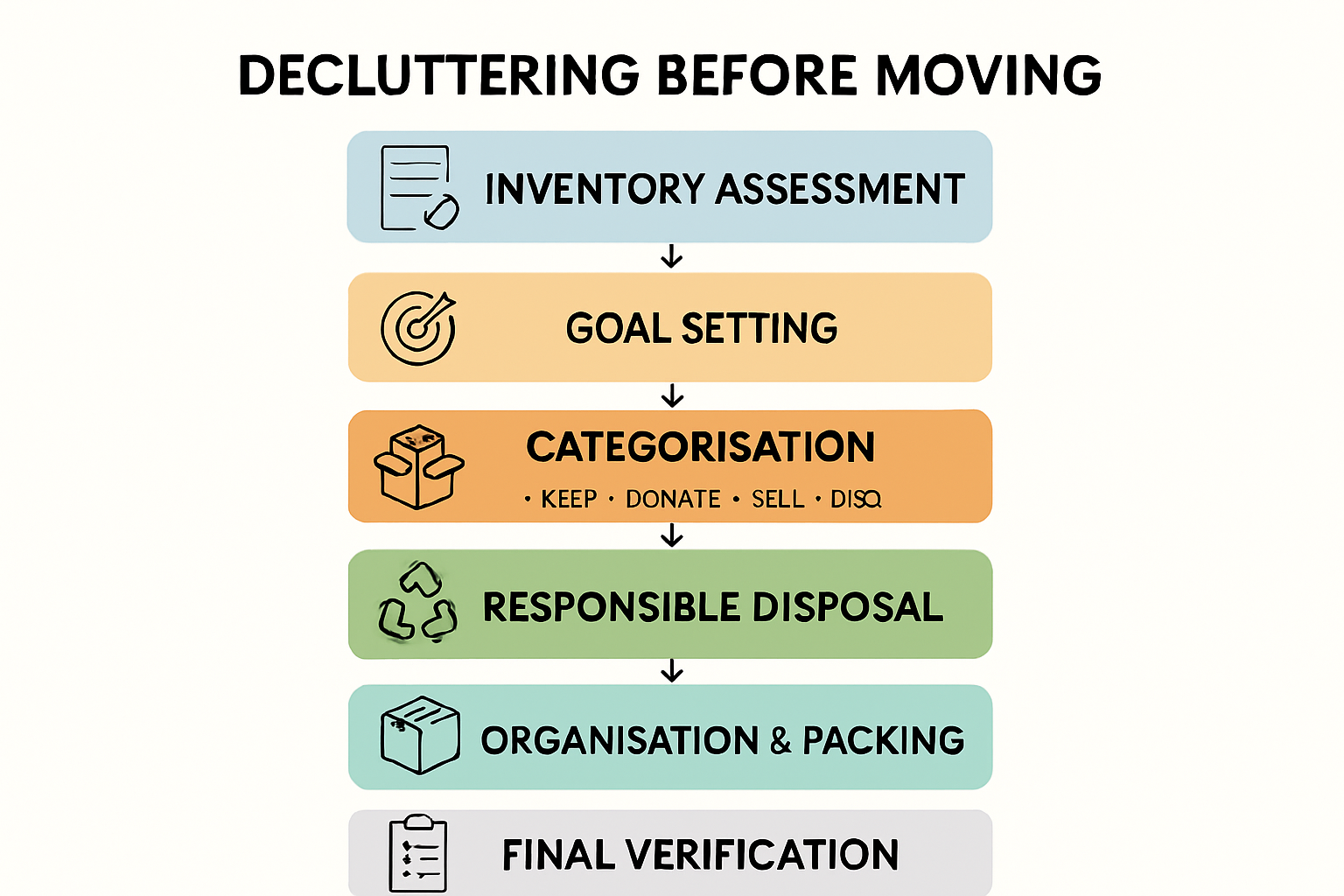
Before diving into the decluttering process, taking a comprehensive inventory of your belongings is crucial for a smooth and strategic move. Understanding exactly what you own will help you make informed decisions about what to keep, donate, sell, or discard.
Start by walking through each room in your current space with a systematic approach. Grab a notebook or use a digital spreadsheet to document your possessions. Begin with larger items like furniture and electronics, then progress to smaller objects and personal items. As you catalogue your belongings, consider their practical value, emotional significance, and the cost of transporting them during your move.
Classify your items into clear categories to streamline the assessment process. Create separate sections for essential items, sentimental possessions, rarely used objects, and items with potential replacement value. This categorization will help you make more objective decisions about what truly needs to accompany you to your new location.
According to University of Minnesota Extension, documenting your household inventory serves multiple purposes beyond moving preparation. Their research suggests creating a detailed record that includes:
As you compile your inventory, be brutally honest about each item’s current utility and future relevance. Consider factors like maintenance costs, replacement expenses, and the emotional weight of keeping certain possessions. Some items might have outlived their practical purpose but hold sentimental value, while others could be easily replaced or donated.
A thorough inventory assessment typically takes several hours, so allocate adequate time and avoid rushing the process. Break the task into manageable sessions across different days if needed. By the end of this step, you should have a clear, comprehensive understanding of your belongings that will guide your subsequent decluttering decisions and make your moving experience significantly more organized and stress free.
Establishing clear and achievable decluttering goals transforms the overwhelming task of preparing for a move into a manageable process. Your goals will serve as a roadmap, guiding your decisions and keeping you motivated throughout the decluttering journey.
Begin by creating a realistic timeline that matches your moving schedule. Consider the complexity of your current living space and the time you have available before the move. Some people might need several weeks, while others might accomplish their decluttering in a few intense weekends. The key is to break down the massive task into smaller, digestible segments that feel achievable and less intimidating.
According to AARP, setting specific and realistic goals is crucial when preparing for a move. They recommend focusing on clearly defined spaces that can be started and completed within your available time, ensuring you maintain momentum and avoid feeling overwhelmed.
Develop a structured approach by prioritizing spaces and categories. Start with areas that accumulate the most unnecessary items, such as closets, garages, and storage spaces. Create a room by room strategy, allocating specific timeframes for each space. For instance, you might dedicate a weekend to sorting through your wardrobe, another to tackling kitchen cupboards, and so on.
Learn more about efficient moving strategies that can complement your decluttering process. Your goals should include not just sorting items, but also deciding their fate: keep, donate, sell, or discard. Assign clear objectives for each category, such as reducing your belongings by 30% or clearing out at least three donation boxes.
Remember that goal setting is personal and flexible. Some people work best with rigid schedules, while others prefer a more intuitive approach. The most important aspect is creating a plan that feels comfortable and achievable for you. Track your progress, celebrate small victories, and be kind to yourself throughout the process. By the end of this step, you should have a clear, written plan that outlines your decluttering strategy, complete with specific goals, timelines, and a vision for simplifying your move.
Categorising your belongings is the strategic cornerstone of an efficient moving process, transforming a potentially chaotic experience into a structured and manageable task. This step requires careful consideration and a systematic approach to sorting through your possessions.
Start by creating four primary categories that will guide your decision making: Keep, Donate, Sell, and Discard. These categories will help you make objective decisions about each item’s future. Prepare several large containers or clearly marked areas to physically sort items as you work through different rooms and spaces.
The Keep category should include items that are essential, frequently used, and have significant practical or sentimental value. Sell items are those in good condition that could generate some additional moving funds. Donate items are still functional but no longer needed by you, while Discard represents items that are broken, obsolete, or beyond repair.
According to AARP, an effective categorisation strategy involves being brutally honest about each item’s utility and future relevance. Consider factors like replacement cost, emotional attachment, and practical necessity when making your decisions.
Check out our comprehensive moving preparation guide for additional insights into streamlining your sorting process. As you categorise, implement a colour coding or labelling system to make your sorting more efficient. Use coloured stickers or tags to mark items quickly, allowing you to make swift decisions without second guessing.
For clothing and personal items, consider a ruthless approach. If you have not used an item in the past year, it likely does not deserve a spot in your moving inventory. Electronics, kitchen gadgets, and decorative items should undergo similar scrutiny. Photograph sentimental items you are hesitant to keep, creating a digital memory that allows you to let go of the physical object.
By the conclusion of this step, you should have a clear, organised system of categorised belongings. Each item will have a defined path forward, reducing moving stress and ensuring you transport only what truly matters. The goal is not just to move your possessions, but to curate a collection of items that genuinely enhance your life in your new space.
Disposing of unwanted items strategically is crucial for a streamlined moving process, transforming potential waste into opportunities for sustainability and potential financial gain. This step requires careful planning and a methodical approach to managing items you have decided not to keep.
Start by researching local donation centres, recycling facilities, and selling platforms that can help you responsibly distribute your unwanted belongings. Different items require different disposal methods. Clothing in good condition can be donated to local charities, while electronics might need specialized electronic waste recycling services. Furniture and larger items could be sold through online marketplaces or donated to community organisations.
According to Yale University’s Sustainability Office, it is essential to handle disposal thoughtfully. Unexpired nonperishable foods and unopened toiletries can be donated to local shelters, while electronic waste should be processed through appropriate recycling channels to minimise environmental impact.
Learn more about sustainable moving practices to ensure you are making environmentally responsible choices. Create a timeline for your disposal process, allocating specific dates for selling items online, scheduling donation pickups, and arranging recycling drop offs. This structured approach prevents last minute scrambling and ensures each item finds an appropriate new home.
Consider hosting a garage sale or using online platforms like Facebook Marketplace, Gumtree, or local community selling groups to sell items with potential value. Price items realistically and be prepared to negotiate. For items that do not sell, have a backup plan for donation or responsible disposal. Some charitable organisations offer free pickup services, which can simplify the process.
Prioritise environmentally friendly disposal methods. Electronic waste, old documents, and hazardous materials require special handling. Contact local waste management services for guidance on safely disposing of these items. Some communities offer specialised collection days for electronic waste, chemicals, and other hard to dispose materials.
By the end of this step, you should have systematically reduced your belongings, generated potential extra funds, supported local charities, and minimised waste. Your thoughtful approach to disposal not only simplifies your move but also contributes positively to your community and environment.
Use the table below to quickly reference recommended disposal methods for various item types you may be dealing with during your decluttering process.
| Item Type | Disposal Method | Additional Tips |
|---|---|---|
| Clothing | Donate to charities | Must be clean and in good condition |
| Electronics | Recycle via e-waste facilities | Remove personal data before disposal |
| Furniture | Sell or donate | Arrange pickup for larger items |
| Nonperishable food | Donate to shelters | Check expiry dates |
| Unopened toiletries | Donate to shelters | Must be unused and unopened |
| Old documents | Shred and recycle | Use secure recycling options |
| Hazardous waste | Specialised disposal via council | Contact local services for guidance |
Organising your remaining items is the pivotal moment where preparation transforms into practical moving strategy. This step bridges your decluttering efforts with the actual moving process, requiring systematic thinking and strategic planning.
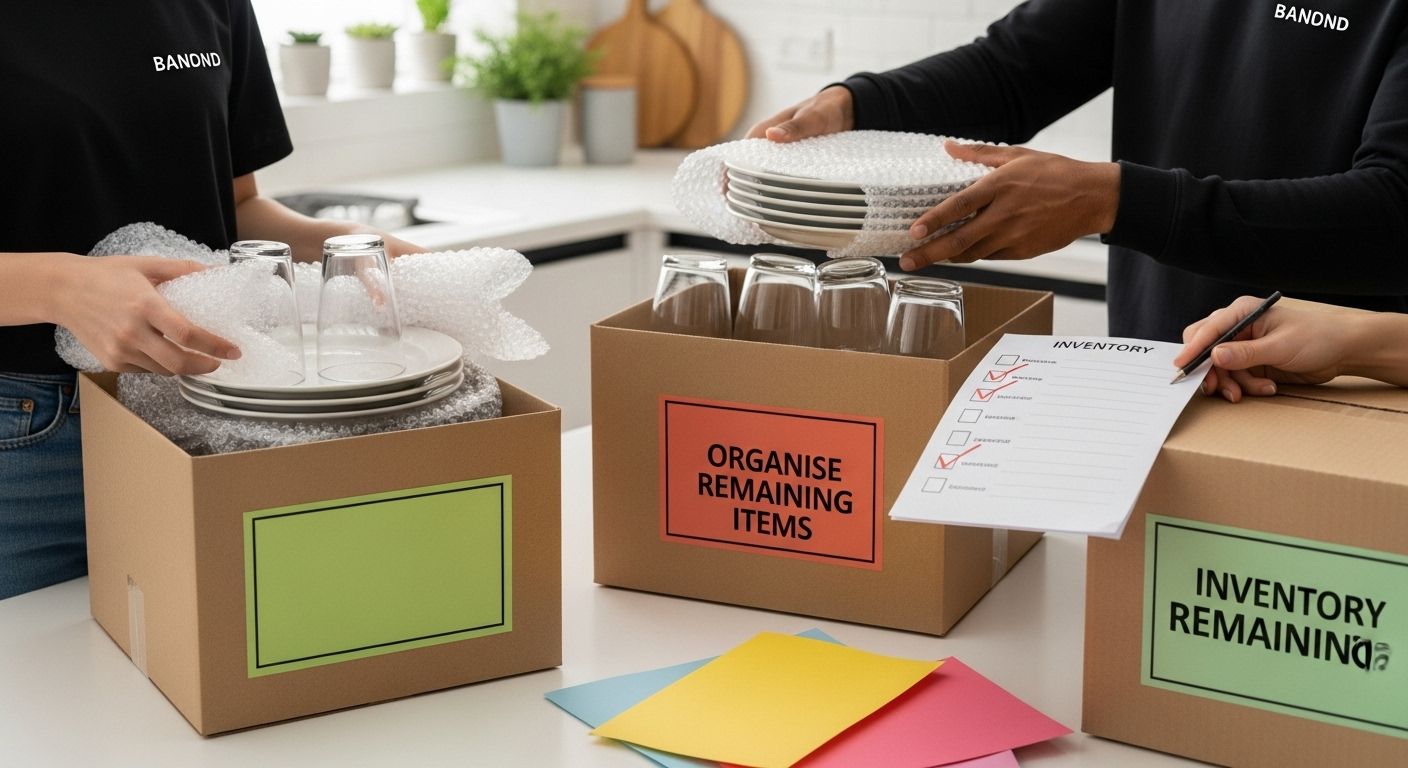
Begin by gathering high quality packing materials. Invest in sturdy moving boxes, quality packing tape, bubble wrap, and protective padding. Group items by room and fragility, creating a systematic approach that will simplify unpacking at your new location. Heavyweight items like books should go in smaller boxes to prevent them from becoming unmanageable, while lighter items can fill larger containers.
Labelling becomes your primary organisational tool. Mark each box clearly with its contents and designated room, using a consistent colour coding system if possible. Create a master inventory list that tracks each box’s contents, which will prove invaluable during unpacking and help prevent lost items. Consider taking photographs of valuable or fragile items before packing as additional documentation.
Electronics and important documents deserve special attention. Pack these items separately and keep them with you during the move. Create digital backups of crucial documents and store them in secure cloud storage. For fragile electronics, use original packaging if available, or invest in specialised protective cases.
Explore our comprehensive moving preparation strategies to refine your organisation approach. Consider the weight distribution in your boxes, ensuring no container becomes too heavy or unstable. Heavier items should be placed at the bottom, with lighter, more delicate items on top.
Prioritise an essentials box that contains items you will need immediately upon arrival: basic toiletries, a change of clothes, important documents, chargers, and a few kitchen basics. This box should be clearly marked and kept easily accessible during the move. Think of it as your survival kit for the first 24 hours in your new space.
By the conclusion of this step, you should have a meticulously organised collection of packed items, each box strategically prepared, labeled, and inventoried. Your remaining belongings are now transformed from a potential moving challenge into a well managed collection ready for transportation. The goal is not just moving your items, but moving them with purpose, protection, and precision.
Verification is the critical final checkpoint in your decluttering journey, transforming your preparation from theoretical planning to practical execution. This step ensures that every decision you have made throughout the previous stages aligns with your moving goals and personal requirements.
Begin by conducting a comprehensive walkthrough of your living space, systematically reviewing each room and storage area. Double check that nothing has been overlooked or accidentally left behind. Examine closets, drawers, shelves, and hidden spaces like under beds or inside kitchen cabinets. Your goal is to confirm that every item has been consciously categorised and processed according to your original decluttering strategy.
According to the U.S. Environmental Protection Agency, methodical verification helps reduce waste and ensures responsible disposal of items during major life transitions. Cross reference your master inventory list with the actual packed boxes, confirming that all items are accounted for and correctly sorted.
Review our professional moving preparation techniques for additional verification strategies. Create a final checklist that includes confirming donation receipts, verifying sold item transactions, and ensuring all recycling and disposal tasks have been completed. Take photographs of your empty spaces as a final record of your thorough decluttering process.
Pay special attention to emotional attachments that might have been overlooked. Sometimes sentimental items can slip through previous sorting stages. Make a final assessment of these pieces, asking yourself whether they truly deserve a place in your new space. Consider taking digital photographs of sentimental items you are reluctant to keep, creating a memory without maintaining physical clutter.
Here is a summary checklist to help ensure you have completed all critical verification steps before your move. Review each item for a final, thorough decluttering process.
| Verification Task | Details |
|---|---|
| Room-by-room walkthrough | Double check all rooms, closets, and hidden spaces |
| Review master inventory list | Cross reference packed boxes with your inventory |
| Confirm donation receipts | Ensure you have records for all donated items |
| Verify sold item transactions | Finalise payments and arrangements for sold items |
| Complete recycling/disposal | Check all unwanted items have been properly disposed |
| Final clean-up | Vacuum, dust, and wipe down surfaces after sorting |
| Photograph empty spaces | Take pictures as a final proof of decluttering |
Organise a final clean up of your space after all items have been sorted, donated, sold, or packed. This not only prepares the area for moving but also provides a psychological sense of closure. Vacuum, dust, and wipe down surfaces, leaving the space pristine and ready for its next occupants.
By the conclusion of this step, you should feel a sense of accomplishment and clarity. Your belongings are purposefully sorted, your space is organised, and you are prepared for a streamlined, stress free moving experience. The verification process transforms decluttering from a task into a strategic, intentional journey of simplification.
Sorting your entire life before a move can feel overwhelming, especially when it comes to deciding what to keep, donate, or discard. If you are struggling to create order out of chaos or worried that your precious items might not survive the journey, you are not alone. Our professional removalists at Onyx Removals understand the challenges of inventorying your possessions, setting realistic goals, categorising everything, and organising your move with confidence. We use detailed planning and a caring touch to ensure your personal, commercial, or office relocation in Melbourne is smooth, secure, and absolutely stress free.

Why risk missing an important detail or spending days on logistics when you can have expert support from a trusted local team? Let us help you with packing, secure transport, responsible waste disposal, cleaning, and more — we handle complex moving needs every day. Visit Onyx Removals for a free quote or learn more in our moving and packing tips and professional cleaning solutions. Get your move sorted properly now — save time, reduce stress, and settle into your new space with confidence.
To assess your current inventory, walk through each room systematically, documenting your possessions in a notebook or digital spreadsheet. Classify items into categories such as essential, sentimental, rarely used, and those with replacement value.
Effective strategies include establishing a realistic timeline based on your moving schedule, focusing on specific, manageable spaces each day, and allocating time for sorting items into categories: keep, donate, sell, or discard.
Create four primary categories: Keep (essential items), Donate (functional but unwanted), Sell (items in good condition), and Discard (broken or obsolete items). Use containers to sort items physically as you go through different spaces.
Research local donation centres, recycling facilities, and selling platforms suitable for your items. Create a timeline for selling online, scheduling donations, and arranging recycling, and prioritise environmentally friendly methods of disposal.

No Related Post


