



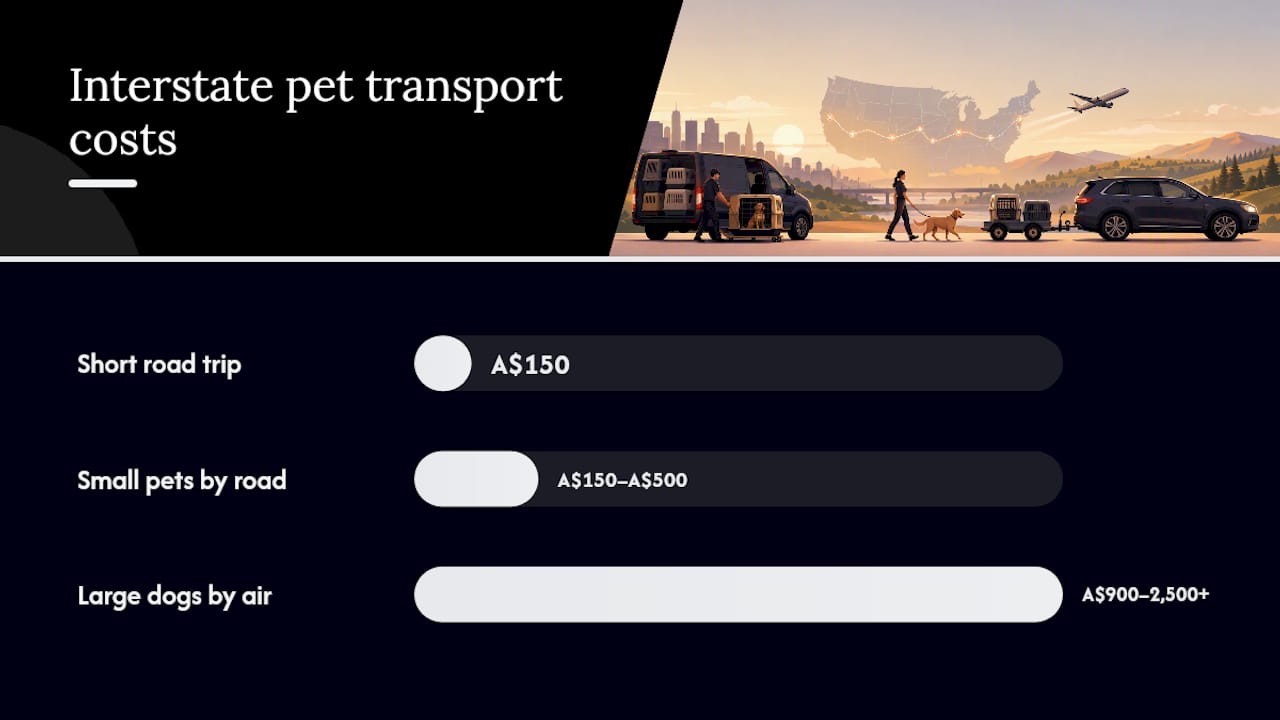
A short road trip for a small cat typically runs A$150 to A$500, while flying a large dog across the country can land anywhere from A$900 to A$2,500 or more. That single range covers almost every scenario an Australian pet owner will face, and the gap comes down to distance, pet size, and whether you go by road or air.
If you’re moving a cat from Sydney to Melbourne by road, expect somewhere near A$350 to A$500 all up. A medium dog on a similar route by air might sit around A$600 to A$1,200. A large breed flying Perth to Brisbane, with crate and handling included, can climb toward A$1,800 to A$2,500, according to AusCostGuides. MoneySmart recommends comparing multiple providers before committing to any pet related expense, and the same logic applies here: the spread between the cheapest and priciest quote for an identical job is often hundreds of dollars. IATA sets the crate construction and travel standards most airlines and transporters follow, which is why crate specs show up on almost every quote you’ll receive.
Pro Tip: Ask every provider for the same breakdown: base transport fee, crate, vet paperwork, and any handling or airport charges. If one quote won’t itemise, that’s your answer before you’ve even compared prices.
Market data from Airtasker shows the full national range stretching from around A$310 up to A$5,000, driven almost entirely by pet size, route length, and whether you choose a premium door-to-door service or a basic depot transfer.
The clearest way to see where your pet sits on the price scale is to compare road and air side by side, broken down by size.
| Mode | Pet size | Typical price range | What’s usually included |
|---|---|---|---|
| Road | Small (cat, small dog) | A$150–A$500 | Crate handling, interstate driver, basic paperwork check |
| Road | Medium dog | A$300–A$500 | Crate handling, water/rest stops, sometimes overnight boarding on long routes |
| Road | Large dog | A$500–A$1,500 | Larger crate handling, may require two-person lift, longer transit |
| Air | Small (cat, small dog) | A$400–A$900 | Airline cargo fee, manifest handling, IATA crate check |
| Air | Medium dog | A$600–A$1,200 | Volumetric weight charge, airport handling, vet cert check |
| Air | Large dog | A$900–A$2,500+ | Higher volumetric weight, crate hire or purchase, ground legs at both ends |
A few real-world examples make this less abstract. A cat travelling Sydney to Melbourne by road generally lands in the A$350 to A$500 bracket. A medium dog on the Melbourne to Brisbane corridor, a route with plenty of road operators competing for business, often comes in cheaper than the same trip on a thinner route like Perth to Brisbane, where air becomes the only practical option and prices jump toward A$1,800 to A$2,500, per AusCostGuides. NSW-based providers typically quote A$300 to A$1,500+ for interstate jobs and A$50 to A$300 for local runs, which gives you a sense of how much distance alone moves the number.
None of these figures include everything. Crate purchase, the vet certificate, and pickup or delivery to your door frequently sit outside the base quote, so always ask what’s excluded before you compare two numbers side by side.
Every quote you receive is built from the same handful of variables. Understanding them means you can spot a fair price and question an inflated one.
Air freight pricing is where most owners get caught out. Airlines don’t just charge by actual weight, they charge by volumetric weight, which factors in the crate’s dimensions rather than just what’s on the scale. A small dog in an oversized crate can end up billed like a much bigger animal. PetWorks notes that crate size and cargo handling fees are the two biggest levers pushing large-breed air moves into the A$900 to A$2,500 range.
Route competition changes everything. A well-serviced corridor like Sydney to Melbourne can have half a dozen operators bidding for your business, while a thin route to somewhere like Darwin or Hobart might have one or two, and that scarcity shows up directly in the quote.
Pro Tip: Always ask whether the quote is based on your pet’s actual weight or the crate’s volumetric weight, and ask outright whether the crate is included in the price or billed as a separate hire or purchase item.
Choosing between air and road isn’t just about price. It’s about how long your pet spends in transit and what conditions they’ll experience along the way.
| Factor | Road | Air |
|---|---|---|
| Typical price range | A$150–A$1,500 | A$400–A$2,500+ |
| Transit time | 1–3 days depending on distance | Same-day or next-day flight, plus ground legs |
| What’s included | Driver-accompanied transport, rest stops, crate handling | Airline cargo booking, manifest handling, crate compliance check |
| Best for | Short to medium distances, budget-conscious owners, pets that travel poorly by air | Long distances, remote states, time-sensitive moves |
Road transport tends to win on cost for anything under roughly 1,500 kilometres, and it avoids the stress of cargo hold travel entirely. Air transport wins on speed and becomes close to unavoidable for anything crossing to Western Australia, the Northern Territory, or Tasmania from the eastern seaboard, where a road trip would otherwise eat three or four days.
Seasonal temperature restrictions matter more than most owners expect. Airlines routinely pause cargo bookings for pets on extremely hot days for welfare reasons, which can bump your pet to a later flight with little notice. If you’re booking a summer move to or from somewhere like Queensland or inland New South Wales, build a few days of buffer into your plan rather than booking the last possible flight before you need to be settled.
The base transport fee is rarely the final number. These are the extras that show up on almost every interstate pet move.
| Add-on | Typical cost range |
|---|---|
| Vet health certificate | A$60–A$120 |
| Airport handling/manifest fee | A$50–A$150 |
| Crate purchase (size dependent) | A$60–A$400 |
| Pet taxi to/from depot or airport | A$30–A$100 |
A single hidden fee, especially airport handling that wasn’t mentioned upfront, can add A$100 to A$200 to what looked like a competitive quote. That’s often the gap between two providers who seemed identical at first glance. Always ask for an itemised invoice before you pay a deposit, not after the booking’s confirmed, since Airtasker’s cost data shows this is one of the most common sources of billing disputes in the industry.
Booking windows depend heavily on your route and the mode you choose. Short, popular corridors are far more forgiving than thin or remote ones.
Transit times vary just as much. A depot-to-depot transfer within the same state can happen same-day. Interstate road moves generally take one to three days depending on distance and whether the driver is running multiple pet jobs on the one route. Air moves are usually same-day or next-day for the flight itself, but factor in the ground legs at each end, which can add half a day or more.
Pro Tip: If your move falls in summer, book earlier than you think you need to. Airlines can pull pet cargo bookings on extreme heat days with little warning, and a last-minute reroute almost always costs more than booking ahead would have.
Getting quotes that are actually comparable means giving every provider the same information and asking the same questions.
Ask every provider the same set of questions before comparing prices:
Watch for a few red flags. A vague “from A$X” price with no breakdown almost always means extras get added later. Missing itemisation, where a provider won’t tell you what’s covered without you pushing for detail, is a warning sign. And any operator pressuring you to book immediately without sending written terms first isn’t one you want handling a live animal.
Pro Tip: Providers that hesitate to put a full itemised quote in writing are the ones most likely to add surprise charges later. A confident, established operator will send you a breakdown without being asked twice.
A few practical habits consistently bring the total bill down, without compromising your pet’s safety or comfort.
Road transport tends to save the most money on well-serviced corridors like Sydney to Melbourne or Melbourne to Adelaide, where competition keeps prices reasonable. It saves far less, and can even cost more in total time and hassle, on long remote routes or when moving to island states like Tasmania, where air is often unavoidable regardless of budget.
Cutting corners in the wrong places is a false economy. Skipping the vet health check to save A$80 can delay or derail your pet’s travel entirely if biosecurity paperwork isn’t in order at the destination state. Choosing an uncredentialed carrier because they quoted A$100 less than everyone else is the kind of saving that can cost you far more if something goes wrong mid-transit.
The single biggest mistake owners make is accepting a headline price without asking what it excludes. A “from A$400” quote that balloons to A$650 once crate, vet cert, and handling fees land isn’t a bait-and-switch exactly, it’s just an incomplete quote that nobody pushed back on. Ask for the full number in writing before you get emotionally attached to the cheap figure.
The second mistake is not checking crate dimensions properly. Owners often measure their pet standing normally, but the correct IATA measurement accounts for your pet standing naturally with room to turn around and lie down comfortably. Get this wrong and you’ll either be charged for an oversized crate you didn’t need, or told at the last minute that your existing crate doesn’t meet requirements.
The third is leaving paperwork until the week before the move. Vet certificates often need to be issued within a specific window before travel, sometimes as tight as ten days, and if your regular vet is booked out, you’re stuck scrambling for an appointment while your move date closes in.
Before you sign anything, run through a short mental checklist: Are your travel dates locked in with both the transporter and, if relevant, the airline? Is the crate the correct size for your specific pet, confirmed against IATA specifications rather than a guess? Is the price itemised, in writing, with nothing left as “to be confirmed”? If you can answer yes to all three, you’re in a solid position to book with confidence.
Interstate pet transport cost in Australia typically ranges from A$150 for a short road trip to A$2,500 or more for a long-distance air move with a large breed.
| Point | Details |
|---|---|
| Budget by size and mode | Expect A$150–A$500 for small pets by road, A$900–A$2,500+ for large dogs by air. |
| Follow the three-quote rule | Compare at least three itemised quotes before booking, as MoneySmart recommends for pet-related costs. |
| Confirm crate details early | Check whether an IATA-approved crate is included, hired, or needs buying, ideally 3–4 weeks ahead for long routes. |
| Don’t skip the vet certificate | Book your vet appointment early since certificates often need to be issued within a tight window before travel. |
| Get everything itemised | Ask for a written breakdown covering crate, handling, vet cert, and pickup/delivery before you pay a deposit. |
Pro Tip: If you’re coordinating a full household move alongside your pet’s transport, ask your removalist whether they offer interstate pet transport support as part of the broader relocation, it often simplifies scheduling both legs together.
Owners planning a full relocation, not just the pet, often find it easier to manage timelines when household removals and pet transport are booked through people who understand both sides. Onyx Removals’ residential removal services can be arranged alongside your pet’s travel plans so pickup dates, packing, and your pet’s departure all line up without the usual last-minute scramble. If you’re still mapping out the wider cost of your move, the interstate moving cost calculator is a useful starting point before you request formal quotes.
A few sources are worth bookmarking before you commit to any interstate pet transport booking.
Always check your destination state’s biosecurity page directly too, since entry requirements (particularly for Queensland and Western Australia) change from time to time and a quote from a transporter won’t always reflect the latest rules. If you’d rather have one provider manage the logistics around your pet’s move alongside your household relocation, Onyx Removals’ pet relocation guide for Melbourne walks through the timeline in more detail.
How much does it cost to transport a pet interstate in Australia?
Most interstate moves fall between A$150 and A$2,500, depending on pet size, distance, and whether you choose road or air. A cat travelling a short distance by road sits at the low end; a large dog flying across the country sits at the high end.
Is it cheaper to transport pets by road or air?
Road is almost always cheaper for distances under about 1,500 kilometres. Air becomes necessary, and pricier, for remote states like Western Australia, the Northern Territory, or Tasmania.
Do I need to buy my own crate, or can I hire one?
Both options exist. Buying an IATA-approved crate (A$60–A$400) usually pays off if you’ll move again, while hiring suits a one-off trip.
What paperwork do I need for interstate pet transport?
A veterinary health certificate is standard for most interstate and all air movements, typically costing A$60–A$120. Some states, like Queensland, have additional biosecurity requirements worth checking directly with the relevant state authority.
How far in advance should I book?
One to two weeks is usually fine for short road corridors. Long or remote routes, and anything during peak holiday periods, need three to four weeks’ notice.
What’s usually not included in a transport quote?
Crate purchase or hire, vet certificates, airport handling fees, and door-to-door pickup are frequently quoted separately unless you specifically ask for an all-inclusive price.

No Related Post


