


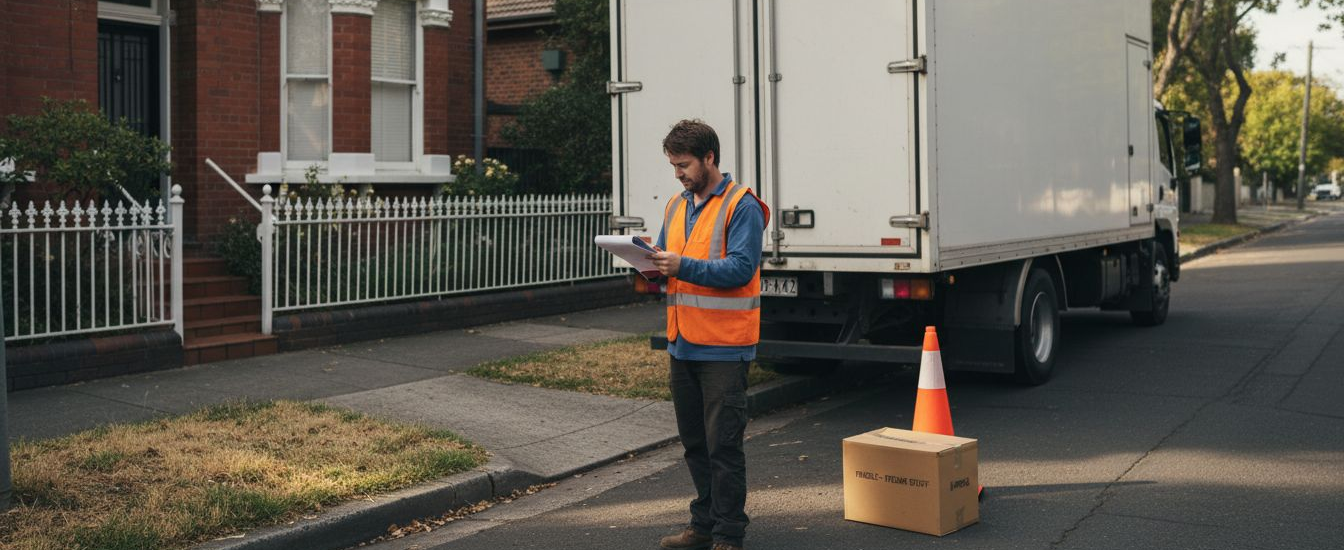
Choosing the wrong large moving truck in Melbourne can inflate your relocation costs by up to 25%. Most homeowners struggle with confusing truck sizes, unclear rental terms, and unexpected fees that turn a simple move into a financial headache. This guide cuts through the complexity, showing you exactly how to select the right truck, understand rental costs, meet legal requirements, and decide between self-drive and professional options for your Melbourne move.
| Point | Details |
|---|---|
| Right truck size saves money | Matching truck capacity to your household volume prevents overspending on unnecessarily large vehicles and reduces fuel costs. |
| Victorian licence rules matter | Trucks over 4.5 tonnes require a Medium Rigid licence, while smaller trucks need only a Class C car licence. |
| Hidden fees add up quickly | Security deposits, fuel charges, overtime fees, and mileage limits significantly increase total rental costs beyond the daily rate. |
| Insurance reduces risk | Comprehensive coverage costs AUD 20 to 50 daily but protects against theft, damage, and liability claims. |
| Professional movers cut damage | Hiring experienced teams reduces damage risks by 30% compared to self-drive rentals, though at higher upfront cost. |
Selecting the correct truck size is the foundation of a cost-efficient move. Large moving trucks in Melbourne typically range from 7 to 10 metres in length with load capacities between 3,000 and 6,000 kg, suitable for most residential relocations. The size you need depends entirely on your household’s volume, measured in cubic metres.
Smaller trucks around 7 metres suit one or two-bedroom apartments, while 8 to 9-metre vehicles handle typical three-bedroom homes. The largest 10-metre trucks accommodate four-bedroom houses or larger properties. Choosing an oversized truck wastes money on higher rental fees, increased fuel consumption, and unnecessary difficulty manoeuvring through Melbourne’s narrow suburban streets and tight driveways.
Estimate your load volume by counting rooms and furniture pieces. A standard three-bedroom home typically requires 35 to 45 cubic metres of truck space. Add 10 cubic metres for each additional bedroom, garage items, or outdoor furniture. Most rental providers offer online calculators, but you can also request an in-person assessment to avoid guesswork.
Common truck sizes and capacities:
| Truck Length | Load Capacity (kg) | Typical Use | Fuel Economy |
|---|---|---|---|
| 7 metres | 3,000-3,500 | Small apartments | 12-15 L/100km |
| 8 metres | 3,500-4,500 | Medium homes | 15-18 L/100km |
| 9 metres | 4,500-5,500 | Large homes | 18-22 L/100km |
| 10 metres | 5,500-6,000 | Very large homes | 22-26 L/100km |
Pro Tip: Take photos of your furniture and send them to rental providers for accurate size recommendations. This prevents costly errors and ensures you book the right truck first time.
Understanding the full cost structure prevents budget blowouts. Average daily rental rates range from AUD 90 to 160, security deposits typically AUD 500 to 1,500, and fuel costs can be 15 to 30% higher than average car fuel consumption. The advertised daily rate rarely reflects your final bill.

Security deposits are refundable if you return the truck undamaged and on time, but they tie up cash during your move. Most providers hold deposits on credit cards for 7 to 14 days after return. Fuel policies vary widely. Some require you to return the truck with a full tank, while others charge per kilometre or deduct fuel costs from your deposit at inflated rates.
Hidden fees catch renters off guard. Overtime charges apply if you return the truck late, often AUD 30 to 60 per hour. Cleaning fees of AUD 80 to 150 hit you if the truck interior shows excessive dirt or damage. Mileage limits restrict how far you can drive, with excess kilometre charges ranging from AUD 0.40 to 0.80 per kilometre beyond your allowance.
Typical rental cost breakdown:
| Fee Type | Typical Amount | Refundable | Avoidable |
|---|---|---|---|
| Daily rental | AUD 90-160 | No | No |
| Security deposit | AUD 500-1,500 | Yes | Return undamaged |
| Insurance | AUD 20-50/day | No | Choose basic coverage |
| Fuel charges | AUD 80-200 | No | Refuel before return |
| Overtime | AUD 30-60/hour | No | Return on time |
| Cleaning | AUD 80-150 | No | Clean truck interior |
Compare quotes from multiple providers focusing on total cost, not just the daily rate. The least expensive one-way truck rental might include unlimited kilometres, while a cheaper daily rate could have strict mileage caps. Factor in distance, estimated fuel consumption, and your schedule flexibility when evaluating average moving costs in Melbourne.
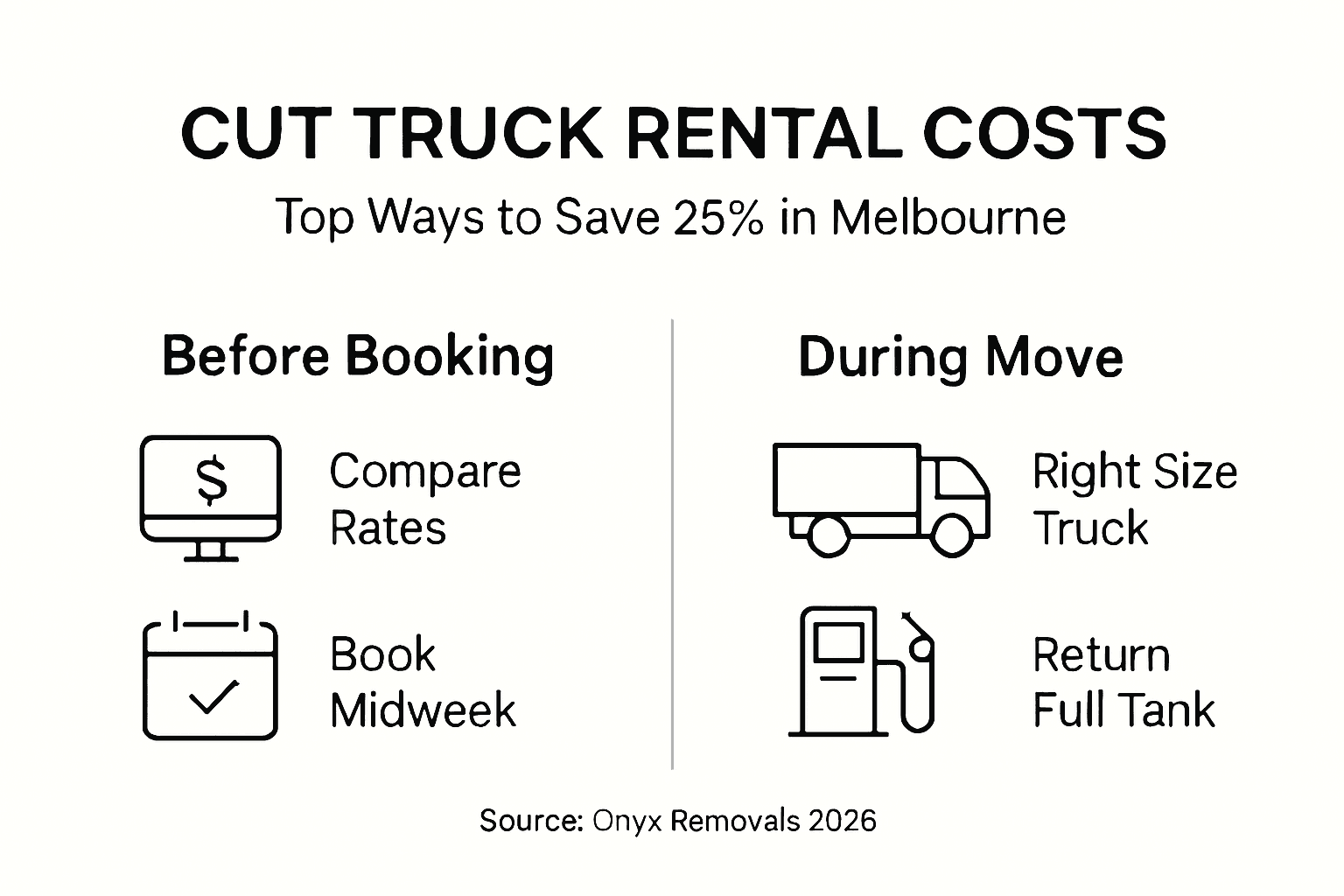
Pro Tip: Book midweek instead of weekends to access lower rates. Many providers offer 10 to 20% discounts for Tuesday to Thursday rentals when demand drops.
Protecting yourself legally and financially requires understanding insurance options and licensing rules. Comprehensive insurance adds AUD 20 to 50 per day, covering theft, loss, and damage, while truck drivers must hold appropriate licences such as Class C or Medium Rigid. Basic rental agreements include minimal third-party coverage, leaving you liable for significant damage costs.
Comprehensive insurance reduces your excess from AUD 3,000 to 5,000 down to AUD 500 to 1,000. This coverage protects against collision damage, theft, windscreen damage, and third-party property claims. Some policies exclude certain damage types like tyre punctures or interior stains, so read terms carefully before signing.
Victorian licensing requirements are strict and enforced. Trucks with a gross vehicle mass (GVM) under 4.5 tonnes can be driven on a standard Class C car licence. Vehicles between 4.5 and 8 tonnes require a Medium Rigid (MR) licence. Driving without the correct licence class voids your insurance and exposes you to fines up to AUD 3,700 plus penalty points.
Victorian truck licence requirements:
Insurance coverage levels:
Rental agreements contain liability clauses that make you responsible for damage occurring during your rental period, even if not your fault. Document the truck’s condition with photos before leaving the depot, noting existing scratches, dents, or mechanical issues. This evidence protects you from false damage claims.
Review your existing moving insurance options to see if your home contents policy covers goods in transit. Many policies exclude items during moves, leaving a coverage gap that rental insurance doesn’t fill.
Pro Tip: Pay for comprehensive insurance if driving unfamiliar routes or parking in tight residential areas. The daily cost is minor compared to potential damage bills.
Deciding between self-drive rentals and professional services depends on your budget, experience, and move complexity. Professional moving services reduce damage risks by 30% compared to self-drive rentals but come with higher fees and less flexibility. Each approach suits different situations.
Self-drive rentals give you complete control over timing, packing methods, and route planning. You pay only for the truck and fuel, making it the cheapest option for simple moves. However, you handle all physical labour, navigation, and potential damage liability. Inexperienced drivers struggle with large trucks in traffic, tight corners, and reverse parking.
Professional services include experienced drivers, loading teams, equipment like dollies and blankets, and comprehensive insurance. These benefits reduce stress and physical strain while protecting your belongings. The trade-off is higher cost, typically AUD 400 to 1,200 for a full-service move depending on distance and volume.
Consider your driver experience honestly. Have you driven vehicles over 7 metres long? Can you confidently reverse a large truck into a narrow driveway? Do you have help loading heavy furniture safely? If you answered no to any question, professional services might prevent costly mistakes.
Self-drive versus professional comparison:
| Factor | Self-Drive Rental | Professional Service |
|---|---|---|
| Cost | AUD 150-350 | AUD 400-1,200 |
| Control | Complete | Limited |
| Physical effort | High | None |
| Damage risk | 30% higher | Lower |
| Flexibility | Maximum | Scheduled |
| Insurance complexity | Your responsibility | Included |
| Parking/access issues | You solve | Team handles |
When to choose self-drive:
When to choose professional services:
The professional moving services cost often balances out when you factor in your time value, injury risk, and potential damage. A damaged dining table costs more to replace than hiring experienced movers initially.
Pro Tip: Hybrid approaches save money while reducing risk. Rent the truck yourself but hire loading labour for AUD 80 to 120 per hour to handle heavy furniture and secure the load properly.
Planning a move involves countless decisions about trucks, costs, and logistics. Onyx Removals eliminates the guesswork with transparent pricing, professional equipment, and experienced teams who understand Melbourne’s unique moving challenges.
Our stress-free moving services in Melbourne include everything from packing supplies to full-service relocations, tailored to your specific needs and budget. We provide upfront quotes with no hidden fees, so you know exactly what you’re paying before we start. Our teams hold proper licences, carry comprehensive insurance, and handle furniture with care that reduces damage risks.
Whether you need reliable moving equipment rentals for a self-managed move or a complete door-to-door service, we match solutions to your situation. Book online today or contact our Melbourne team for personalised advice that makes your relocation straightforward and affordable.
You need a standard Class C car licence for trucks under 4.5 tonnes gross vehicle mass, which covers most 7-8 metre rental trucks. Vehicles between 4.5 and 8 tonnes require a Medium Rigid (MR) licence. Driving without the correct licence class voids insurance and incurs fines up to AUD 3,700.
Count your rooms and multiply bedrooms by 10 cubic metres as a baseline. A typical three-bedroom home needs 35 to 45 cubic metres, fitting an 8-metre truck. Add extra capacity for garages, sheds, or outdoor furniture. Most rental providers offer free online calculators or phone assessments to confirm the right size.
No, fuel is almost never included in the base rental rate. You typically receive the truck with a full tank and must return it full, or face inflated fuel charges deducted from your deposit. Large trucks consume 15 to 30% more fuel than cars, so budget AUD 80 to 200 depending on your distance.
Comprehensive insurance costing AUD 20 to 50 daily is recommended for most moves, reducing your damage excess from AUD 3,000-5,000 to AUD 500-1,000. Basic rental agreements include only minimal third-party coverage, leaving you liable for collision damage, theft, and truck repairs. Always photograph the truck’s condition before departure.
Parking large trucks in suburban Melbourne requires planning. Many narrow streets and driveways challenge 9-10 metre vehicles. Check local council parking restrictions, as some areas ban commercial vehicles overnight or require permits. Arrive early to secure street parking, and consider arranging parking with neighbours if your driveway is tight.

No Related Post


