



Corporate relocations don’t have to mean lost productivity. Professional movers can reduce office relocation downtime by approximately 35%, challenging the misconception that disruption is unavoidable. Through structured project management and expert coordination, Melbourne businesses can execute efficient office moves that maintain operations. This guide provides decision-makers with practical strategies to plan and execute relocations that minimise downtime and protect business continuity.
| Point | Details |
|---|---|
| Strategic planning reduces downtime | Early stakeholder engagement and structured timelines cut disruption significantly |
| Professional movers minimise risks | Experienced teams handle logistics, IT transitions, and coordination to prevent costly delays |
| Budget with contingencies | Hidden costs like storage fees and overtime charges require financial buffers |
| Compliance prevents penalties | Melbourne building permits, workplace safety standards, and insurance requirements must be met |
| Communication drives success | Regular updates and feedback loops keep teams aligned throughout the relocation process |
Corporate relocations refer to planned office moves within Melbourne’s commercial landscape. These transitions involve relocating entire business operations, including personnel, equipment, technology infrastructure, and furniture to new premises.
Melbourne’s dynamic commercial property market drives frequent office relocations. The city’s central business district and suburban commercial hubs offer diverse options for growing companies. Property costs, accessibility to transport networks, and proximity to talent pools influence location decisions.
Common reasons for corporate relocations include:
Understanding these factors helps decision-makers recognise when relocation becomes necessary. The next step involves identifying what causes downtime during these transitions and how to prevent it.
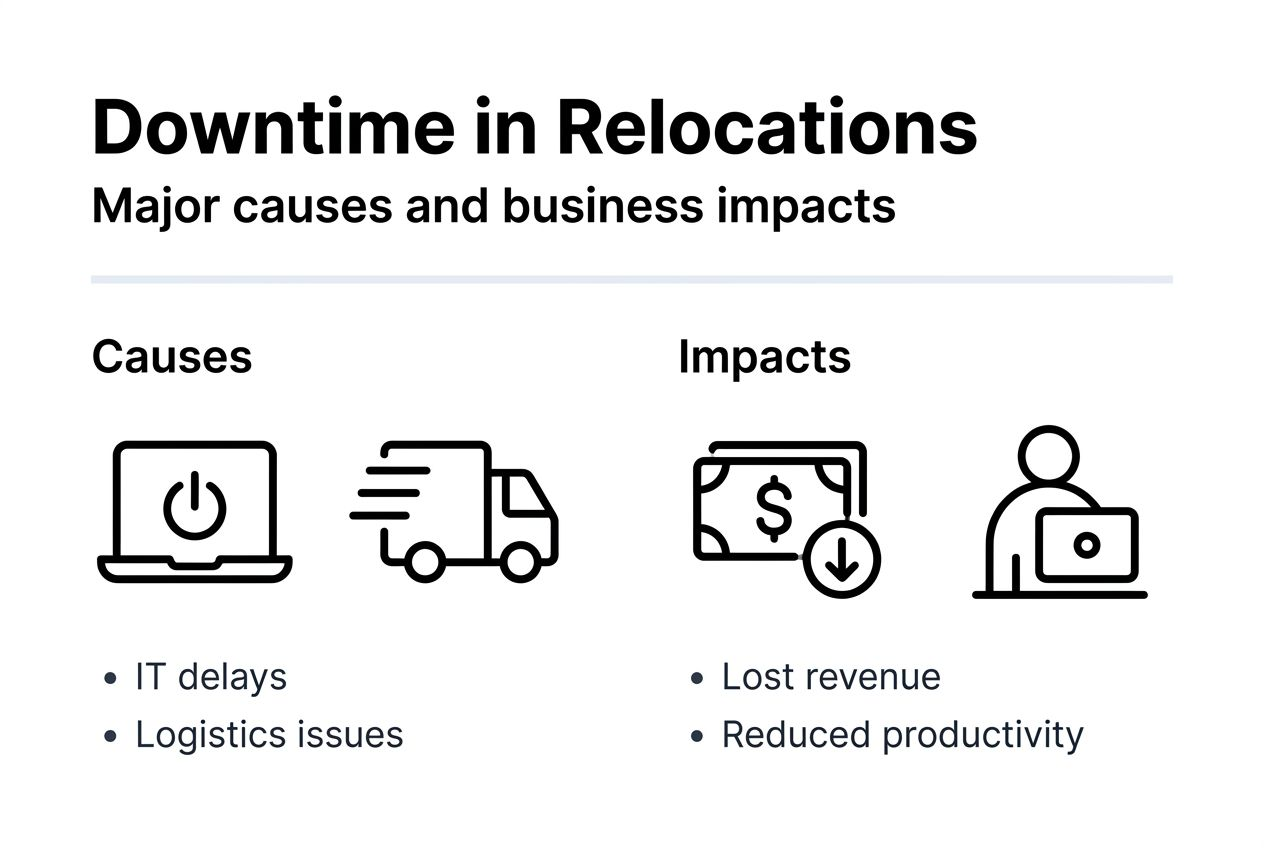
Downtime represents periods when business operations halt or significantly slow during office moves. This interruption directly affects revenue, productivity, and customer service.
Planning failures rank as the primary downtime culprit. Inadequate timelines, poor resource allocation, and lack of contingency plans create bottlenecks. Communication lapses compound these issues when teams don’t receive clear instructions about packing schedules, move dates, or new office layouts.
Key downtime causes include:
Melbourne SMBs face particular vulnerability. IT downtime incidents occur 3 to 5 times per year on average, with typical recovery times between 40 to 90 minutes. During office moves, these incidents spike dramatically without proper planning.
Downtime impacts extend beyond immediate operational disruption. Employee productivity plummets as workers navigate unfamiliar spaces and wait for systems to come online. Morale suffers when staff face prolonged uncertainty about basic work arrangements. Customer service deteriorates when teams can’t access critical systems or files.

Financial consequences multiply quickly. Lost revenue from halted operations combines with overtime costs for rushed setup work. Damaged equipment from hasty moves adds unexpected expenses. Client relationships strain when service delivery falters.
These risks aren’t inevitable. Proper planning through structured office relocation timeline melbourne frameworks and office move project management melbourne approaches significantly reduce downtime. Business continuity during relocation strategies keep operations running throughout transitions.
Project management applied to corporate relocations provides the structured framework that prevents chaos and downtime. This approach treats office moves as complex projects requiring systematic planning, execution, and monitoring.
Effective commercial relocation project management involves four key phases:
Crucial roles ensure smooth execution. The project manager orchestrates all activities, maintaining timeline discipline and resolving conflicts. Internal stakeholders from IT, HR, and department heads provide specialised knowledge and represent team needs. Professional movers handle physical logistics with expertise that internal teams lack.
| Management Approach | Benefits | Typical Downtime |
|---|---|---|
| Unstructured ad hoc | Flexible but chaotic | 5 to 7 days |
| Basic checklist | Some organisation | 3 to 4 days |
| Full project management | Controlled and efficient | 1 to 2 days |
Structured management delivers measurable advantages. Clear communication channels prevent confusion and ensure everyone understands responsibilities. Risk identification and mitigation strategies address potential problems before they escalate. Timeline control keeps the project on track despite inevitable challenges.
Pro Tip: Appoint a dedicated project manager at least 90 days before the planned move date. Early appointment allows thorough planning and stakeholder engagement before time pressures intensify.
This framework transforms relocations from stressful scrambles into controlled transitions. The next section breaks down specific planning phases that apply this structure practically.
A 90-day timeline provides sufficient lead time for thorough corporate relocation planning. Breaking this period into distinct phases ensures systematic progress and prevents last-minute chaos.
Days 90 to 60: Assessment and early planning
Days 60 to 30: Detailed planning and coordination
Days 30 to 7: Preparation and pre-move activities
Days 7 to 0: Final execution
| Phase | Duration | Key Activities | Success Metrics |
|---|---|---|---|
| Assessment | 30 days | Inventory, vendor selection, team formation | Complete asset list, signed contracts |
| Planning | 30 days | IT planning, coordination, communication | Detailed schedules, staff awareness |
| Preparation | 23 days | Packing, backups, final checks | 80% packed, verified backups |
| Execution | 7 days | Move, setup, testing | Operations restored, systems functional |
IT infrastructure demands particular attention. Plan technology transitions at least 75 days in advance. This allows time for network design, cabling installation, server relocation, and thorough testing. Coordinate with an office relocation project manager melbourne specialist to ensure technical requirements integrate smoothly with physical logistics.
Contingency planning protects against unforeseen events. Identify critical paths where delays would cascade through the schedule. Build buffer time around high-risk activities like IT cutover or building access. Maintain backup options for key vendors and alternative dates if weather or access issues arise.
Employee communication requires continuous attention throughout all phases. Weekly updates maintain awareness and reduce anxiety. Two-way channels allow staff to raise concerns and ask questions. Clear packing instructions and deadlines prevent confusion.
Pro Tip: Schedule IT infrastructure moves on Friday evenings or weekends. This provides the maximum time window for setup and troubleshooting before staff return to work, minimising productivity loss.
Successful relocations depend on involving the right people at the right time. Key stakeholders include department heads who understand team needs, IT managers responsible for technology continuity, HR personnel managing employee concerns, and facilities teams coordinating building logistics.
Early involvement proves critical. Engaging stakeholders during the assessment phase surfaces requirements and constraints before plans solidify. This prevents costly mid-project changes when someone realizes a critical need was overlooked. Early buy-in also builds champions who advocate for the project within their teams.
Continuous involvement maintains momentum. Regular steering committee meetings with senior stakeholders ensure strategic alignment. Weekly working group sessions with operational stakeholders address tactical details. This layered approach balances big-picture oversight with hands-on problem-solving.
Communication best practices for corporate relocations:
Two-way communication channels prove particularly valuable. Staff closest to daily operations often identify practical issues that planners miss. Creating safe spaces for concerns and questions builds trust and uncovers problems early.
Employee engagement directly affects relocation success. Staff who understand the rationale behind moves and feel heard about concerns show higher morale and cooperation. Those kept in the dark resist changes and fail to prepare adequately. Managing change during relocation requires addressing both practical and emotional aspects of transition.
Stakeholder mapping helps identify influence and interest levels. High-influence, high-interest stakeholders need close engagement and frequent updates. High-influence, low-interest stakeholders require monitoring to prevent surprise objections. This strategic approach ensures effort focuses where it matters most.
Corporate relocation costs extend far beyond moving truck hire. Hidden expenses catch unprepared decision-makers off guard, blowing budgets and creating financial stress.
Typical hidden costs include:
Building realistic budgets requires comprehensive cost mapping. Start with obvious expenses like professional movers, packing materials, and new furniture. Add technology infrastructure costs including cabling, equipment upgrades, and testing. Factor in facility costs such as building modifications, security systems, and utilities setup.
Contingency planning protects against budget overruns. Reserve 15 to 20 per cent of the total budget for unexpected expenses. This buffer covers scope changes, timeline extensions, or problems discovered during execution. Decision-makers who skip contingencies face difficult trade-offs when surprises arise.
Professional movers deliver cost benefits beyond their service fees. Corporate movers cut downtime costs through efficient execution that reduces lost productivity. Their expertise prevents damage that generates replacement costs and insurance claims. Coordinated logistics eliminate duplicate vendor charges and scheduling conflicts.
Past move data improves forecasting accuracy. Companies tracking previous relocation expenses gain baseline figures for planning. Industry benchmarks provide comparison points when internal data isn’t available. Melbourne-specific cost data accounts for local labour rates and property market conditions.
Cost-benefit analysis helps justify professional service investment. Compare professional mover fees against potential downtime costs, damage risks, and internal resource requirements. The analysis typically favours professional services when factoring in hidden costs and risk mitigation.
Melbourne corporate relocations must navigate specific regulatory requirements to avoid penalties and ensure workplace safety. Non-compliance creates delays, fines, and potential liability.
Building codes and permits govern many relocation activities. Moving large items through common areas may require building management approval. Modifications to the new office such as partition installation or electrical work need relevant permits. Loading dock usage typically requires advance booking and compliance with building rules. Failure to secure proper approvals can halt moves mid-execution.
Workplace health and safety regulations protect employees during relocations. Employers must conduct risk assessments identifying hazards in both old and new premises. Manual handling training prevents injuries when staff assist with packing. Clear pathways and proper lighting in both locations reduce trip and fall risks. Emergency procedures must remain operational throughout the transition.
Key safety considerations include:
Contractual obligations require careful attention. Moving company agreements should specify insurance coverage, liability limits, and claims procedures. Lease agreements for both old and new premises contain notice periods, condition requirements, and exit obligations. Vendor contracts for IT, furniture, and other services need coordination clauses ensuring seamless handoffs.
Insurance coverage protects against relocation risks. Contents insurance covers damage to office assets during transport. Public liability insurance protects against third-party claims from accidents. Professional indemnity may apply for specialized equipment moves. Reviewing policy terms ensures adequate coverage for relocation scenarios.
Documentation maintains compliance trails. Maintain records of permits, safety assessments, insurance certificates, and contractor licenses. These documents prove due diligence if disputes or incidents occur. Systematic record-keeping also streamlines future relocations by providing templates and checklists.
Specialised commercial removalists melbourne bring expertise that internal teams simply can’t match. Their experience handling hundreds of corporate relocations translates directly into reduced downtime and smoother transitions.
Expert packing protects valuable assets while maximising efficiency. Professional teams use appropriate materials and techniques for different item types. They label systematically for easy identification at destination. Their speed comes from practiced workflows rather than rushed work.
Strategic timing coordination minimises business disruption. Professionals schedule moves during low-activity periods like weekends or after hours. They sequence activities so critical functions remain operational longest. Their logistics expertise prevents bottlenecks that delay reopening.
IT coordination capabilities prove particularly valuable. Experienced movers understand technology infrastructure requirements. They work with IT teams on disconnection and reconnection sequences. Their handling protocols protect sensitive equipment from damage that causes extended downtime.
Resource management ensures adequate personnel and equipment. Professional companies scale teams to project size and timeline. They maintain backup resources if problems arise. This flexibility prevents delays from resource shortages that plague self-managed moves.
Professional moving services provide strategic timing, logistics expertise, and resource management that keep office relocations controlled and reduce chaos.
Real-world examples demonstrate these benefits. A Melbourne accounting firm relocated 85 staff across two floors using professional movers. The move completed over a Friday to Sunday period with full operations resuming Monday morning. Staff reported minimal disruption and praised the coordinated approach.
Another Melbourne technology company attempted a self-managed move to save costs. Poor coordination led to three days of partial operations and extended IT downtime. The hidden costs from lost productivity and client service issues exceeded professional mover fees by approximately 40 per cent.
Pro Tip: Integrate professional movers into project planning from the assessment phase. Their early involvement identifies logistical constraints and optimization opportunities that internal teams often miss. This collaborative approach maximises their expertise throughout the project lifecycle.
Efficient corporate relocations stem from structured project management, comprehensive planning, and professional execution. The strategies outlined here directly address common downtime causes and provide actionable frameworks for Melbourne decision-makers.
Structured project management transforms chaotic moves into controlled transitions. The four-phase approach covering assessment, planning, execution, and evaluation ensures systematic progress. Dedicated project managers maintain timeline discipline and resolve conflicts before they escalate.
Stakeholder engagement proves critical throughout the journey. Early involvement of department heads, IT managers, and HR personnel surfaces requirements and builds buy-in. Continuous communication through regular updates and feedback channels keeps teams aligned and reduces resistance.
Budgeting and compliance form the foundation of successful moves. Comprehensive cost mapping including hidden expenses prevents financial surprises. Contingency buffers handle unexpected challenges without derailing projects. Regulatory compliance with Melbourne building codes, workplace safety standards, and contractual obligations avoids penalties and delays.
Actionable checklist for corporate relocations:
First steps for decision-makers planning relocations: Begin with thorough assessment of current operations and relocation drivers. Form a core project team representing key stakeholders. Contact professional movers for initial consultations on timeline, logistics, and cost estimates. This foundation enables informed decisions about project scope and approach.
Professional expertise significantly reduces risks and downtime. Experienced movers bring systematic approaches, proven workflows, and resource flexibility that internal teams lack. Their involvement typically delivers returns exceeding service fees through prevented downtime and avoided problems.
Successful corporate relocations require more than good intentions. They demand specialised expertise, systematic execution, and coordinated logistics that professional moving services provide.
Onyx Removals specialises in moving services Melbourne businesses trust for efficient corporate relocations. Our team brings extensive experience managing complex office moves that maintain business continuity and minimise downtime.
Our comprehensive company relocation assistance Australia services cover every aspect of your move. From initial assessment through final setup, we provide tailored project management, expert packing, careful transport, and coordinated IT transitions. Our systematic approach addresses the challenges outlined throughout this guide.
Partner with an experienced office relocation project manager Melbourne team that understands your business needs. Contact Onyx Removals for a customised relocation consultation that transforms your office move from stressful challenge to smooth transition.
Structured project management with detailed timelines reduces downtime by coordinating all activities systematically. Early planning covering IT infrastructure, logistics, and stakeholder communication prevents delays. Experienced professional movers execute efficiently through proven workflows and resource management. Weekend or after-hours scheduling keeps disruption minimal.
Storage fees, overtime charges, insurance premiums, and duplicate rent often catch decision-makers unprepared. IT setup costs, furniture disposal fees, and cleaning expenses add significant amounts. Staff productivity losses during transition periods represent substantial hidden costs. Building 15 to 20 per cent contingency buffers protects budgets from these surprises.
Department heads provide team requirements and represent staff interests throughout planning. IT managers ensure technology infrastructure transitions smoothly with minimal system downtime. HR personnel manage employee communications and address workforce concerns. Facilities teams coordinate building logistics and vendor access. Early engagement of these stakeholders ensures comprehensive planning and smooth execution.
Building permits govern modifications and loading dock usage in both old and new premises. Workplace health and safety regulations require risk assessments and proper manual handling protocols. Contractual obligations in moving agreements specify insurance coverage and liability terms. Lease agreements contain notice periods and condition requirements that must be satisfied. Maintaining documentation of compliance protects against penalties and disputes.

No Related Post


