


TL;DR:
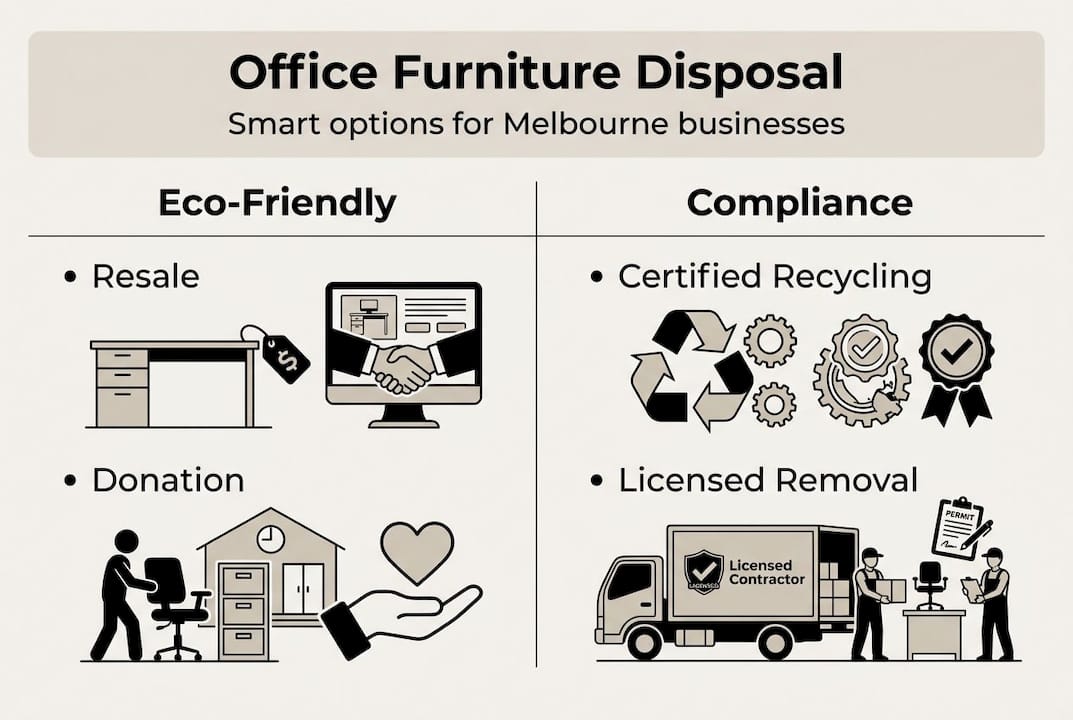
- Responsible disposal includes resale, donation, recycling, and compliance with Victorian law.
- Proper planning early maximizes revenue, minimizes legal risks, and enhances business reputation.
- Using licensed professionals ensures compliance, better recycling options, and reduced environmental impact.
When an office move or refurbishment is on the horizon, most Melbourne businesses assume old desks, chairs, and filing cabinets are headed straight to landfill. That assumption is costing businesses money, creating legal exposure, and missing real opportunities to do better. Responsible disposal covers resale, donation, recycling, and compliance with Victorian environmental law — all of which are more accessible than most people realise. This guide walks you through every practical option, the legal obligations that apply in Victoria, and how to plan a disposal process that is both cost-effective and genuinely eco-friendly.
| Point | Details |
|---|---|
| Prioritise eco-friendly options | Resale, donation, and recycling are better for business and environment than landfill. |
| Know your compliance duties | Legal obligations in Victoria cover waste types, hazardous items, and reporting. |
| Plan well ahead | Start 8 weeks before your relocation to avoid surprises and maximise value. |
| Weigh DIY vs. professional help | DIY is affordable but risky for offices; professionals offer compliance and convenience. |
| Disposal is an opportunity | Sustainable disposal can boost your brand and even generate revenue. |
Once you realise landfill isn’t your only option, it’s important to understand why sustainable disposal is now the preferred path for Melbourne businesses. The stakes are higher than most people expect, and the upside is bigger too.
First, there is the legal dimension. Victoria’s Environment Protection Act 2017 establishes a general environmental duty, which means every business has a legal obligation to minimise the risk of harm to human health and the environment from its activities. This includes how you get rid of office furniture. Ignoring this duty is not just an ethical lapse — it can attract fines and regulatory attention.
Second, there is the reputational angle. Sustainability is now a genuine business differentiator in Melbourne. Clients, staff, and stakeholders increasingly notice how organisations handle their environmental responsibilities. A business that quietly dumps a truckload of usable furniture in landfill is taking a reputational risk that is entirely avoidable.
Third, and perhaps most surprisingly, responsible disposal can actually generate revenue or reduce costs. As outlined in office furniture removal guidance for Melbourne businesses, disposal options ranked by preference put resale first, then donation, then recycling, then reuse, with landfill only as a last resort. Resale can return real dollars. Donation can satisfy corporate social responsibility commitments. Recycling recovers materials and keeps waste out of the ground.
There is also the broader community and circular economy argument. Melbourne has a growing ecosystem of organisations, schools, not-for-profits, and social enterprises that actively seek quality second-hand office furniture. When businesses engage with this ecosystem, they contribute to a local circular economy that benefits everyone.
“The most sustainable piece of furniture is the one that already exists.” Keeping usable items in circulation is always better than manufacturing new ones.
Key reasons to prioritise sustainable disposal:
For businesses planning sustainable office relocations, embedding disposal planning into the broader move strategy is the smartest first step.
With strong reasons to act responsibly, let’s break down your disposal options and how to choose the best path. Not every method suits every situation, so understanding the trade-offs is essential.
| Disposal method | Cost | Sustainability | Revenue potential | Complexity |
|---|---|---|---|---|
| Resale | Low to medium | High | Yes | Medium |
| Donation | Low | High | No (tax benefit possible) | Low |
| Recycling | Low to medium | High | Minimal | Medium |
| On-site reuse | None | Highest | No | Low |
| Landfill | Medium to high | Low | No | Low |
As disposal options are ranked from best to worst — resale, donation, recycling, reuse, landfill — here is how to work through each one:
For items that are genuinely past their useful life, junk furniture removal services can handle the heavy lifting compliantly. For full office clear-outs during business moves, office furniture removal for business moves offers a structured, compliant approach.
Pro Tip: Before calling a skip bin company, spend one hour photographing and listing your best items online. Even a modest return from resale can offset disposal costs significantly.
Knowing your options is only half the battle — Melbourne businesses must also meet strict legal and environmental standards. Getting this wrong can be costly.
Victoria’s Environment Protection Act 2017 requires businesses to classify their waste correctly and apply best practice solutions. This is not optional. The Act covers general waste, priority waste, and e-waste, each with different handling requirements.
| Waste type | Examples | Key requirement |
|---|---|---|
| General waste | Timber desks, fabric chairs | Landfill or recycling, standard disposal |
| Priority waste | Treated timber, some coatings | Licensed contractor required |
| E-waste | Monitors, printers, cables | Separate collection, cannot go to landfill |
| Combustible materials | Foam padding, certain laminates | Special handling and transport rules |
Key legal obligations for Melbourne businesses:
Lease obligations are a common blind spot. Many commercial leases in Melbourne include ‘make good’ provisions that require tenants to remove all furniture and restore the space. Failing to comply can result in withheld bonds or legal disputes with landlords.
For practical guidance on minimising removal disruption while staying compliant, early engagement with a licensed disposal partner is strongly recommended. The legal framework under Victoria’s Environment Protection Act also sets out compliance duties for combustible items, which apply to certain office furniture materials including foam and treated laminates.

Once you understand the rules, the big decision is whether to do it yourself or hand it to the pros. Both paths are viable, but they carry very different risks and rewards.
DIY disposal is appealing because it appears cheaper upfront. Council hard rubbish collections are free, and hiring a skip bin seems straightforward. But for commercial offices, the picture is more complicated.
DIY risks and limitations:
As noted in guidance on office furniture removal, DIY council hard waste is free or limited but risks non-compliance, delays, and landfill overuse — while professionals cost more but offer savings via sustainability credits and revenue sharing.
Professional office furniture removal services bring licensed compliance, scale, and access to resale and recycling networks that most businesses simply don’t have on their own. They also provide documentation — critical for lease compliance and environmental reporting.
When calculating the real cost of DIY, factor in staff time, vehicle hire, potential fines, missed resale revenue, and the risk of non-compliance. For most medium to large office clear-outs, professional services deliver better value once all costs are counted.
Pro Tip: Ask any removal company for their waste disposal certificates and recycling rates before booking. A reputable operator will provide these without hesitation. For more practical guidance, office furniture moving tips can help you prepare before the team arrives.
Regardless of whether you go with DIY or a professional, clear planning is the secret to smooth, legal, and eco-friendly disposal. Start early, and the whole process becomes manageable.
Pro Tip: Create a simple spreadsheet with item name, condition, category, and assigned disposal method. Share it with your removal partner in advance — it speeds up the process and reduces miscommunication.
For businesses planning ahead, business furniture removal tips offer further practical guidance on coordinating large-scale office clear-outs efficiently.
Most guides on office furniture disposal focus on cutting costs or avoiding fines. That is useful, but it misses the bigger picture. The businesses that handle disposal best are not just minimising risk — they are actively building something valuable.
When you document your disposal process thoroughly, you create a transparency trail that supports sustainability reporting, satisfies ESG requirements, and gives your team something to be genuinely proud of. That is not a soft benefit. Investors, clients, and prospective employees increasingly scrutinise how organisations behave when no one is watching.
The conventional wisdom says disposal is a cost centre. We think that framing is outdated. A well-planned disposal process recovers revenue through resale, builds community goodwill through donation, reduces regulatory risk through proper classification, and positions your business as one that takes its responsibilities seriously.
For Melbourne businesses, the opportunity is real. Engaging with sustainable office relocation insights early in the planning process turns what most people treat as a logistical headache into a genuine competitive advantage. The businesses that get this right are not doing anything heroic — they are just planning earlier and thinking more clearly.
If managing compliance, logistics, and sustainability across an office clear-out sounds like a lot to juggle, you don’t have to do it alone.
Onyx Removals works with Melbourne businesses to handle office furniture disposal from start to finish — covering eco-friendly pathways, legal compliance, and minimal downtime. Whether you need Melbourne commercial removalists for a full office relocation, packing and unpacking help to manage the transition, or access to full service moving solutions tailored to your business, our team is ready to make the process straightforward, sustainable, and stress-free. Get in touch today for a tailored quote.
The best approach prioritises resale and donation first, followed by recycling, with landfill as a last resort only for items that cannot be reused or recovered in any other way.
Victoria’s Environment Protection Act 2017 sets a general environmental duty, requires correct waste classification, and mandates separate handling of e-waste and combustible materials by licensed operators.
Council hard rubbish is generally limited to residential properties, and commercial quantities risk non-compliance — professional removal is the safer and more scalable option for office clear-outs.
Start at least 8 weeks in advance to allow time for inventory, waste classification, quoting, and booking compliant disposal partners before your move date.

No Related Post


