



TL;DR:
- Matching your storage solution to the duration of your move gap reduces costs and handling risks.
- Options range from depot holds for under two weeks to self-storage units for longer periods, with portable containers suited for two to six weeks.
The single most useful rule for picking a storage option when you move: match the solution to the length of your gap, not your gut feeling. For a gap under two weeks, ask your removalist about a relocation guide for families depot hold first. For two to six weeks, a portable container or pod cuts double-handling and often saves money. For anything longer, a traditional self-storage unit is usually the most cost-effective path. Most residential movers in Australia will find themselves in one of these four situations:
There are five types worth knowing. Each solves a different problem.
Self-storage units are the most familiar. You rent a unit at a facility, get a key or access code, and come and go as you please. Units range from small locker-sized spaces to rooms large enough for a full four-bedroom house. Month-to-month contracts are standard, which suits movers who aren’t sure exactly how long they’ll need the space. See the types of storage solutions available for residential moves if you want a breakdown by home size.
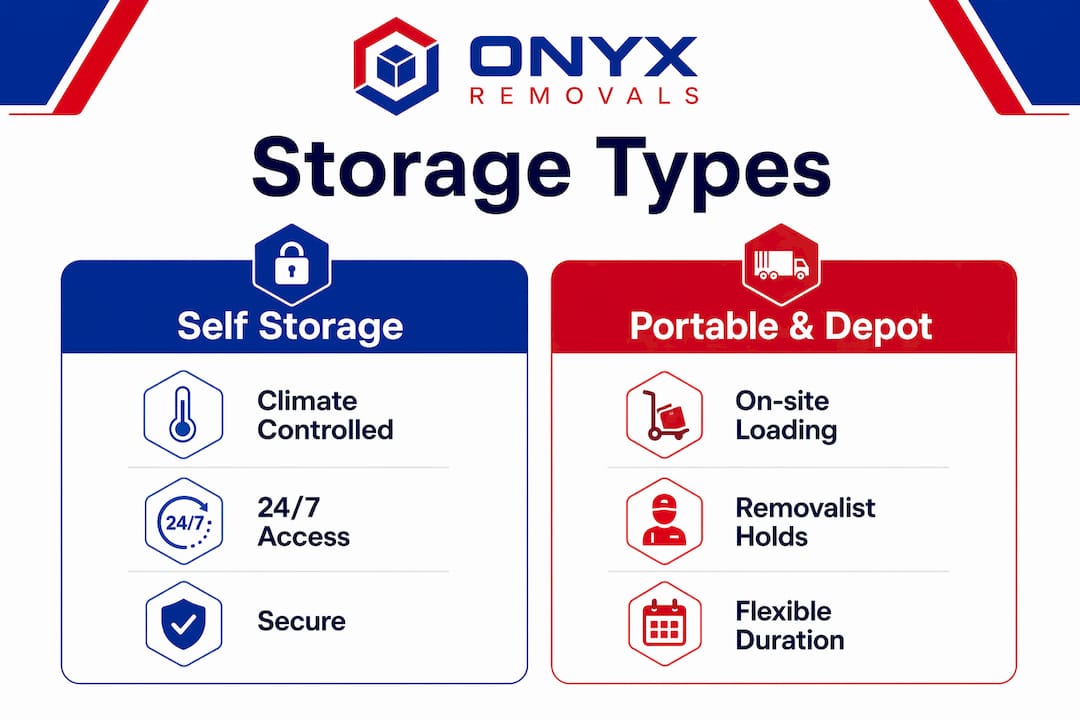
Portable containers and pod-style services involve a container being delivered to your property. You load it at your own pace, then the provider collects it and either stores it at a depot or transports it directly to your new address. The big advantage is that your goods are loaded once, which removes the extra load-unload cycle that costs time and risks damage.
Mobile storage (containerised interstate transport) is a variation where the container is moved on a truck as part of the relocation itself. Particularly useful for interstate moves where timing windows are tight and the cost of rushing is real.
Removalist depot or warehouse holds are short-term holds arranged directly with your removalist. Your goods stay in their secure warehouse between pickup and delivery. No separate booking, no second truck. This is the least-known option and often the cheapest for gaps under a week or two.
Peer-to-peer or garage storage (renting space from a private individual) exists but carries real risk: no professional security, no climate control, and unclear liability if something goes wrong. Worth mentioning only to rule it out for anything valuable.
The operational differences matter more than the headline price. Here’s how they stack up across the criteria that actually affect your move.
| Factor | Self-storage unit | Portable container/pod | Removalist depot hold |
|---|---|---|---|
| Access | 24/7 (most facilities) | Limited; depot hours only | Restricted; by arrangement |
| Security | CCTV, gated, individual locks | Depot CCTV; padlock on container | Removalist warehouse; varies |
| Who loads | You | You | Your removalist |
| Double-handling risk | High (two extra trips) | Low (loaded once) | Very low (one chain of custody) |
| Best gap length | 6+ weeks | 2–6 weeks | Under 2 weeks |
| Climate control | Available (extra cost) | Rarely available | Rarely available |
| Hidden cost risk | Admin fees, insurance gap | Delivery/pickup fees | Re-handling fees if extended |
For fragile or high-value items — antiques, artwork, electronics — a climate-controlled self-storage unit is the safest long-term choice. Basic steel shipping containers can trap heat and condensation, particularly in coastal and humid regions of Australia like Queensland and coastal NSW, where temperature swings accelerate damage to timber and leather.
Pro Tip: When negotiating a depot hold with your removalist, ask for the rate in writing and confirm the exact pickup and delivery windows before you sign anything. Vague verbal agreements on timing are where surprise re-handling fees appear.
Costs vary by location, unit size, and provider, but the patterns are consistent enough to budget around.
| Storage type | Typical short stay (1–2 weeks) | Typical medium stay (4–6 weeks) | Typical long stay (3+ months) |
|---|---|---|---|
| Self-storage (small unit, ~3×3m) | Full month charged regardless | — | — |
| Portable container/pod | Delivery + depot fee; often competitive for 2–6 weeks | Competitive; check pickup fee | Less cost-effective than self-storage |
| Removalist depot hold | Often substantially less than a full storage month | Less common; costs rise | Not designed for long stays |
The short-gap trap is real. Many movers pay for a full month of self-storage when a removalist depot hold would have covered the same gap at a fraction of the cost. If your gap is under a week, call your removalist before you book anything else.
The other cost trap is the full budget picture: headline rent plus admin fees, insurance, and the additional removalist trip to deliver your goods from the unit. For a 2–3 bedroom move stored for four to six weeks, those extras can add meaningfully to what looked like a simple monthly rate.
Pro Tip: Get quotes that include delivery, pickup, and any admin fees in one line. A portable container quote that looks expensive upfront often beats self-storage once you price in the second removalist trip.
Good packing discipline pays off twice: once when you load, and again when you unpack.
Packing materials to have ready:
For a full checklist of what to buy or hire, the packing supplies guide from Onyx Removals covers quantities by home size.
Furniture protection: Clean all surfaces before wrapping. Dismantle tables, bed frames, and wardrobes where possible to reduce stress on joints and save space. Wrap edges and legs with moving blankets, and use breathable fabric covers rather than tight plastic wrap. Plastic wrap on upholstery traps moisture and encourages mildew, particularly in Australia’s humid climates. Raise everything off the concrete floor using pallets or timber risers to maintain airflow underneath.

Fragile and specialty items: Mirrors and artwork need edge protectors and bubble wrap, then a vertical position in the unit (never flat under other items). Electronics should be in original boxes where possible, or double-boxed with foam padding. Pianos require specialist movers; don’t attempt a DIY approach. For antiques and high-value timber pieces, a climate-controlled unit is worth the extra cost — restoration after humidity damage almost always costs more than the upgrade.
Pro Tip: Tape labelled hardware bags directly to the furniture piece they belong to. It saves hours of confusion during unpacking and eliminates the “mystery bag of screws” problem entirely.
Loading order: Heavy items go in first against the back wall. Fragile and frequently needed items go near the front. Leave a narrow access aisle down the centre of the unit so you can retrieve things without unloading everything. Stack evenly and avoid overloading the top of boxes — crushed boxes at the bottom are one of the most common causes of damage in storage.
Most self-storage facilities carry limited liability. That means if your belongings are damaged by a leak, a pest infestation, or a fire, the facility’s insurance rarely covers full replacement value. Confirming your own coverage before you move anything in is not optional.
The key insurance question: Does your home contents policy extend to items in off-site storage? Many standard policies do not. You may need to extend your policy, take out a separate transit and storage policy, or check whether your removalist’s insurance covers the depot hold period. Get the answer in writing before you hand over your goods.
Security checklist — questions to ask any provider:
Documentation to secure before you store:
For more on protecting valuables during a move, the security tips guide from Onyx Removals covers what to check at the facility level and what to handle yourself.
In Australian coastal and humid regions, climate-controlled storage is not a luxury for timber, leather, and electronics — it’s the difference between items arriving in good condition and items needing repair or replacement.
Work through this in order. The right answer usually becomes obvious by step three.
Decision checklist:
Questions to ask any storage provider:
Red flags to watch for:
For many residential movers, the simplest and most cost-effective path is a single provider who handles the move and the storage under one contract. Onyx Removals offers exactly this for Melbourne and surrounding areas: residential removal, professional packing and unpacking, and storage solutions including short-term depot holds.
The practical advantage is fewer moving parts. One quote covers the truck, the crew, and the hold period. Insurance questions are simpler because your goods stay in one chain of custody from pickup to final delivery. There’s no second removalist trip to retrieve goods from a separate facility, and no coordination between two different companies when your settlement date shifts.
Where a combined service saves the most: settlement delays, interstate moves where timing is uncertain, and any move involving fragile or high-value items that you’d rather not handle twice. When your removalist already knows what you own and how it’s packed, the handover to storage and back is far less risky than transferring goods between providers.
Onyx Removals’ residential removal service is built around exactly these scenarios. The team handles packing, transport, and storage coordination as a single managed process, which removes the administrative load that catches most movers off guard. For families managing a move with children, a renovation, or a tight settlement window, that single point of contact is worth more than it sounds.
The right storage choice comes down to one variable above all others: how long your gap is, because that single factor determines which option saves you the most money and the most handling effort.
| Point | Details |
|---|---|
| Match option to gap length | Under 2 weeks: depot hold. 2–6 weeks: portable container. 6+ weeks: self-storage unit. |
| Avoid the short-gap trap | Booking a full self-storage month for a few days costs far more than a removalist depot hold. |
| Confirm insurance before you store | Facility liability is typically limited; extend your contents policy or take out transit cover. |
| Pack for retrieval, not just storage | Heavy items at the back, fragile items at the front, and leave an access aisle down the centre. |
| Onyx Removals combined service | One provider for move and storage removes double-handling and simplifies insurance for Melbourne movers. |
The advice that gets repeated least often is the one that matters most: every time your belongings are loaded and unloaded by a different crew, the risk of damage goes up and so does the cost. Most movers focus on the weekly storage rate and miss the bigger number, which is the total cost of two extra removalist visits plus the time and stress of coordinating them.
Australia’s moving context makes this worse than it sounds. Settlement delays are common, interstate timing is rarely precise, and renovation timelines slip. The movers who come out ahead are the ones who build a buffer into their storage plan from the start, choose an option that keeps their goods in one place for the whole gap, and get every rate and window confirmed in writing before they hand anything over. A removalist depot hold that costs less than a full storage month is only useful if you actually ask for it. Most people don’t, because they don’t know it’s available.
Onyx Removals handles residential moves in Melbourne with storage built in, so you’re not juggling two providers when your settlement date moves.
To get an accurate quote, have these details ready: your volume estimate (number of bedrooms or a rough item count), pickup and delivery postcodes, your preferred moving window, and whether you need climate-controlled storage for any items. The more specific you are upfront, the more accurate the quote.
Request a residential removal quote directly through Onyx Removals, or browse the full services overview to see what’s included in a combined move and storage package. Comparing a few quotes is always worth doing — just make sure you’re comparing the full cost, not just the headline rate.
This article provides general information about storage options for residential moves in Australia. It is not professional legal, financial, or insurance advice. Confirm current pricing, contract terms, and insurance coverage directly with your chosen provider before committing.

No Related Post


