



Book as soon as your moving date is likely. For a small local move in an off-peak month, some weeks of advance booking is workable. For a large home, a peak-season date, or an interstate run, significantly more lead time is needed. Leave it later and you are choosing between whatever is left, not what actually suits your move.
Here is a quick guide to booking windows by move type:
Timing affects three things above everything else: whether a good crew is available on your date, what you pay, and how much stress you carry into moving day.
Removalist pricing works like any service with limited capacity. When demand spikes, your choices shrink. That does not just mean a higher headline rate. It can mean a smaller truck than you need, an afternoon start when you wanted the morning, or no availability at all from the company you wanted.

Lead time also changes how accurate your quote is. When you book early and provide a proper inventory with access notes, a removalist can price the job correctly from the start. Accurate inventory and access notes reduce the chance of last-minute fees for stairs, waiting time, parking, or storage appearing on the day. Book late and you are often getting a rough estimate over the phone, which leaves room for surprises.
There is a coordination dimension that most people underestimate. A confirmed booking date gives you a fixed point to organise everything else around: utility transfers, end-of-lease cleaning, childcare, parking permits, and strata lift bookings. Without that anchor, small scheduling problems cascade. The cleaner cannot come until the truck has gone. The lift is booked by someone else. The parking permit takes five business days and you applied too late.
Experienced crews also book out faster than inexperienced ones. If you want a team with a strong track record, you need to get in early. The last slots available in a busy week tend to go to whoever is still available, not whoever is best.
Certain windows in the Australian calendar are consistently harder to book than others. Knowing them in advance lets you either plan around them or build in extra lead time.
Peak periods to watch:
Quick tip: If your move falls in any of these windows, add at least two to four weeks to the booking lead time you would normally allow. Holiday-specific planning is worth reading before you lock in a date.
The aftermath of severe weather events also creates unexpected demand spikes. When a storm or flood forces households to relocate quickly, it absorbs available crews across a region fast.
The table below maps common move types to practical booking windows. These are the recommended lead times used across the Australian removalist industry.
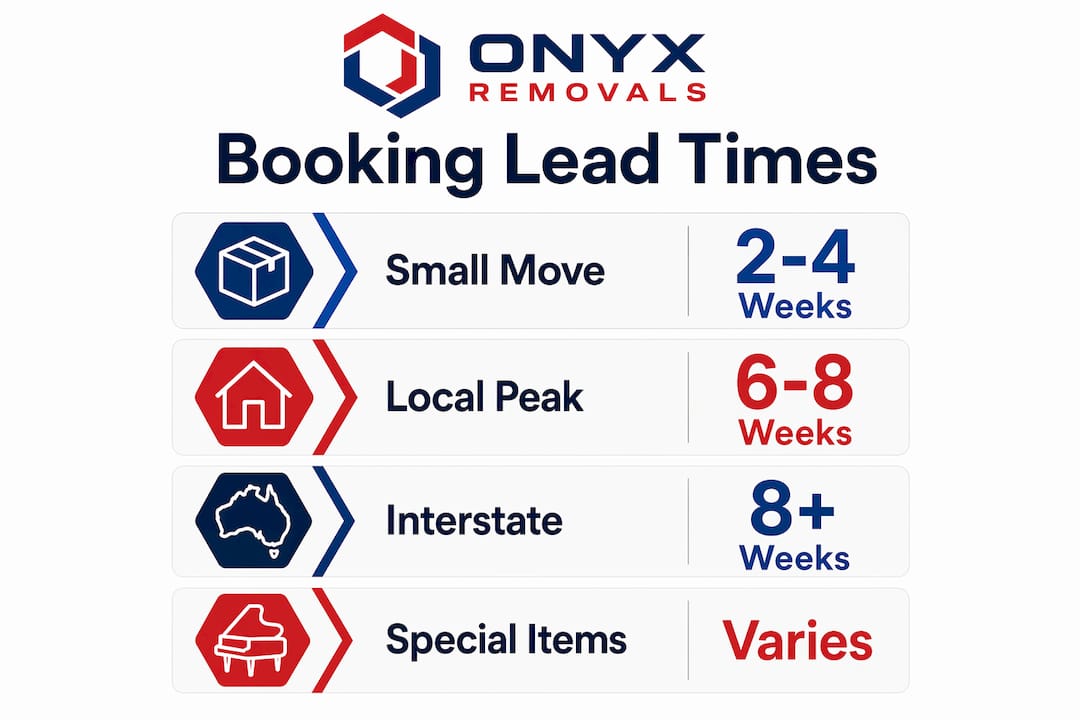
| Move type | Suggested lead time | Key reason |
|---|---|---|
| Small local move (off-peak) | 2–4 weeks | Flexible scheduling, smaller truck |
| Typical local household | 4–6 weeks | Crew and truck coordination |
| Peak-season local move | 6–8 weeks | High demand, limited slots |
| Large home or difficult access | 8–10 weeks | Equipment, crew size, permits |
| Interstate move | 8–12 weeks | Logistics, route planning, equipment |
| Holiday-period interstate | 10–12 weeks or more | Maximum demand, earliest booking wins |
| Office or commercial relocation | 8–10 weeks | After-hours access, IT coordination |
| Specialty items (piano, pool table) | Add 2–4 weeks to above | Specialist crew and equipment |
A few examples show why the windows differ so much. An interstate move from Melbourne to Brisbane is not just a longer drive. It requires a dedicated truck or a shared-load arrangement, a crew that can handle multi-day transport, and often storage at one end if settlement dates do not align. That coordination takes weeks, not days.
A piano move adds complexity regardless of distance. Specialty items and restricted access frequently require specialised crews, equipment, and third-party approvals that cannot be arranged overnight. A staircase piano in a strata building with a narrow lift is a three-variable problem. Each variable needs its own lead time.
When to book immediately:
When you can afford a little more time:
Mid-week moves on Tuesday through Thursday are consistently more cost-effective than weekend moves. Truck availability is better, crews are less rushed, and start times are more flexible. A less-pressured crew is also more careful, which tends to reduce the risk of damage and overtime.

Off-peak months such as April, May, August, and September typically carry lower demand and lower rates compared with the summer peak. January and December are the most expensive and hardest to book. March and October sit in the middle, busy enough to warrant early action but not as compressed as the summer stretch.
Low-demand windows to target:
Pro Tip: When you contact removalists for quotes, give them a range of three to five acceptable dates rather than a single date. This lets them match you to a slot that suits their scheduling, which often produces a better rate and more flexibility on crew size and start time.
Late booking is not just inconvenient. It changes the economics and the operational reality of your move in ways that add up fast.
The direct costs:
The operational risks:
If you find yourself in this position, last-minute moving tips can help you manage the situation, but prevention is far cheaper than recovery.
A practical scenario: you leave booking until two weeks before a late-January move. The removalists you wanted are full. You find a crew available at short notice, but they can only do an afternoon start. Settlement is delayed by two hours. The afternoon start plus the delay means the move runs into the evening. You need overnight storage for the items that cannot go in until the next morning. That storage cost, the after-hours rate, and the rushed packing damage to one piece of furniture add several hundred dollars to what looked like a straightforward job.
Some moves have variables that sit entirely outside the removalist’s control. These are the ones that catch people out most often.
For specialty item removals, the general rule is to add two to four weeks to whatever lead time you would otherwise use, and to confirm equipment availability explicitly when you book.
Other situations requiring extra notice:
The quality of your quote depends almost entirely on the quality of the information you provide. A vague call produces a vague estimate. A specific call produces a fixed price.
Before you contact any removalist, have this ready:
Key questions to ask the removalist:
Pro Tip: Send photos of your access points and any tricky items by email before the quote call. Removalists who can see the job before they price it are far less likely to add fees on the day. It also gives you a paper trail if there is a dispute.
Providing an accurate inventory and access notes early is the single most effective way to prevent surprise fees on moving day. The moving checklist and timeline from Onyx Removals is a practical starting point for building your inventory.
A few practical moves can meaningfully reduce what you pay and improve your scheduling options.
When comparing quotes, ask each removalist the same set of questions: fixed versus hourly pricing, minimum charges, what triggers an additional fee, and what happens if settlement is delayed. The cheapest headline rate is rarely the cheapest total cost.
Onyx Removals handles moves across Melbourne every week, including peak-season large-home relocations, short-notice apartment moves, and strata-heavy inner-city jobs. A few patterns come up consistently.
Pro Tip: Ask for a provisional hold as soon as your settlement date looks likely, even if it is not yet confirmed. A provisional booking costs nothing to hold in most cases and protects your preferred date while paperwork catches up. Just confirm the cancellation terms in writing first.
Pro Tip: For strata buildings, contact the building manager before you contact a removalist. The lift booking window determines your move window, not the other way around. Trying to reverse that order adds weeks to your planning.
Pro Tip: Stage your packing to match your booking window. Start with rooms you use least (spare bedroom, garage, storage areas) four to six weeks out. Leave daily-use rooms until the final week. This spreads the workload and means you are not living out of boxes for a month.
A peak-season large-home move: A family in Melbourne’s eastern suburbs booked a four-bedroom home move for mid-January. They contacted Onyx Removals nine weeks out, which gave enough time to arrange a two-truck crew, book the strata lift at the destination apartment, and organise a parking permit for the origin street. Settlement shifted by two days at the last minute. Because the booking had been made early, the date change was absorbed without a rush fee and without losing the crew.
A short-notice apartment move: A renter in the inner north needed to vacate within ten days after a lease dispute. With limited options available at that notice, the priority shifted to securing any available slot and managing the access constraints. The move went ahead, but at a higher rate than a planned booking would have cost, and with an afternoon start that made the day longer than necessary.
Onyx Removals’ stress-free moving guide covers the full planning timeline in detail, from first contact through to moving day.
Book as soon as your moving date is likely: earlier booking gives you better crews, more scheduling flexibility, and lower rates across every move type.
| Point | Details |
|---|---|
| Book early for peak periods | Peak-season local moves need 6–8 weeks; interstate moves need 8–12 weeks minimum. |
| Mid-week and off-peak months save money | Tuesday–Thursday moves and months like April, May, August, and September offer lower rates and better availability. |
| Prepare before you call | A room-by-room inventory, access photos, and a date range produce accurate quotes and prevent day-of fees. |
| Special situations need extra notice | Strata lifts, pianos, and restricted access each add 2–4 weeks to any standard booking window. |
| Onyx Removals handles timing-sensitive moves | Onyx Removals offers provisional holds, strata liaison, and specialty-item handling across Melbourne. |
Most people treat the booking date as an administrative task, something to tick off once the big decisions are made. That is the wrong order. The booking date is the decision that makes everything else possible.
What strikes me most, looking at how moves go wrong, is how rarely the problem is the move itself. The truck arrives, the crew is capable, the distance is manageable. What derails the day is the cascade of small things that were never coordinated: the lift that was not booked, the permit that was not applied for, the cleaner who could not come until the afternoon because the morning was already gone. Every one of those problems was solvable with two more weeks of lead time.
There is also a quality argument that does not get made often enough. The best removalist crews are booked first. Not because they charge more, though sometimes they do, but because people who have used them before come back and book them early. If you are calling around two weeks before a Saturday in January, you are not choosing from the full market. You are choosing from what is left.
The practical reassurance is this: even if your settlement date is not confirmed, a provisional booking with clear cancellation terms costs you very little and protects a great deal. Onyx Removals works with customers at every stage of the planning process, including those who are still waiting on settlement, and can hold dates while the paperwork catches up.
Getting the timing right is one thing. Having a team that can actually deliver on it is another. Onyx Removals gives Melbourne households and businesses a concrete advantage: provisional date holds while settlement finalises, strata liaison handled on your behalf, specialty item handling for pianos and oversized furniture, and flexible scheduling across residential, commercial, and packing services.

The difference between a smooth move and a stressful one is usually decided weeks before the truck arrives. Onyx Removals’ residential removal service is built around that reality: accurate quotes, confirmed bookings, and a team that coordinates the details so you do not have to. Get a quote now and lock in your date before the window closes.
Permits and strata approvals:
Onyx Removals resources:
| Resource | What it covers |
|---|---|
| City of Sydney permit portal | Parking and loading zone permits for Sydney moves |
| NSW Fair Trading | Tenant rights, lease end obligations, dispute resolution |
| Australian Border Force | International move customs and biosecurity rules |
| Strata manager / building manager | Lift bookings, move-hour restrictions, damage bonds |
| Onyx Removals moving checklist | Full planning timeline and pre-call inventory guide |

No Related Post


