


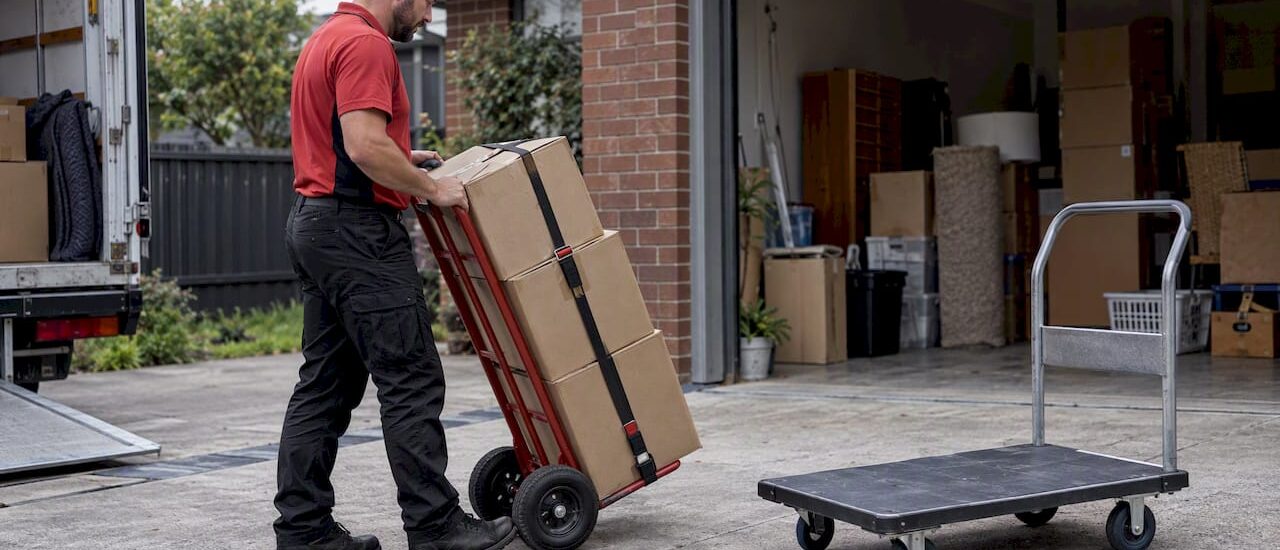
A moving trolley is a wheeled material handling aid used to move heavy or bulky items by pushing or pulling rather than lifting. People also call it a hand truck or hand trolley, and the term overlaps with “dolly” for flat, four-wheel versions. The main split is tilt-to-roll designs versus flat-platform designs, and while trolleys cut down on lifting, they still carry push, pull and crush risks if used carelessly.
TL;DR:
- Two-wheel hand trolleys are ideal for tall, narrow items on level surfaces, but they become harder to control with wider loads.
- Four-wheel dollies suit wide, heavy, or boxed items and require more space for turning but provide better stability.
- Use stair trolleys or powered aids for stairs or long distances, especially when loads exceed the rated capacity or involve awkward shapes.
- Always measure the load, check rated capacity, and choose wheel type based on floor surface to prevent tipping or control issues.
- Professional movers prefer using multiple tools and assessments, such as power lifts or extra help, for challenging loads or stairs.
Most household and commercial moves rely on a small handful of trolley designs, each built for a different shape of load. Picking the wrong one is the most common reason a move takes longer or ends in a scraped wall or a sore back.
The two-wheel hand trolley is the classic L-shaped frame with a flat toe plate and a near-vertical backrest. You tilt the load back onto the toe plate and wheel it along on two large wheels. It suits tall, narrow items such as fridges, washing machines, filing cabinets and stacks of boxes strapped together. Because the load tilts back, your view forward stays reasonably clear, which matters more than people expect once you are navigating a hallway.
Four-wheel dollies and platform trolleys carry the load level rather than tilted, sitting flat on a rectangular or square deck. They suit sofas, mattresses, crated appliances and multiple boxes that need to travel as one stable unit. Because nothing is on an angle, they handle wider or heavier items with less tipping risk, though they take more floor space to manoeuvre.
Shelf, cage and platform trolleys add raised sides or multiple tiers, which is useful when you are shifting several loose or oddly shaped items at once rather than one large piece, such as kitchen boxes, pot plants or retail stock.
Stair trolleys and multi-wheel stair climbers use stepped or triangulated wheel clusters to walk a load down a flight of stairs with less lifting, but they are slower, need a clear and even stair run, and are not suited to spiral or very narrow staircases.
Hand pallet jacks and lift trolleys are built for palletised loads or items that need lifting to bench height, common in warehouses and retail deliveries rather than typical household moves.
A few other things worth knowing at a glance:
Once you know the types, the next question is which one fits the load and the route in front of you. The WorkSafe Victoria guidance on using trolleys notes that trolleys reduce lifting and carrying, but pushing, pulling and steering still create musculoskeletal injury risk, so the match matters.
Tilt-to-roll two-wheel trolleys keep the load’s weight resting partly on the frame and partly on your grip, which works well for tall, narrow items but gets harder to control as width increases. Flat four-wheel dollies spread the load evenly across the deck, which is steadier for wide or heavy pieces but needs more clearance to turn.
Manoeuvrability comes down to wheel type and turning radius. Large pneumatic or rubber wheels roll more easily over uneven floors and cords, while small hard castors are fine on smooth concrete but jolt on gravel or broken paving.
Capacity and stability trade off against each other: a taller stack raises the centre of gravity, so a trolley loaded to its rated limit but stacked high is more likely to tip than the same weight stacked low.
Terrain decides more than most people assume. Stairs, ramps, narrow doorways and rough ground all reduce the control you have over start, turn and stop forces, points covered in the Safe Work Australia model code on hazardous manual tasks.
A short decision checklist helps when you are standing in the garage trying to choose:
Before you buy or hire anything, measure the load. Dimensions and an honest guess at where the centre of gravity sits will tell you more than the trolley’s marketing copy ever will.
Our guide to essential equipment for safe heavy moves covers gear choices in more depth if you are assembling a kit rather than a single trolley.
Pro Tip: Test the empty trolley on your actual route first. A tight hallway corner or a worn doorstep will tell you more in ten seconds than any spec sheet.
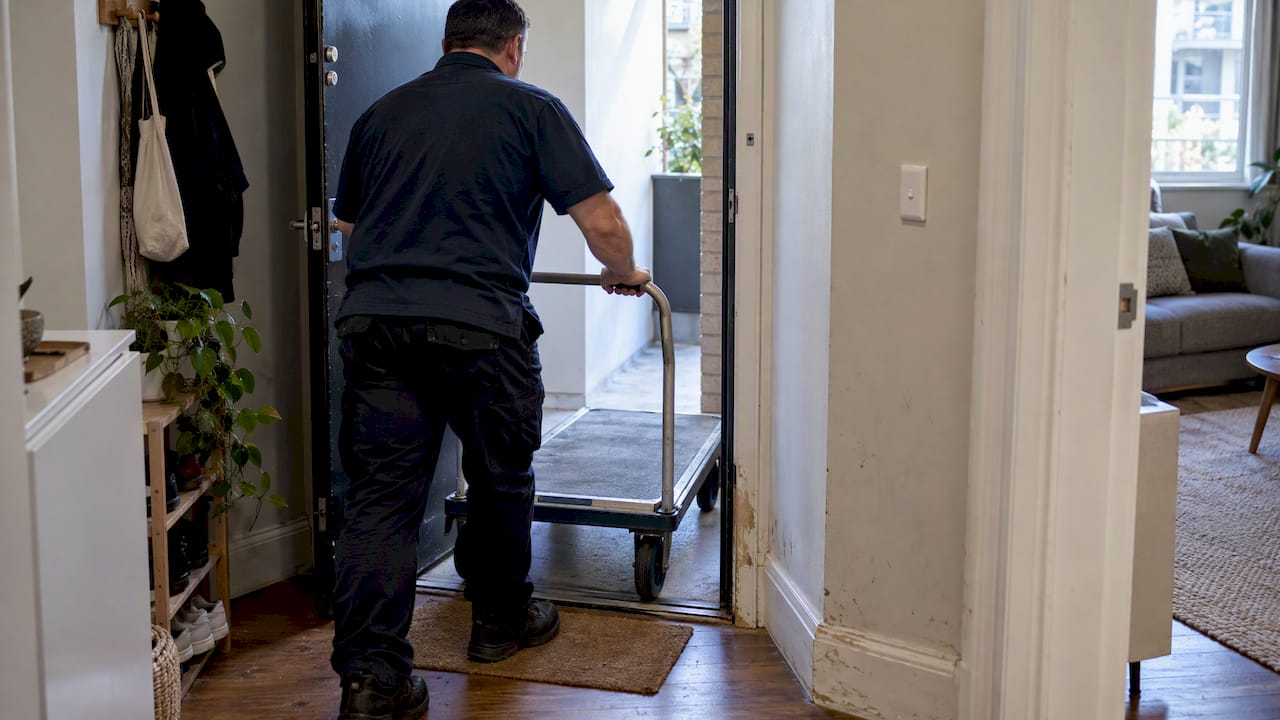
Good technique turns a trolley from a convenience into a genuine safety tool. The UNSW materials handling guideline lays out a practical sequence that applies just as well at home as in a warehouse.
Hazardous manual tasks, including pushing and pulling heavily loaded trolleys, are a recognised cause of workplace musculoskeletal disorders, and Safe Work Australia’s guidance on lifting, pushing and pulling recommends mechanised aids over manual handling wherever that is practical.
Avoid the obvious traps: never overload past the rated capacity, never ride on a trolley, and never walk backwards down a staircase while guiding one. Our step-by-step guide to moving heavy furniture safely walks through the same sequence with more detail on tricky items.
Professional crews treat the trolley as one tool among several, not the default for every job. The decision usually comes down to the load, the stairs and the distance involved.
For jobs that sit outside a simple household trolley run, our guide on hiring help for moving heavy furniture covers what to look for.
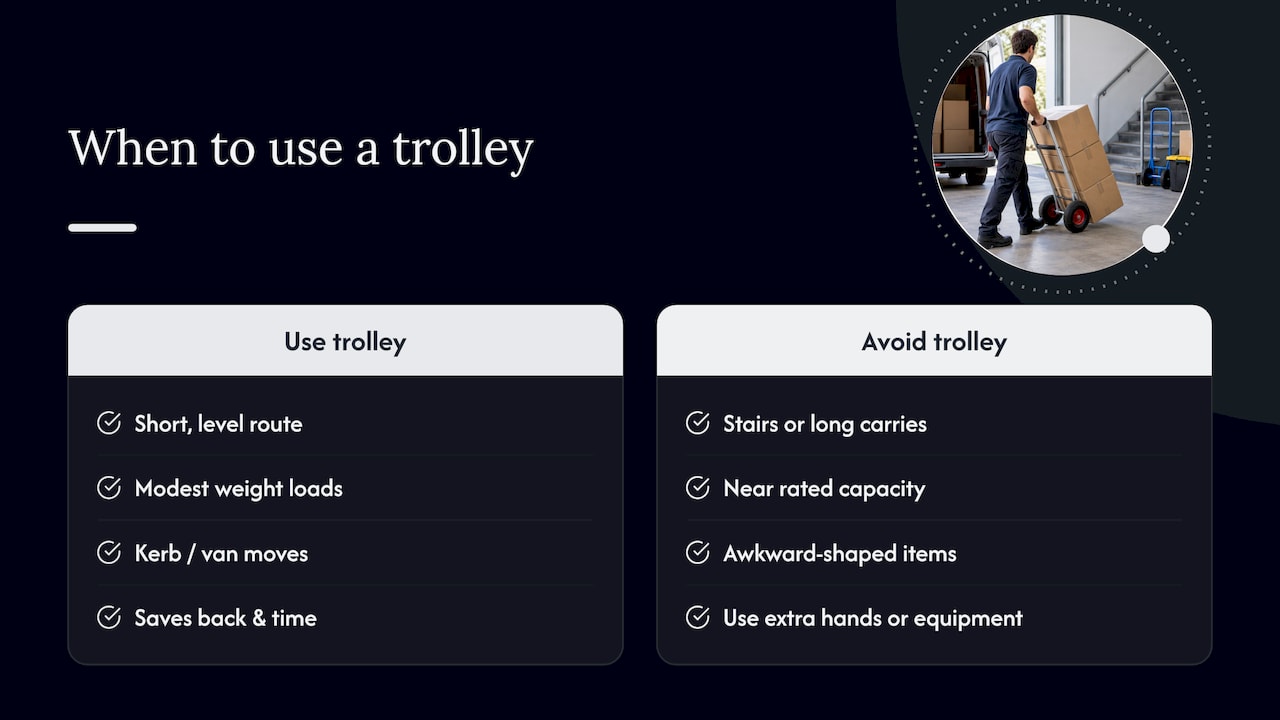
A trolley earns its place on short, level routes with modest weights: a fridge to the kerb, boxes from a spare room to a van parked out front. That is DIY territory, and a well-chosen trolley will save your back and your time.
Stairs, long carries, awkward shapes or anything near the upper end of a trolley’s rated capacity change the calculation. At that point, a second pair of hands or proper equipment matters more than willpower. Whatever you choose, check the rated capacity first and walk the route before you load anything.
— Dinshaw
A moving trolley is also called a hand truck, hand trolley or, for the flat four-wheel version, a dolly. All describe wheeled equipment used to push or pull loads rather than lifting and carrying them, as the WorkSafe Victoria guidance describes.
Hardware retailers commonly stock hand trolleys and platform dollies for sale or hire, though specific stock and hire availability varies by store and is best checked directly with the retailer. If you need equipment plus labour for a full move, a removalist service is a more complete option than hiring a trolley alone.
The main types are two-wheel hand trolleys for tall narrow loads, four-wheel platform dollies for wide or heavy items carried level, shelf and cage trolleys for multiple loose items, stair trolleys for steps, and hand pallet jacks for palletised loads. Each suits a different load shape and route, as outlined earlier in this guide.
A trolley’s purpose is to move heavy or bulky items by rolling them rather than lifting and carrying them, which reduces strain on the body. The Safe Work Australia model code notes that pushing is usually preferable to pulling because it allows better use of body weight and forward vision.

No Related Post


