


TL;DR:
- Heavy equipment moves in Melbourne require detailed planning, permits, and compliance with strict laws.
- Proper rigging, secure restraint, and site assessments are essential to prevent damage and ensure safety.
- Experience, thorough documentation, and communication are more important than low quotes when choosing a mover.
Moving a heavy piece of equipment is nothing like shifting a couch. A single mismanaged relocation can result in property damage, serious injury, costly regulatory fines, and project delays that ripple for weeks. Whether you’re a homeowner needing a spa relocated across a tight courtyard or a business owner shifting industrial machinery to a new warehouse, the complexity of heavy equipment moving in Melbourne is routinely underestimated. This guide breaks down everything you need to know: what the regulations actually require, how the professional process works, which risks to watch for, and how to select a moving company that genuinely knows what it’s doing.
| Point | Details |
|---|---|
| Ask about compliance | Always confirm your mover has the proper licences, permits, and insurance for heavy equipment transport in Victoria. |
| Plan for risks | Professional movers assess risks up front, including weather, access, and legal requirements, to avoid costly surprises. |
| Verify industry expertise | Choose companies with proven, local experience handling heavy equipment in both residential and commercial settings. |
| Understand the process | A good mover will walk you through each step, from assessment and permits to delivery and safe unloading. |
Not everything large qualifies as “heavy equipment” in a professional moving context, but the category is broader than most people assume. Generally speaking, heavy equipment refers to any machinery, vehicle, or speciality item that exceeds the capacity of standard removal methods because of its weight, size, or structural fragility. Think industrial air compressors, CNC lathes, MRI machines, large concrete mixers, outdoor spas, heavy safes, and commercial printing presses.
For Melbourne homeowners, the most common scenarios involve items like:
For business owners, the list expands considerably:
Melbourne adds its own layer of difficulty. Urban density in suburbs like Fitzroy, Collingwood, and Richmond means narrow laneways, low overhead clearances, and tight loading zones. Weather is unpredictable, and local council regulations vary from one precinct to the next. Permit requirements, noise curfews, and road usage agreements can catch underprepared operators completely off guard.
“A thorough pre-move site assessment is not optional — it is the foundation of every safe heavy equipment relocation. Without it, you’re guessing.”
This is why moving large machinery tips should always start with a proper on-site evaluation rather than a phone quote. Pre-transport assessment forms the backbone of every compliant job, alongside secure rigging, GPS tracking, and full insurance. Skipping any of these steps creates serious exposure for everyone involved.
Once you understand what heavy equipment moving involves, the next logical question is: what does the law actually require? The answer is more structured than most people expect, and non-compliance carries real consequences.
In Victoria, heavy equipment transport is governed by the Heavy Vehicle National Law (HVNL). Under this framework, OSOM permits are required for any load exceeding 2.5 metres in width, 4.3 metres in height, 12.5 metres in length, or 42.5 tonnes in total mass. These are not soft guidelines — they are hard legal thresholds.
| Load dimension | Standard limit | OSOM permit required if exceeding |
|---|---|---|
| Width | 2.5 metres | Yes |
| Height | 4.3 metres | Yes |
| Length | 12.5 metres | Yes |
| Total mass | 42.5 tonnes | Yes |
When a permit is required, additional obligations apply. These include route pre-planning with the relevant road authority, pilot (escort) vehicles at the front or rear of the load, and strict daylight-only movement restrictions on certain roads. Load restraint standards are equally firm: loads must withstand 0.8g forward force and 0.5g in all other directions. That’s not a guideline; it’s an engineering standard built into Australian road law.
Here are the core compliance elements your moving company should demonstrate:
Chain of Responsibility, or CoR, is a framework that holds everyone from the equipment owner to the transport driver legally accountable for safety. It’s not just the driver’s problem if something goes wrong. You, as the client, can also be held liable if you knowingly engage a non-compliant operator.
Pro Tip: Before signing any agreement, ask your mover to show you their most recent permit for a comparable job. A legitimate operator will have no hesitation producing this documentation on request.
For safe machinery relocation, compliance isn’t an administrative burden — it’s a sign that the company genuinely knows their craft. And if you’re searching for experienced Melbourne heavy object movers, make compliance your first filter, not price.
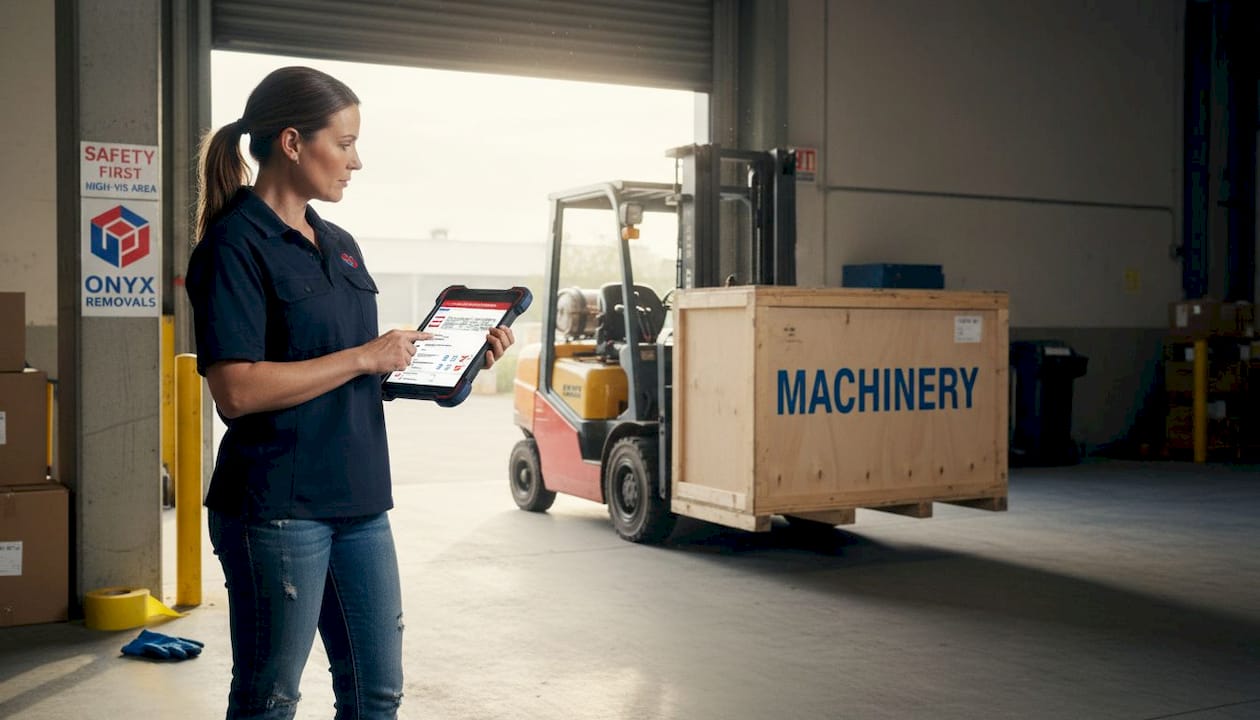
Understanding the regulatory side of things is valuable. But what does an actual professional heavy equipment move look like from start to finish? Here is how a properly managed relocation unfolds.
1. Site visit and risk assessment
A qualified assessor visits both the pickup and delivery locations. They document ceiling heights, floor load ratings, access points, elevation changes, and any obstacles that could affect equipment movement. This step is non-negotiable for a well-run job.
2. Rigging and loading
The equipment is secured using purpose-built rigging hardware: chain blocks, spreader bars, shackles, and slings rated for the specific load weight. The rigging method is chosen based on the item’s centre of gravity and structural integrity.
3. Transport logistics and tracking
The vehicle departs with GPS tracking active. For large loads requiring pilot vehicles, coordination with escort drivers happens in real time. Route deviations due to traffic, road works, or unexpected clearance issues are managed on the fly.
4. Unloading and placement
At the delivery site, the unloading process mirrors the loading procedure. If craneage is required, it is pre-booked and integrated into the schedule. Final placement is confirmed against the client’s floor plan.
5. Compliance sign-off
All documentation, including permits, restraint checklists, and delivery confirmation, is filed. This protects both the mover and the client under the CoR framework.
Real-world examples illustrate just how demanding this work gets. A 42-tonne concrete pump truck was successfully relocated in Melbourne using a specialised flat tow configuration. At the other extreme, a 185-tonne mining shovel upper carriage was moved interstate using a multi-axle configuration. Even residential moves can involve two-stage container logistics with SideLoader and SuperTilt equipment.
| Move type | Equipment used | Complexity level |
|---|---|---|
| Concrete pump truck (42t) | Flat tow config | High |
| Mining shovel carriage (185t) | Multi-axle, interstate | Extreme |
| Residential spa relocation | Crane and sling | Medium |
| Commercial printer move | Skates and rigging | Medium-High |
Pro Tip: Always ask your mover for a written schedule before the job begins. A professional company will give you a clear timeline including loading start, estimated transit duration, and delivery window. Vague timeframes are a warning sign.
If you want a fuller picture of the scope involved, the big item removal guide covers residential and commercial scenarios in practical detail.
Every heavy equipment move carries risk. Acknowledging that upfront is a sign of professionalism, not weakness. Here’s where things go wrong and what experienced operators do to prevent it.
Equipment damage during transport
Improper restraint is the single leading cause of transport damage. An item shifts even slightly and contacts the trailer wall, causing thousands of dollars in harm. Professional operators use rated tie-downs, friction mats, and custom-built cradles where necessary.
Legal liability exposure
If your mover doesn’t carry adequate insurance and something goes wrong, you may find yourself personally liable. Always request a certificate of currency for both public liability and goods-in-transit insurance before the job commences.
Weather and access delays
Melbourne’s weather can shift from clear to stormy in under an hour. Overcoming transport challenges requires proactive planning: permits must be applied for in advance, alternate routes pre-approved, and weather windows factored into scheduling. CoR holds all parties accountable when poor planning creates an incident, so there’s no room for last-minute scrambles.
Paperwork errors
Missing or incorrect permit details can halt a job at a police or transport inspection point. Reputable companies maintain dedicated compliance staff who review documentation before every job.
“Planning for weather, site access, and permits early is not just best practice — it’s the difference between a smooth move and an expensive, stressful failure.”
Here is what the best companies do to keep your move on track:
Pro Tip: When hiring moving help for anything heavy, ask specifically: “What’s your protocol if something unexpected happens on the day?” A strong answer reveals experience. A vague one reveals risk.
For practical guidance on managing larger appliances and heavy items, the heavy appliance moving advice section covers what homeowners specifically need to watch for.
Armed with knowledge about the process and the risks, you’re now ready to choose your mover. Here’s a clear, practical framework to guide your decision.
Step 1: Verify credentials before anything else
A legitimate heavy equipment mover should be able to immediately provide:
Step 2: Ask the right questions
The questions you ask during an initial conversation reveal more than any website or brochure. Use these:
Step 3: Spot the warning signs
Some operators look legitimate at first glance. Watch for these red flags:
Step 4: Assess Melbourne-specific experience
An operator who regularly works in metropolitan Melbourne understands the nuances: council permit requirements that vary by suburb, VicRoads approval timelines, the quirks of loading zones near commercial precincts, and how to manage moves in high-density residential areas without disrupting neighbours.
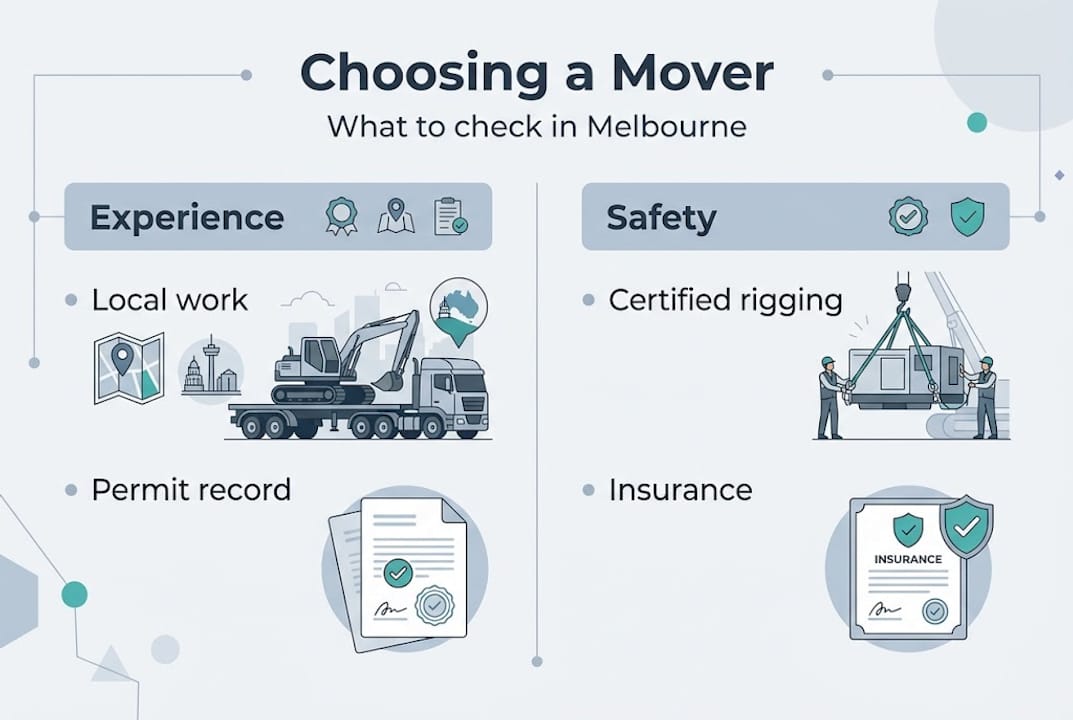
Pre-transport assessment and certified rigging are baseline standards, not premium extras. Any operator presenting them as add-ons is not equipped for the job.
Pro Tip: Check the company’s reviews specifically for heavy or specialist moves, not just general removals. A five-star review for moving boxes tells you nothing about how they’ll handle a 500kg lathe.
For additional guidance on specialist transport, the fragile item transport tips resource is a useful companion for clients moving sensitive or high-value equipment alongside heavy items.
Here’s an opinion based on real experience: price shopping for heavy equipment movers is one of the most expensive mistakes a Melbourne homeowner or business owner can make. It feels rational. You’re getting three quotes, comparing numbers, being financially responsible. But the number on the quote rarely reflects the full picture.
Cheap operators cut corners in specific, predictable ways. They use underrated restraint gear. They skip the site visit. They apply for permits after the job is booked rather than before. They carry minimal insurance. And when something goes wrong, those corners become your problem, legally and financially.
The safe heavy machinery moves that go smoothly share a common trait: they’re run by companies that planned for every foreseeable outcome before the truck moved an inch. That planning costs time and money. It’s reflected in the quote. And it’s worth every cent.
What separates excellent operators is not flashy equipment — it’s the depth of their pre-move process, the clarity of their communication, and the rigour of their compliance documentation. In our experience, those qualities correlate directly with outcome quality. A mover who can articulate their risk management process in plain language, show you the permits, and give you a project coordinator’s direct number is worth far more than one who promises a bargain and delivers ambiguity.
Prioritise Melbourne experience, documented case studies, and transparent compliance practices over a lower invoice. Your equipment, your property, and your business continuity depend on it.
Moving heavy equipment in Melbourne requires more than a truck and a strong team. It demands planning, compliance, specialist equipment, and clear communication from start to finish.
At Onyx Removals, we manage both Melbourne residential moving and commercial relocation experts services, including specialist heavy equipment transport that meets all Victorian regulatory standards. Our team is licensed, insured, and experienced across a wide range of heavy item moves — from residential spas and large safes to commercial machinery and industrial fit-outs. We handle permits, provide detailed project plans, and keep you informed every step of the way. Contact us today for a tailored quote and find out how straightforward a professionally managed heavy equipment move can be.
Heavy equipment includes large machinery, vehicles, industrial tools, or speciality items too heavy or bulky for standard moving methods, such as safes, spas, workshop machinery, and commercial printers. A professional mover will assess whether your item requires specialist handling during the initial site evaluation.
Yes, an OSOM permit is required if your load exceeds 2.5m wide, 4.3m high, 12.5m long, or 42.5 tonnes in total mass under the Heavy Vehicle National Law.
Professional companies use specialised rigging and restraint methods, certified load-securing equipment, goods-in-transit insurance, and pre-move risk assessments to eliminate the most common causes of transport damage.
CoR ensures that all parties are accountable — owners, operators, and drivers — for safety and compliance, meaning you as the client share responsibility for engaging a properly licensed and insured mover.
The process begins with a site assessment, followed by rigging and secure loading, permit confirmation, GPS-monitored transport, and careful unloading. Full compliance documentation is completed at each stage to protect all parties under Victorian law.

No Related Post


