


TL;DR:
- Moving house with children is emotionally and logistically complex, as they experience significant loss and disruption. Preparing them early through honest communication and involving them in the process helps reduce anxiety and builds a sense of control. After the move, restoring routines and managing parental stress are crucial for children’s emotional adjustment and stability.
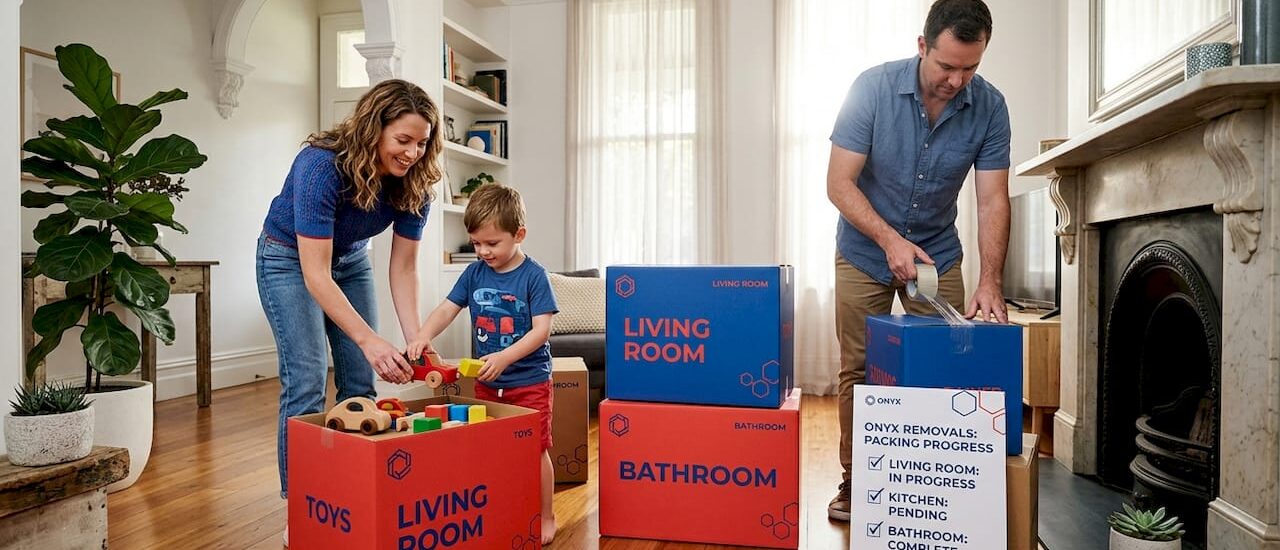
Moving house with kids is one of the most logistically and emotionally complex things a family can do. It is not simply a furniture problem. It is a simultaneous disruption of routine, friendships, school, and the physical spaces children associate with safety. Melbourne families face this challenge regularly, whether relocating across suburbs or crossing the city entirely. This guide gives you age-specific strategies, a clear moving day framework, and honest advice about what happens after the boxes are unpacked, so you and your children arrive at the other end intact.
| Point | Details |
|---|---|
| Start early preparation | Discuss the move openly with your children well before moving day to reduce stress. |
| Protect routines | Immediately re-establish bedtime, meals, and morning routines to provide security. |
| Pack smart for kids | Make a dedicated first-night essentials box with comfort items and necessities. |
| Expect adjustment time | Children usually settle in 1–2 weeks but watch for longer-term issues. |
| Seek help if needed | Persistent behavioural or emotional problems after the move may require professional support. |
Before any box gets taped, it helps to understand what your children are actually losing. Adults tend to frame a move in practical terms: new suburb, better schools, more space. Children experience it differently. They lose their bedroom, their familiar street, their next-door friends, and the after-school routine that makes their world predictable, all at once.
A long-distance family move ranks among the most disruptive events a child experiences, comparable to divorce or the loss of a grandparent. Even a local Melbourne move, say from Fitzroy to Footscray, can feel enormous to a six-year-old who has never known a different backyard. The physical distance is irrelevant to them. The loss of familiarity is everything.
Younger children, particularly those under five, rely on routine predictability as a form of psychological security. When that predictability collapses simultaneously with a new environment, sleep regression, clinginess, and emotional outbursts are common responses. Older children and teenagers tend to express the disruption differently, through social withdrawal, irritability, or academic disengagement.
Understanding these emotional effects helps you prepare kids emotionally before the moving truck arrives, rather than trying to manage the fallout afterwards. Refer to the Melbourne family moving checklist early in your planning so nothing critical gets left to the last week.
Common emotional and behavioural impacts to watch for:
The single most effective thing you can do for your children before moving day is talk to them honestly and early. Not with forced positivity, and not with vague reassurances like “it will be great.” Children read through optimistic deflection. What they need is acknowledgement that the move will be hard in some ways, and a clear plan for what you will do together when it is.
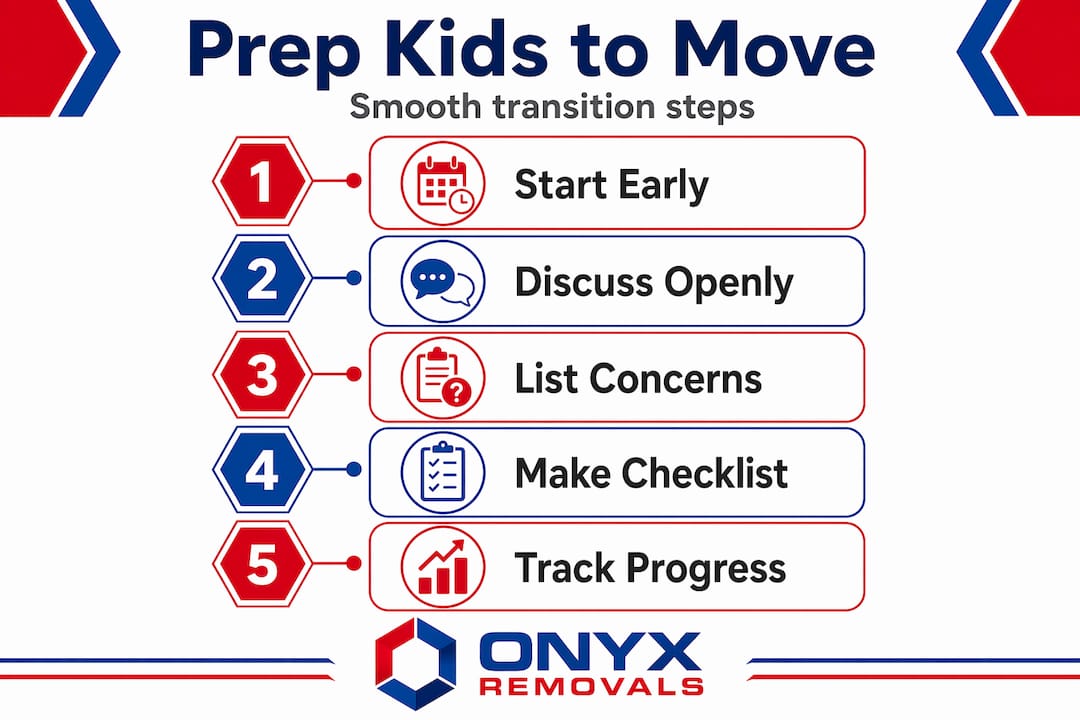
A practical approach is the “What might be hard? What will we do?” conversation. Sit down as a family and list the actual things each child is worried about. For a seven-year-old, that might be leaving their best friend. For a fourteen-year-old, it might be starting a new school mid-year. Then problem-solve those specific fears together. “We will ask Lara’s mum for a weekend visit once we are settled” is more comforting than “you will make new friends.”
Research confirms that involving kids with bounded choices, such as letting them pack their own small box or choose the colour scheme for their new room, reduces anxiety by giving them a sense of control within a situation they cannot control entirely. This is not about letting children run the move. It is about preserving their sense of agency.
A step-by-step approach to age-appropriate preparation:
Use your family moving checklist to track these milestones alongside the practical logistics, so the emotional preparation does not get swallowed by the admin.
Pro Tip: For teenagers especially, avoid framing the move as purely exciting. Acknowledge the loss directly. “I know this is hard, and I know you did not choose this” lands far better than relentless positivity, which teenagers find dismissive.
Moving day is where even the most prepared families hit friction. The solution is to treat the day as two parallel operations: the physical move, and the children’s experience of it.
Assign roles before the day begins. One adult coordinates with the removalists, oversees the truck, and manages logistics. The other adult is dedicated entirely to the children. This is not a luxury arrangement. It is genuinely necessary if you want both operations to run without crisis.
What to set up before the removalists arrive:
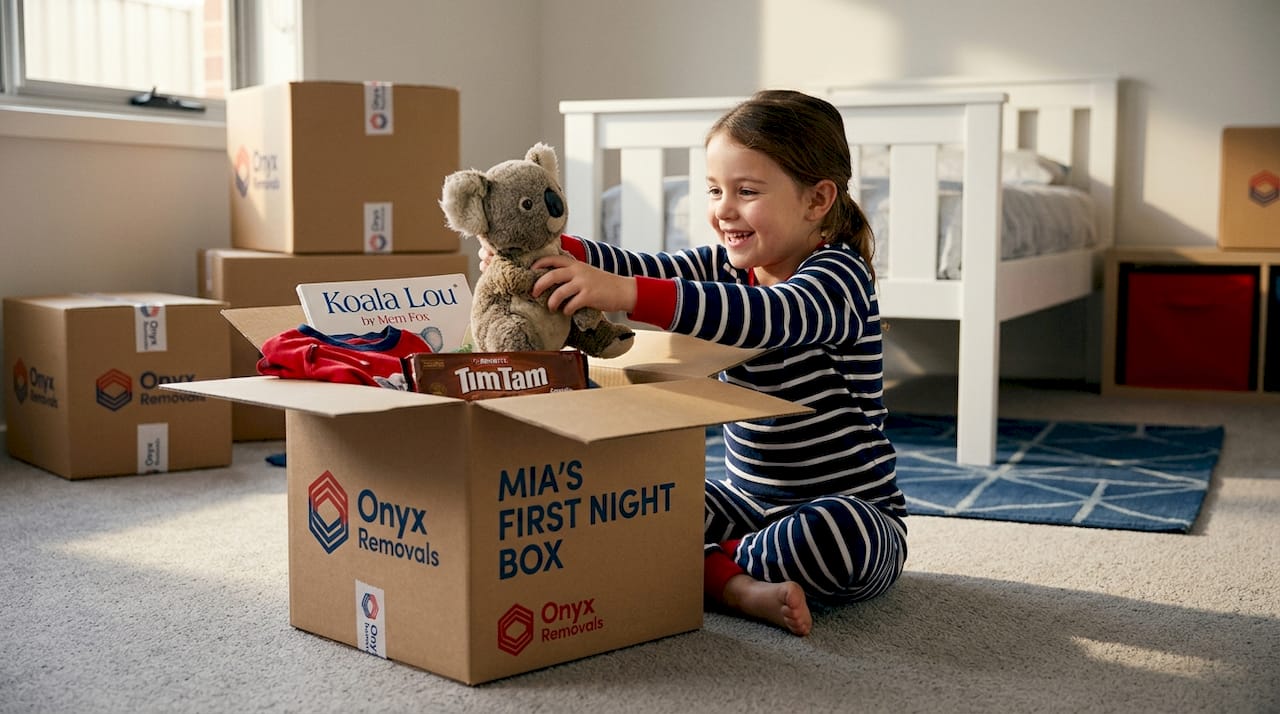
Pack a first-night box for each child containing bedding, a change of clothes, their comfort item, pyjamas, and snacks, and keep it with you in the car, not in the moving truck. This box is unpacked first, before anything else, so the child’s sleeping space is functional regardless of how much chaos surrounds it.
| Item | Why it matters |
|---|---|
| Comfort toy or blanket | Provides security in an unfamiliar space |
| Bedding and pillow | Familiar smells aid sleep in a new room |
| Pyjamas and change of clothes | Avoids a frantic box search at 8pm |
| Favourite snacks | Keeps blood sugar stable and moods manageable |
| Books or loaded device | Settles children during downtime |
| Nightlight | Prevents fear of an unfamiliar dark room |
Step-by-step moving day approach for families:
Review moving day best practices in advance so the logistics side runs smoothly enough to give you headspace for your children.
Pro Tip: Do not pack comfort objects, favourite toys, or transitional items in the moving truck under any circumstances. If the truck is delayed (and trucks are sometimes delayed), a child without their comfort toy at bedtime in a new room is a genuine problem.
The first week in a new home is often underestimated. Parents assume that once the boxes are in, the hard part is over. The reality is that the emotional work peaks here, not before.
The most important thing you can do in those first days is restore the routines that act as anchors for your children, even if the house is still in disarray. Establish consistent mealtimes and bedtime rituals such as bath, story, song, and lights-out from the very first night, regardless of whether the bookshelves are assembled or the kitchen is unpacked.
Key routines to prioritise immediately:
Expect some regression, particularly in children under five. Bedwetting that had stopped may restart. A child who was sleeping through the night may need resettling again. This is physiologically normal and typically resolves within two to three weeks if routines remain consistent. Overreacting or showing frustration prolongs it. Stay calm, stay consistent. Use the post-move routine tips as a reference for structuring those first critical weeks.
Pro Tip: Prioritise your child’s bedroom setup on day one, even at the cost of other rooms. A child who sleeps in a familiar-feeling room on night one adjusts significantly faster than one who sleeps in a bare, unfamiliar space.
Most families find their rhythm faster than they expect, provided the routines are held. Families usually regain routine within 1–2 weeks after a move when mealtimes and bedtime patterns remain consistent. That is genuinely good news, and worth sharing with your children so they know the discomfort has an end.
Your role in the adjustment period is not to make everything perfect. It is to be the calm, consistent presence your children can orient around. That means not visibly catastrophising the chaos, not expressing your own moving stress in front of young children at volume, and checking in regularly rather than assuming quietness equals coping.
Signs of normal adjustment (typically resolves within 2 to 4 weeks):
Warning signs that warrant professional assessment:
If your child is showing persistent warning signs, speak with your GP first. They can refer you to a paediatric psychologist or child therapist. Melbourne has strong resources through the Royal Children’s Hospital and numerous community health services across suburbs.
The support during adjustment phase is just as important as the physical move itself. Do not treat the emotional unpacking as optional.
Here is something we have observed across many Melbourne family relocations that almost no moving guide addresses: parents consistently underestimate the impact of their own stress on how their children cope. Not the moving logistics. Their emotional state.
Children do not read instruction manuals. They read their parents. A parent who is visibly overwhelmed, snapping at small problems, or expressing dread about the move is communicating to their child that the situation is genuinely dangerous. That is the signal children receive, even when the words are reassuring. You can say “this will be great” while your body language says “I am not coping,” and your child will trust the body language every time.
The conventional advice focuses entirely on what you do for the children. Prepare them, involve them, pack their favourite teddy. All correct. But the less comfortable truth is that the single most powerful thing you can do for your children during a move is manage your own state with some discipline. That does not mean suppressing genuine emotion or pretending the stress is not real. It means processing it somewhere other than in front of a seven-year-old at 11pm on moving night.
Concretely: brief your partner privately, use a trusted friend as a pressure valve, or take ten minutes in the new backyard alone. Give yourself the thing you are trying to give your children, a moment of stability within the chaos. Then walk back in and be the calm centre they need. It is the best moving tip for parents that no one talks about.
When the logistics side of a move is under control, you get your attention back for the people who need it most.

Onyx Removals works with Melbourne families every day who are navigating exactly this. Our team handles the packing, the heavy lifting, the transport, and the timing so that you can stay present for your children rather than coordinating a truck. We offer residential removal services tailored to families, including packing and unpacking support, storage solutions if your timeline is complicated, and experienced removalists who understand that a family move has more moving parts than furniture. Get in touch for a quote and let us handle the boxes while you focus on the people.
Use simple, concrete language to explain what is happening, let them pack a small box of special items, and maintain their feeding and sleep routines throughout. Temporary regression is normal and passes with consistent care from familiar caregivers.
Pack bedding, a change of clothes, their comfort item, pyjamas, snacks, and entertainment. Keep comfort items with parents rather than in the moving truck, and unpack this box before anything else in the new home.
Most children settle into a new rhythm within one to two weeks when bedtime and mealtime routines are kept consistent from day one. Routine consistency is the primary factor in how quickly families regain their stride.
Seek support from your GP or a child therapist if behavioural regression or hopelessness persists beyond four to six weeks, or if your child shows sustained withdrawal, aggression, appetite changes, or unexplained physical complaints.

No Related Post


