



Buy double-walled cardboard cartons for the bulk of your move, add a handful of specialty boxes for wardrobes, dishes and mattresses, and hire a few plastic crates only if you’re moving fragile items in wet weather or up several flights of stairs. The one rule that actually saves you: match box size to weight (books go small, doonas go large), then label every carton with its room and an unpacking priority number. That’s the whole system.
TL;DR:
- Using small boxes for dense, heavy items and large boxes for lightweight, bulky items helps prevent injury and makes packing easier.
- Double-walled cardboard is recommended for most moves, with plastic crates reserved for fragile, valuable, or weather-sensitive items.
- Planning for a move involves 6 to 8 weeks of preparation, including decluttering, ordering supplies, and booking removal services.
- Most moves require 30 to 70 boxes depending on home size, with extra supplies needed for heavy collections and seasonal gear.
- Proper packing techniques, like weighing items and labeling by room and priority, reduce breakage and streamline unpacking.
Most home moves need three cardboard sizes and a few specialty cartons. Get the mix wrong and you’ll either be lugging a book-filled tea chest that threatens to split, or paying to ship five half-empty boxes of doonas.

Small boxes (roughly 30 x 30 x 30cm) exist for one reason: dense, heavy items. Books, tools, tinned food, vinyl records. Anything you can pick up with one arm and still feel your shoulder tomorrow. Medium boxes (around 40 x 40 x 40cm) are your workhorses, ideal for kitchenware, toys, shoes and mixed odds and ends. Large boxes (up to 60 x 45 x 45cm) suit light, bulky items like linen, cushions and lampshades. Never fill a large box with anything dense. It becomes a two-person lift and a genuine back-injury risk.
Specialty cartons solve specific packing headaches:
The cardboard-versus-plastic debate matters more than people think. Wilson Storage recommends double-walled cardboard as the default for most short and medium moves, because it is cheap, easy to label with a marker, and recyclable once you’re done. Plastic crates cost more upfront but are more durable and weatherproof, which matters if your move day forecast includes rain or you’re navigating narrow apartment stairwells where boxes get knocked around. The smartest approach mixes both: cardboard for the bulk of your load, crates for anything fragile, valuable or headed into storage.
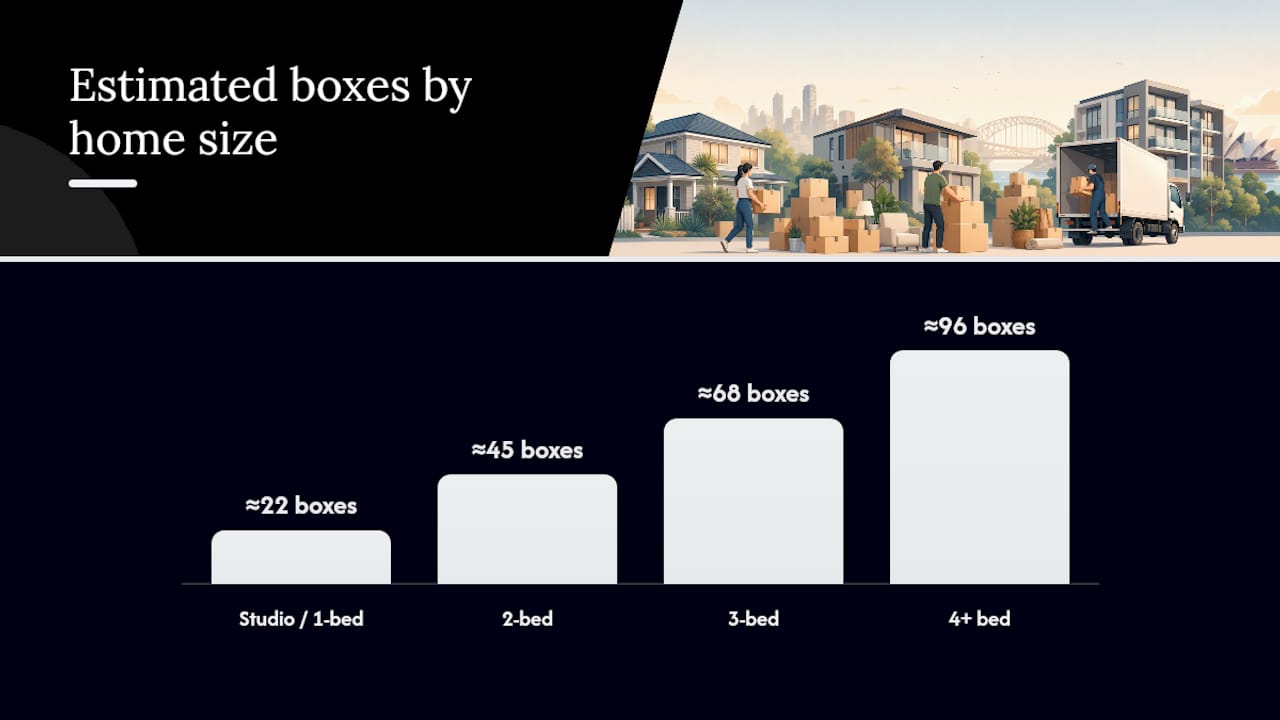
Box counts scale with bedroom count, but they’re not linear, because kitchens and living areas add a fixed load regardless of how many people sleep in the house.
Those ranges assume an averagely furnished home. A serious book collection, a garage full of tools, or seasonal gear like camping equipment and Christmas decorations can add another 10 to 20 boxes on their own. Books especially throw estimates out, because they’re heavy enough that you’ll need extra small boxes rather than fewer larger ones.
Add a buffer of 10 to 15% on top of whatever number you land on. You will find things at 11pm the night before that didn’t make the original count. For soft goods like clothing and linen, suitcases and plastic tubs you already own often do the job better than another cardboard box, and they don’t need to be bought or returned.
You’ve got three real options, and most moves end up using a blend of all three.
Buying new gives you consistent sizes and undamaged cardboard, which matters for stacking safely in a truck. Choice recommends sourcing packing supplies from storage warehouses, hardware stores and stationery retailers, all of which typically sell rather than give away boxes. Prepacked bundles from a specialist box shop or your removalist are usually the cheapest per-box option because you’re buying in volume rather than one at a time.
Renting plastic crates makes sense when timing, weather or stairs work against you. If you’re doing a wet-season move or hauling boxes up three flights with no lift, the extra sturdiness and stackability of hired crates cuts down on breakages and repeat trips.
Free boxes exist, but there’s no single universal source. Community groups and local marketplaces are the most reliable free channel, alongside asking retail backrooms directly. Check every free box for water stains, insect activity and crushed corners before you commit to it. A weak box at the bottom of a stack is how you end up with smashed crockery on the truck ramp.
Good packing technique is about weight management first, protection second, and a labelling system that makes unpacking painless.
Pro Tip: Keep one box per room deliberately half-empty until the final morning. It becomes the catch-all for chargers, remotes and whatever you were still using an hour before the truck arrives.
For a full breakdown of colour-coded and numbered labelling systems, Onyx Removals’ guide on how to label moving boxes covers the detail this section only has room to summarise.
Book your removalist and order packing supplies 6 to 4 weeks out. Selectra’s moving checklist notes that removalist capacity gets tight closer to moving day, especially for local jobs, and interstate moves need 6 to 8 weeks of lead time.
If you’re down to 2 or 3 weeks, skip the room-by-room approach and pack by urgency instead. Non-essentials first, in bulk, using whatever boxes you can get same-day from a hardware store or box shop. Build one essentials box regardless of timeline. Toiletries, chargers, a change of clothes, basic tools and any medication belong in it, sealed last and loaded first.
Onyx Removals’ crews default to double-walled cardboard for general contents and switch to rented plastic crates when a job involves fragile glassware, art, or a wet-season move up a stairwell without lift access. That mix keeps costs down without gambling on breakages.
For readers weighing supply-only against a full-service pack, our comparison of packing versus unpacking services breaks down which option suits which budget.
The industry default is to tell people to buy more boxes than they need “just in case.” That’s backwards. The real cost blowout in most moves isn’t running short of cartons. It’s buying single-wall boxes that are too flimsy for their contents, so people either double up on boxes or watch a bottom seam give way on moving day.
Decluttering before you order anything is the step almost everyone skips, even though it’s the one that actually shrinks your box count and your final bill. If you haven’t touched something in 12 months, it shouldn’t be getting a box at all.
Where most advice also falls short is treating cardboard and plastic crates as a binary choice. They’re not competitors. The other 20%, your grandmother’s china, the good telly, anything going into storage for months, deserves a crate. Spend your money where the risk actually sits, not evenly across everything you own.
— Dinshaw
Buying the right box mix from three different retailers eats an entire Saturday you don’t have. Onyx Removals sells packing materials as prepacked bundles, sized and quantified for studios through to four-bedroom homes, so you order once instead of guessing at three separate shops.

Each kit pairs the double-walled cartons this guide recommends with the specialty boxes (wardrobe, dish pack, mattress bag) that are hardest to find in a hurry. If you’d rather skip sourcing altogether, Onyx’s packing and unpacking service sends a crew that supplies, packs and labels everything using the same room-and-priority system covered above. Either way, head to the packing materials page to check current bundle sizes or request a quote for a full pack.

No Related Post


