


Professional furniture disassembly means a trained removalist takes your bed frames, wardrobes, desks and tables apart, labels and bags every fitting, protects the pieces and reassembles them at the other end. It is worth paying for when the furniture is large, heavy, built with hidden fixings or too awkward to get through a doorway or stairwell. For a flat-pack bookshelf and a free Saturday, doing it yourself is fine.
This guide explains what the service covers, how to prepare, where DIY goes wrong, and what to ask before you book.
TL;DR
- Book disassembly when furniture is heavy, bulky, antique or built-in. Do it yourself only for simple flat-pack pieces you can lift safely.
- Plan ahead: the Australian Furniture Removers Association (AFRA) recommends starting the disassembly process at least two weeks before a move.
- Lost screws and bolts are the most common failure. Every fitting should be bagged, labelled and taped to its piece.
- Ask about insurance, reassembly and written scope before you accept a quote.
- We at Onyx Removals offer assembling and dismantling as part of a Melbourne move, alongside packing, cleaning and waste removal.
Table of Contents
- What professional furniture disassembly actually covers
- Which furniture is worth handing to a professional
- Why not just do it yourself
- How to prepare: a timeline that works
- Doing a simple job yourself, properly
- Is there a qualification for this work?
- What to ask before you book
- Our perspective on furniture disassembly
- Work with Onyx Removals
- Office and commercial furniture
- What about furniture you are getting rid of?
- FAQ
- Sources
What professional furniture disassembly actually covers
The phrase is used loosely, so it helps to separate the pieces of the job.
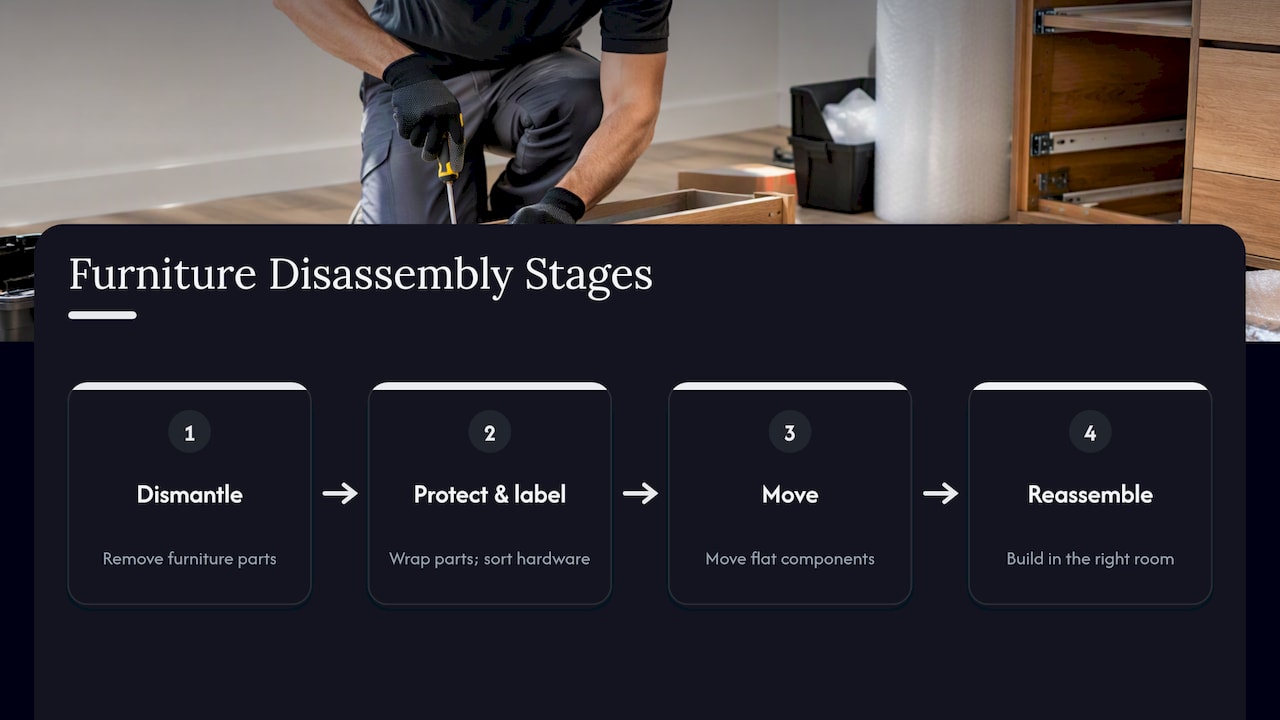
Dismantling. Taking furniture apart: removing bed slats and headboards, unbolting wardrobe doors and carcasses, lifting tabletops off legs, detaching shelves and drawers, and removing legs from sofas where the design allows.
Protecting and labelling. Each part is wrapped, edges and corners are protected, and hardware is sorted. This step is what separates a tidy job from a box of mystery bolts.
Moving. Flat, wrapped components load far better than assembled pieces. They take less space and reduce the pressure on joints.
Reassembly. Putting everything back together in the right room, with the right fittings, and checking that doors hang straight and drawers run.
People search this under several names: furniture dismantling, assembly and disassembly, or a handyman to take furniture apart. A removalist who does it as part of the move is often simpler than hiring a separate handyman, because one team takes responsibility for the piece from the old room to the new one. If you want a closer look at that arrangement, our page on movers that disassemble and reassemble furniture covers it.
Which furniture is worth handing to a professional
Not everything needs to come apart. Some items are safer moved whole, and some should never be taken apart by an amateur.
| Item | Usually taken apart? | Why it matters |
|---|---|---|
| Bed frames (timber, metal, slat) | Yes | Long rails are awkward on stairs and prone to scratching walls and the frame itself |
| Large wardrobes and robes | Yes | Tall, heavy, and often fixed to a wall or ceiling track |
| Dining tables | Yes, legs and leaves | Legs snap off easily if the table is carried assembled |
| Office desks and workstations | Yes | Many have cable trays, dividers and bolted frames |
| Bunk beds and cots | Yes | Safety fixings must be refitted correctly |
| Modular or sectional sofas | Often | Connecting brackets need to be released, not forced |
| Entertainment units, bookcases | Depends | Flat-pack MDF can loosen after a second assembly |
| Solid timber and antique pieces | Case by case | Old joinery may be glued or pegged and should not be dismantled without advice |
| Glass-topped items | Remove the glass | Glass travels flat and wrapped |
A useful test: if the item will not clear the narrowest doorway, corner or stair on the route, or if it takes more than two people to lift without strain, it is a candidate for disassembly or at least for a professional’s judgement.
Why not just do it yourself
Many people can disassemble a bed. The problems come from the details around it.
Weight and handling risk
Safe Work Australia’s National Code of Practice for Manual Handling notes there is no single weight limit, but the risk of back injury rises significantly with loads above roughly 16 to 20 kg, and fewer healthy adults can lift safely as the load heads toward 55 kg. A wardrobe carcass or solid timber tabletop is well beyond that range. WorkSafe Victoria also points out that manual handling covers any task needing force, not just lifting, and that the first aim is to reduce the need for manual force with aids such as trolleys and slides, or by hiring professionals.
Taking a large piece apart is one way to reduce that force: two 15 kg panels are a very different task from one 40 kg cabinet. It is also why we do not suggest you drag a half-dismantled wardrobe down the stairs to “save time”.
Lost and mixed-up hardware
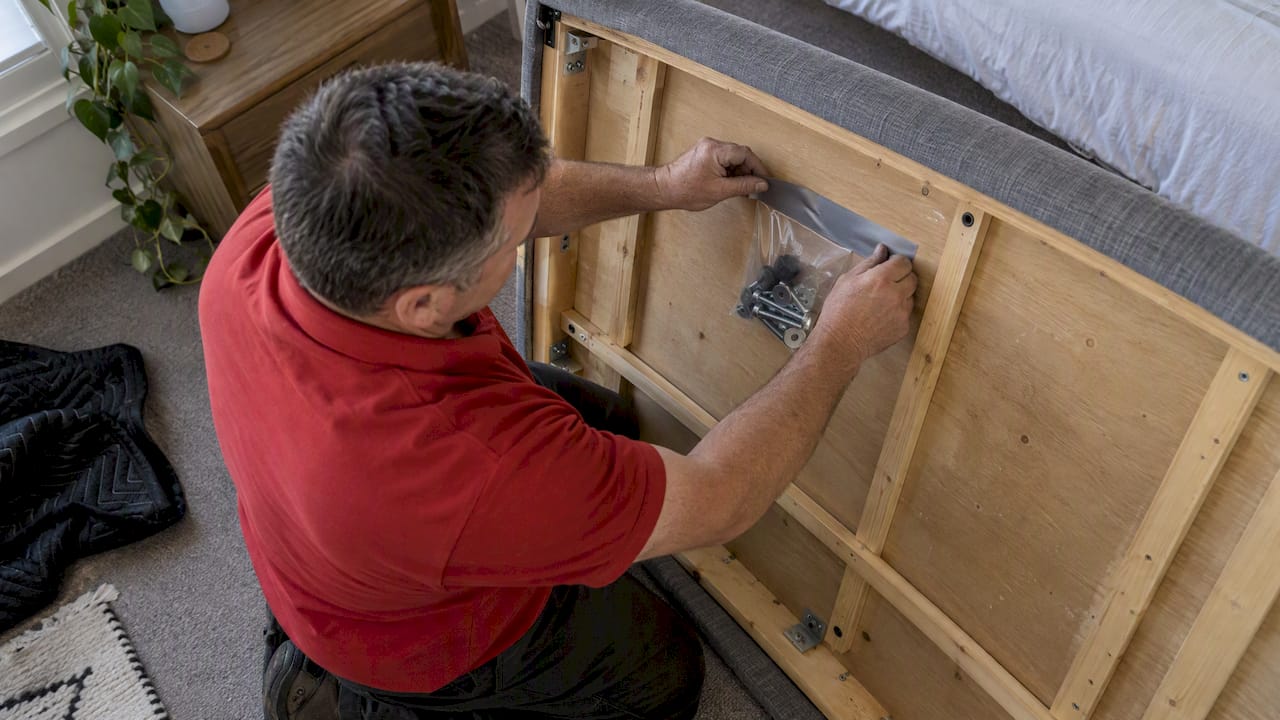
AFRA’s moving guide identifies lost fasteners as the most common pitfall. Its advice is to put bolts, screws and small attachments in a self-sealing bag and tape it to the base of the item, or label it clearly and keep it in a box for similar hardware. A pro does this on every job without thinking about it. Most DIY disasters happen because the bag went into a random box.
Damage to the furniture and the property
Cam locks stripped by the wrong screwdriver, laminate chipped when a panel is levered, door frames scraped, floors gouged. These cost more than the service would have.
Time on the day
A move is already a long day. Taking apart a three-bedroom home’s beds, robes and desks on the morning of the move often delays the truck. That is why the lead time matters.
How to prepare: a timeline that works
AFRA’s guide suggests getting started at least two weeks before the move for a standard residential move. Here is how we would structure it.
- Four weeks out: Walk through every room and list what needs to come apart. Photograph complex pieces, such as modular units and anything with hidden brackets.
- Three weeks out: Ask for a quote that names the pieces, not just “furniture disassembly”. Check whether reassembly is included.
- Two weeks out: Find instruction manuals or download them. Decide what you will take apart yourself (simple items) and what you will leave to the team. Order packing supplies if needed.
- One week out: Clear access: parking, lifts, narrow hallways, items stacked in front of wardrobes. Tell the team about wall-fixed pieces.
- Move day: Keep a floor plan of the new home. Decide where each piece goes before it arrives. AFRA’s guide notes that asking removalists to place furniture in its final position is far easier than rearranging heavy items afterwards.
If you want a fuller sequence for packing around this, see our packing timeline for moving.
Prepare for what happens at the other end
Reassembly is a chance to fix things. Tall bookcases and chests of drawers should be anchored to the wall in homes with young children, and cots must go back together exactly to the manufacturer’s instructions. If a nursery is part of your move, a staged list like this babyproofing checklist can help you plan what gets done and when.
Doing a simple job yourself, properly
For a bed frame, a basic table or a flat-pack desk, a careful DIY approach works:
- Photograph the piece from every side before you touch it.
- Use the right driver and Allen key. Never a drill on high torque.
- Remove parts in a logical order, and bag fittings for each section separately (headboard, rails, slats).
- Write on the bag and on the part with painter’s tape: “bed, left rail, top bolts”.
- Tape the bag to the part it belongs to, as AFRA recommends.
- Wrap panels and corners with blankets or cardboard. Keep glass and mirrors flat or on edge, never leaning at an angle.
- Keep one small box for tools you will need at the other end.
Stop and call a professional if the piece is glued, wall-mounted, over about 20 kg per part, or if you cannot tell how it was assembled.
Is there a qualification for this work?
There is a nationally recognised unit, MSFFF2002 Dismantle and re-assemble furniture, listed on the National Training Register. It is a useful reference for what the skill involves, but a unit title is not a licence. No single credential tells you a removalist is good. Look for evidence instead: clear scope, insurance, references and a written quote.
What to ask before you book
Whatever kind of provider you use, ask these questions.
- Is reassembly included and where? Some quotes cover only dismantling.
- Which pieces, exactly? A list by room avoids surprises on the day.
- What happens if something is damaged? Under the Australian Consumer Law, removal services must be provided with due care and skill. AFRA’s guidance on moving insurance also recommends asking whether your removalist can offer transit insurance covering household goods.
- What insurance is held? AFRA says all its members carry public liability insurance, and most can sell additional goods in transit cover. Ask any provider for the details in writing.
- Is the contract clear? Consumer Affairs Victoria has issued a public warning about a removalist that failed to respond to complaints, a reminder to check that the contract and complaint process are transparent before you pay a deposit.
- Who does the work? Employees or subcontractors, and how many people will arrive.
The three kinds of provider you will come across are removalists who include disassembly in the move, handyman or task marketplace workers, and furniture-specific installers. A removalist is usually the best match when the furniture is also being moved, because one party carries responsibility for the whole job. A handyman can suit a single piece that stays in the same house.
Our perspective on furniture disassembly
We see the same pattern on moves across Melbourne. The pieces people worry about, like a big sofa, are often fine. The ones that cause trouble are the ones nobody planned for: the bunk bed that cannot be assembled without a missing bolt, the wardrobe fixed to the wall, the desk that looks simple until you find the hidden cam locks.
Our view is that disassembly should be decided at quote stage, not on the day. A plan that lists each piece, who handles it and where it ends up lets us bring the right tools and allow the right time. That is why we build a personalised moving plan around the home, not a generic package, and why we like to handle dismantling, packing, transport, cleaning and waste removal as one coordinated job rather than four separate bookings.
We also think honesty beats upselling. If a flat-pack bookcase will not survive another assembly, we would rather tell you before the move so you can decide whether to replace it. If a piece is better moved whole, we will say so.
— Dinshaw
Work with Onyx Removals
Onyx Removals is a Melbourne moving company. Our services include residential moves, office relocations, assembling and dismantling, storage, waste disposal and skip bin arrangement. If you need boxes packed too, our packing and unpacking service is listed at $109 per hour. For disassembly and the rest of your move, we work from a quote based on your home and the pieces involved, so tell us what you are moving and we will build the plan around it.
If you are moving a home, our residential removal page explains how a typical job runs. Moving heavy items in particular? Read our guide to moving heavy furniture safely.
Office and commercial furniture
Offices bring different problems: workstations in banks of six, cable management, partition screens, boardroom tables that arrive in one piece and will not leave the same way. The main priority is minimal downtime, so disassembly is usually done after hours or over a weekend and reassembled to a floor plan so staff can start on Monday.
WorkSafe Victoria’s office guidance states that using mechanical aids or hiring a specialist furniture removalist is more effective at reducing manual handling risk than relying on staff training in lifting alone. In practice that means don’t ask your team to carry desks out on a Friday afternoon. For planning, see our office relocation timeline for Melbourne.
What about furniture you are getting rid of?
Sometimes the answer to a broken-down bed or a bulky old couch is not to move it. Taking furniture apart makes it easier to remove, and waste disposal or a skip bin may be the right route. We can arrange both as part of a move, so old pieces leave the same day as the rest. Check council rules for hard rubbish if you go it alone, since collection arrangements vary by council.
FAQ
Can I hire someone to dismantle furniture?
Yes. You can book a removalist, a handyman or a furniture installer. A removalist is usually the most convenient if the furniture is also being moved, since the same team takes it apart, transports it and reassembles it.
How far in advance should I book furniture disassembly?
AFRA’s moving guide recommends starting disassembly at least two weeks before a standard residential move. Booking the service earlier, ideally when you request your removal quote, gives the team time to plan tools and access.
Is furniture always reassembled after it is taken apart?
Not automatically. Some quotes include only dismantling, so ask for reassembly to be written into the scope. When the same removalist does both, hardware is far less likely to go missing between homes.
What is the best way to move a heavy piece of furniture?
Reduce the load first by removing doors, drawers, legs and shelves, then use trolleys or slides and a second person. Safe Work Australia’s manual handling code shows risk rises sharply above roughly 16 to 20 kg, so for wardrobes, solid timber tables and similar pieces, hand the job to a professional team.
Sources
- National Code of Practice for Manual Handling, Safe Work Australia
- The Moving Guide Kit, AFRA
- Moving or lifting objects, WorkSafe Victoria
- MSFFF2002 Dismantle and re-assemble furniture, National Training Register
- Moving insurance, AFRA
- Why choose an AFRA member, AFRA
- Public warning notice, Consumer Affairs Victoria
- Officewise guide to health and safety in the office, WorkSafe Victoria
Recommended
About the Author


