



TL;DR:
- Moving companies use hourly rates for local moves and weight-based tariffs for interstate relocations to determine costs. A detailed inventory and choosing a binding estimate help prevent unexpected expenses and ensure budget accuracy.
Moving companies calculate costs using one of two methods: hourly labour rates for local moves, or weight and distance tariffs for interstate moves. Understanding which method applies to your relocation is the single most effective way to budget accurately and avoid bill shock on moving day. Local moves typically cost $500 to $3,500+, while a standard interstate move for a 2–3 bedroom home runs $1,500 to $8,500+. The method your removalist uses determines which variables matter most, and knowing those variables puts you in control of the final price.
Local move pricing is built on an hourly rate model. The removalist charges per mover per hour, then adds fixed or variable fees for the truck, fuel, and any extra services required. Getting across each component stops you from being caught off guard when the invoice arrives.

Labour is billed at $40 to $60 per hour per mover for customer-facing rates. That figure covers the mover’s base wage, payroll taxes, workers’ compensation, and public liability insurance. A two-person crew on a standard three-hour job therefore costs $240 to $360 in labour alone before any other charges apply.
Truck fees are charged either as a flat rate or as a variable cost based on distance travelled. Fuel is sometimes bundled into the truck fee and sometimes listed separately. Always ask your removalist how they structure these charges before you accept a quote.
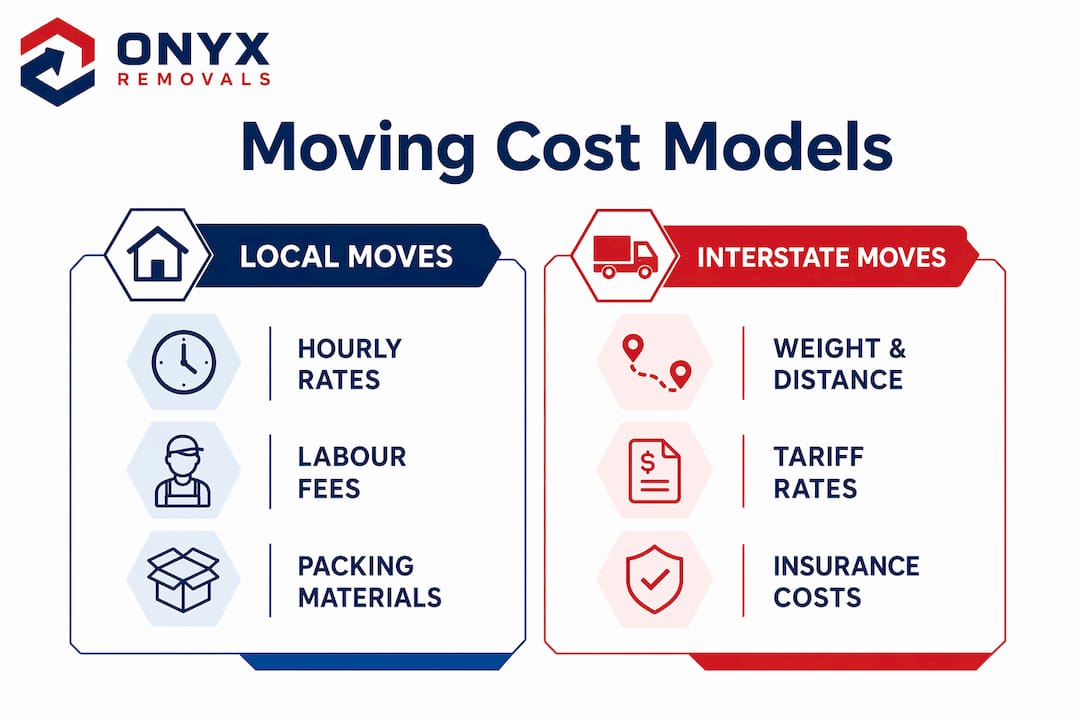
Packing materials cost $50 to $200 for a typical residential move, depending on home size and the level of service you choose. Materials are usually itemised separately from the base move charge. If you supply your own boxes, you can reduce this cost significantly.
Most local move quotes omit surcharges such as stair fees, long-carry fees, and bulky item levies until after the job is done. These accessorial charges are standard in the industry but are often buried in the fine print. The most common ones include:
Pro Tip: A low hourly rate is often a marketing tactic. Always ask for a full written breakdown of every charge before you book, including accessorial fees. The true cost of a local move is the sum of all line items, not just the headline hourly rate.
Interstate moves use a weight and distance tariff model rather than hourly billing. The final shipment weight is determined by weighing the empty truck before loading and the loaded truck after. The difference between those two figures is your shipment weight, and that number drives the base charge.
Interstate carriers apply tariff rates of $0.55 to $0.85 per pound per 1,000 miles. A typical 2-bedroom home move of 500–1,000 miles costs $3,060 to $5,280 in 2026. Distance multipliers and minimum charge thresholds also apply, meaning a very light shipment over a short distance may still attract a minimum fee set by the carrier’s published tariff.
The tariff rate covers transport only. Additional services are charged separately as accessorial fees. Common examples include:
Full-value protection insurance adds 15% to 30% to the total move cost. Basic released-value coverage is included at no charge but only pays a fraction of the item’s actual value if something is damaged. For a detailed look at your options, the insurance for moving house guide covers the trade-offs clearly.
The type of estimate you accept determines your financial exposure. The table below summarises the three standard options:
| Estimate type | How it works | Consumer protection |
|---|---|---|
| Binding estimate | Locks in the price for listed services | Strongest. Price cannot increase at delivery. |
| Non-binding estimate | Based on projected weight; final bill may vary | Weaker. Can reach 110% of the original estimate at delivery. |
| Not-to-exceed estimate | Final bill is the lower of actual or estimated cost | Strong. You only pay less if actual weight is lower. |
Beyond the base calculation method, several variables push the final price up or down. Understanding them before you request quotes gives you real leverage.
Volume and weight are the most direct cost drivers. More furniture means more labour hours on a local move and a heavier shipment on an interstate move. Decluttering before you move is one of the most effective ways to reduce costs, particularly for interstate moves where weight-based charges apply directly.
Timing and seasonality have a measurable impact on price. Scheduling a move between october and april can yield savings of 15–25% compared to peak summer periods. Weekday moves are also cheaper than weekend moves in most markets. Regional and seasonal demand directly impacts pricing, with peak periods commanding premium rates regardless of move size.
Access conditions affect both time and cost. Narrow driveways, multi-storey apartments without lifts, and long distances between the truck and the front door all add to the job duration or trigger surcharge fees. Communicate these details to your removalist upfront so they can quote accurately.
Additional services each carry their own price tag:
Each add-on is legitimate and useful, but each one increases the total moving house service price. Knowing which services you actually need before you request quotes prevents scope creep on the final invoice.
Instant flat-rate quotes for long-distance moves are often unreliable without a detailed inventory review. The most accurate estimates come from an in-home or virtual walk-through survey, where the removalist assesses every item to be moved. This process eliminates guesswork on both sides and produces a quote grounded in real data.
An exact inventory list is the foundation of cost accuracy. Missing items from your list means the removalist cannot price the job correctly, and you risk a higher bill on moving day. Walk through every room, including the garage, shed, and attic, before you finalise your inventory.
Pro Tip: Always request a written, itemised quote that separates labour, truck fees, fuel, packing materials, and surcharges. A quote that shows only a single total figure gives you no way to identify where costs are inflated. Use the compare moving quotes guide to evaluate multiple quotes side by side.
A binding estimate is the safest option for interstate moves. A non-binding estimate can legally increase to 110% of the original figure at delivery, leaving you with a larger bill than expected. For local moves, ask the removalist to confirm which surcharges apply to your specific job before you sign anything. The home removal quotes guide walks through exactly what to ask and what to watch for.
Moving costs are calculated by hourly labour rates for local moves and by shipment weight multiplied by distance for interstate moves, with estimate type determining your financial protection.
| Point | Details |
|---|---|
| Two pricing models | Local moves use hourly rates; interstate moves use weight and distance tariffs. |
| Surcharges add up fast | Stairs, long carries, fuel, and bulky items are charged on top of the base rate. |
| Estimate type matters | A binding estimate locks your price; a non-binding estimate can rise to 110% at delivery. |
| Timing saves money | Moving between october and april can reduce costs by 15–25% compared to peak periods. |
| Inventory accuracy is critical | A complete, detailed inventory is the only way to get a reliable quote from any removalist. |
The single biggest source of budget blowouts I see is the gap between what a customer thinks they’re paying and what the invoice actually says. That gap almost always comes down to two things: a non-binding estimate accepted without question, and an incomplete inventory provided at the quoting stage.
My advice is direct. For any interstate move, insist on a binding estimate. It is the only document that legally locks the price for the services listed. Yes, you may pay slightly more upfront than a non-binding quote suggests, but you will not face a surprise at delivery. For local moves, ask the removalist to list every surcharge that could apply to your specific job. Stairs, a narrow street, a piano in the spare room — these are not unusual, and a good removalist will price them upfront without being asked.
Decluttering before an interstate move is not just good housekeeping. It directly reduces your shipment weight and therefore your base tariff charge. Selling or donating furniture you were planning to replace anyway is one of the most practical ways to cut moving costs.
Book during the off-peak period if your timeline allows. The savings between a january move and a march move can be meaningful, particularly for longer distances. And always tell your removalist about access challenges at both ends of the move before the quote is finalised. Surprises on moving day cost everyone time and money.
— Dinshaw
Planning a move and unsure where your budget should sit? Onyx Removals provides detailed, itemised quotes for both residential moving services and interstate relocations, with no hidden surcharges buried in the fine print.

The team at Onyx Removals conducts thorough pre-move assessments to capture every item, access condition, and service requirement before a price is confirmed. That process produces quotes you can actually rely on. Onyx also supplies professional moving equipment and packing materials to support every stage of the move. Whether you are relocating a single-bedroom apartment across Melbourne or coordinating a full office move interstate, Onyx Removals has the experience to manage it accurately and efficiently.
Local removalists charge an hourly rate per mover, typically $40 to $60 per hour, then add fees for the truck, fuel, packing materials, and any applicable surcharges such as stairs or long-carry fees.
A binding estimate locks in the total price for all listed services, meaning the removalist cannot charge more at delivery. It offers stronger consumer protection than a non-binding estimate, which can legally increase to 110% of the original figure.
Interstate moving costs are determined by multiplying the shipment’s weight by the distance travelled, using the carrier’s published tariff rate of $0.55 to $0.85 per pound per 1,000 miles, plus accessorial charges for additional services.
Yes. Full-value protection insurance typically adds 15% to 30% to the total move cost. Basic released-value coverage is included at no charge but pays only a fraction of an item’s replacement value if it is damaged.
Scheduling a move between october and april, outside peak summer demand, can reduce costs by 15–25%. Weekday moves are also generally cheaper than weekend bookings with most removalists.

No Related Post


