



Sorting through moving company quotes can leave Melbourne homeowners unsure about what to expect when planning a local move. Accurate cost estimates aren’t just helpful—they give you a clear financial picture before you sign up with any removalist. By understanding how professional Melbourne removalists forecast and itemise expenses, you gain the confidence to choose the right service and avoid unwanted surprises. Discover how a systematic forecast of all expected expenses sets the stage for a smoother, stress-free relocation.
| Point | Details |
|---|---|
| Understanding Estimates | A moving company cost estimate provides a projection of expenses based on your specific needs, helping you budget for relocation services. |
| Types of Estimates | There are three main types of estimates: indicative, budget, and firm, each varying in accuracy and binding nature, affecting your financial expectations. |
| Transparent Breakdown | An itemised estimate shows the costs of labour, transport, and materials, ensuring you are aware of where your money goes and helping compare different removalists. |
| Impactful Factors | Key factors impacting your quote include volume and weight of belongings, distance, required services, and timing; be prepared to provide accurate information for best value. |
A moving company cost estimate is a detailed preview of what you’ll pay for your relocation services. It’s not a quote locked in stone, but rather a systematic forecast of all expected expenses based on your specific moving needs. When a removalist company provides you with an estimate, they’re essentially saying: “Based on what you’ve told us about your move, here’s what we expect the costs will be.”
Think of an estimate as a financial roadmap for your move. A removalist will assess factors like the volume of your belongings, the distance from your current home to your new one, the services you need (packing, storage, unpacking), and any specialised requirements you might have. According to consumer protection guidelines, moving company cost estimates provide a snapshot of potential costs associated with packing, transporting, and handling your furniture and goods, helping you understand your financial obligations before you hire anyone. This transparency is crucial because it allows you to make informed decisions and compare options between different removalist companies.
What separates a cost estimate from other types of quotes is its structure. An estimate breaks down charges into categories so you can see exactly where your money goes: labour costs, equipment rental, packing supplies, transport, and any additional services. This itemised breakdown reflects the systematic forecast approach used across industries to capture quantities, resources, and costs comprehensively. For Melbourne homeowners, this means you can spot exactly what you’re paying for and whether you want to adjust your moving plan (perhaps scaling back on packing services or storing some items temporarily instead of moving everything at once).
One critical point: estimates can change. If you provide incomplete information about your move, or if circumstances change between when you receive the estimate and moving day, the final cost may differ. This is why getting a detailed estimate with a thorough home assessment matters far more than a quick phone quote. Onyx Removals, like reputable removalist companies, will conduct a thorough evaluation of your belongings and home layout to provide accurate estimates. The estimate period also matters. A good estimate from a Melbourne removalist typically remains valid for 30 days, giving you time to make decisions without rushing.
Pro tip: When requesting an estimate, provide detailed information about your move including the exact inventory of items, any heavy or fragile pieces, and your preferred moving date, as this ensures the estimate accurately reflects your actual costs and reduces the likelihood of unexpected charges on moving day.
Moving estimates come in different flavours, and understanding the distinctions between them is crucial for Melbourne homeowners. Not all estimates are created equal, and the type you receive can significantly impact your budget planning and expectations. The main types fall into distinct categories based on their level of detail, accuracy, and how binding they are, which reflects estimate classes that vary by project phase and required accuracy.
An indicative estimate is the preliminary version, typically provided after a brief phone conversation or quick online questionnaire. This is what you get when you ring a removalist and describe your move in general terms. Indicative estimates are ballpark figures, designed to give you a rough idea of what a move might cost without requiring detailed information. For example, if you tell a removalist you’re moving a three bedroom house across Melbourne, they might provide a range like $4,500 to $6,500 based on their experience with similar moves. This type of estimate is helpful for initial budget setting but carries significant uncertainty because the removalist hasn’t actually seen your belongings or assessed your home.
Budget estimates are more detailed than indicative ones. These typically come after a phone conversation where the removalist asks thorough questions about your inventory, the complexity of your move, and any special requirements. You might discuss items like pianos, artworks, or antique furniture that need specialist handling. Budget estimates still carry some uncertainty, but they’re more grounded in specific information about your situation. The removalist will provide a more refined cost range, perhaps $5,200 to $6,800, based on the details you’ve shared. These estimates are commonly used when homeowners are comparing multiple removalist companies and want a better sense of costs before committing to an in-home survey.
A firm estimate is what separates serious planning from guesswork. This is the detailed estimate provided after a removalist has visited your home, physically assessed your belongings, and discussed all the specifics of your move. A removalist might spend 30 to 60 minutes at your property, checking room by room, identifying heavy items, assessing stairwell access, and understanding any special requirements. Firm estimates serve different purposes in contracts and procurement, with greater clarity about what’s included and excluded. When Onyx Removals provides a firm estimate, you’ll see a fixed price or a narrow range (perhaps $5,800 to $6,200) that reflects the actual assessment of your home and possessions. This estimate is far more reliable and gives you genuine confidence in your moving costs.
Think of the progression this way: indicative estimates are conversations, budget estimates are informed discussions, and firm estimates are commitments based on facts. Indicative estimates might vary by 30 percent or more from your final bill. Budget estimates narrow that variance to perhaps 15 to 20 percent. Firm estimates after a home visit typically fall within 5 to 10 percent of your final costs, assuming no major scope changes.
The timing also differs. Indicative estimates arrive within hours or a day. Budget estimates might take a day or two as the removalist reviews their notes. Firm estimates require scheduling a home visit, which could take a week or longer depending on the removalist’s availability. For Melbourne homeowners in a hurry, this can feel frustrating, but the accuracy gained justifies the wait.
Another critical difference concerns what’s binding. Indicative and budget estimates are not promises. If circumstances change, costs can shift. A firm estimate, however, represents a genuine commitment from the removalist. If you’ve provided accurate information and nothing changes about your move, the firm estimate should be honoured. This is where transparency and trust become essential.
Here’s how the main types of moving estimates compare in key areas:
| Estimate Type | Accuracy Range | Typical Use Case | Binding Nature |
|---|---|---|---|
| Indicative Estimate | ±30% or more | Early budgeting, initial call | Non-binding, rough guide |
| Budget Estimate | ±15–20% | Comparing options, shortlisting | Non-binding, more specific |
| Firm Estimate | ±5–10% | Finalising move, detailed scope | Binding if scope unchanged |
Pro tip: Request a firm estimate after an in-home assessment rather than relying on phone quotes, as this ensures accurate pricing and prevents unexpected charges on moving day.
Your removalist quote isn’t plucked from thin air. It’s built on a foundation of specific variables that directly impact how much your Melbourne move will cost. Understanding these factors gives you insight into why two removalists might quote different prices for the same move, and it helps you evaluate whether a quote genuinely reflects your needs. The primary drivers centre on the scope and complexity of what you’re moving, where you’re moving to, and when you need it done.
Volume and Weight of Your Belongings
This is the starting point for any quote. A removalist assesses how much stuff you’re moving, both in terms of physical space and actual weight. A studio apartment generates a vastly different quote than a four bedroom house. But it’s not just about room count. A minimalist three bedroom home with sparse furnishings costs less than a three bedroom filled with decades of accumulated possessions. When you request a quote, removalists ask detailed questions about your inventory. Do you have a piano? Heavy furniture? Fragile collections? Each item category influences the final number. Quotes from removalists are influenced by the volume and weight of items, along with distance to the new location and required services.

Distance and Location Factors
The kilometres between your current home and your new one directly affect labour time and fuel costs. Moving across Melbourne’s inner suburbs costs considerably less than relocating from Docklands to the Dandenong Ranges. But distance isn’t the only location consideration. Some addresses present logistical challenges that bump up costs. A narrow street with limited parking for the removal truck, a high rise apartment requiring elevator booking, or a property accessed via a long gravel driveway all add complexity. Removalists factor in travel time, fuel, and the physical challenges of accessing both locations. A straightforward suburban house-to-house move flows smoothly, whilst a unit move requiring equipment coordination takes longer and costs more.
Services and Packing Requirements
What exactly are you asking the removalist to do? A basic transport-only service costs less than full-service packing, unpacking, and setup. If you’re handling packing yourself, you’ll pay one rate. If you want the removalist to pack everything, including wrapping fragile items and dismantling furniture, costs escalate significantly. Specialist packing for valuable items like artwork, mirrors, or antique furniture commands higher rates due to the skill and materials required. Storage needs also influence the quote. If you require temporary storage of items whilst you’re transitioning between homes, that’s an additional service with associated costs.
Timing and Availability
When you move affects your quote. Peak moving season in Melbourne runs from late summer through spring, when demand is highest and removalists charge premium rates. Moving mid-week or mid-month typically costs less than weekend or end-of-month moves when everyone shifts simultaneously. Public holidays near moving day can complicate scheduling and increase costs. If you have flexibility, mentioning you can move on a quiet Tuesday in February rather than a Saturday in November opens doors to better pricing.
Labour Costs and Workforce Rates
Behind every quote sits the cost of paying skilled removalists. Labour rates fluctuate based on market conditions, experience levels, and demand. Professional removalists in Melbourne command appropriate rates because they’re trained to handle your belongings safely and efficiently. Cheaper quotes sometimes reflect lower labour standards or less experienced teams. The analysis of Australian project costs shows that labour rates significantly influence pricing alongside logistical complexity and service scope.
Flat Fee Versus Time Based Pricing
Understanding your quote structure matters enormously. Some removalists quote flat fees for specific moves, meaning you pay a set price regardless of whether it takes three hours or five. Others charge hourly rates, where the clock starts when the team arrives and stops when the last item is unloaded. Flat fee quotes suit straightforward moves you can predict accurately. Time based quotes work better when there’s uncertainty about complexity or duration. When comparing quotes, clarify whether the price is flat or hourly, as this dramatically changes how costs accrue.
Additional Charges and Inclusions
Careful reading of your quote reveals what’s included and what costs extra. Some removalists bundle items like furniture padding and basic equipment. Others charge separately for trolleys, dollies, or protective coverings. Stairwell access fees, parking permits, or lift hire in apartment buildings might be separate line items. Understanding these inclusions prevents surprise charges on moving day. This is why clarifying what’s included and potential additional charges remains crucial before you commit.
See which factors most impact the final cost of your Melbourne move:
| Factor | Example Impact | How to Manage for Best Value |
|---|---|---|
| Volume & Weight | More items = higher cost | Reduce unnecessary belongings |
| Distance & Location | Longer drive, tricky access | Choose accessible dates/parking solutions |
| Timing & Availability | Peak days cost more | Move mid-week or off-season for savings |
| Service Level | Full packing increases fees | Pack yourself where confident |
| Labour Requirements | Experienced crew costs more | Request quotes with skill level clarified |
Pro tip: Request detailed written quotes that break down labour costs, materials, distance charges, and any additional fees separately, as this allows direct comparison between removalists and reveals hidden costs upfront.
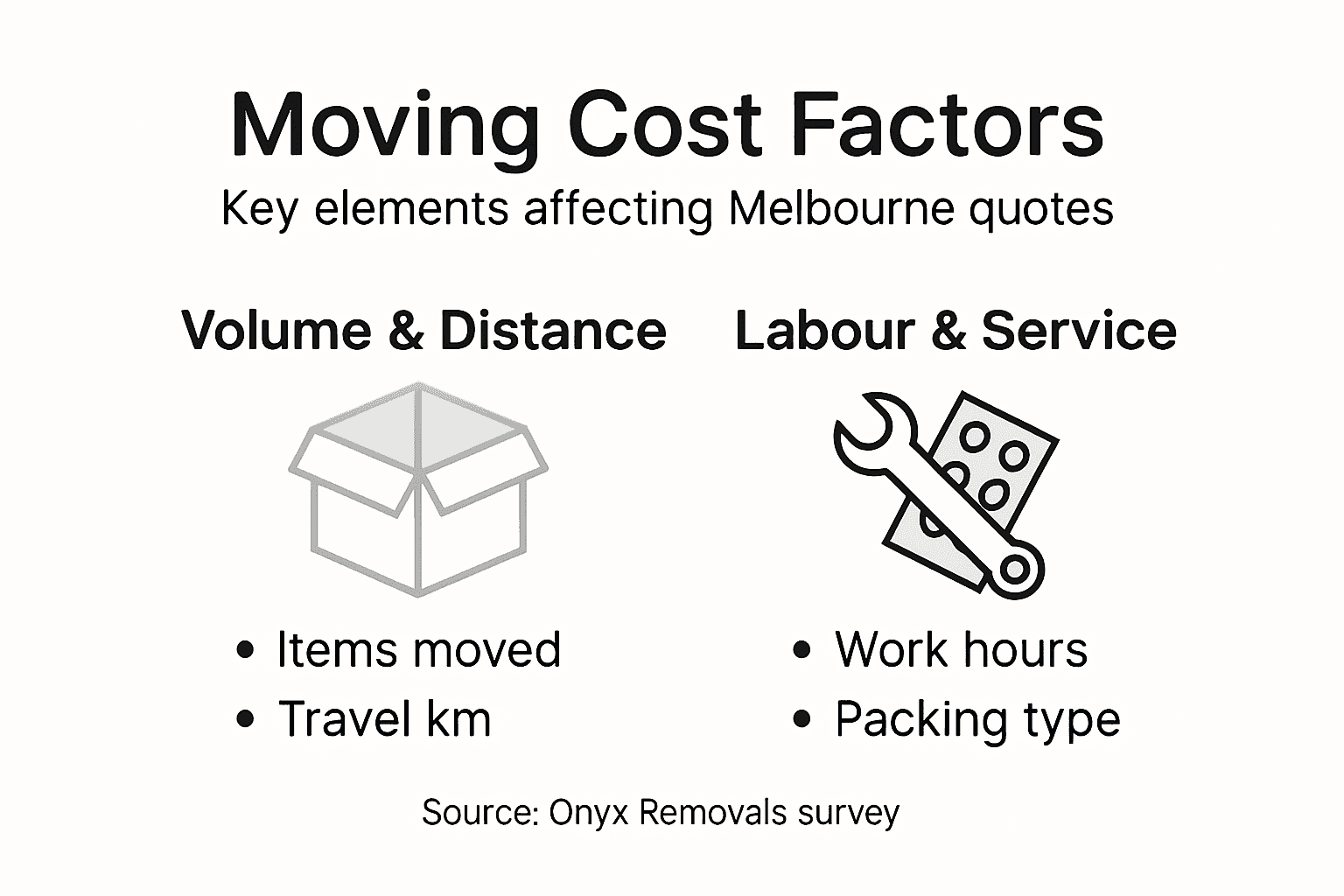
Removal companies in Melbourne use a systematic approach to calculate your moving costs. It’s not guesswork or arbitrary pricing. Instead, removalists apply a formula that considers multiple variables specific to your move, your home, and the local Melbourne context. Understanding this calculation process demystifies why your quote looks the way it does and helps you make informed decisions about which removalist offers genuine value.
The foundation of any cost calculation starts with assessing volume and weight. A removalist either visits your home in person or conducts a detailed phone interview to understand exactly what you’re moving. They’re not just counting rooms. They’re evaluating the actual cubic metres your belongings will occupy in the truck, plus the weight of heavier items like pianos, safes, or stone benches. This matters because a truck has limited space, and heavy items affect fuel consumption and labour intensity. Once they know the volume and weight, they can estimate how many removalists they’ll need, what truck size is appropriate, and roughly how long the job will take.
Distance is the second major calculation factor. Melbourne’s geography creates varied scenarios. Moving from Collingwood to Fitzroy across a few kilometres costs vastly less than relocating from the CBD to Yarra Glen. Removalists factor in kilometres travelled, fuel costs at current rates, and the time team members spend driving rather than loading or unloading. But distance involves more than just straight line kilometres. They also consider Melbourne’s traffic conditions. A move scheduled during peak hour might take significantly longer than the same distance travelled mid-morning. Traffic congestion directly translates to labour costs because your removalists are still on the clock whilst sitting in traffic.
Labour hours form the heart of your quote. This is where your specific circumstances heavily influence pricing. Removal companies calculate costs by assessing the volume or weight of belongings, distance between locations, and labour hours required, along with additional services. Removalists estimate how long your move will take based on the volume of items, the complexity of the job, and any physical challenges. A straightforward suburban house move with good access might take four removalists eight hours. A unit move requiring elevator coordination and careful navigation through tight hallways might take the same four removalists ten hours. That two hour difference directly increases your costs.
Your Melbourne postcode influences pricing in ways you might not immediately recognise. Access difficulties matter enormously. A property on a quiet street with abundant parking and wide doorways moves smoothly and costs less. An inner city apartment requiring parking permits, lift booking, and careful manoeuvreing through narrow corridors creates logistical challenges that removalists must price in. Some Melbourne suburbs have narrow laneways or heritage restrictions that complicate truck access. Removalists know these areas and factor in extra time, additional equipment, or even smaller truck options.
Parking restrictions across Melbourne also impact costs. Some suburbs enforce strict no-parking rules on moving day, requiring expensive parking permits or traffic management arrangements. A removalist might need to hire traffic controllers or arrange special permits, all of which adds to your final bill. Street parking availability varies wildly across Melbourne. Easy parking in outer suburbs costs nothing extra. Difficult parking in inner suburbs or near busy commercial areas might require formal arrangements and additional fees.
Additional services amplify base costs. If you’re requesting packing services, the removalist calculates additional labour hours plus the cost of packing materials like boxes, tissue paper, bubble wrap, and tape. Storage services add warehouse facility costs and handling fees. Specialist services like piano moving, art handling, or safe relocation command premium labour rates because they require trained specialists. Furniture disassembly and reassembly add labour hours. Each service layer builds on the base calculation.
Removalists may present costs in different formats. Some quote an all inclusive flat fee based on their assessment. Others break it into hourly labour plus materials and distance charges. Some quote truck and labour as separate line items. Understanding how your particular removalist structures their pricing helps you compare fairly with other quotes. A $5000 flat fee from one company might break down differently than a $5000 quote from another if one includes packing materials whilst the other charges separately.
Seasonal factors influence the calculation too. During peak moving season from October through March, demand is high and removalists charge accordingly. Off season moves in winter cost less because removalists have more flexibility and less demand competition. Public holidays and school holidays see surcharges because removalists anticipate heavy demand.
Onyx Removals and other professional removalist companies apply these calculation principles consistently, ensuring your quote reflects the genuine cost of moving your belongings safely and efficiently across Melbourne.
Pro tip: Provide removalists with a detailed, itemised list of everything you’re moving, including dimensions and weights for heavy items, as this enables more accurate cost calculations and prevents quote revisions after the assessment.
Extra charges on moving day blindside homeowners more often than you’d think. What started as a $5000 quote somehow becomes $5800 when the truck pulls away. Understanding which charges are legitimate and which are avoidable prevents nasty financial surprises. Some extra fees are genuinely unavoidable because they reflect real costs. Others stem from vague contract language or poor communication upfront. The key is knowing the difference before you sign anything.
Stairwell and Access Charges
One of the most common extra charges involves stairs and difficult access. If your home requires removalists to carry items up multiple flights of stairs or through narrow hallways, many removalists charge a premium. A three storey townhouse with tight staircases costs more to move than a single level home, even if the volume of items is identical. Long carries from the truck to your front door incur additional fees. An apartment on the third floor of a building without a lift generates stairwell charges. These charges are usually legitimate because they directly reflect increased labour time and physical difficulty. However, they’re often not mentioned in initial quotes if you don’t explicitly describe your home layout. This is why detailed communication during the estimation process matters.
Packing Material and Supply Costs
Packing materials seem invisible until you see them on your invoice. Boxes, tape, bubble wrap, tissue paper, and protective blankets add up quickly. A removalist might quote labour at one rate but charge separately for materials. If you’ve requested full packing service, expect to pay for the materials protecting your belongings. Some removalists include basic packing supplies in their quote. Others charge per item or per box. The pitfall arises when you assume packing is included and discover charges appear later. Your original quote might say “packing service $1500” but the final invoice shows “packing labour $1500 plus materials $380.” Read your quote carefully to understand whether material costs are bundled or separate.
Storage and Holding Fees
If you need temporary storage between moving out and moving into your new home, storage fees apply. These aren’t hidden charges exactly, but homeowners sometimes underestimate the cost. Storage facility rental, handling fees for moving items in and out, and potentially climate controlled storage all add expenses. A one week storage stint might cost $200. A month long storage situation could run $800 or more. The longer you store items, the more you pay. Additionally, some removalists charge handling fees each time items enter or leave the storage facility, effectively charging you twice for handling the same boxes.
Delay and Waiting Time Charges
This is where vague contract terms create problems. If your quote specifies “four hour job” at a certain rate, but the move takes six hours, removalists charge for the extra time. Delays happen. The property is more cluttered than expected. Access is more difficult. Items take longer to pack and load. When delays occur, you’re charged for the additional labour. The pitfall is not clarifying whether your quote includes a buffer for unexpected delays. A professional removalist should discuss this upfront. Some include 30 minutes of buffer time in their estimate. Others expect payment for every minute beyond the quoted timeframe. Ask explicitly what happens if the move takes longer than estimated.
Insurance and Liability Coverage
Common extra charges include fees for stairs, long carries, additional packing materials, delays, storage fees, and insurance. Insurance deserves special attention because it protects your belongings but adds cost. Basic transit insurance might be included in your quote. Extended coverage or agreed value insurance costs extra. Some removalists offer optional damage waiver coverage. If you want full protection, you’ll pay for it. The problem arises when homeowners don’t realise they’re uninsured or underinsured because they didn’t ask about insurance options. Check your quote to see what insurance is included and what’s optional.
Public Holiday and Weekend Surcharges
Moving on a Saturday instead of Tuesday costs more. Moving during public holidays costs significantly more. Extra fees such as surcharges for public holidays and special requests are common in regulated transport services throughout Melbourne. If your quote is provided for a Wednesday move but you actually need to move on the Easter weekend, the removalist will charge a public holiday surcharge. These charges are legitimate and necessary because removalists pay higher labour rates on public holidays and weekends. However, they’re sometimes not prominently disclosed in initial quotes. Ask about timing surcharges when requesting your estimate to avoid surprises.
Vague Written Estimates are your enemy. A quote that says “removal services $5000” without itemising what’s included creates ambiguity. Does it include packing? Storage? Materials? Insurance? A detailed written estimate breaks down every component. When you compare quotes, always compare identical scopes of work. One removalist charging $5500 might include packing and materials. Another at $4800 might not.
Unclear Cancellation and Change Policies create financial traps. If your moving date shifts or you need to reduce the scope, what happens to your quote? Some removalists charge penalties for date changes. Others adjust the quote. Know the policy before committing.
Failing to Declare Items leads to charges when removalists discover items they didn’t anticipate. If your quote doesn’t account for your grand piano and you reveal it on moving day, you’ll pay extra. Disclose everything upfront.
Not Reading the Fine Print leaves you vulnerable. Contracts contain crucial information about liability limits, payment terms, and additional charges. Take time to read and understand what you’re signing.
Pro tip: Request a detailed written estimate that itemises all charges, defines what’s included and excluded, specifies the timeframe and what happens if the move exceeds it, and lists all potential additional charges upfront, then compare this detailed breakdown against quotes from other removalists to identify genuine value.
Getting accurate, fair quotes requires strategy and diligence on your part. You can’t simply call one removalist, accept their quote, and hope for the best. The process demands comparison, detailed communication, and careful documentation. When you invest time in gathering proper quotes, you gain confidence in your budget and protect yourself from nasty surprises. The effort upfront pays dividends when moving day arrives and costs align with expectations.
Request Multiple Quotes from Different Removalists
Start by contacting at least three different removalist companies in Melbourne. This isn’t excessive. It’s essential due diligence. Each removalist brings different pricing structures, service offerings, and expertise. One might specialise in unit moves. Another excels with large family homes. A third focuses on interstate relocations. By contacting multiple companies, you gather data points that reveal market rates and identify outliers. A quote significantly lower than others might indicate corner cutting. A quote significantly higher might reflect premium service or unnecessary add-ons.
When contacting removalists, ensure you’re comparing identical scenarios. Describe the exact same move to each company. Same number of rooms, same destination, same moving date. This allows genuine comparison. If you describe your move differently to different removalists, you’ll get incomparable quotes. Consistency is crucial. Provide all three removalists with identical information about your home, your belongings, and your moving date.
Verify that the removalists you contact are licensed and accredited. Obtaining multiple quotes from licensed and accredited removalists protects you because these companies operate under consumer protection standards. Check the company’s credentials, insurance status, and customer reviews before requesting quotes.
Provide Detailed Information About Your Move
Vague information leads to vague quotes. Be specific. Don’t just say you’re moving a three bedroom house. Describe the actual items you’re moving. Do you have a grand piano? A pool table? Heavy antique furniture? Fragile artwork? Each specialised item influences the quote. Removalists need to know whether they’re packing delicate china or sturdy kitchen appliances.
Describe your home layout in detail. Is your property a single storey home with easy access? A three storey townhouse with narrow staircases? A ground floor apartment? An upper floor unit without lift access? Accessibility dramatically impacts labour requirements and therefore costs. A property with limited parking or narrow laneways creates logistical challenges that removalists must price in.
Mention the moving date and any timing constraints. Weekend moves cost more than weekday moves. Public holiday moves cost significantly more. If you have flexibility, mention that. If your moving date is fixed, make that clear. Timing influences whether a removalist has availability and what rates apply.
Describe the destination property with equal detail. Is it a similar style home? A smaller apartment? Does it require lift access? Are there stairs? Limited parking? The receiving property’s characteristics matter as much as the departing property.
Request Itemised, Written Estimates
Never accept a verbal quote. Insist on written estimates that break down costs into specific categories. A good written estimate shows labour costs, materials costs, distance charges, and any additional services separately. This itemisation reveals what you’re actually paying for. When comparing quotes, you can see whether one company charges more for labour whilst another charges more for materials.
Your written estimate should clearly state what’s included and what’s not included. Does packing labour include packing materials? Or are materials charged separately? Is basic transit insurance included? Or must you pay extra for coverage? Is furniture disassembly and reassembly included? Understanding inclusions prevents bill shock on moving day.
Ask removalists to specify any conditions or contingencies in their written estimate. For instance, does the quoted price assume access to both properties is straightforward? What happens if access is more difficult than anticipated? Does the quote assume you’re moving on a weekday? What surcharge applies if you move on a weekend?
Seek Clarity on Pricing Structure and Terms
Understand whether you’re receiving a flat fee estimate or an hourly rate estimate. Flat fees provide certainty but work best when scope is very clear. Hourly rates introduce uncertainty but might be appropriate for complex moves. Following best practices in contract standards entails clear, written agreements specifying scope, pricing bases, and responsibilities. Ask removalists to explain their pricing model and what circumstances might change the final cost.
Clarity on terms prevents disputes. Ask specifically:
These questions might feel uncomfortable to ask, but professional removalists expect them and welcome clarity upfront.
Conduct In-Home Assessments
Don’t rely solely on phone quotes. Invite removalists to visit your home for a proper assessment. An in-home visit allows removalists to accurately evaluate what you’re moving, assess your property’s access and layout, and identify potential challenges. The resulting firm estimate reflects actual conditions rather than assumptions.
During the in-home visit, walk the removalist through your entire property. Show them every room, every cupboard, and every item you’re moving. Discuss any concerns about fragile items, heavy furniture, or tight spaces. Ask questions about their approach to protecting your home and belongings. A thorough in-home assessment typically results in quotes that vary by only 5 to 10 percent from the actual final cost.
Compare Total Value, Not Just Price
The cheapest quote isn’t always the best deal. A $4500 quote from an inexperienced operator might cost $6000 by the time they damage your belongings or mishandle your move. A $5500 quote from an established, professional removalist might deliver superior service and reliability. Consider what you’re paying for. Professional removalists invest in proper equipment, training, insurance, and customer service. These elements cost money.
Look at the complete package. Does one removalist include packing materials whilst another charges separately? Does one offer storage options whilst another doesn’t? Does one provide premium transit insurance whilst another offers basic coverage only? When you see the total picture, the “most expensive” quote might actually represent the best value.
Pro tip: Schedule in-home assessments with your top three removalist choices, providing each with identical information about your move, then request detailed written estimates breaking down all costs, and compare them side by side on a spreadsheet to identify the best value rather than simply the lowest price.
Understanding moving company cost estimates can be overwhelming for Melbourne homeowners who want to avoid surprises and hidden charges. If you are looking to secure a firm, detailed quote with transparent pricing that reflects your unique moving needs, Onyx Removals is your trusted partner. We specialise in delivering tailored moving solutions that consider every factor from volume and distance to packaging and timing, ensuring you get a fair and accurate estimate.

Experience stress-free relocation with our team of experienced professionals dedicated to clear communication and personalised service. Visit Onyx Removals now to request your in-home assessment and detailed quote. Explore our comprehensive range of moving options by browsing our business – Onyx Removals category and let us help you make your Melbourne move seamless and affordable.
A moving company cost estimate is a detailed forecast of the costs associated with your relocation services, providing a financial roadmap based on your specific moving needs.
A moving estimate is typically a breakdown of anticipated costs based on assessed factors like volume, distance, and services required. In contrast, a quote is a fixed price that may not account for all variables.
The main factors include the volume and weight of your belongings, the distance to your new location, any specific services requested (like packing or storage), and timing of the move.
To ensure an accurate moving estimate, provide detailed information about your belongings, your home’s layout, and any specific requirements during the assessment process with the removalist.

No Related Post


