



TL;DR:
- Effective office move budgeting involves accounting for all costs, including IT, lease obligations, and productivity loss, beyond just removalist fees. Planning 6 to 12 months ahead and adding a contingency of 15 to 20% help control expenses and accommodate unexpected overruns. Post-move reconciliation and proactive vendor management ensure cost accuracy and future financial improvements.
Office move budget planning is the single biggest factor separating a smooth relocation from an expensive, disruptive disaster. Most businesses underestimate what moving actually costs, and the surprises rarely come from the removalists. They come from lease clauses, IT complexity, productivity losses, and a hundred small expenses that never made it onto anyone’s list. This guide walks you through every cost category, practical preparation steps, and the mistakes that quietly drain budgets. Whether you’re relocating a 20-person team or an entire corporate floor, the financial planning you do now determines the outcome you get on moving day.
| Point | Details |
|---|---|
| Cover all cost categories | Include IT, make-good, signage, and productivity loss in your office move expense checklist, not just removalist fees. |
| Plan 6 to 12 months ahead | Starting your office relocation financial plan early reduces total costs and avoids expensive rush fees. |
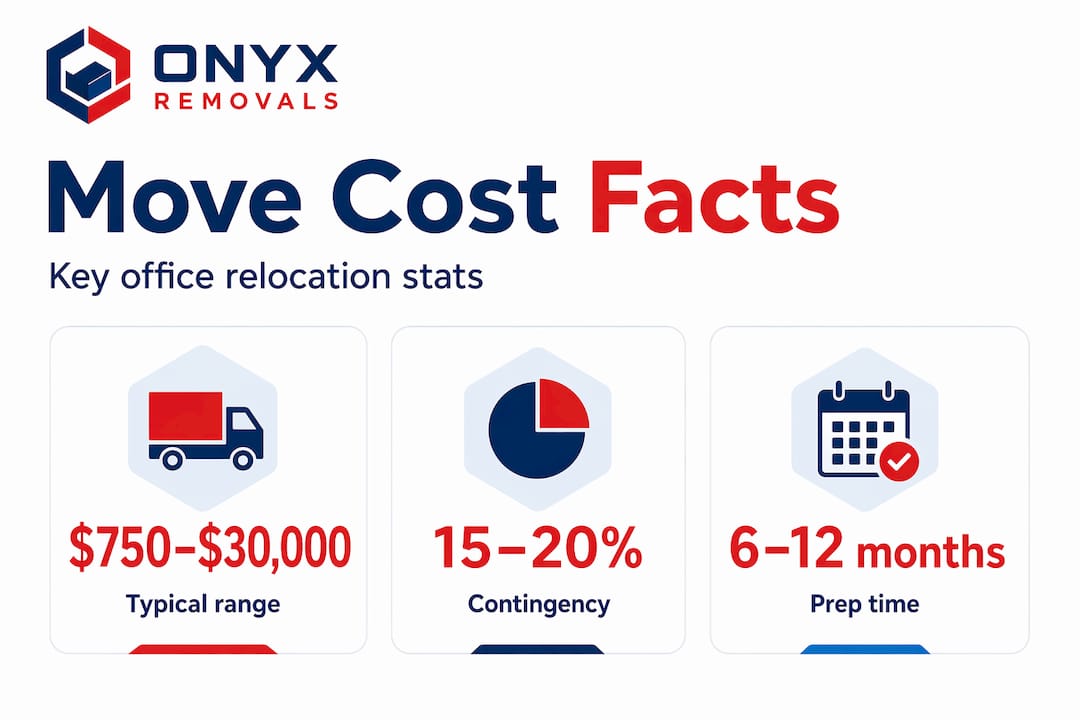
| Add a 15 to 20% contingency | Relocation logistics often exceed initial estimates by 20 to 40%, so buffer accordingly. |
| Assign a budget owner | A single person coordinating vendors and tracking invoices prevents scope creep and cost blowouts. |
| Reconcile after the move | Post-move budget reviews capture lessons that improve your planning for any future relocation. |
Getting your office relocation budget breakdown right means going well beyond removalist quotes. The physical move is just one slice of the total cost of moving an office. Here is every major category you need to account for.
| Cost category | Typical range (AUD) | Notes |
|---|---|---|
| Professional removalists | $750 to $30,000+ | Varies by office size and distance |
| IT infrastructure relocation | $5,000 to $10,000 | Per 30-person office; includes cabling and server moves |
| Make-good obligations | $250 to $300 per sqm | Higher for specialised fit-outs |
| Furniture and fit-out | Variable | New workstations, chairs, partitioning, storage |
| Signage and collateral | $100 to $3,000+ | Printed materials, building signage, stationery |
| Storage | $200 to $2,000+ per month | If staging between old and new sites |
| Utilities and new site setup | Variable | Connection fees, NBN, security systems |
| Productivity loss | Potentially $900,000+ | Largest hidden cost for mid-sized businesses |
Removalist fees cover labour, vehicle hire, insurance, and any special handling for heavy or delicate items. These are often the first number businesses get but rarely the only one that matters.
IT infrastructure deserves its own line item from day one. This covers data cabling at the new site, server relocations, phone systems, access controls, and security camera setups. A 30-person office will routinely spend between $5,000 and $10,000 on IT alone, and that figure climbs quickly with more complex environments.
Make-good costs are where Australian businesses frequently get blindsided. Your lease likely requires you to restore the premises to their original condition before you leave. At $250 to $300 per square metre, a 300 sqm office could generate a $75,000 to $90,000 make-good bill if you have not budgeted for it. Specialised fit-outs push that number higher.
Lease overlap is another silent budget killer. Leases can require 6 to 12 months notice, and missing that window means paying rent on premises you have vacated for an additional year.
Pro Tip: When building your office move expense checklist, include a column for “confirmed” versus “estimated.” This simple habit forces you to chase actual quotes rather than letting rough numbers harden into assumed figures.
Knowing the cost categories is step one. Building an accurate office relocation financial plan requires a structured process.
Conduct a full inventory. Walk every area of your current office and document what is being moved, what is being disposed of, and what needs specialist handling. This directly affects removalist quotes and storage requirements.
Get at least three detailed quotes. Multiple quotes from professional removalists reveal pricing variations and help you identify what each provider includes or excludes. Pay close attention to insurance coverage, call-out fees, and after-hours rates.
Engage IT and facilities specialists early. IT teams need time to scope cabling, test infrastructure at the new site, and plan server migrations. Getting their cost estimates in week one prevents nasty surprises in week twelve.
Review your current lease thoroughly. Check notice periods, make-good obligations, and any restrictions on alterations. This single step can save tens of thousands of dollars.
Gather departmental input. Finance, operations, HR, and IT all have requirements that affect the budget. A department head who flags the need for a server room at the new site during planning saves far more than one who mentions it a month before moving day.
Add a contingency allowance of 15 to 20%. Relocation costs can exceed initial estimates by 20 to 40% once the move is underway. A formal contingency line is not pessimism. It is good financial practice.
Use a budgeting template or project management tool. Spreadsheets work, but dedicated tools make it easier to track estimates against actuals as invoices arrive. Review your budget against real costs every 30 to 90 days.
Pro Tip: Planning 6 to 12 months ahead can reduce total relocation costs by up to 20%. The earlier you lock in vendors and confirm site requirements, the fewer expensive decisions you make under time pressure.
For a practical starting point, the office moving timeline guide from Onyx Removals maps out exactly when to take each of these steps.

Budgeting for office space change does not stop once the spreadsheet is built. Cost control during execution is where well-planned moves distinguish themselves from expensive ones.
Assign a single budget owner. This person reviews every invoice before payment, tracks cumulative spend against the budget, and flags any scope changes before they are agreed to. Without this role, costs creep unnoticed across multiple vendors and departments.
Pro Tip: Build a short weekly cost report that shows budget versus actual spend by category. Sharing this with your leadership team at each project update keeps everyone informed and reduces the chance of surprises at the final invoice stage.
For practical guidance on keeping your schedule and budget in sync, Onyx Removals has Melbourne-specific advice on reducing costs during execution.
Most office move cost overruns trace back to a handful of predictable errors. Recognising them before you start is far cheaper than fixing them mid-move.
Ignoring lease termination costs. Make-good and notice period expenses are contractual obligations, not optional. Businesses that fail to budget for them often face five or six-figure bills they cannot absorb.
Underestimating IT complexity. A 30-person office can easily spend $5,000 to $10,000 on IT relocation under normal circumstances. Add a server migration or a change in internet provider and that number rises quickly.
Ignoring productivity loss. This is typically the largest hidden cost in any relocation. Productivity loss alone can cost mid-sized companies close to $900,000. Even if you cannot prevent it entirely, budgeting time and resource to minimise it makes a material difference.
Setting contingency below 15%. Given that logistics costs routinely run 20 to 40% over initial assumptions, a 5% or 10% contingency line is not sufficient. It creates false confidence without real protection.
Choosing on price alone. The lowest removalist quote is only a bargain if the provider delivers what was promised. Check reviews, confirm insurance, and ask for references from comparable commercial moves.
Forgetting collateral and signage. Updating your address on signage, stationery, and marketing materials adds up to between $100 and $3,000 or more. These are easy to overlook until the bills arrive.
Pro Tip: Run your draft budget past someone who has managed an office relocation before. A single conversation with an experienced office relocation specialist often surfaces three or four cost items you have missed entirely.
Once the physical move is complete, your office move financial planning is not finished. Reconciling actual costs against your original estimates is the step most businesses skip and the one that would improve every future move.
In my experience, the businesses that manage office relocations well share one quality: they treat the budget as a living document rather than a one-time estimate. I’ve seen companies spend months refining a fit-out plan while leaving their lease termination clause unreviewed, only to discover they missed a 12-month notice period. That mistake alone wiped out the savings they thought they had negotiated in their new lease.
IT involvement from day one is not optional. I’ve watched IT teams brought in four weeks before moving day trying to scope cabling requirements that should have been confirmed months earlier. The result is rushed work, premium rates from contractors, and systems that don’t perform as expected on the first day at the new site.
The other thing I’ve found consistently valuable is building the contingency line before you have any idea what will go wrong, because something always does. It might be a building management issue at the new site, a delayed fit-out, or a make-good dispute. When there is an allocated contingency, those problems get solved. When there isn’t, they create conflict between departments about whose budget absorbs the overrun.
Vendor selection beyond price is worth every extra dollar spent on due diligence. A removalist who has done hundreds of commercial moves handles logistics differently than one whose core business is residential. That experience shows up in how they protect equipment, manage building access, and communicate during the move. The cheapest quote rarely reflects that value.
Good communication underpins everything. When your budget owner keeps all vendors, department heads, and leadership informed of progress and problems in real time, small issues stay small.
— Dinshaw
Planning a commercial relocation in Melbourne is significantly easier when you have a team that has done it before. Onyx Removals works with businesses of all sizes, providing transparent quotes, experienced project coordination, and practical support that keeps your relocation on schedule and on budget.
Whether you need help building a realistic cost estimate, coordinating a complex multi-floor move, or simply want advice on timing and vendor selection, the team at Onyx Removals can help. Their commercial removalist services are designed specifically for Melbourne businesses that cannot afford extended downtime. For post-move obligations, their cleaning services also cover make-good requirements. Reach out to Onyx Removals to start a conversation about your move.
Office moving costs range from $750 for small offices to over $30,000 for larger premises, depending on size, distance, and complexity. IT, make-good, and fit-out costs are additional and often exceed the removalist fee.
A contingency allowance of 15 to 20% of total estimated costs is recommended, as relocation costs frequently exceed initial projections by 20 to 40%.
Budget planning should begin 6 to 12 months before the move date. Starting this early can reduce total relocation costs by up to 20% and ensures lease notice periods are not missed.
Make-good obligations, IT infrastructure costs, lease overlap rent, productivity loss, and signage updates are the expenses most frequently left off the initial office move expense checklist.
Request itemised quotes from at least three providers, confirming what each includes for insurance, after-hours rates, and special handling. Onyx Removals provides guidance on comparing removalist quotes to help you evaluate offers accurately.

No Related Post


