



TL;DR:
- A move coordinator handles all aspects of relocation, from planning to logistics and vendor management. They reduce delays, costs, and stress by proactively managing risks and stakeholder communication. Proper coordination significantly improves operational uptime and employee satisfaction during moves.
A move coordinator is a dedicated professional who manages every detail of a relocation from start to finish, acting as the single point of accountability for planning, logistics, and communication. Whether you are moving a household across Melbourne or relocating an entire office, the role of a move coordinator determines whether the process runs to schedule and budget or descends into costly delays. In the relocation industry, this function is also called a relocation coordinator or move manager, and both terms describe the same project management responsibility. Structured relocation planning boosts on-budget completion rates by 25 percentage points for Australian office moves. That single figure makes the case for professional coordination better than any anecdote.
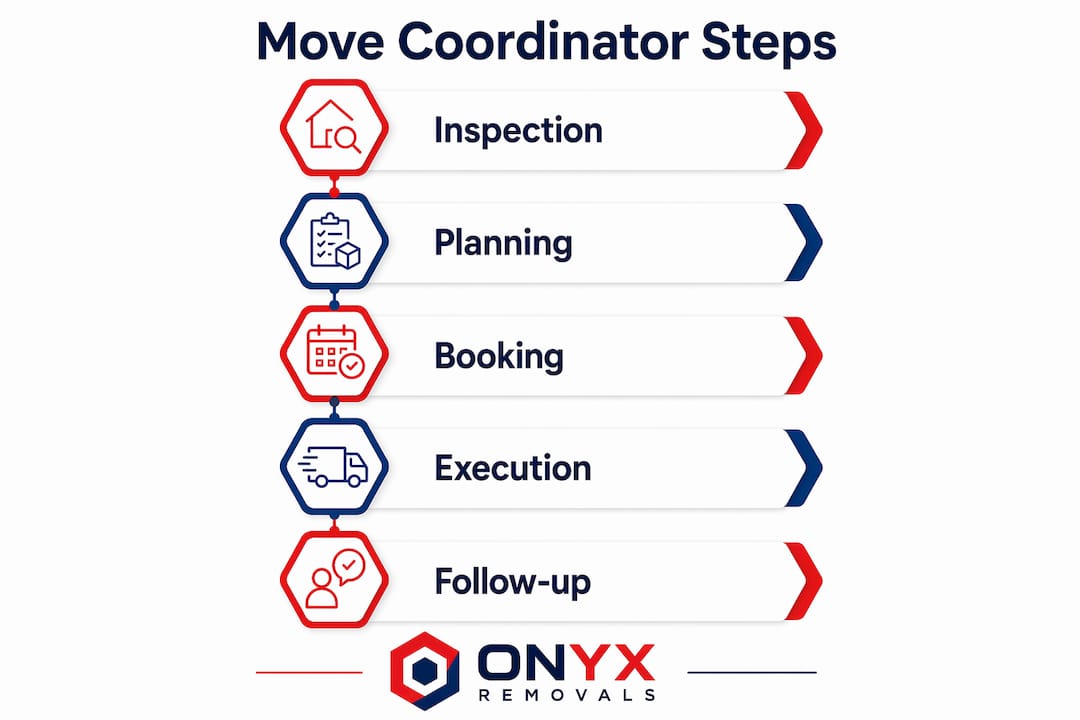
Move coordinator responsibilities span the full lifecycle of a relocation, from the first site inspection to the final unpacking check. The role is best understood as project management applied to physical and logistical change.
Planning and scheduling sit at the core of the job. A coordinator sets a master timeline, assigns milestones, and works backwards from the move date to identify every task that must be completed in sequence. For commercial moves, this planning window typically runs three to six months. For residential moves, four to six weeks of preparation is the minimum needed to avoid last-minute cost blowouts.
The day-to-day duties of a relocation coordinator cover a wide range of tasks:
Pro Tip: Book your lift and loading bay access at least four weeks before moving day. These bookings fill quickly in Melbourne’s CBD high-rises, and a missed slot can push your entire schedule back by 24 hours or more.
The difference between a residential and commercial coordinator is largely one of scale and stakeholder complexity. A residential coordinator manages a household’s timeline and personal needs. A commercial coordinator must align IT teams, HR, facilities managers, and department heads simultaneously, all while keeping the business operational.

The benefits of a move coordinator go well beyond convenience. They translate directly into measurable financial and operational outcomes.
Dedicated relocation coordinators significantly reduce business downtime by prioritising IT connectivity before staff arrive at the new site. Even a single day of downtime can cause significant productivity and trust loss for small teams. That is why the coordinator’s role in pre-move IT audits is not optional; it is the single highest-risk item on the schedule.
The practical advantages of professional move management services include:
For businesses, the return on investment is clear. For individuals, the value is measured in reduced anxiety and a stress-free house move that does not derail work, family, or finances.
The move coordinator job description is often confused with adjacent roles, and that confusion leads to gaps in accountability. Understanding the distinctions matters before you hire or appoint anyone.
| Role | Primary focus | Who they report to |
|---|---|---|
| Move coordinator | End-to-end project management, risk, and vendor liaison | Client or business owner |
| Internal coordinator | Staff communications and business requirements | HR or operations manager |
| External relocation manager | Logistics, removalists, and third-party vendors | Move coordinator or client |
| Removalist | Physical transport and packing | Move coordinator |
Successful moves combine internal coordinators managing communications and business requirements with external coordinators handling logistics and vendors. Using both prevents task drift, where critical items fall through the gap between two parties who each assume the other is responsible.
The most common misconception is treating a move coordinator as a customer service representative. They are not. Move coordinators act as project managers who own the risk register and proactively identify logistical failures before they occur. A customer service rep reacts to problems. A move coordinator prevents them.
The scope of the role also extends further than most clients expect. A coordinator does not just book a truck. They audit IT infrastructure, negotiate building access windows, manage insurance documentation, and brief every vendor on site-specific requirements. That breadth is what separates professional move management services from a basic removalist booking.
Effective move coordination follows a repeatable process. Improvisation is the enemy of a smooth relocation.
Start planning early. Commercial moves need a three to six month runway. Residential moves need a minimum of four to six weeks. Starting late compresses every subsequent task and removes your ability to recover from setbacks.
Conduct a site audit at both locations. Visit the origin and destination buildings to assess lift capacity, loading bay dimensions, after-hours access rules, and IT infrastructure. 35% of Australian relocations face delays due to unassessed building access in high-rise environments, and those delays drive up to 40% budget overruns when IT management is poor.
Build a RACI matrix. A RACI (Responsible, Accountable, Consulted, Informed) matrix assigns clear ownership to every task across your team and vendors. Without it, critical items like data backup verification or key handover get missed because everyone assumed someone else was handling them.
Schedule buffer time. Professional move coordinators build buffer time into schedules to handle infrastructure challenges like lift bookings and loading bay access. A buffer of two to four hours on moving day is standard practice for Melbourne CBD buildings.
Set a communications cadence. Weekly milestone updates to all stakeholders prevent surprises. Use a shared project tracker so that the IT team, HR, facilities, and the removalist are all reading the same schedule.
Confirm IT systems before staff arrive. The golden rule for commercial relocations is that IT systems must be operational before the first employee walks through the door. A coordinator who does not verify this the evening before moving day is taking an unnecessary risk.
Pro Tip: Create a “day-one essentials” box for each team or household. Label it clearly and load it last so it comes off the truck first. This single habit eliminates the most common complaint on moving day: nobody can find the coffee machine, the server cables, or the toilet paper.
A moving timeline checklist is the most practical tool a coordinator can give a client. It converts an abstract plan into a sequence of dated actions that anyone on the team can follow and tick off.
A move coordinator is the single most effective investment for any relocation, because professional coordination directly reduces costs, downtime, and stress across both residential and commercial moves.
| Point | Details |
|---|---|
| Early planning is non-negotiable | Commercial moves need three to six months; residential moves need at least four to six weeks of preparation. |
| Coordinators own the risk register | Proactive identification of access and IT issues prevents the delays that cause up to 40% budget overruns. |
| Internal and external roles work together | Combining both coordinator types prevents task drift and covers every aspect of the move. |
| IT connectivity is the top commercial priority | Moves with dedicated IT leads achieve 92% operational uptime versus 65% without one. |
| Destination support reduces turnover | Coordinators who manage the human side of relocation, including settling-in services, improve employee retention. |
People consistently underestimate the move coordinator role until something goes wrong. I have seen businesses lose a full trading day because nobody confirmed the loading bay booking at the new building. I have seen families arrive at a new home to find the removalists stuck in the car park because the body corporate was not notified. Both situations were entirely preventable with a coordinator who owned those tasks.
The part that surprises most clients is how much of the role is about managing people, not boxes. Relocating staff across Melbourne means managing anxiety, uncertainty, and competing priorities from HR, IT, and department heads simultaneously. Destination support for employees, including school searches and local orientation, is not a luxury add-on. It is what separates a move that retains good people from one that accelerates their departure.
The other underrated skill is knowing when to push back on a timeline. Clients often want to move faster than the building, the IT infrastructure, or the removalist schedule will allow. A good coordinator says no to an unrealistic date and proposes a workable alternative. That conversation is uncomfortable, but it is far less painful than a failed move day.
If you are planning a commercial relocation, read the company relocation assistance guidance before you set your move date. The timeline requirements alone will reshape your planning.
— Dinshaw
Planning a move in Melbourne and not sure where to start? Onyx Removals provides professional move coordination across residential, commercial, and office relocations, with an experienced team that handles planning, vendor liaison, IT scheduling, and on-the-day logistics.
Onyx Removals’ Melbourne moving services cover everything from packing and transport to cleaning and storage, all coordinated through a single point of contact. For businesses, the team also supports commercial relocation project management to minimise downtime and protect operational continuity. Get in touch with Onyx Removals to discuss your move timeline and receive a tailored plan.
A move coordinator manages the full relocation process, including planning timelines, booking vendors, conducting site audits, and overseeing logistics from packing to placement at the new location. They act as the single point of accountability for every task across the move.
Commercial relocations require a coordinator at least three to six months before the move date. Residential moves need a minimum of four to six weeks of preparation to avoid delays and added costs.
A removalist handles the physical transport and packing of items. A move coordinator manages the entire project, including the removalist, IT teams, building access, risk planning, and stakeholder communications.
Yes. IT connectivity is the top priority for commercial move coordinators. Moves with dedicated IT leads achieve 92% operational uptime, compared to 65% for moves without one, making IT coordination a core part of the role.
A move coordinator who provides destination support, such as school searches, local orientation, and settling-in services, directly reduces employee stress and improves retention outcomes for businesses relocating staff.

No Related Post


