


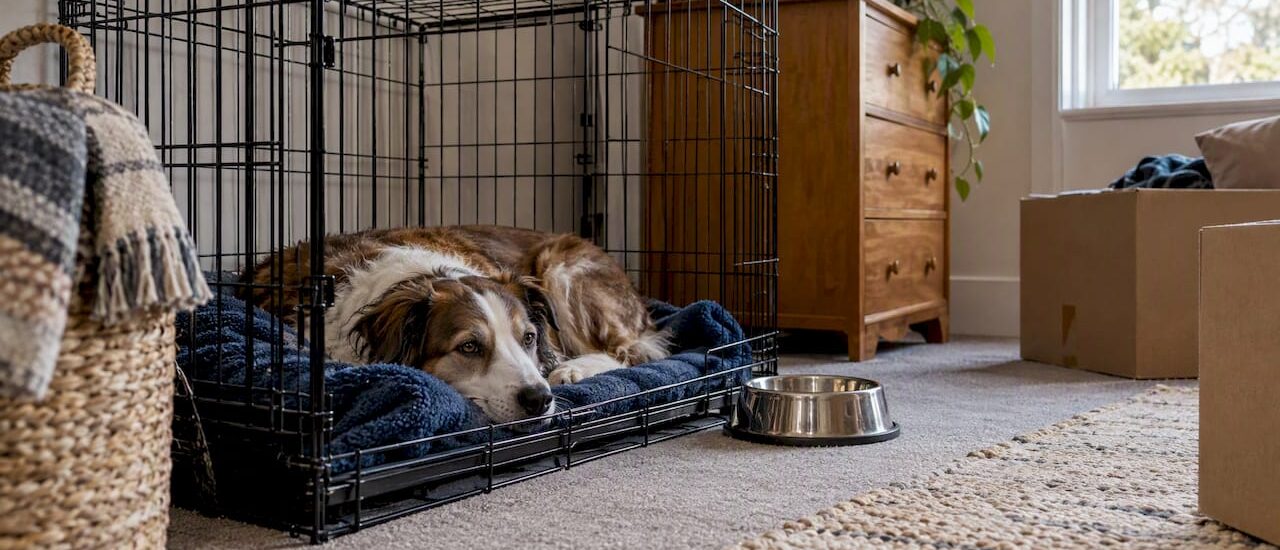
A pet-safe moving environment is a controlled, quiet space where your animal is secured and never left unattended while doors are open, furniture is moving and a truck is being loaded. It also covers a safe journey, a heat plan, and up-to-date ID so your pet can be returned to you if they bolt. This guide shows what that looks like in practice for a Melbourne move, and where Victorian rules apply.
Most people picture a calm pet on a comfy bed. That is part of it, but a pet-safe environment is really a set of controls that remove the ways an animal gets hurt, lost or stressed during a move:
The riskiest moments are not the drive itself. They are the handovers: carrying boxes through a propped-open front door, loading the vehicle, and arriving at an unfamiliar house with unlatched gates. Plan around those.
RSPCA Australia’s moving guidance is simple. If your pet is with you on the day, keep them secured in one room with enough food and water, or, if your dog is crate trained, in their crate somewhere safe and quiet. Pets are sensitive to disruption, and a move is full of it: strangers, noise, cartons, a house that suddenly smells and looks different.
Pick a room you will pack last, ideally a bedroom or bathroom with a door that closes fully. Then:
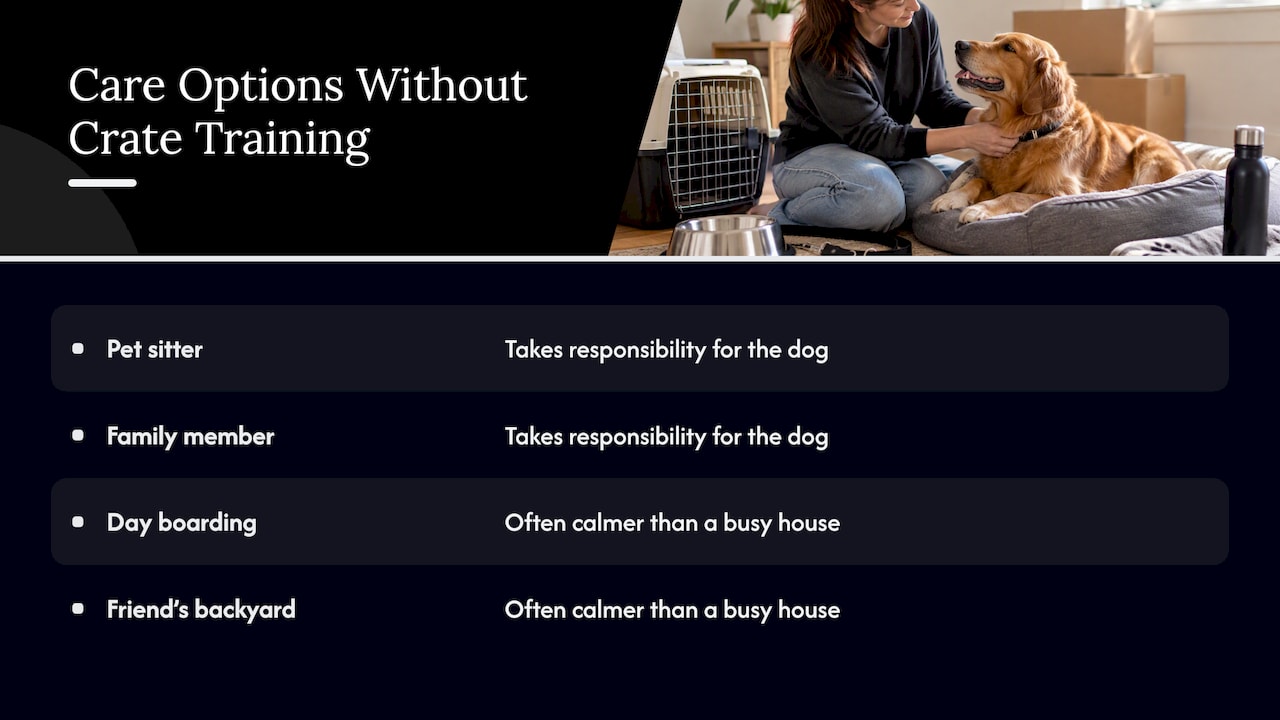
Moving day is a bad time to introduce a crate for the first time. RSPCA Queensland points out that if your dog isn’t crate trained you may need a plan such as a pet sitter or a family member taking responsibility. Boarding for the day, or a friend’s backyard, is often calmer than a closed room in a house full of activity.
If you do want a crate for the journey, start weeks ahead. RSPCA’s emergency-planning guidance recommends reward-based training so animals enter and settle in a carrier or crate. The same habit that helps in a bushfire evacuation helps on a moving day.
Melbourne weather can swing from mild to 35°C in a day, and moves are the sort of job where a pet ends up waiting somewhere with the engine off. Victoria spells out the rules.
| Situation | What Victorian guidance says |
|---|---|
| Pet unattended in a car | Illegal for more than 10 minutes when outside temperature is 28°C or higher |
| Dog on the back of a ute or trailer | Must be appropriately tethered or caged, with extra requirements on metal trays at 28°C or above unless the dog has insulating protection |
| Heat stroke timeframe | As little as 4 to 6 minutes |
| Parked in shade, windows down | Still not safe to leave pets, according to the same guidance |
The 10-minute legal limit is not a safe window. The heat-stroke warning is about minutes, so the practical rule is zero unattended time in a vehicle.
Pet safety on the road is not just good manners. In Victoria, the person in charge of a dog must make sure it is transported appropriately and has its essential needs met, including food, water, protection from heat or cold and a safe position on the vehicle. Under the ACT’s Animal Welfare Act, an example of how these laws are drafted, transporting an animal in a way that causes or is likely to cause unnecessary injury, pain or stress is an offence. RSPCA’s transport principles say the same thing from a welfare angle: containment, loading and unloading must be arranged to avoid injury, pain, suffering or distress.
What this means for your car:
Keep the journey short and the number of handovers small. Each transition, such as house to car and car to new house, is a chance for stress or escape.
A door left open for ten minutes is all it takes. In Victoria, dogs and cats must be registered and microchipped, and the City of Melbourne notes that registration is renewed before 10 April each year. RSPCA Victoria also says you must update microchip registry details if you change address.
Before the move:
After the move:
Arrival is the second high-risk moment. Before the pet comes inside:
If you are moving into a place where you will be arranging unpacking, assembly of furniture or skip bins, schedule the noisy tasks for after your pet has settled in, not on the first afternoon.
A pet-safe move is a shared effort. When you book, tell the crew about your animals and ask:
Plants are another consideration, since some common houseplants are toxic to pets, and moving them in a hot truck adds risk. We cover specialist loads like this on our services page.
We move households across Melbourne, and the pets are rarely the problem. The problem is the gap between what the owner pictured and what actually happens on the day: doors open for hours, a crew that was never told there was a nervous cat in the back bedroom, a truck loaded in full sun.
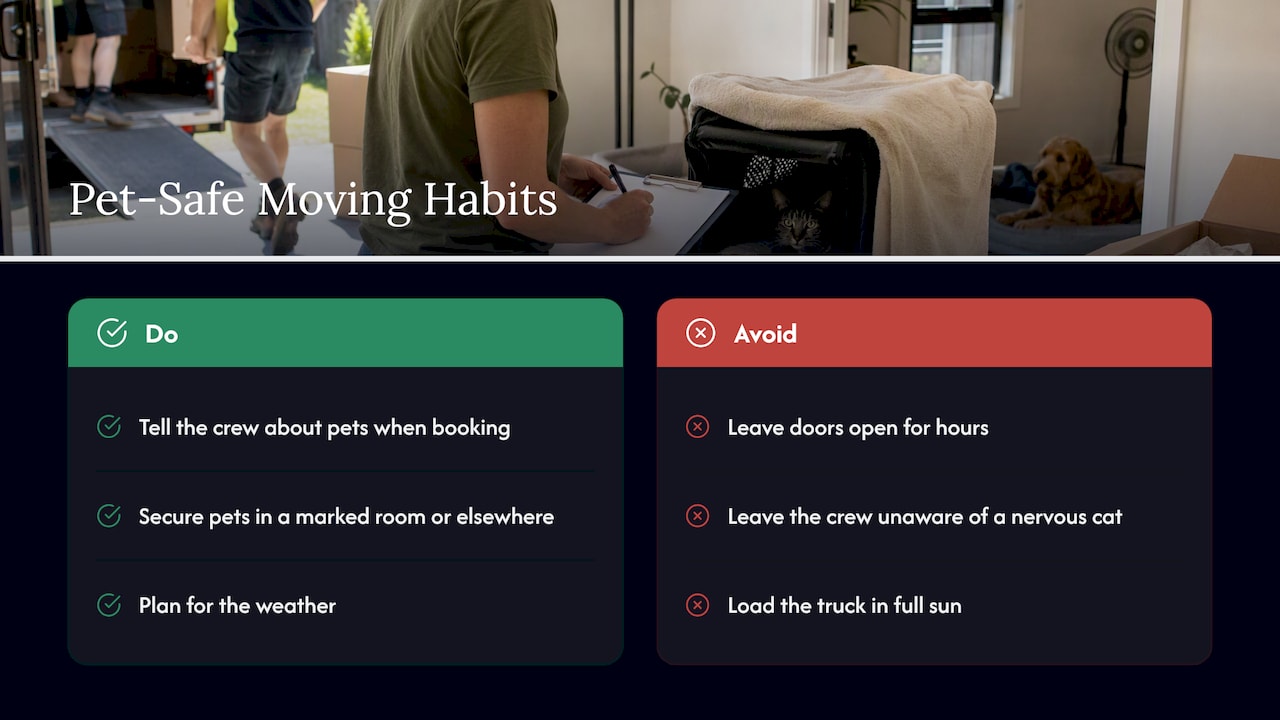
The moves that go smoothly share three habits. The owner tells us about the animals when booking. The pet is secured in a marked room or, better, somewhere else entirely with a trusted person. And the plan allows for the weather instead of hoping for it. We would rather rearrange a start time than have an animal stressed in the heat.
We plan each move around the household, and having one team manage packing, cleaning and removal means fewer strangers coming and going and fewer handovers in the home. That helps a pet more than most people expect. If you want a longer walk-through, our guide to moving house with pets goes step by step.
— Dinshaw
A tidy house with the pet safely out of the way is easier to move. Our team handles packing and unpacking at $109 per hour, so you are not juggling boxes while keeping an eye on a worried dog, and we handle residential moves, bond cleaning, waste disposal and storage as a single plan. Tell us about your animals when you request a quote and we will build the day around them.
If your pet is travelling interstate or you need to budget for specialist transport, our pages on pet relocation costs in Melbourne and interstate pet transport are a good place to start.
| When | What to do |
|---|---|
| 4 to 6 weeks before | Start crate or carrier training, check vaccinations, registration and microchip details |
| 1 to 2 weeks before | Book boarding or a carer if needed, tell your removalist about your pets, check the weather forecast |
| The day before | Pack a pet kit: food, two bowls, bed, litter, medication, vet records, a lead |
| Moving day | Pet in the quiet room or with a carer, doors signed, water topped up |
| Arrival | Walk the fence, set up the safe room, keep doors closed |
| First two weeks | Update council and microchip details, keep routines steady |
Yes, if they are secured in a closed room or crate with food, water and ventilation, and everyone knows not to open the door. For anxious animals or crews working in and out all day, a carer’s home or boarding is calmer. RSPCA Australia recommends a secured room or a crate in a quiet place.
In Victoria it is illegal to leave an animal in a car for more than 10 minutes when it is 28°C or hotter outside. Because heat stroke can set in within 4 to 6 minutes, the safe approach is never leaving a pet in a parked car at all.
Yes. Update the microchip registry with your new contact details and tell your new council so registration moves with you. These are separate steps, and doing both means your pet can be returned if they get lost.
The principles are the same: containment, supervision, shade and ID. Cats usually do best in a belted carrier and a single quiet room at the new house, while dogs need a secure harness or crate and a checked fence line.

No Related Post


