



TL;DR:
- Proper planning and early booking are essential for a smooth and cost-effective move.
- Choosing a reputable, insured removalist with good reviews reduces risk of damage and delays.
- Professional packing significantly decreases damage claims and protects valuable or fragile items.
Moving house in Melbourne is one of the most logistically demanding things a household can do, yet most people underestimate just how much can go wrong. Consumer Affairs Victoria received 700+ complaints in a single year, the majority related to damage caused by removalists. That figure alone should make you pause before booking the cheapest option you find online. The good news is that with the right preparation and a trustworthy provider, your move can be smooth, safe, and far less stressful than you might expect. This guide walks you through every essential step.
| Point | Details |
|---|---|
| Prioritise reliability over price | Choosing well-reviewed, insured removalists prevents costly damage and stress during your move. |
| Start planning early | A thorough inventory and early booking dramatically reduce last-minute issues. |
| Professional packing pays off | Using expert packers and the right materials cuts the risk of damage by up to 80%. |
| Move mid-week for savings | Schedule your Melbourne move mid-week to secure the best rates and availability. |
Before you contact a single removalist, you need a clear picture of exactly what your move involves. This sounds obvious, but most households skip this step and end up with surprise costs, delays, or damaged items on move day. Taking stock of your situation early is the single most powerful thing you can do.
Start by walking through every room and noting what needs to go. Think beyond the obvious furniture. Consider fragile items like artwork, mirrors, and glassware. Think about bulky or awkward pieces such as pianos, large outdoor furniture, or gym equipment. Note any access challenges at either property, including narrow staircases, tight hallways, or limited street parking for a large truck.
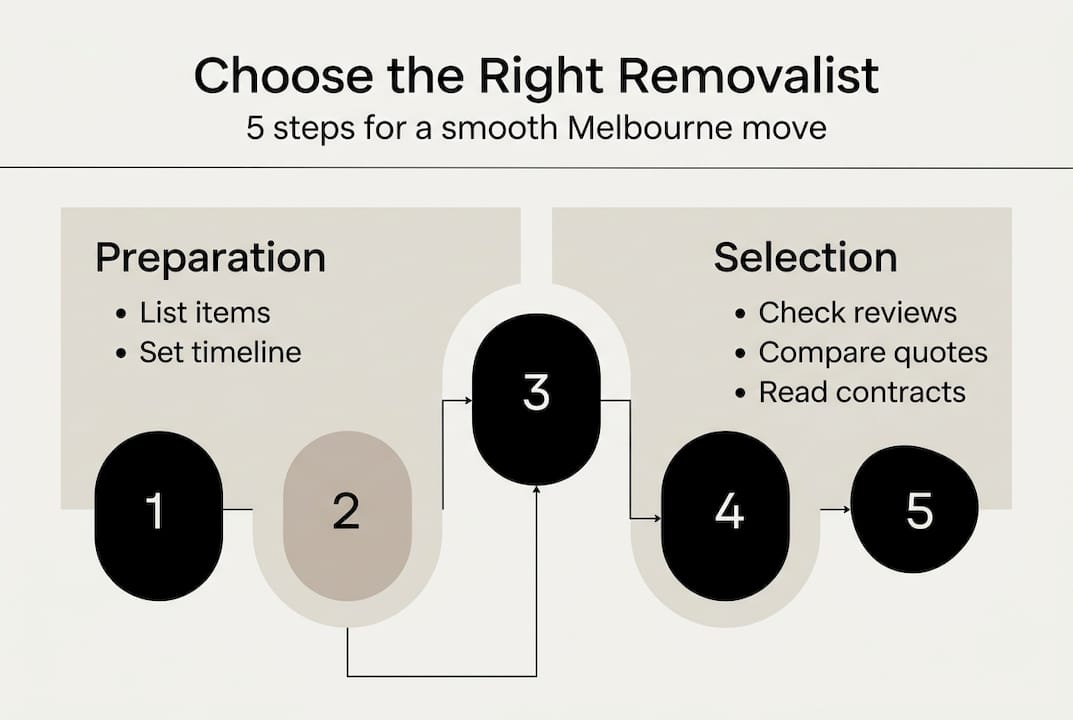
Once you have a clear picture, you can decide how much professional help you actually need. Some households are comfortable managing packing themselves and just need a truck and crew. Others benefit enormously from a full-service option that covers packing, transport, and unpacking. Neither choice is wrong, but knowing which suits you saves time and money when comparing quotes.
Here is a quick checklist to help you define your needs:
Timing is also critical. Experts recommend you start planning 8 weeks early with a room-by-room inventory. That might feel excessive for a two-bedroom flat, but it gives you time to declutter, source packing materials, and compare removalists without rushing. A thorough moving checklist for Melbourne keeps everything on track, and a well-structured prepare inventory removes the guesswork entirely.
The households that move smoothly are almost always the ones that planned early. The ones that scramble at the last minute are the ones that end up paying more, losing items, or dealing with damage claims.
Once you know your needs, choosing the right removalist becomes much easier. The challenge is that the Melbourne removalist market is crowded, and not every operator meets the same standard. Price is the first thing most people look at. It should actually be one of the last.
Here is how different removalist types generally compare:
| Type | Price | Risk level | Best for |
|---|---|---|---|
| Budget/unvetted | Low | High | Very simple, low-value moves |
| Established firm | Mid to high | Low | Most residential moves |
| Specialised removalist | Higher | Very low | Pianos, antiques, complex access |
Reliability and track record matter far more than saving a few hundred dollars. 99% on-time performance and consistently high review ratings are the clearest signs of a reputable operator. Look for firms with a strong volume of genuine reviews, not just a handful of five-star ratings from years ago.
Insurance is non-negotiable. Ask every removalist you speak to exactly what their policy covers. Transit insurance should protect your belongings from the moment they leave your home to the moment they arrive at the new address. Check whether the policy covers full replacement value or just depreciated value. That distinction matters enormously for expensive furniture or electronics.
Always request a written quote that itemises every cost. Verbal estimates are not binding, and surprise charges on move day are a common complaint.
Contract terms are equally important. A professional firm will give you a clear written agreement that outlines what is included, what is excluded, and what happens if something is damaged. Vague contracts are a red flag. Insured, high-review firms consistently outperform cheaper alternatives when it comes to protecting your belongings and resolving issues professionally.

Pro Tip: Ask each removalist how they handle damage claims. A confident, straightforward answer signals a company that stands behind its work. Hesitation or deflection is a warning sign.
For a broader overview of what to expect, the household relocation basics guide covers the full picture of what a professional service should include.
Packing is where many moves go wrong, and it is often the area where households try hardest to save money. The hidden cost of that decision can be significant.
One of the most overlooked risks is insurance. If you pack your own boxes and something breaks in transit, your removalist’s insurance may not cover it. DIY packing risks claims denial, while professional packers can reduce damage by up to 80%. That is not a minor difference. It means the money you saved on packing could easily be wiped out by a single broken item that is not covered.
Professional packers use purpose-made materials, tested techniques, and years of experience to protect your belongings. They know how to wrap fragile items, how to distribute weight across boxes, and how to secure contents so nothing shifts in transit.
Here is a comparison of common packing mistakes versus professional methods:
| Common DIY mistake | Professional approach |
|---|---|
| Overloading boxes | Weight-balanced packing per box |
| Packing dishes flat | Vertical dish packing with dividers |
| Using newspaper on glass | Acid-free tissue and bubble wrap |
| Unlabelled boxes | Colour-coded, room-specific labelling |
| Mixing fragile and heavy items | Separate, clearly marked fragile boxes |
If you are committed to packing yourself, here are the non-negotiable rules:
Pro Tip: Label every box on the side, not the top. When boxes are stacked, you can read the side label without moving anything.
For a full list of what you need, check out essential packing materials and browse the moving tips library for practical guidance.
A well-planned move does not have to be an expensive one. There are several proven strategies Melbourne households use to reduce both stress and cost without cutting corners on quality.
Here is a step-by-step approach:
The best move-day experiences almost always come down to one thing: the household was ready. Boxes were packed, labelled, and staged near the door. The removalists could work efficiently from the moment they arrived.
Pro Tip: Book your removalist before you start packing, not after. Knowing your move date creates a firm deadline that keeps your preparation on track.
For households watching their budget, explore affordable moving options and the detailed guide on how to move on a budget without sacrificing quality or safety.
After working with hundreds of Melbourne households, we have noticed a consistent pattern. The moves that go badly are almost never caused by bad luck. They are caused by decisions made weeks before move day, usually in the name of saving money or time.
Choosing a removalist based purely on price is the single biggest mistake households make. The cheapest operator rarely has the insurance, experience, or equipment to handle a real-world move without incident. When something goes wrong, and with unvetted operators it often does, the financial and emotional cost far exceeds whatever was saved on the quote.
The other overlooked factor is expertise. A skilled removalist crew does not just carry boxes. They assess access, protect floors and walls, disassemble and reassemble furniture correctly, and manage the logistics of a complex move without drama. That knowledge is genuinely valuable and cannot be replicated by a borrowed ute and a few willing friends.
We always say: the Melbourne moving timeline is your best friend. Start early, plan thoroughly, and invest in a provider whose track record speaks for itself. The pennies saved on a budget operator are rarely worth the risk.
Understanding what makes a great removalist is one thing. Finding one you can actually trust with your home and belongings is another.

At Onyx Removals, we offer stress-free Melbourne moving solutions tailored to your specific needs, whether you are moving a studio apartment or a large family home. Our team brings full insurance, high review scores, and years of hands-on Melbourne experience to every job. We also supply quality packing materials and offer a complete residential removal service that covers everything from the first box to the final piece of furniture in place. Get in touch today for an obligation-free quote and find out how straightforward your next move can be.
Book your removalist at least 6 to 8 weeks before your move date to secure your preferred time slot and allow enough time for a thorough room-by-room inventory and packing plan.
Most policies cover loss or damage in transit, but DIY-packed boxes may be excluded from claims. Always read the policy terms carefully before signing.
Yes. Mid-week moves typically attract lower rates and better crew availability compared to Friday afternoon or weekend slots.
Choose an insured, high-review firm, use professional packing where possible, and ensure all fragile items are clearly labelled and properly cushioned.
Check for clear insurance terms, a fully itemised quote, and an explicit list of what is and is not included in the service. Vague or verbal-only agreements are a warning sign.

No Related Post


