



TL;DR:
- Proper planning is crucial to avoid costly operational disruptions and budget blowouts during a Melbourne office move.
- Local Melbourne-specific factors like permit processing, loading zone restrictions, and weather significantly impact relocation success.
- Engaging experienced professional movers and local expertise minimizes downtime and ensures a smooth, timely transition.
Moving a Melbourne office without a structured plan is one of the most expensive mistakes a business can make. Operational disruption, lost productivity, and blown budgets are all too common when companies underestimate what a relocation actually involves. Over 60% of organisations underestimate relocation risks, and poor planning is the primary cause. This guide gives you a clear, practical roadmap covering every critical stage of a business move, from the first planning meetings through to post-move review, so your Melbourne business keeps moving forward without missing a beat.
| Point | Details |
|---|---|
| Start planning early | Give yourself at least 6–12 months for large or complex relocations to avoid hidden risks. |
| Structured steps work | Breaking down the process into phases reduces disruption and boosts success. |
| Professional support saves costs | Engaging experienced movers can lower downtime expenses and stress for your team. |
| Control costs actively | Regularly review your budget, seek local quotes, and factor in all extras like IT, insurance, and staff support. |
Think of a business relocation less like a single event and more like a construction project. It has phases, dependencies, and milestones that must happen in a specific order. Skipping steps or compressing timelines creates costly knock-on effects that are difficult to reverse once the move is underway.
For larger offices, a structured timeline starting 12 to 18 months in advance is the accepted industry standard. Smaller teams can sometimes compress this to four to six months, but only when complexity is genuinely low. In Melbourne, the reality is often more complicated than it first appears.
The typical phases of a business relocation look like this:
| Phase | Timeframe before move | Key focus |
|---|---|---|
| Preliminary planning | 12 to 18 months | Lease review, scope, budget |
| Date locking and fitout | 6 to 12 months | Permits, contractors, IT planning |
| Transition setup | 3 to 6 months | Staff prep, asset audits, packing |
| Move execution | 1 to 4 weeks | Physical relocation, IT cutover |
| Post-move review | 1 to 4 weeks after | Debrief, issue resolution, sign-off |
Melbourne adds its own layer of complexity. CBD loading zones have strict access windows that vary by street and time of day. Council permits for loading dock use or road closures can take weeks to process. Fibre and NBN connection transfers often require lead times that surprise even experienced operations managers. Understanding Melbourne office move timelines in detail helps you avoid these local surprises before they become critical problems.
Key pitfalls to watch for during each phase:
The businesses that navigate relocations smoothly are the ones that treat the process as a project, not a task. That distinction matters enormously when you are managing staff expectations, client commitments, and ongoing operations simultaneously.
Once you understand the full scope, the next step is tackling the high-priority groundwork before anything else is scheduled or committed. Getting these foundations right prevents the most expensive problems later.
Here is what to organise in roughly sequential order:
For companies managing complex multi-department moves, professional move project management services can coordinate all of these streams without consuming your internal team’s capacity.
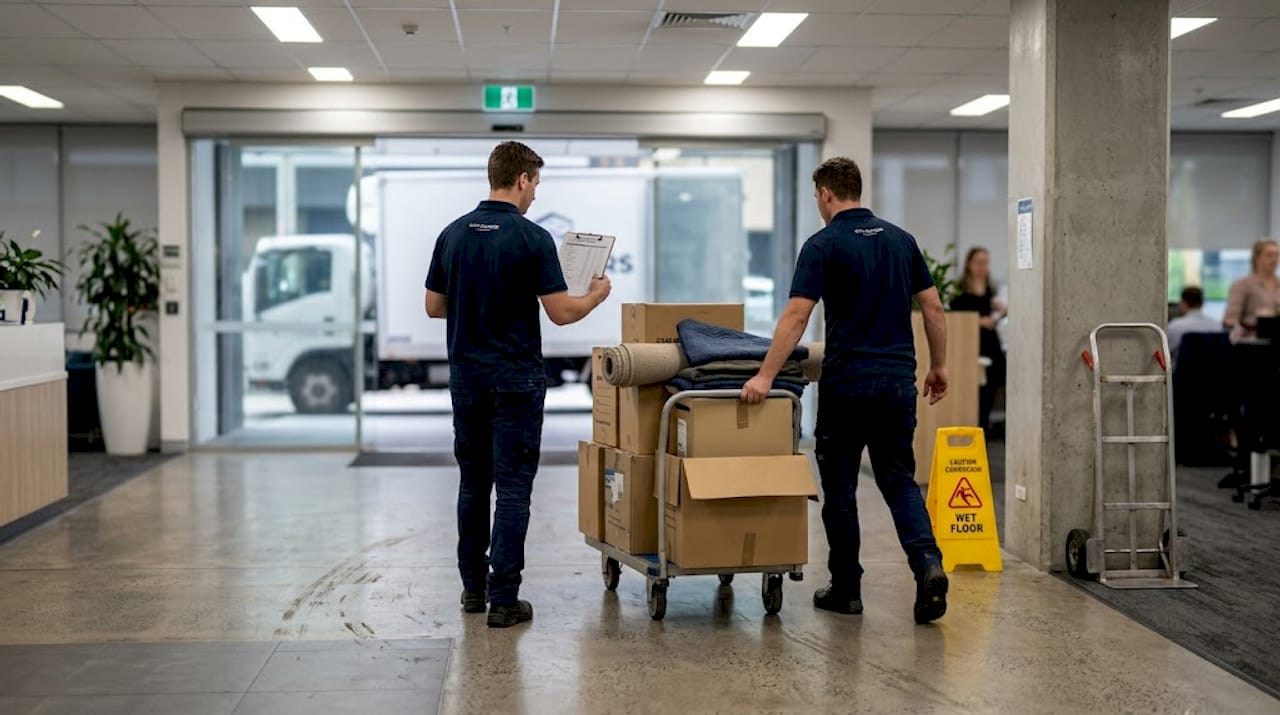
Poor planning leads to major costs, with over 60% of organisations underestimating what their relocation will actually demand. The preparation phase is where you change that statistic for your own business.
Pro Tip: If your Melbourne office relies on specialised technology or regulated data infrastructure, explore temporary office options to maintain operations during the transition window rather than forcing a hard cutover.
With your foundations in place, here is how to move through the relocation systematically. Assign a named team leader to each workstream so accountability is clear and nothing falls between responsibilities.
The case for professional movers is well supported. Professional movers reduce downtime costs by 35%, while DIY moves often exceed budget by 40% due to delays and handling errors. For a real-world benchmark, Mondelēz successfully moved 500 staff and 2,000 crates across three weekends without disrupting operations, a result that came directly from meticulous pre-move planning and experienced execution.
| Approach | Upfront cost | Risk of downtime | Budget blowout risk |
|---|---|---|---|
| DIY move | Lower initially | High | Up to 40% over budget |
| Professional movers | Higher initially | Low | Reduces costs by 35% |
Pro Tip: Review the detailed office relocation steps with your project leader and map each action to a named person and a due date. A checklist without owners is just a wish list.
Budget blowouts in business relocations are almost always predictable in hindsight. Knowing where the money goes is the first step to controlling it.
Real cost benchmarks for Melbourne office moves in 2026:
The most common reasons costs spiral beyond projections:
“The businesses that control relocation costs are not necessarily the ones with the biggest budgets. They are the ones that planned for the costs they knew and built a buffer for the ones they did not.”
For practical office move cost-saving tips, staged moves are one of the most effective tactics. Moving one department at a time keeps the rest of the business operational and spreads the disruption over manageable intervals.
Pre-installing technology at the new site before the physical move begins is another tactic that consistently delivers results. When staff arrive on the first morning and their systems are already running, productivity returns to normal within hours, not days. Supporting employee wellbeing during moves also shortens the resettlement period significantly. Staff who feel supported adapt faster, and that directly impacts how quickly your business returns to full capacity.
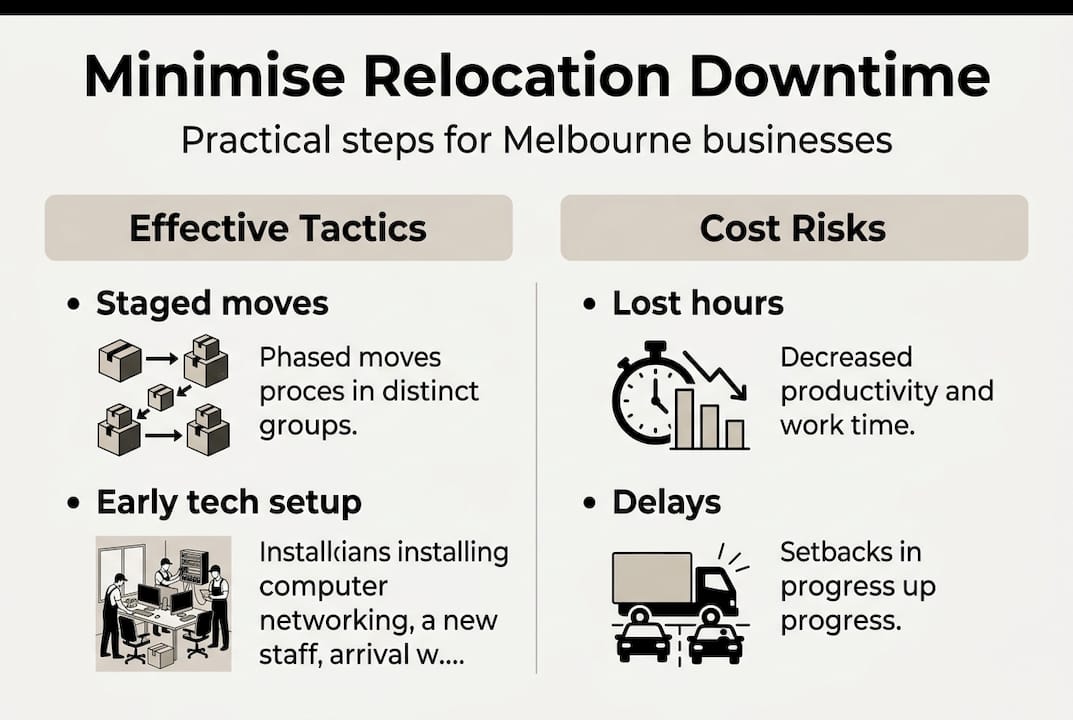
Professional movers reduce downtime costs by 35%, which means the fee for experienced help is often recovered through avoided disruption alone.
Here is something most relocation guides will not tell you: national checklists are largely useless for Melbourne businesses. They are written for a generic office in a generic city, and Melbourne is neither of those things.
The CBD has loading zones that change by the hour. Some streets require council permits just to park a truck long enough to unload. Fibre connections to certain Melbourne buildings are managed by building management, not your provider, and the lead times involved can push your planned go-live date back by weeks without warning.
Then there is the weather. Melbourne’s notorious four-seasons-in-one-day pattern has derailed more than a few outdoor loading operations. Experienced local removalists factor this in. National providers often do not.
Blending a structured relocation plan with genuine Melbourne-specific expertise is not a luxury. For most Melbourne businesses, it is the difference between a move that finishes on time and one that becomes a months-long operational headache. Generic advice gets you started. Local knowledge gets you across the line.
Planning a business relocation in Melbourne is far less daunting when you have an experienced team behind you. Onyx Removals specialises in tailored commercial relocations, from small office moves to large multi-department transitions, with project management support built in from day one.
Explore our full range of Melbourne commercial moving services or read through our comprehensive moving process guide to see how we approach every relocation. For businesses that need hands-on coordination from start to finish, our project management experts are ready to take the complexity off your plate so your team can stay focused on the work that matters.
Large relocations should be planned 12 to 18 months ahead; smaller moves need at least four to six months to allow for permits, staff preparation, and technology transitions.
Costs range from AU$750 to $4,500 for small offices and can exceed AU$12,000 for larger companies, before adding IT migration, packing, and insurance to the total.
DIY moves exceed budget by up to 40% due to downtime and delays, while professional movers reduce downtime costs by 35%, making professional help cost-effective in most cases.
The key risks are operational disruption, lost productivity, and failing to address permits and CBD access requirements early enough to avoid delays on moving day.

No Related Post


