



A delivery docket is the paper (or digital) record that a consignment changed hands. In a warehouse it does three jobs at once: it is the proof of delivery, the checklist for receiving stock against the purchase order, and the evidence you fall back on when goods go missing, arrive damaged or are disputed. It is not an approval to pay and it is not a certificate that the load is correct. It only records what was handed over, by whom, to whom and when.
This guide explains what a docket should contain, how a warehouse uses it from the dock to the invoice, where it goes wrong, and what it means if you are a business moving stock or relocating a warehouse in Melbourne.
In Australian trade, “docket” is the everyday word for the document that travels with goods and is signed at the point of delivery. Overseas you will see it called a delivery note, a packing slip or a consignment note. The warehouse team does not much care about the label. They care about what is written on it.
The Australian Border Force’s guidance on proof of delivery, written for licensed depots handling import and export goods, sets out the standard: the record should show the date and time of receipt, the receiver’s signature and printed name, and the vehicle registration. Those four details are what let someone later prove who had custody of the goods, and when.
Two things a docket is not:
That distinction matters most when something is wrong, which is exactly when people reach for the docket.
Receiving is the control point. What the supplier shipped, what your purchase order says and what is physically on the pallet either match or they do not. The docket is the first document the receiver picks up.
A typical receiving routine looks like this:
Nationally recognised training reflects this. The units TLIA0023 Receive goods and TLIA0004 Complete receival and despatch documentation both cover identifying documentation requirements, checking goods on arrival and completing the paperwork as part of daily warehouse work.
Many warehouses turn the docket into an internal record, often called a goods received note (GRN). A goods received note template lists the fields most teams capture: the supplier’s docket or consignment reference, the purchase order number, carrier and vehicle details, and quantities ordered, delivered and accepted for each line. Recording delivered and accepted quantities in separate columns is a small habit with a big payoff, because the two numbers differ whenever something is wrong.
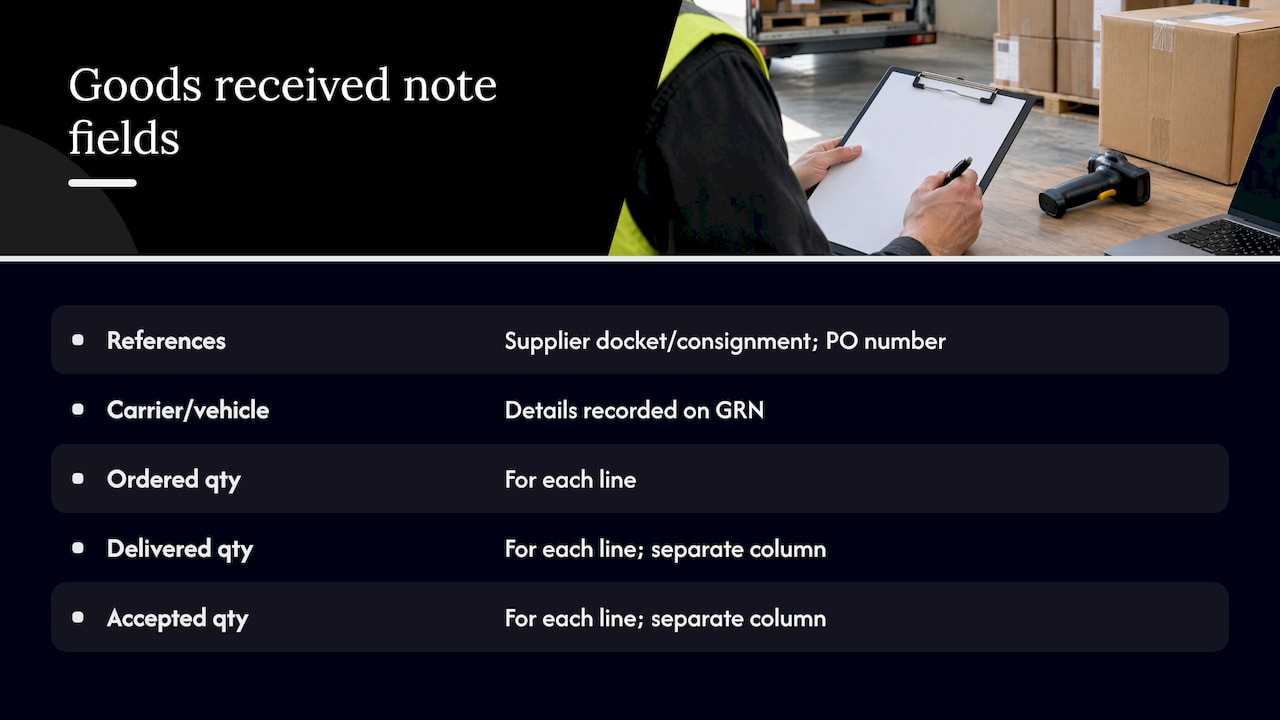
The same source makes a point worth repeating: check against the purchase order, not just the supplier’s docket. A docket that matches itself proves nothing about what you ordered.
Finance teams usually pay only when the purchase order, the receipt and the invoice agree. The docket is the evidence behind the receipt. A university procurement guide, for example, explains that users receipt the goods in the system after delivery and that Finance proceeds with payment once the item is fully received.
That is why the common belief that “we signed it, so it is approved” is wrong. Logistics reconciliation specialists make the same point: a signed docket only documents that custody changed hands. Deciding whether a short or disputed load is acceptable stays with the accountable person, not the paper.
Going the other way, the outbound docket is your protection. It shows what left your dock, in what quantity and who took it. If a customer claims a short delivery, the signed docket from the driver (and later from the customer) shows where custody sat at each point.
| Field | Why it matters |
|---|---|
| Docket or consignment number | Links the paper to the order, the GRN and the invoice |
| Purchase order number | Lets the receiver match the delivery to what was ordered |
| Supplier, carrier and receiver names | Shows every party in the chain |
| Description and quantity of goods | The basis for checking the delivery |
| Date and time of delivery | Pins down who had custody when |
| Vehicle registration | Identifies the vehicle for verification and audit |
| Receiver’s signature and printed name | A signature alone is hard to trace to a person |
| Notes on damage or shortages | Protects the receiver and supports any claim |
Industry bodies stress consistency here. CHEP Australia, which manages reusable pallets, says inconsistent documentation such as missing signatures or wrong references creates administrative complexity between trading partners, and that standardised requirements, including receiver stamps and printed names, help resolve disputes.
In healthcare and food storage, quantity is not enough. Queensland Health’s guide notes that deliveries may need to be accompanied by items such as Safety Data Sheets for chemicals or temperature records for perishables. Leave them off and the receiver can reject the whole shipment at the dock, however good the products are.
In Australia, the docket also feeds your compliance record. The Heavy Vehicle National Law is administered by the National Heavy Vehicle Regulator, and under its Chain of Responsibility (CoR) provisions, every party in the heavy vehicle supply chain has a duty to ensure the safety of its transport activities. A warehouse that loads or receives heavy vehicles is part of that chain.
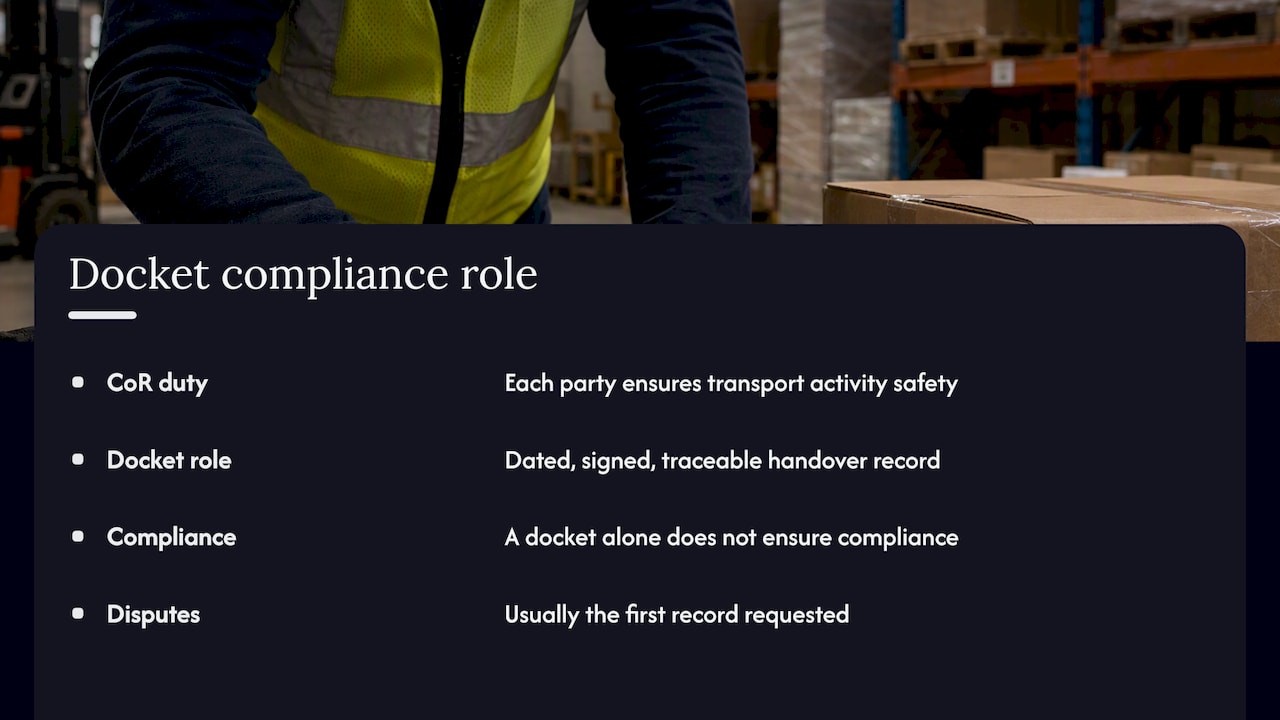
A complete docket will not make you compliant by itself. What it does is give you a dated, signed, traceable record of each handover. The ABF guidance linked above treats the docket as an audit record for exactly this reason. If a load is disputed or goods go missing, the docket is usually the first thing anyone asks to see. One missing printed name, vehicle registration or timestamp can leave you unable to show who held the goods at a given time.
When you find damage, document it properly: what you saw, where, when, with photographs. This guide to documenting damage before accepting a delivery is written for property managers dealing with glass, but the habits carry over to any goods you receive: photograph first, describe precisely, record the time.
Paper still works, but more operators are shifting to electronic proof of delivery. According to Microlise’s overview of ePOD for ANZ businesses, drivers can capture signatures, photos, GPS location and timestamps at the delivery point, which reduces manual entry errors and keeps records ready for inspection. The same source notes that ePOD is not itself a legal requirement. Its value is in supporting CoR obligations with records you can produce immediately, rather than digging through stored paperwork.
Another ePOD provider, Docketbook, describes GPS and time-stamped, audit-logged digital dockets shared between companies so everyone works from the same information. Whether you go digital or stay on paper, the test is the same: can you produce a complete, signed record for any delivery within minutes?
We run removals, commercial moves and warehouse pickups and deliveries out of Melbourne, so we handle other people’s goods every day. Our view is simple: the docket is where trust turns into evidence.
When a business relocates an office or warehouse, stock and equipment leave one site and arrive at another, often in several loads. That is precisely when dockets get sloppy. Nobody feels the pressure of a signed receipt until a pallet is missing or a cabinet is scratched. We think the right habit is to treat each load as its own handover: a list of what is going, a record of what arrived, and notes of anything that differs, agreed at the door rather than argued about afterwards.
We also see why an integrated approach helps. When one provider handles packing, transport, storage and waste removal, there are fewer handovers, and fewer handovers mean fewer places for the paperwork to break. Whoever you use, ask how they record pickup and delivery, and keep your own copy.
— Dinshaw
A warehouse move is a chain of dockets: stock out of the old site, stock into storage or the new site, waste and surplus removed. A few suggestions:
If you want to understand how deliveries to a home work in practice, for instance when furniture stores deliver to you, we have explained how furniture store delivery services work in Australia. The same rule applies at a front door as at a loading dock: check before you sign.
Onyx Removals offers commercial moves, office relocation, retail and warehouse pickups and deliveries, contracted delivery, pantech truck hire, storage facilities, packing and unpacking, waste disposal and skip bin arrangement, all in Melbourne. Packing and unpacking for offices and houses is listed at $109 per hour on our pricing page. Other services are quoted to the job.
If you are planning a warehouse or office move and want a clear handover at each stage, see our services or get in touch to talk through your move.
A delivery docket is a document that accompanies goods and records their delivery, including date, time, receiver’s signature, printed name and vehicle registration. It acts as proof of delivery and shows when custody passed from carrier to receiver. It is also called a delivery note or POD.
No. A signature shows that custody changed hands, not that the quantities, condition or paperwork were right. The receiver still has to reconcile the docket against the purchase order and decide whether any shortage or damage is acceptable. That is why exceptions should be written on the docket before you sign.
There is no single answer that fits every business, because retention depends on your industry, contracts and the records you must hold for tax or regulatory purposes. Check with your accountant or the relevant regulator for your situation. In practice, keep dockets filed and searchable for at least as long as an invoice or dispute could remain open.
Not as a legal requirement. ePOD is a tool that makes records faster to capture and easier to produce, which is useful for audits and Chain of Responsibility obligations. Paper can work if it is complete, legible and filed properly.
Record it on the docket before the driver leaves, take photographs, and notify the supplier or carrier straight away. Do not sign for the full quantity and sort it out later, because the signed docket will be used against your claim.

No Related Post


