



TL;DR:
- Proper equipment reduces injury, property damage, and increases move efficiency.
- Choice of moving tools depends on furniture type, floor, and access challenges.
- Professional help is recommended for heavy, complex, or delicate items and challenging locations.
Moving heavy furniture is not simply a test of strength. Most people assume that with enough willing hands, any piece of furniture can be safely shifted from one place to another. That belief is responsible for a staggering number of preventable injuries, scratched floors, and damaged goods every year. The real game-changer in any successful relocation is the equipment you bring to the job. Whether you are moving a Victorian-era sideboard out of a Brunswick terrace or relocating a commercial fit-out in the Melbourne CBD, understanding which tools to use and when can mean the difference between a smooth move and a costly disaster.
| Point | Details |
|---|---|
| Correct equipment prevents injury | Using proper moving tools minimises the risk of personal harm and property damage. |
| Choose gear for each situation | Match equipment to the type of items and environment to ensure a safe and smooth move. |
| Hire professionals for complex jobs | Experts have specialised tools and experience that save time and reduce stress for challenging moves. |
| DIY works for simple moves | With the right tools and preparation, homeowners can tackle small-scale moves themselves. |
There is a persistent myth that a strong back and a few mates are all you need for moving heavy furniture. In reality, the physical and financial risks of under-equipped moves are significant. Back injuries, muscle strains, and crushed fingers are common outcomes when people attempt to manoeuvre bulky pieces without proper gear. Australian workplace safety data consistently highlights manual handling as one of the leading causes of musculoskeletal injuries across all industries.
The financial consequences extend well beyond medical bills. Dragging a heavy bookshelf across polished floorboards can cause damage that costs thousands of dollars to repair. Knocking corners into freshly painted walls, scratching marble floors, or dropping a wardrobe down a staircase can result in repair and replacement bills that far exceed the cost of hiring a removalist in the first place.
Efficiency is another compelling reason to invest in the right tools. Consider what takes a team of four people with no equipment an entire afternoon to complete. The same job with the correct trolleys, lifting straps, and sliders can often be done by two people in half the time. That efficiency matters enormously for businesses managing office relocations where every hour of downtime translates directly to lost productivity.
There is also the matter of insurance and liability. Many contents insurance policies and building management agreements require that moves be conducted with appropriate equipment. Using unsuitable equipment increases the risk of injury and damage, and it can also give insurers grounds to deny claims.
Here is a quick summary of the core risks associated with moving heavy furniture without proper gear:
Pro Tip: Before any lift, experienced removalists always walk the path from origin to destination and mentally match the equipment needed to each stage of the journey. This five-minute planning step prevents the vast majority of on-the-day problems.
The principles behind furniture removal safety go beyond just protecting people. They protect your property, your schedule, and your wallet. With the stakes clear, let us explore the equipment that makes these moves possible.
Understanding the full range of tools available is the first step to choosing wisely. Trolleys, dollies, lifting straps, and sliders are essential for heavy item relocation, but each has specific strengths and situations where it truly excels.
Here is a breakdown of the main equipment types and their ideal uses:
| Equipment | Best used for | Key benefit | Limitation |
|---|---|---|---|
| Upright trolley | Fridges, washing machines, tall cabinets | Vertical stability, easy steering | Not suited to very low, flat items |
| Furniture dolly | Wardrobes, desks, sofas | Spreads weight across four wheels | Requires flat, smooth surfaces |
| Lifting straps | Almost any large item | Reduces strain on back and hands | Needs two trained users |
| Furniture sliders | Tables, beds, drawers | Protects floors while gliding | Limited to flat surfaces |
| Stair climber dolly | Any heavy item on stairs | Motorised models reduce effort | Higher cost, needs training |
| Moving blankets | All furniture | Prevents scratches and dents | Must be secured properly |
| Corner guards | All furniture, walls | Protects edges and surfaces | Adds bulk temporarily |
Pro Tip: Always match your equipment choice to the floor type. Metal-wheeled trolleys on polished timber or stone tiles can cause serious scratching. Rubber-wheeled or padded options should be your default for any floor surface you care about.
If you want specific large furniture removal tips for Melbourne conditions, including narrow inner-city hallways and heritage building staircases, there are detailed resources available to guide your planning.
Now you know the key equipment types, but picking the best tool for your needs requires a bit more nuance. The right combination depends on your move’s complexity, the type of property, and the specific challenges involved.
Consider the difference between a simple ground-floor apartment move and a multi-level office relocation in the Melbourne CBD. The first might require nothing more than a furniture dolly, some sliders, and a set of moving blankets. The second could demand stair climbers, multiple trolleys, ratchet straps, floor runners, and a coordinated team.
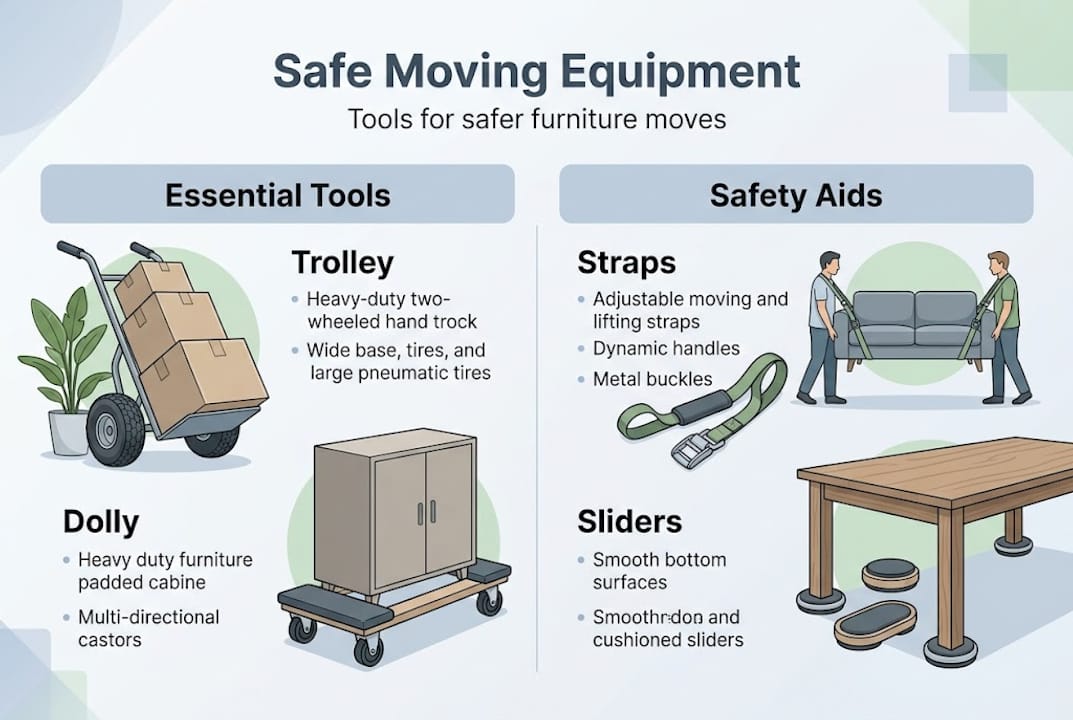
Specific equipment fits particular scenarios, improving both safety and speed. Here is a practical comparison to help you choose:
| Scenario | Recommended equipment | Difficulty level | DIY or professional? |
|---|---|---|---|
| Single-level home, standard furniture | Dolly, sliders, moving blankets | Low | DIY possible |
| Multi-level home with stairs | Stair climber, lifting straps, dolly | Medium-High | Professional advised |
| Office fit-out relocation | Multiple trolleys, floor runners, blankets | High | Professional recommended |
| Heritage building, tight hallways | Custom padding, sliders, disassembly tools | High | Professional recommended |
| Single bulky item (piano, safe) | Specialist rigging or piano board | Very High | Professional only |
Before you select any equipment, ask yourself these four questions:
For bulky or specialty items, standard hire equipment may simply not be enough. A cast iron bathtub, a commercial refrigeration unit, or an antique armoire may need custom padding, rigging, or disassembly before any movement can begin. In those cases, hiring help for heavy moves in Melbourne is almost always the smarter call.
One practical approach that works well for many Melbourne households is a hybrid model. You handle the lighter boxes and smaller items yourself, while a professional team manages the heavy and awkward pieces with the right gear. This keeps costs reasonable without compromising on safety for the things that matter most.
Equipment alone is not always enough. Sometimes, handing over the job is the safest and most sensible decision you can make. Knowing when to call in the experts can save you time, money, and physical pain.
There are some clear signs that a professional moving team is the right choice:
“The biggest mistake people make is underestimating the job. They think it will take two hours and end up spending a full day dealing with problems that the right equipment and experienced hands would have prevented entirely.” This is a sentiment our team hears regularly from clients who have attempted a difficult move themselves before calling us in.
Professional movers have advanced equipment and can handle complex relocations that would be genuinely dangerous for untrained individuals. They also carry public liability insurance, which protects both you and your property if something does go wrong.
For genuine DIY situations, the checklist looks quite different:
For specialty item removals such as pianos, safes, or large-format artwork, there is really no viable DIY option. These items require not just equipment but genuine expertise in rigging, weight distribution, and route planning.
Melbourne’s residential market also presents some unique challenges. Inner-city suburbs like Fitzroy, Collingwood, and Richmond are filled with Victorian and Edwardian terraces that have steep, narrow staircases and doorways designed for an era when furniture came in smaller pieces. These physical constraints make professional involvement advisable far more often than people expect.
Most articles about moving equipment focus entirely on the gear itself. What they rarely acknowledge is that the best equipment in the world cannot compensate for poor planning or a poorly prepared space.
We have seen professional-grade trolleys and stair climbers fail to help because the path from room to truck was cluttered, poorly lit, or had a doorway that had not been measured properly. Equipment is a multiplier. It multiplies whatever preparation you bring to the job. Good preparation with the right tools produces excellent results. Poor preparation with expensive gear still produces chaos.
There is also a cost-versus-risk judgement that people rarely apply rigorously. Renting specialist equipment for a single move often costs more than most people expect once you factor in delivery fees, bond requirements, and the time spent learning to use unfamiliar tools safely. For many Melbourne households, the total cost of a well-equipped DIY move is surprisingly close to the cost of hiring a professional team, especially when you account for the risk buffer.
Then there are the small details that have an outsized impact. Moving in summer heat on a day above 35 degrees Celsius increases fatigue and error rates. Failing to lay floor runners before starting means you discover the damage only after the job is done. For anyone considering a large or complex move, resources like our bulk furniture removal guides offer the kind of nuanced, practical knowledge that most generic equipment articles simply do not cover.
Ready to make your next heavy furniture move in Melbourne safe and efficient?
At Onyx Removals, we do not just show up with muscle. We bring the right moving equipment in Melbourne for every job, from furniture dollies and stair climbers to floor protection and custom padding for specialty pieces. Our experienced team has handled everything from Federation-era farmhouses in the Dandenong Ranges to high-rise office fit-outs in Southbank. Whether you need full-service support or a helping hand with the heavy items, our residential removal services are designed to fit your specific needs and budget. Get in touch today for a tailored quote and find out how straightforward your next Melbourne relocation can be.
Stair climbers and specialist tools reduce injury risk significantly on stairs, and when paired with lifting straps used by experienced individuals, they offer the safest approach to multi-level moves.
For most small apartments, sliders and simple trolleys available through equipment hire companies are more cost-effective than purchasing, especially for a one-off move.
Many insurance policies will not cover damage caused by improper handling, and using correct equipment is a common requirement within both contents insurance policies and building management agreements.
Yes, because professional movers bring equipment and expertise that improve outcomes regardless of distance, and the time savings alone typically justify the cost for any business relocation.
Avoid metal-wheeled dollies or trolleys without rubber protection, as the hard wheels can cause deep scratching and gouging on polished timber surfaces that is expensive to repair.

No Related Post


